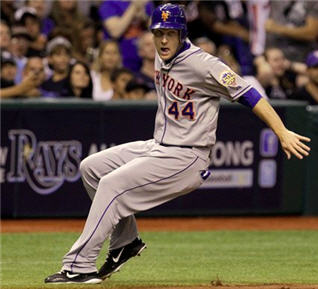
In case you missed it, Mike Baxter played the whole game Saturday and went 0-for-0. He walked five times, tying the National League record for a nine-inning game. TedQuarters celebrates this achievement, and notes that Baxter now owns the team’s best on-base percentage. (Small sample size, of course.) Here’s video:
Category Archives: Mets
Where they’re at, pt. 2
Last week I looked at all the age-27 and younger position players who have suited up for the Mets this year to try to assess what we’ve learned about them in 2012 and how it bodes for their futures with the club. Here’s the sequel to that post: The pitchers.
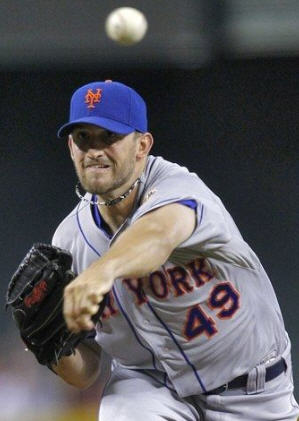
Jonathon Niese: With a contract extension inked early in the season, Niese obviously has a part in the Mets’ future. The young lefty — still only 25 and with over 500 Major League innings on his resume — has pitched like a credible middle-of-the-rotation starter so far this year. Niese faded after July in 2010 and 2011, so the next couple of months could go a long way toward determining whether that’s a pattern or a coincidence. With a solid ground-ball rate and strong rate stats, Niese has pitched to his peripherals with a 3.72 ERA in the first four-plus months of 2012, benefiting from a career-low batting average on balls in play but suffering a bit from a career-high home run per fly ball rate. Both should normalize a bit, but as long as Niese stays healthy and keeps pitching the way he has there should be no doubt of his status in the Mets’ rotation moving forward.
Dillon Gee: Gee had kind of a weird year. The second-year starter struck out way more batters, walked way fewer and yielded more groundballs than he did in his rookie campaign, but the results didn’t quite follow. If he’s done for 2012 after surgery to correct a blood clot in his shoulder, he finishes with an unspectacular 4.10 ERA but a 3.69 FIP and a 3.53 xFIP. Gee’s high strikeout rate was more in line with his Triple-A numbers from 2010, so perhaps, if he returns healthy in 2013, the improvement is sustainable. It allowed him to average nearly an inning more per start in 2012 than he did in 2011 and makes Gee look like a valuable member of a big-league staff. Whether he’s in the Mets’ rotation come Opening Day 2013 should depend entirely on his recovery.
Bobby Parnell: My friend Ripps, a true SABR if there ever was one, sent me this text message a couple nights ago: “It feels like Bobby Parnell should be better than he is but it seems like he is much worse than he is.” I couldn’t put it better myself. Parnell’s blazing fastball and now-nasty-looking curveball have made him by far the Mets’ best reliever this year: He has the best strikeout to walk rate and best ERA of anyone who has been in the bullpen for the bulk of year — faint praise, for sure. Parnell’s few high-profile meltdowns and his unfortunate association with the rest of the Mets’ relief corps have clouded what should be a partly sunny outlook: This will be his third straight season as a capable Major League reliever, and he gets a lot of ground balls, strikes out more than a batter an inning, and doesn’t walk too many. He’s 27 so it seems unlikely he’ll get much better, but he’s under team control through 2016 and good enough that he should be an important part of a Major League bullpen as long as he’s healthy. But it does seem like he’s worse than that, for whatever reason.
Jeremy Hefner: No one outside the Hefner household appears to get too excited about Jeremy Hefner starts, and Hefner himself admitted he wasn’t as good as Johan Santana earlier this week — true, but a surprisingly humble statement from a Major Leaguer. Hefner’s only 26, though, and his 5.04 ERA in 50 innings with the Major League club masks solid peripherals and a strong part-season at Triple-A Buffalo. He throws strikes, which is more than many can say. His lack of strikeout stuff means he’ll likely have to rely on weak contact and a good defense behind him, which could get him in trouble on occasion. But he seems well-suited to the role given to Miguel Batista at this season’s outset: A long reliever and spot starter for the big-league Mets. Hefner’s got options remaining so he could ride the Buffalo shuttle if there’s a roster crunch next season, but he’s good enough to keep around.
Matt Harvey: Even after Sunday’s shaky start, it looks like Harvey will have to pitch his way out of the Mets’ 2013 rotation. Though Harvey hasn’t pitched very deep in games so far at the big-league level, he has shown the stuff to overpower Major League hitters and struck out 23 of them in his first 16 1/3 innings at the level. He’s still a bit wild — walking 3.9 batters per nine both at Triple-A Buffalo and so far in the Majors — but Harvey’s health and performance this season bode well for his future. He looks fit to at least join Niese and Gee as solid young starters in the Mets’ rotation next year with a reasonable shot to be better than both.
Elvin Ramirez: Elvin Ramirez has thrown 12 1/3 Major League innings this year, and though I watch nearly every pitch of every game I can hardly remember any of them. They’ve been pretty forgettable, as Ramirez, who has been wild throughout his Minor League career, has walked more than he’s whiffed in the bigs. That’s not good, and though Ramirez mounted a 1.99 ERA in 40 2/3 innings at Double-A and Triple-A this year, the walks prevent him from looking like a dependable Major League reliever. He’s only 24, so Ramirez still has time, but counting on him to be a part of the 2013 bullpen seems foolish until it’s clear he’s made some improvement or adjustment.
Josh Edgin: Edgin was also pretty wild in the Minors, but he appeared to improve across the season and into his first 12 Major League innings. Sort of by default, Edgin has emerged as one of the Mets’ best late-inning options in the very early part of his big-league career. He’s lefty and he throws hard, which means he likely has a long big-league future. Unless the Mets go crazy for bullpen arms in free agency — and perhaps even if they do — Edgin should be penciled in for the team’s 2013 bullpen. If he performs anything like he has in his first month in his next two, write over that pencil in ink.
Chris Schwinden: If you’re only aware of Schwinden’s three woeful Major League outings in 2012, you don’t know a quarter of the story. After being DFA’d by the Mets in late May, he was claimed by the Blue Jays. He made one start for their Triple-A team, then was waived again and claimed by the Indians. He made three starts for their Triple-A Columbus squad, then was DFA’d in late June. He got picked up by the Yankees, made one start for their Triple-A team before being DFA’d again and picked up by the Mets, the only organization he had known before his whirlwind tour of the highest Minor League level. Schwinden has actually been great in Buffalo this season, boasting a strikeout to walk ratio over three and a 2.19 ERA in 78 innings. His 2012 transaction ledger suggests he can have value to a Major League team as a spot starter or fill-in member of the rotation, but also that teams see him as expendable when rosters get crowded. I’m rooting for him, for what it’s worth.
Pedro Beato: Beato’s seven sporadic outings with the big club in 2012 did not go well, but he’ll be back. He has a 1.97 ERA in Triple-A this year with a 0.906 WHIP, and he’s still got the arm that everyone raved about when the Mets grabbed him in the Rule 5 draft before 2011. Bullpen arms are fickle. Beato could pitch well for a few years in the future and someday earn a “closer” label somewhere and hang around the Majors for years. Or he could prove a Manny Acosta type, good enough to dominate Triple-A and pitch well in spurts at the big-league level. Either way, if he’s around and healthy come February he should compete for a role in the Mets’ 2013 bullpen.
Robert Carson: Carson’s got youth, handedness, arm strength and roster status on his side, but he looked pretty hittable in Double-A and in his insignificantly brief Major League stints this year. His first go-round in Triple-A has gone well over a very short sample, but oddly Carson has had more success against righties than lefties. Lefty relievers often seem to emerge in their mid-to-late 20s, so it’s way too soon to rule out a successful big-league career for Carson. But it’s also way too soon to expect one.
In sum, and despite this season’s bullpen atrocities, the future of Mets pitching looks better than it did last year at this time. If Gee returns to form, the Mets should enter 2013 with at least a solid pitching staff. R.A. Dickey looks like a lock for the front of it, with Niese and Harvey somewhere behind him, and Johan Santana and Gee inked in if they’re healthy. Plus, in Parnell, Hefner, Edgin and Beato they’ve got youngish arms with varying degrees of promise that should vie for bullpen roles. And, in Zack Wheeler, Jenrry Mejia and Jeurys Familia, the Mets have three talented 22-year-old pitchers in Triple-A.
But don’t think about trades. The cliches are true: There’s no such thing as too much pitching and there’s no such thing as a pitching prospect. The best way to build a great staff is to compile as many good pitchers as possible and hope some of them stay healthy. The Mets now appear to have a deep crop of good or potentially good pitchers. Let’s hope some of them stay healthy.

Friday Q&a, pt. 1: Mets outfield stuff
Luckily I don’t have to decide right now, so this is purely hypothetical. Also, I don’t have to decide in the offseason either. I don’t ever have to decide whether to tender arbitration to Andres Torres and Manny Acosta. But if by some weird chance Sandy Alderson called me in the next five minutes and said, “Hey Ted! It’s me, Sandy Alderson. Should we tender contracts to Torres and Acosta this season? It’s your call, but we need you to decide right now,” I’d probably say yes to Torres and no to Acosta.
The Mets need outfielders in the worst way. Torres certainly hasn’t earned a starting role in 2012, but he’s probably good enough to merit whatever increase he gets on his $2.7 million salary this year. He covers a ton of ground in the outfield, he’s a switch hitter, and he has quietly raised his on-base percentage to a respectable .351 (as of Thursday afternoon when I’m writing this). He seems a good fit as a fourth outfielder, regardless of who else is on the team.
The counter argument, I guess, is that with Jordany Valdespin and Kirk Nieuwenhuis sort of in the fold and Matt den Dekker hopefully coming up the pike, the Mets don’t really need center fielders. But neither Valdespin nor den Dekker can be counted on for much Major League offense at this point, and Nieuwenhuis obviously needs some work. Plus all three of those guys hit left-handed. I look for bigger upgrades, certainly, but unless I’m planning to sign another switch-hitting center fielder, I’m bringing back Torres.
Incidentally, another switch-hitting center fielder — B.J. Upton — [bah – update: Upton is not a switch hitter. My mistake, he bats right] is slated for free agency this offseason. Upton’s enduring a down year and comes with something of a spotty reputation, but he’s a really nice player and he won’t turn 28 until later this month. He’s not the superstar he was once expected to become and I have no idea what he’ll fetch on the open market, but he does seem like a pretty good fit for the Mets. Just depends on the cost, obviously. (That should cover Andrea’s question, incidentally.)
As for Acosta: I’m a pretty big Acosta apologist (Acostogist?) and he’s not likely to earn that much in arbitration, but the guy’s got an ERA over 10. He’s got good enough stuff that you’d expect someone will want him, but I can’t imagine there’ll be a feeding frenzy for his services. I’d try to non-tender him and bring him back on a Minor League deal or something.
https://twitter.com/RobPatterson83/status/231055658169008130
Lots of questions about the outfield. Let’s throw Jordany Valdespin into that mix too, to cover @SeanKenny’s question.
In decreasing order of likeliness to start in the 2013 outfield, I’ll say: Nieuwenhuis, Torres, Duda, Valdespin, Bay. As bad as he looked for the last part of his tenure with the 2012 Mets, Nieuwenhuis might be the best all-around player of that lot right now, and he stands to improve moving forward. If the Mets’ opponent starts a righty on Opening Day, I’m guessing Nieuwenhuis is in there.
As I said above, it appears there’s a role for Torres on next year’s club barring a free-agent signing or two, so by default he’s vaguely likely to start Opening Day.
Duda’s future with the team most likely depends on his ability to play the outfield, and there’s not much evidence he can do that just yet. The team appears committed to Ike Davis at first. Since it seems likely Duda will hit like a capable Major League corner player again, he has some value. But there’s not much sense in the Mets’ parting ways with him until he starts hitting at some level or he shows he absolutely cannot play left field. He saw his first time there in Buffalo on Tuesday; the Mets should spend the rest of the month trying to figure out if they can make that work. If it does, he’ll be back in the lineup in the Majors.
Valdespin now looks like he has a Major League future of some sort, but I suspect his offense will regress this year and the Mets will want him to learn to be more patient. And I’d be pretty surprised if Bay’s on the roster to start next season, sunk cost be damned.
So if you’re playing at home, the guy I have as most likely to start Opening Day next year is one of the two currently in Triple-A. Weird. Whatever. Who’ve you got?
Breaking point
Jason Bay started in left field for the Mets last night after missing all but one at-bat’s worth of the last two games with a shin injury. He went 0-for-4 with a walk and two strikeouts and left an orchestra on base. Since returning from the disabled list on July 17, Bay is hitting .093 with a .204 on-base percentage and one extra-base hit — a home run against the Nats in his second game back. Though it’s still only a 121 at-bat sample, he now has a .531 OPS for the year, the lowest it has been after more than five games in any season of his career.
Bay is a really nice guy. By nearly all accounts, he’s dedicated to improving himself and working as hard as he did in the strong seasons that earned him the four-year, $66 million contract with a vesting option for 2014 he inked with the Mets before 2010. He is purportedly a very good teammate and, when he’s not struggling, he is hailed as a leader in the clubhouse. And the Mets are still on the hook for all $16 million of Bay’s 2013 salary and the $3 million buyout on the option.
But something has to give. This doesn’t seem revelatory to anyone who has watched Bay struggle these past few weeks and these past few years, yet someone or some collection of people in the Mets’ organization is keeping Bay on the roster and starting the bulk of the team’s games.
Why? The Mets are 15-18 in games Bay has started and 36-36 in the others, so they haven’t exactly been way worse with him in the lineup than without him. Maybe that’s a factor, though it doesn’t seem a particularly good one. He hits right-handed on a roster full of lefties. Sure, he has fared worse against lefties this year than every position player who has spent any significant time with the club besides the backup catchers and Kirk Nieuwenhuis (with whom he is about even)But Bay’s handedness must be a consideration. Plus he runs the bases well in the increasingly rare instance he reaches one safely, and he plays sure-handed if not rangy defense in left field. And there’s all that money.
None of those, in isolation or in conjunction with the rest, seems like a good enough reason to keep Bay in the lineup every night or even on the roster. Presumably Sandy Alderson would like to see Bay bounce back to the point where he could find some team somewhere willing to take on even a little of Bay’s salary in a Gary Matthews-type deal, but what could Bay really do in the next two months to convince anyone he’s worth appreciably more than a guy available at the league minimum? Nothing that seems likely after three straight seasons of underwhelming to awful performance, that’s for sure.
The Mets don’t have many appreciably better options, but a case could be made that both the recently dispatched Nieuwenhuis and Lucas Duda offer more advantage to the Mets even against lefties. Duda is not a good defensive outfielder, but he out-hit Bay against lefties this year and seems apt to potentially be such a massive offensive upgrade against righties to mitigate his flaws. Nieuwenhuis struggled against lefties this year and in the Minors last year, but he is likely a better defender than Bay.
But even if you allow that Duda and Nieuwenhuis are in Triple-A to work on fixing the issues preventing them from excelling at the big-league level and that the team is prioritizing their development over its needs at the big-league level, and even if you figure that the team wants to be able to bring Bay to Spring Training next year to see if he’s somehow rejuvenated and ready to contribute somehow before they cut him loose for good, there’s really no justification for starting him against right-handed pitchers like they did last night. With switch-hitting Andres Torres and lefty-hitting Jordany Valdespin and Mike Baxter on the roster, the Mets could field an all-lefty-hitting outfield with strong defense. And Scott Hairston, too, represents a better option against righties than Bay at this point.
If the Mets want to keep Bay around for whatever reason, they should give him the best chance to succeed by playing him only against left-handers. If they’re still interested in winning as many games as they can — and they showed that they are when they held on to Hairston at the trade deadline — there’s just no good excuse to give Bay so much playing time.
More like the no-trade deadline amirite?
Over at Amazin’ Avenue, Chris McShane contends that the Mets were smart not to force trades at the trade deadline. And he’s right. The hoopla and nonsense surrounding the trade deadline (and the Winter Meetings) seem more like facts of life at this point than anything worth lamenting. Plenty of fans — excited or angry or passionate in some way — demand improvements or change, and old and new media fan the flames because it’s something to talk about in the midst of a long season. So it swells to this tremendous tidal wave of silliness. You can surf it or fight it or try to duck it entirely, but it’s coming regardless.
The Mets didn’t trade Scott Hairston. For some reason this pisses people off even though Scott Hairston has been one of the best reasons to watch the Mets all season. Reportedly, they fielded some offers and didn’t hear anything they felt was worth more to their short- or long-term future than the next couple months of Hairston’s lefty-mashing. Since the Mets’ front office seems to be in the business of making reasonable decisions, and since they employ an army of scouts and I don’t, and since they heard what was offered for Hairston and I didn’t, I’ll give them the benefit of the doubt on this one.
Baseball Show: Pickoffs
Video
New sandwich coming to Citi Field
Corey brings word of a new sandwich coming to Citi Field on Aug. 7. The forthcoming concession represents the first retail store for area meat legend Pat LaFrieda, supplier of beef for seemingly every good burger in the city. He’ll cut out the middle-man via a filet mignon sandwich with cheese and carmelized onions on a baguette, which costs $15 but looks pretty spectacular:

Needless to say, I’ll let you know how it goes.
Link
Know Your Enemy: Giants
Video
Grant Brisbee from McCoveyChronicles.com skypes in:
http://web.sny.tv/media/video.jsp?content_id=23467221&topic_id=30955196
Where they’re at
I wrote on Friday — and plenty before that — that this year for the Mets is mostly about next year for the Mets. Obviously the full season will provide the best and broadest wealth of information with which the team can assess its players moving forward. But since the trade deadline is nearly upon us and Mets fans everywhere are looking for ways the team could improve its standings in the short- and long-term future, I figured it’s a good time to look around the roster and try to determine which of the Mets’ young (and youngish) players should figure into their plans for next year and beyond.
The following are all the position players who have played in the Mets this year and are in their age-27 season or younger.
Josh Thole: Thole is 25. He has struggled at the plate a bit this year, but by all accounts his defense has improved. It seems reasonable to expect Thole’s offense to bounce back toward his career norms and, given his age, improve a little bit from there. That’d make him only about a league-average catcher, but since the Mets don’t have much in the way of catching prospects in the high Minors and since going big for a free-agent catcher seems like a bad risk, Thole seems like a passable option to start games behind the plate for the Mets in 2013 and beyond. Ideally, they will find a decent, righty-hitting catcher with which to platoon him.
Ike Davis: Fun with arbitrary endpoints! Since June 6, Davis has a .958 OPS. That’s the good news. The bad news is that he started out so poorly that a month and a half’s worth of excellent production has only brought his season rate up to a .718. Davis appears to have suffered a few more defensive hiccups this season than he did in the past. A strong finish to the 2012 campaign from Davis will go a long way toward convincing the Mets and their fans that he should be their everyday first baseman moving forward, and I’d bet on that. Davis’ career OPS is now at .785, a touch above league average for first basemen even despite his youth and his woeful first half to this season.
Daniel Murphy: While the rest of the Mets have slumped, Murphy’s second-half resurgence has raised his season rates to his career norms. This is Murphy: High batting average, solid but unspectacular on-base percentage, doubles power without many home runs. Murphy’s defense hasn’t been good, but it seems to have improved to the point that it’s worth carrying at second base to keep his bat in the lineup. He’s never going to be Joe Morgan there, but if he hits he can play.
Ruben Tejada: The future looks bright for Tejada, once dismissed as a non-prospect due to his lack of obvious physical talents. For the second straight year, he has gotten on base a lot and played good defense. The biggest thing, of course, is that he’s 22. Just being able to not embarrass yourself in the big-leagues at Tejada’s age is impressive. His .297/.361/.352 line over the past two years suggests he could be a capable-to-plus Major League middle infielder for a long time coming.
Lucas Duda: Duda, as you know, got demoted a couple weeks ago. His defense in right field was atrocious and he didn’t hit enough to make up for it. But despite his offensive struggles this season, Duda has been good enough in the Majors and Minors the past few years to suggest he has a Major League career ahead of him. It’s just not in right field, and it might not be with the Mets. There aren’t many teams on which hitting left-handed is a detriment to your chances of making the roster, but Duda’s handedness doesn’t help his case for the club as long as so many other lefty hitters are around. (For what it’s worth: Duda has been better against lefties than Jason Bay this year.) He needs to start playing left field in Triple-A. If, for whatever reason, he can do that better than he can play right, maybe he resurfaces in the Mets’ starting lineup before long. If he can’t, he’s trade bait or a Triple-A hedge for Davis at first.
Kirk Nieuwenhuis: I argued on the podcast recently that Nieuwenhuis is the young outfielder most likely to emerge as a Major League regular. It’s not now, of course, with the once bro-tastic center fielder heading back to Buffalo to make way for Mike Baxter. Nothing Nieuwenhuis did or didn’t do in the Majors this year should surprise anyone who has been following him since the Minors: He played solid defense wherever the Mets put him, he hit for a little bit of power, and he struck out way too much. The good news is he’s 24 and — though it’s easy to forget — coming off a mostly lost 2011 season. With more reps in Triple-A, Nieuwenhuis should be able to pull it together and become, at the least, a platoon outfielder in the future. Unless the Mets bring in a couple of everyday type players, look for that to happen as soon as next year.
Justin Turner: Justin Turner is great at throwing pies and coming up to the plate to “Call Me Maybe,” and is by all accounts an awesome dude. He’s a justifiable Major Leaguer on a team that needs a second baseman in a pinch or needs a low-cost backup middle infielder. With Murphy looking more like a reasonable starter at second base, though, and Ronny Cedeno around to backup second and short, Turner appears rather redundant on the Mets’ roster. That’s not his fault and it’s not necessarily the case moving forward, but if anyone’s willing to give up anything of value for Turner’s services, the Mets should probably go for it.
Jordany Valdespin: Without looking, how many times has Jordany Valdespin walked this season? Any guesses? It’s twice. He has walked two times in 111 plate appearances: once May 8 and once July 6. His early-career power outburst has been awesome to watch, but it is unsustainable. If Valdespin doesn’t start taking more pitches, he’s not going to get any to drive. Still, his transition to the Majors and to the outfield at his relatively young age has been strong enough to suggest he’ll probably have a big-league career. I can’t think of a great comp, but I’d guess his upside is as a solid utilityman, playing all over the outfield and filling in at second, maybe third, and shortstop in a desperate situation.
Mike Baxter: It’s easy to glorify Baxter based on a tiny, 65 at-bat sample and one heroic moment, so let’s do just that: Mike Baxter is the best. Remember that catch he made? Remember all the timely hits? The Pride of Whitestone returns tonight, and if he hadn’t cemented his status as a folk hero yet, he’ll do it now by taking playing time away from Bay.
Josh Satin and Zach Lutz: Neither of these guys got much of a chance in the Majors this year, but they’re both right-handed and both routinely hit well in the Minors. If Lutz — the more powerful hitter of the two — can stay healthy, it wouldn’t be terribly surprising to see him spend more time with the big club next year as a right-handed bench bat and backup to Davis.
So what’ve we learned so far this season? The Mets have a bunch of guys who appear apt to become capable Major League role players or platoon guys, a few who look like solid regulars, and no offensive player (beyond David Wright) who looks likely to become a bona fide star.
There’s no rule that you must have any set number of guys labeled stars to succeed, of course, and if the Mets happen to get career years out of Davis, Tejada, Thole and Murphy next year along with typical production from Wright, their offense could be very good. They should be looking for outfielders, though — especially outfielders than can hit lefties.