Just sitting here watching the wheels

Look how stuff gets spun:

Yesterday, Adam Rubin published a report that the Royals are looking to deal Jose Guillen and “have identified the Mets as a potential trading partner, although there was no deal considered close.”

James Kannengeiser already did a fine job pointing out how dumb this trade would be at Amazin’ Avenue.

I would guess the whole thing is bluster. It doesn’t take a well-placed source to tell you the Royals would like to trade Jose Guillen this offseason. The Royals don’t have much money to spend, and Jose Guillen is owed $12 million despite not being very good at baseball.

So the Daily News prints it. And since the Mets have had some reported interest in Guillen in the past, can take on some payroll and need a power bat for a corner outfield spot, it’s not hard to identify them as a potential partner.

Here’s where it jumps a step, though: The Sporting News, citing the Daily News, credits the rumor to a Mets source and implies that the Mets are interested. RealGM.com does the same thing.

But that’s not what the story says, at all. Pay attention to the language: The Royals have identified the Mets as a potential trade partner. That’s intentionally vague. All that means is someone in the Royals organization hopes the team can pawn Guillen off on the Mets.

A rumor developed last offseason that the Mets could trade Carlos Beltran for Robinson Cano, so I traced it back to its origin and pointed out that it was clearly speculation gone out of control.

But check the comments section on that MetsBlog post: Readers alternately weighed in on the rumor as though it were real, or accused me of forwarding something that wasn’t real.

All I was aiming to do was expose how speculative and nonsensical so many hot-stove reports are. Pay attention to the way things are worded and trace everything back to its original source and you’ll figure out pretty quickly that about 50 percent of the Internet’s rumored trades start out with one person speculating.

Hear me say stuff

I’ll be calling in to talk about the hot-stove season with Matt Pignataro and the gang at Seven Train to Shea tonight at 7 p.m ET.

To listen live, click here.

SPOILER ALERT: If they ask me if I think the Mets should trade all their prospects for Roy Halladay, I’ll say no.

Anatomy of a useless trade

Paul Vargas at Section Five Twenty-Eight rounded up some free-agent first basemen the Mets should avoid a couple of weeks ago, and noted that Ross Gload was traded from the Rockies to the Mets as part of the monstrous Jeromy Burnitz trade in January of 2002, then sold back to the Rockies five days later.

This is particularly hilarious, because the Mets traded cash to the Rockies as part of the original deal, so basically it was the Major League equivalent of backsies. “You know what? Never mind on this Gload kid. We don’t have as much money in the bank as we thought we did; Mo Vaughn is eating us out of house and home.”

The whole saga must have been a rollercoaster ride for Gload, who grew up a Mets fan in the Hamptons and had only been picked up by the Rockies off waivers from the Cubs that September.

When you think of it, really, baseball’s whole system of roster management is pretty savage. I understand that it’s the system in place, and that I kind of make my living off of it, plus it’s probably something young players are prepared for. And the Major Leaguers are certainly well-compensated.

But man, could anything be worse than to have to pick up your whole life and move just because Steve Phillips says you have to?

Which brings me to the real point about the Burnitz deal. It was a pretty amazing example of the plain redirection of unspectacular players in bulk. Check it out:

The Mets traded Lenny Harris, Glendon Rusch, Todd Zeile, Benny Agbayani and cash and got back Burnitz, Lou Collier, Jeff D’Amico, Mark Sweeney, Craig House and five days of Ross Gload.

The Rockies traded five days of Gload, House and former Met Alex Ochoa and got back Zeile, Agbayani and cash.

The Brewers traded Burnitz, Collier, D’Amico and Sweeney and got back Harris, Rusch and Ochoa.

Burnitz was the only player involved who had been better than average in the preceding season and Zeile, Agbayani, Rusch and Ochoa were the only others who had been Major League regulars.

Collier, Sweeney and House were all gone from the Mets by Opening Day of that season. D’Amico did yeoman’s work in the back of the Mets’ rotation in 2002 and was gone before the next season. Burnitz struggled in 2002 then got off to a hot start in 2003 and was dealt for, among others, Victor Diaz.

Agbayani fell apart in his first year with the Rockies and was picked up off waivers by the Red Sox in August. Zeile played one unspectacular year as the Rockies’ third baseman then left to free agency after the season.

Harris did a nice job as the primary pinch-hitter for the 2002 Brewers, enough to earn him a free-agent contract with the Cubs the following season and keep him stumbling around the league for three more years. Ochoa got off to an uninspiring start with the Crew and was traded for Jorge Fabregas at the 2002 trade deadline.

Rusch, one of my favorites from his Mets days, essentially pitched like a much shorter and left-handed version of D’Amico in 2002, then completely tanked in 2003.

Rusch and Burnitz were the only players of the 11 involved in the deal that were still with their new club by the start of the 2003 season, and only Rusch finished out that year with his team. He left for free agency that offseason.

The teams combined to go 204-281 in 2002. Only the Rockies avoided last place in their division, finishing in fourth place with a 73-89 record.

Obviously there were reasons for the deal at the time. The Mets, for example, had just obtained Mo Vaughn and Roger Cedeno, so they didn’t need Zeile or Benny anymore, and Burnitz was another power bat to add to the lineup.

But man, how much time and effort must have gone into a deal that ultimately didn’t help any of the teams involved? Oh, the best-laid plans of Steve Phillips.

For what it’s worth, the Rockies would later obtain Sweeney, Burnitz and Rusch in 2003, 2004 and 2009, respectively. Rusch and Gload were the only players remaining in the Majors last season, and Agbayani retired from playing in Japan a few weeks ago.

Some things about Bengie Molina

You know what two words keep coming up around the Mets this offseason that really scare me?

Bengie Molina.

In his latest epic for MLB.com, Marty Noble, after firing off a few shots at out-of-touch bloggers, writes:

Bengie Molina and Rod Barajas are available and the Mets have their eyes on both. Barajas is younger and has more power. Molina has been a productive hitter with the Giants, but his thick body is 35.

OK, let’s define “productive hitter.”

In his three years with the Giants, Molina produced a 90 OPS+ over 1606 plate appearances. Over those same three years, the average National League catcher produced a 91 OPS+.

Does that make Molina a productive hitter? No. It makes him an average hitter for a catcher, which is kind of like being an average musician for a member of Nickelback.

Molina’s reasonable .742 OPS over that time is mostly fueled by his .440 slugging percentage. On one hand, it’s tempting to say that’s nice for a team that clearly lacked power in 2009. On the other hand, as Sam at Amazin’ Avenue pointed out today, a big part of the reason OPS is not a perfect stat is that it overvalues slugging in regards to on-base percentage.

And Molina’s OBP with the Giants was a miserable .302.

Not productive.

The good thing about how infrequently Molina reaches base, though, is that in the rare event he gets there, he’s an utter embarrassment. To the eye, he’s about the slowest player in the history of Major League Baseball. Statistically, he has regularly cost his team about 20 bases per season, according to BillJamesOnline.net.

Plus he’s 35, like Noble said, so he’s not getting any faster.

Defensively? Well, he moves about as well behind the plate as he does on the basepaths. Catcher defense is a tough thing to gauge statistically, but Driveline Mechanics recently put him right near the bottom of all Major Leaguers.

Here is one interesting tidbit about Bengie Molina: Five of the six players named Molina to ever play Major League Baseball have been catchers, and only three of them — The Cathing Molina Brothers — are related. The only non-catching Major League Molina was Gabe, a pitcher who wasn’t very good.

Joe Posnanski on Jeff Francoeur

In the middle of a typically awesome blog post about the LVP (Least Valuable Player) award, Joe Posnanski discusses Jeff Francoeur’s candidacy:

I unfairly include him because:

1. He was so legendarily bad with the Atlanta Braves — .250/.282/.352 — that he was well on his way to winning the award before getting traded to the Mets.

2. He was so good with the Mets — .311/.338/.498 — that the Mets undoubtedly believe that he is back to being the guy who was on the cover of Sports Illustrated. They will now be inspired to spend considerable money and effort to keep him in New York. And, hey, they could be right. He could be the player he was in the second half … and from everything I know about Francoeur, I hope that is what happens. He seems to be a great guy.

However, I would be remiss if I did not point out: They also could be wrong — after all, over his last 2,500 at-bats Francoeur has an 89 OPS+ and the defensive numbers seem to indicate that he has regressed into a below average outfielder. Francoeur could be a Riddler-like trap, and the Mets could be just about ready to fall in.

What he said.

Not that they shouldn’t bring him back for next year. They’re going to and it’s fine. It’s the locking him up for the future thing that’s concerning.

Read the post, I think I cited more of it than blogger integrity permits. Actually, subscribe to his RSS and read everything he writes.

Reese’s piece

Toby Hyde, just returned from a trip to the Arizona Fall League, provides a great scouting report with video on Mets’ prospect Reese Havens. He writes:

The game film validates, to some degree, the power he showed in St. Lucie, and his approach was plenty patient.   Add a few more singles to his batting average in the FSL (where he struck out just 73 times in 97 games) and his .247/.361/.422 line would look a lot better.   I wouldn’t be the least bit surprised to see Havens hittin .280/.380/.450 by July of next year for AA Binghamton.

Havens will likely continue his transition from shortstop to second base with the B-Mets this year, under the watchful eye (or maybe the watchful shimmying hips) of Timmy Teufel.

If you recall, Havens was a guy expected to move quickly through the Mets’ system when they drafted him in 2008. On paper, his stats with Port St. Lucie in 2009 weren’t overwhelming, but it’s important to keep in mind that the Florida State League is generally considered a pitcher-friendly one.

According to MinorLeagueSplits.com, Havens’ line, when neutralized for park and luck, becomes a much more impressive .280/.387/.465, far more in keeping with the one Toby predicts for him at Double-A.

I’m far from sold on Havens, but his plate discipline and power — even at a low level — are promising signs. If he can continue progressing and successfully make the positional switch, he could be ready for regular play at Citi at some point in the 2011 season.

That’s a long way off, but it’s an important factor to consider while rumors abound about the Mets dealing Luis Castillo and signing Orlando Hudson to a multi-year deal.

Havens almost certainly won’t help the Mets in 2010 and it’s  silly to plan the team around a guy who’s still a couple of years away. The Mets will have a much more accurate sense of Havens’ longterm value to the team after he faces higher-level competition this season, though, so it might be imprudent to sign any second baseman on the backside of his prime for multiple years when they could have — in either Havens or Ruben Tejada — a good, inexpensive, young, homegrown solution ready midway through that player’s contract.

Again, if I was certain the Mets could compete in 2010, I’d be all about finding an upgrade over Castillo. But that’s not really the ticket to building a sustainable winner, and since the Mets frequently demonstrate no willingness to move on from sunk costs, it’d be a shame to see a guy occupy precious payroll and a starting spot just because the team made a misguided attempt to win immediately.

One quick note on Toby, for what it’s worth: He’s an excellent guy and does a tremendous job, plus he recognizes how I’m killing it, but he might be a vampire. We e-mail with some frequency, and I’m not certain I’ve ever received a message from him that didn’t arrive between 2 a.m. and 5 a.m.

Anonymous sources say the darndest things

James Kannengeiser at Amazin’ Avenue, obviously as giddy as I am about the Georgetown hoops game that starts at 4 p.m. today, posted a pretty amazing rundown of things he heard from his anonymous sources.

My favorites:

– My anonymous sources are familiar with the thinking of people who have knowledge of a league official’s inside man.

– My anonymous sources are trying to find the words to describe Bengie Molina without being too disrespectful.

He included a few from my Twitter feed, which I appreciate, though I should note that I completely stole the idea to tweet about anonymous sources from James’ Twitter feed.

Anyway, here’s some more undeniable insight from the MLB Hot Stove, courtesy of my giant network of baseball insiders:

– According to a person familiar with the Cubs’ thinking, it doesn’t happen very often.

– An MLB insider close to Brian Sabean says he has terrible B.O.

– A well-placed source with connections to the Mets organization says, “I’m Keith Hernandez.”

– According to a Yankees insider, Brian Cashman has suggested to ownership that the team trade Derek Jeter, and even maintained a straight face for about 10 seconds before cracking up.

– According to a Japanese baseball expert, Hideki Matsui 大人のビデオの印象的なコレクションを持っている。

– An anonymous MLB source tells me he was just speculating, and that it was really irresponsible of me to spin that into an entire column.

Joel Pineiro particularly intriguing

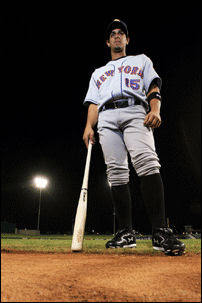
According to Adam Rubin, the Mets are “particularly intrigued” by Joel Pineiro.

It makes sense, because Joel Pineiro is particularly intriguing. Not necessarily as an answer in the Mets’ rotation, but just in general.
Looking at Pineiro’s counting stats, I’d immediately dismiss him as a potential free-agent fit. After all, he’s 31 and coming off his only decent year since 2003. Plus he doesn’t really strike anybody out.

But Fangraphs paints a more interesting picture, as it often does. Turns out Pineiro pretty decidedly changed his approach in 2009, confirming various reports. He threw way more fastballs (sinking ones, no less) than he ever did before — which probably contributed to his miniscule walk totals — and so, predictably, induced more contact.

His groundball rate went from hovering in the mid-to-high 40s to an outstanding 60.5 percent, dropping his line-drive and flyball rates accordingly. He cut his home runs per flyball rate in half.

There’s probably some luck and randomness in there, but Pineiro pretty clearly figured out a way to pitch to bad contact more effectively than he ever had before. Simply put, batters just didn’t hit him hard.

Whether that’s sustainable is something else entirely. Pineiro succeeded under Cardinals pitching guru Dave Duncan, and, like I said before, doesn’t have much of a track record to fall back on.

Essentially I just wanted to throw out the idea that Pineiro could be more than a one-year wonder. I’d expect him to regress toward his mean, but, assuming he can maintain his adjusted approach, be a pretty decent pitcher in the next couple of seasons.

The Mets could do a whole lot worse, in other words.

Also, for what it’s worth, I had a video game once in which Pineiro always ended up a Hall of Famer when you played in franchise mode. So there’s that.

The problem with “winning now”

Anyone who has read this space with any consistency knows how I feel about the Mets trading away prospects this offseason, but I’ll reiterate for newcomers. (And because I just don’t have much else to say today.)

There is a time and place to trade prospects.

Fans of almost every Major League club overvalue their team’s prospects, because — mostly thanks to the Internet, I imagine — we now follow them from the moment of their signing to the time they arrive in the big leagues or leave the organization. But prospects are never sure things, and many, many of the players that appear most bound for success, either mechanically or statistically, never turn into Major Leaguers.

So yeah, sometimes a team is best served by moving one or a couple of its best young players for an established star. If a team feels it is one piece away and a star player could be had at a reasonable cost, then yeah, pull the trigger.

For the Mets, this is not one of those times.

Obviously it’s best to evaluate such deals on a case-by-case basis, as no deal could be properly assessed without knowledge of the specific players involved. But the problem with established Major Leaguers is that they usually cost big money, and the Mets are already close to their reported budget.

A trade for Roy Halladay would be exciting, for sure. It’d give the Mets an unbelievable 1-2 punch at the top of their rotation.

But a trade for Roy Halladay would also be a trade for about $20 million a year for the next several years. And that gives the team a whole lot less flexibility to fill its countless other holes moving forward, including a couple in that same starting rotation.

Many will argue that the Mets are “built to win now” and so must go all-in to compete in 2010, since they will inevitably crumble after 2011 when Carlos Beltran and Jose Reyes will, barring extensions, become free agents.

Guess what? That’s nonsense.

The only thing that could make the Mets a “win-now” club is committing to that philosophy. To say that the Mets must win in 2010 would be to know for certain that not a single one of their current prospects will be contributing at the Major League level by 2011.

That’s a possibility, of course. There’s always the chance that none of Ike Davis, Jon Niese, Fernando Martinez, Jenrry Mejia, Reese Havens, Brad Holt and Ruben Tejada pan out. I’m optimistic that at least a couple of them will, but then again, I’m a Mets fan. I overvalue their young players.

And with young players, there are few guarantees.

There is this one, though: For the first few years of their Major League tenure, players are always inexpensive. And with the recent trend of teams locking up young players to long-term extensions, Major League contributors can often be secured for a reasonable price beyond their arbitration years and deep into their primes.

And that, for about the millionth time, is what the Mets need. That’s what allows a team to free up cash for when the right free agents are available, and to take on payroll when a big-name player is available via trade.

Mortgaging the future for the opportunity to win in the present might work, at times, for small-market teams on the verge of losing a slew of stars to free agency. But a team with the Mets’ payroll should never have to.

A team with the Mets’ payroll should be built to win every single year, because making the playoffs — no matter how strong the club — doesn’t come anywhere close to guaranteeing a World Series victory.

The best way to do that is to make the postseason as frequently as possible, and so no team with the Mets’ means should ever build to “win now.” It is the very definition of short-sighted thinking.