SNY.tv Flashback: Matt Harvey
Video
Reply

https://twitter.com/Miss_Met/status/228884299250798592
That, Shannon, is an important question with a pretty easy answer: It’s R.A. Dickey in a landslide. The only identifiable sleeper candidate is Manny Acosta, who has in the past boasted the team’s most underrated hair. But if I’ve seen Acosta hatless since his return, I can’t remember it.
https://twitter.com/tpgMets/status/228884626251345921
At that rate? Sure. Hairston has done all sorts of valuable Scott Hairston things in his tenure with the Mets: He crushes lefties, he seems willing and comfortable working primarily as a reserve player, and he plays passable to decent defense at all three outfield positions. And almost all the Mets’ outfielders with a shot at a roster spot next season hit left-handed: Kirk Nieuwenhuis, Lucas Duda, Mike Baxter, Matt den Dekker. They’ve got righty-hitting Jason Bay and switch-hitting Andres Torres under control for next year, but it wouldn’t be particularly surprising if neither breaks camp with the 2013 Mets.
https://twitter.com/DanDotLewis/status/228884943546228736
This is really Toby’s department, but I’ll sort of bite: This might as well be a trick question, since the Mets appear to have about eight outfielders in the Majors and Triple-A who look capable of being Major League pieces but probably not Major League starters. At this point, it seems safe to figure that none of Hairston, Torres, Bay, Fred Lewis and Adam Loewen will be more than a Major League piece. There’s still hope for Duda, Nieuwenhuis and den Dekker to emerge as Major League starters, but they’ve all got warts to address before they do.
Duda will hit again, and probably hit enough to be a Major League regular in some form. It’s almost certainly not in right field at Citi Field, though, so for him to emerge as a Major League starter as an outfielder he’s going to have to take to left. Nieuwenhuis might have the best chance of anyone to wind up an everyday player, regardless of his recent struggles. He’ll have to cut down on the strikeouts and improve against lefties, obviously, but he looks good enough to play anywhere defensively and his offensive numbers look palatable if you consider his relative youth and all his missed time last season. It won’t take much improvement for him to become a low/middle-of-the-pack offensive center fielder.
https://twitter.com/TooGooden16/status/228885631395315714
I’ll guess no. Picking up Ramon Hernandez (if it’s only for money) seemed to make sense a week ago, but if the Mets want Johnson around to foster Harvey’s development, I doubt Hernandez’s bat is good enough to make it worth carrying three catchers. And I don’t think it’s time to give up on Thole. By most accounts, his defense has improved a lot this year. His offensive numbers have fallen off a bit, but he’s only 25 and his career Major League rates — the largest available sample — suggest he’s already nearly a league-average catcher.
A fierce storm pounded my neighborhood last night, violent enough to merit watching from my stoop under cover of the doorway. Rain pounded the street and sidewalk and kicked up so much mist that even the few parts of the air that weren’t occupied by raindrops seemed still somehow full of rain. Lightning strobe-lit the sky in sharp bolts and dull bursts. Thunder cracked… thunderously.
By an hour later when I walked to the grocery store, the streets were still quiet in the storm’s aftermath but the rain had subsided to a haphazard drizzle. I got home, made a sandwich, and sat down to watch Matt Harvey pitch.
Let’s talk about the weather: The Mets got caught out in an awful tempest after the All-Star Break, a storm like the one a couple years ago that dropped a tree into my parents’ living room and forced me to drive a half-mile in reverse on the pitch-black Taconic Parkway. Johan Santana and Dillon Gee went on the disabled list, David Wright hicupped for the first time this season and the team’s offense stagnated, the bullpen sucked to new lows, Lucas Duda got demoted, pitchers called out catchers, Terry Collins called out pitchers. Everything went wrong. Cats and dogs, you know.
Then Matt Harvey pitched.

Harvey probably isn’t all the Mets need to get through this. He’ll probably allow some runs this year, and he probably won’t strike out more than two batters an inning. At some point, even if he proves a clear upgrade over the Mets’ other options and a capable Major League starter, he’ll probably show some evidence why some scouts insisted he wasn’t quite ready for the show. Hell, he probably won’t wind up the best pitcher in Major League history, and he probably won’t lead the Mets to a rash of World Series dominance.
But we don’t have any Major League evidence to suggest otherwise just yet, so we can revel for these next few days in undaunted hope. And even if we’re willing to be reasonable about it and accept right now that he probably isn’t all of those things, we can see the obvious signs of a strong big-league pitcher: a blazing fastball, a biting slider, a heartbreaking curveball. And we can imagine a near future with R.A. Dickey, Harvey and Jon Niese cementing the Mets’ rotation and recognize how it might become a strength. And then, holy hell, Zack Wheeler’s supposed to be better?
Even if the addition of Harvey isn’t enough to reverse the fortunes of the 2012 Mets, last night he established himself as must-see material, a reason to watch and dream on the Mets. 2012 was always supposed to be about 2013 and 2014 anyway, and now we better understand why.
With Toby and Patrick, as usual. Download it on iTunes here.
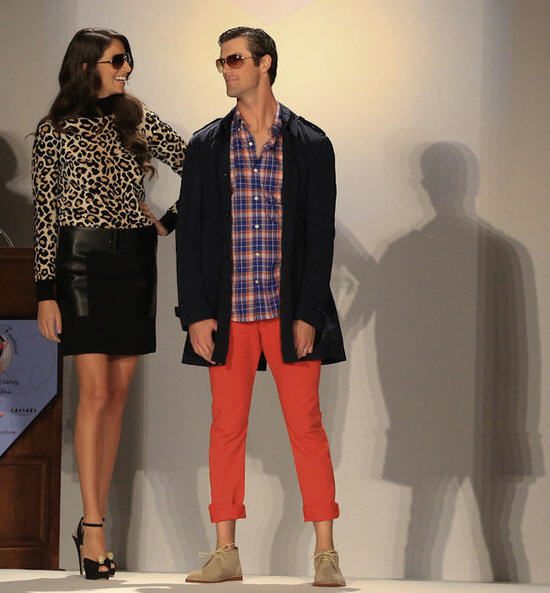
If you somehow missed it, Cole Hamels reportedly signed a six-year, $144 million contract extension with the Phillies yesterday. This is good.
As I’ve mentioned a few times here, I kind of love Cole Hamels. For one thing, he’s an excellent pitcher — perhaps actually underrated. When you account for his home park, Hamels has been just about as good across his career as Justin Verlander and Felix Hernandez, but I feel like his dominance has been buried a little under the Phillies’ frequent acquisitions of more veteran pitchers. Hamels should be considered in the upper echelon of pitchers under 30, up there with the likes of Verlander, Hernandez, Matt Cain and Zack Greinke.
For another, look at him. He’s hilariously silly. And though I revel in collecting and archiving embarrassing photos of the man, the longer I do it, the more I suspect he just doesn’t give a crap what any of us think about his fashion choices and modeling career. At this point, given the popularity of the archive and the frequency with which it has been linked in Philly-based media, I wouldn’t be surprised if he’s seen it himself. I’ve been meaning to try to set up an interview to see if he’s a good sport about it.
But though I harbored quiet fantasies of Hamels becoming a Met, it’s probably best he’ll remain a Phillie. Expensive, long-term contracts for starting pitchers rarely work out — though Hamels has youth on his side. Plus now he contributes to the Phillies’ pending payroll jam, for whatever that’s worth.
More than anything, it’s fun for the Mets to have an enemy who works to bring back old-school baseball while wearing capri pants and listening to Lifehouse. I would have enjoyed some short-term schadenfreude if he were traded, knowing that the Phillies were selling parts at the deadline, but I imagine in the long-run I’ll have more fun with a Twi-hard committed to the Mets’ biggest rival.
The following is a drawing from around 1790 by British caricaturist and illustrator Thomas Rowlandson. It’s called “A kick-up at a hazard table!” Hazard was a dice game popular in London in the 18th century — an earlier, more complex version of craps.
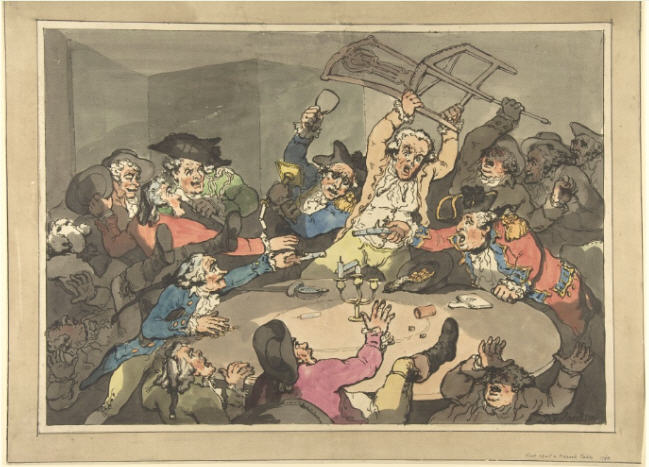
The drawing caught my eye at the Met a couple of months ago. Mostly, I like it because it seems like a good, funny time capsule, and because it appears to be drawn with the type of confidence and enthusiasm that I generally enjoy in all forms of media. Partly, I like it because I am a baseball fan who appreciates the staggering power of randomness.
I don’t know many particulars of 18th-century British society beyond wig-powdering. Maybe the melee depicted above ensued after harsh words about King George III or the changing political tide in Europe. But I assume the conflagration in Rowlandson’s drawing came in response to a costly run of misfortune at the table.
Constructing a baseball team is hardly a game of pure chance. Teams can scout and analyze and coach to improve their odds, and the probabilities are never as discrete or obvious as those in a dice roll. But because its outcomes are impossible to accurately predict, it always requires a series of gambles.
The Mets started 2012 with calculated risks all over the field. They inked young players with short resumes into spots up and down their lineup. Two of them were coming off season-ending injuries. Two were playing new positions. Two had never spent a full season as a Major League regular before. To boot, all starting pitchers come with a significant chance of injury. And given the fluctuations in performance typical of relief pitchers, bullpens are often labeled a crapshoot. Undoubtedly, with more offseason resources to play with, the Mets’ front office could have better hedged some of its bets. But every team enters every season relying on some degree of good luck for success.
For most of the first half, the Mets rolled sevens way more often than snake eyes. Or something. I don’t really know craps or hazard and I’m growing rather tired of this metaphor. Two of the team’s surest bets — David Wright and R.A. Dickey — paid off more than anyone could have expected. Johan Santana, coming off a surgery that ended many careers, pitched like an ace for two months. The bullpen sucked and some of the young players struggled, as you probably know, but the team’s wins were more than enough to outweigh its losses.
Since the All-Star Break, their luck has turned. Santana and Dillon Gee got hurt and left the Mets relying on pitchers with much longer odds of success. The bullpen still sucks, some of the young players have continued struggling, others have struggled to new lows, and role players that contributed more than expected in the first half have done the opposite in the early parts of the second. Everything, it seems, went wrong at exactly the same time.
Now fans — myself included — are kicking up like a bunch of 18th-century British dudes after a series of unfavorable dice rolls, except hopefully without the pistols. We’re yelling, pointing fingers, smashing chairs, and scurrying for the exit with our hands above our head, drowning in woe-is-mes and I-told-you-sos. We’re blaming Terry Collins for the same decisions we often celebrated in the first half. We’re faulting Alderson for his actions and inaction. We’re questioning the team’s once-heralded chemistry, and we’re pinning almost everything on Miguel Batista or Jason Bay or Lucas Duda or Andres Torres.
Some of those gripes are legit, no doubt. The Mets counted on some bad bets, and in hindsight we can squint and see how they were bad from when they were made. But I suspect, for most of us, if we were shown in early March the Mets’ baseball-reference page in late July, we’d raise eyebrows at some parts and nod knowingly at others, concede that 47-50 sounds about right even if we hoped they’d be better, then scan down the pitching column and say, “whoa, wait: Mike Pelfrey got hurt?”
It’s the timing that’s killing us. Or killing me, at least. Even recognizing what I do about chance and small samples, the Mets’ early success seemed so reliable that I started believing they had figured out a way to buck the odds, or, at the very least, that their good fortune could continue through September.
It didn’t. Such is fortune. Such is baseball. Every year, a couple of teams enjoy a seemingly magical run of good luck, and fans of all the others lament all the bets — safe and silly — that didn’t ultimately pay off.
Here are your 2012 Mets, 47-50: Bad in the bullpen, short in the rotation, awful on defense, and with an offense that doesn’t appear quite good enough to overcome all that. The good news, if you’re searching, is that every game provides the team more information with which to make better bets in the future.
The best news, I suppose, is that their luck can change again as swiftly as it did at the All-Star Break. There’s still plenty of time. Santana could return and pitch like vintage Johan Santana again. R.A. Dickey could enjoy another ridiculous run of dominance, David Wright could continue performing like the very best player in baseball, and, hell, maybe the guys in the bullpen could even pitch to their career rates and maintain a damned lead just once. The team’s mid-season gambles could bring back massive and unexpected returns. It doesn’t seem likely, but then I guess outside of a few glorious weeks, it never really did.
With the Mets’ bullpen, going into extra innings is like going into sudden death overtime in hockey and pulling the goaltender.
I wrote that headline before Sunday’s Mets game. Hopefully something extremely awesome happens in it to make the headline obsolete. Otherwise: Panic!
I’m out of the office today. There’ll be something about the Mets here later or tomorrow.
https://twitter.com/RobPatterson83/status/226309308453900288
Legit chance? Yes. Likely? Probably not.
So much can happen between now and next spring, but Wheeler should be promoted to Triple-A soon. Figuring the Mets will want to limit his innings to around 150 — he’s at 101 2/3 now — he’ll probably only get a handful of starts at the Minors’ highest level before the end of the season.
Wheeler still walks batters at a pretty high rate, and I suspect the Mets would want to see evidence that he has cut that down before they promote him. The good news is his walk rate has steadily declined as he has advanced through the Minors — 5.8 BB9 in Low A in 2010, then 4.1 BB9 in High A in 2011, and now 3.2 BB9 in Double-A in 2012. Also, he allows very few hits and home runs, which implies he yields mostly weak contact.
Provided he’s healthy, Wheeler will get an invite to big-league camp in Spring Training. There — again, provided health — he will likely join Johan Santana, R.A. Dickey, Jon Niese, Dillon Gee, Matt Harvey, Jeurys Familia, Jenrry Mejia, whoever else survives the coming 40-man roster crunch, and whomever the Mets add to the 40-man roster to protect from the Rule 5 Draft.
Wheeler is reputed to have more talent than a lot of those guys, so maybe if he shines in Spring Training and the Mets decide he has nothing left to prove in the Minors, he’ll make the team. The front office appears to be pretty conservative with promoting its pitching prospects, though, so if I had to bet, I’d guess Wheeler starts next season in Triple-A and (given continued success) joins the big club whenever it first has a need.
https://twitter.com/JasonCronk/status/226309241076580354
My thoughts are this: I agree. Not for a rental, at least. If the Mets were trading for a guy — at any position, really — with an established level of success that they’d have under control for the next few years, then sure, trade prospects. If the Mets were trading for a guy signed through the end of 2012, then they shouldn’t give up anything they think will help them in the future. Winning a Wild Card means entry to a one-game play-in, like you say. And besides that, relievers are fickle. Remember how much better the Mets’ bullpen looked on paper coming into 2012 than it has looked on the field in 2012? There are very few closers that come with guaranteed success in the role, and fewer yet that will be available at this trade deadline. Buying one on behalf of the 2012 season — when the rest of the bullpen will still be the rest of the bullpen, when the team still won’t hit lefties or play good defense — at the possible detriment to 2013-2015, seems silly.
Could he benefit from more regular at-bats in Buffalo? Probably. Would I send him down if I were in charge? Probably not. Though he has certainly struggled, Nieuwenhuis still offers value to the Mets, and the Mets are still trying to win as much games as they can.
Against righties this year, Nieuwenhuis has a .782 OPS. Jason Bay’s OPS against righties for the last two years is more than 150 points lower. Nieuwenhuis is rangy on defense and fast on the basepaths.
It seems about time the Mets stop giving Bay regular starts against right-handers. If he starts crushing lefties enough for anyone to suspect he can hit like the 2009-vintage Jason Bay again, then by all means, play him every day again. At this point, though, with slew of lefties that appear apt to out-hit Bay against righties and the team still in contention, penciling him into the lineup daily hurts the team.
So if it were up to me — and it’s not, thankfully — I’m keeping Nieuwenhuis around and playing him against righty starters, hoping he adjusts and breaks out of his slump. Whenever Mike Baxter is ready to return, I reassess. But that’s down the road.
Via email, Luke writes:
I like Terry Collins, but his use of Miguel Batista in high leverage situations drives me into a furious rage, and I break things. How do you feel about it?
I was perhaps Batista’s last apologist among Mets fans in 2012 since I’m fascinated by the way he always puts up woeful peripherals but an above-average ERA. But yeah, the sight of Batista warming up in late innings of a tight game is certainly frustrating. The thing is, if Bobby Parnell’s the interim closer, which member of the Mets’ bullpen would you want to see warming up in the late innings of a tight game? Ramon Ramirez has probably pitched his way into more responsibility, but that’s pretty much it.
A few more good email questions came in after I wrote this, but I’m closing in on 800 words so I’m going to stop here. I’ll get to the ones that are still relevant in future mailbag posts.
 Tedquarters