Is it fair to call Mike Pelfrey a disappointment?

In short: No.

I mean, it depends on your definition of “disappointment,” of course, and what your expectations were for Pelfrey when he joined the Mets in 2006 — I know my own were certainly sky-high. But if you’re citing his draft position as evidence that he hasn’t lived up to his potential, I urge you to consider the following chart I spent my morning compiling.

I went back through all the drafts since 2001 and compared the career fangraphs WARs of every pitcher selected in the top 10 overall. That’s not the most comprehensive means of comparison, I know, but I figured it’s a good way to get a quick-and-dirty sense of a pitcher’s value. Then I eliminated the guys from the last three drafts, figuring it’s not anything like fair to compare them to established pitchers so early in their careers.

Then, with Moneyball in mind, I removed all the high-school pitchers from the list to try to make the comparison a little tougher on Big Pelf. There were 12 high-school pitchers drafted in the top 10 overall picks since 2001, four of whom (Gavin Floyd, Zack Greinke, John Danks and Clayton Kershaw) have since outproduced Pelfrey, three of whom never threw a big-league pitch.

So the following is the list of all college pitchers selected in the top 10 overall from 2001-2008, omitting both instances where a pitcher did not sign with the drafting club.

It’s 29 guys, and Pelfrey ranks eighth among them in fWAR. Certainly he’s not Justin Verlander or Tim Lincecum, but I’d hardly call a guy who has produced in the upper echelon of top-drafted pitchers “a disappointment.” Obviously teams drafting pitchers that high are hoping for aces, but there’s so much risk involved that landing a suitable innings-eater should be at least a satisfying outcome. Disappointments include the 10 guys on the list with zeros or negative numbers next to their names.

Year Pick Pitcher Team Total fWAR
2001 2 Mark Prior Cubs 15.8
2001 3 Dewon Brazelton Devil Rays -0.6
2001 6 Josh Karp Expos 0
2001 7 Chris Smith Orioles 0
2001 8 John Van Benschoten Pirates -0.8
2002 1 Bryan Bullington Pirates -0.8
2002 9 Jeff Francis Rockies 16.5
2003 3 Kyle Sleeth Tigers 0
2003 4 Tim Stauffer Padres 2.3
2003 8 Paul Maholm Pirates 13.9
2004 2 Justin Verlander Tigers 32.4
2004 3 Philip Humber Mets 3.5
2004 4 Jeff Niemann Devil Rays 5.3
2004 6 Jeremy Sowers Indians 3.3
2004 10 Thomas Diamond Rangers 0
2005 6 Ricky Romero Blue Jays 9.8
2005 8 Wade Townsend Devil Rays 0
2005 9 Mike Pelfrey Mets 8.6
2006 1 Luke Hochevar Royals 7.4
2006 2 Greg Reynolds Rockies -0.6
2006 4 Brad Lincoln Pirates 0.2
2006 5 Brandon Morrow Mariners 8.3
2006 6 Andrew Miller Tigers 2.8
2006 10 Tim Lincecum Giants 27.9
2007 1 David Price Devil Rays 10.4
2007 4 Daniel Moskos Pirates 0.2
2007 6 Ross Detwiler Nationals 1.5
2007 8 Casey Weathers Rockies 0
2008 4 Brian Matusz Orioles 2.6

Exit the Fernanchise

So Fernando Martinez is off to the Astros, cut from the Mets’ 40-man roster to make room for Ronny Cedeno and his career .286 on-base percentage, joining Lastings Milledge and the Alexes Ochoa and Escobar in a long line of ballyhooed Mets outfield prospects to ultimately provide the team little more than a handful of underwhelming at-bats plus Rich Becker, Ryan Church and some fraction of one-and-a-half pitiful seasons’ worth of Robbie Alomar.

In Martinez’s case, the hindsight is now crystal clear: They should have traded him for Dan Haren or CC Sabathia. They should have seen and understood his obvious physical limitations instead of stubbornly clinging to his youth and promise despite his general lack of meaningful production at any Minor League level.

That’s true, really. Based on the way it all panned out for Martinez with the Mets, they absolutely should have traded him when he still maintained some of the value that came with the Teenage Hitting Machine hype, regardless of what so many of us believed then and probably still believe now about the importance of developing players from within. And we can reasonably debate whether Martinez, at 23, was the sensible guy to cut from a roster that still includes Armando Rodriguez, D.J. Carrasco and Jeremy Hefner, but there’s really no arguing that the Mets of 2007-2011 wouldn’t have been better off parting with Martinez at some time sooner than Jan. 11, 2012.

It’s… well, it’s disappointing, for one thing.

But there are some lessons here regardless, and they are absolutely not that every team should trade its much-hyped prospects for available veteran help — though Martinez’s case will inevitably be cited to make that argument at some point in the not-too-distant future.

His fall from stature instead underscores, I think — and once again, really — the enormous challenge of scouting, developing and understanding young talent that is endeavored by teams, the baseball media and fans alike.

Using Baseball America’s preseason rankings, Grant Brisbee painted a heartbreaking picture of Martinez’s accelerating decline over the past four years. Understandably unstated in the post is that none of Ruben Tejada, Daniel Murphy, Lucas Duda or Dillon Gee ever ranked among Baseball America’s Top 100 and all a) have now inarguably provided the Mets more than Fernando Martinez ever will and b) are currently penciled or inked into starting roles for the 2012 Mets, for better or worse.

Which is not to diminish the exhaustive work done by Baseball America or any other prospecting outlet, only to qualify it. Those rankings are based in part on the players’ upside, and certainly none of the young Mets appear likely to ever be as good as people thought Martinez might have someday been, back when he was still a Teenage Hitting Machine.

Any reasonable Minor League writer will admit that he’s dealing in a ton of uncertainty — they’re called “prospects,” after all. Players develop at various speeds in various ways, and there are hundreds of possible routes to a successful big-league career. Sometimes 19-year-old prodigies develop arthritis and flame out, and sometimes 24-year-old slap-hitters start crushing Double-A pitching and never stop.

That is a long-winded way of saying: It’s best not to rush to rule anyone out or in.

It’s not to say we shouldn’t bother paying attention. Even for all my most-prospects-suck crotchetiness, I still gobble up nearly every year-end ranking of Mets prospects I can find and pore over stats from the team’s low Minors looking for diamonds in the rough. It’s fun, and when the team’s immediate big-league chances look gloomy, it’s a great way to maintain hope for sunnier days down the road. But I would caution against putting too much faith in any list or getting too worked up over rankings. (I tend to trust Kevin Goldstein and our own Toby Hyde most on Mets prospects, for whatever it’s worth.)

Back to the now-departed Fernanchise: I hate to be this guy again, but I think the other lesson or reminder or general item of sadness inherent in the move is the human aspect to it.

And maybe I shouldn’t feel sorry for a guy who got more money for playing baseball at 16 than I likely ever will for anything in my life, but for whatever reason the image of Martinez that stands out in my memory is seeing him leaving the Mets’ Spring Training clubhouse in jeans and a t-shirt looking very much like the college-aged kid he was: certainly athletic, but perhaps a bit soft in the belly. And I remember thinking about the grumblings I’d heard that week about his work ethic, and then thinking about what people would have grumbled about my work ethic (and belly) at 22 (or ever) if anyone outside my family cared.

Martinez is still only 23, so in all likelihood there’s plenty of time for him in baseball and everything. Maybe he gets an opportunity in Houston and hits like Ted Williams, or at least like Carlos Lee, and enjoys a long, successful career in the Majors. Or maybe he doesn’t, but he’s smart and resourceful enough to find a gainful and satisfying way to occupy the rest of his years, inside or outside the game.

And though I’d be hard-pressed to argue there are many better ways to spend your late teens and early 20s than playing baseball — or more accurately, in Martinez’s case, rehabbing for baseball and “resuming baseball activities” — even with all the long bus rides and crappy hotel rooms and cheap meals intrinsic to Minor League life, you’ll never convince me it can’t be strange and at least a little bit sad to wake up at 23 facing the real possibility that the goal you’ve been pursuing since 16 may be unobtainable due in part to physical factors largely beyond your control, and that all you’ve heard about your potential from the crowds gathering around your batting-practice sessions could very well amount to little more than 131 Major League at-bats and a hell of a lot of fuss.

 

Whodunit

Oldish news now: I was going to write something making fun of all the people playing Guess Who? to determine the author of the anonymous NY Magazine article, but it turns out I’m sitting here doing the exact same thing.

The content is hardly groundbreaking — it’s nothing you can’t read on a dozen blogs everyday or hear on WFAN every morning. But it’s interesting when attributed to a “Met,” vague as that might be. So I’m wondering who you think is responsible:

[poll id=”50″]

Fear not: Miguel Batista returning

The Mets have signed free-agent right-handers Miguel Batista and Fernando Cabrera to Minor League deals and invited them to Major League camp. They also signed a light-hitting shortstop named Sean Kazmar, who will report to Minor League camp and not be mentioned for the remainder of this blog post.

Batista you know: He’ll be 41 by Opening Day, he writes poetry and mystery novels, he somehow manages to guile his way to a reasonable ERA every year despite lousy peripherals, and he pitched that two-hit shutout in Game 162 in 2011 that was entirely overshadowed by a first-inning bunt single. On a Minor League deal, he’s a hedge for the five starters penciled in to the Mets’ Opening Day rotation. The Mets will need a fifth starter by April 11, so if Johan Santana is not yet ready to go, Batista will likely be in the mix for early-season starts with Chris Schwinden and… I don’t know, D.J. Carrasco? Pedro Beato?

Cabrera is more interesting. He has thrown 175 1/3 mostly poor innings across parts of seven seasons in the Majors, nearly all of them marked by lots of walks, lots of home runs, and lots of strikeouts. But for the past three years he has mostly pitched in Triple-A in Pawtucket and Sacramende* and mostly been pretty good, striking out over 10 batters per nine in that stretch and maintaining a 2.77 K:BB ratio.

Given the Mets’ 40-man roster crunch it seems unlikely Cabrera will crack the club out of Spring Training, but if he continues to pitch like he has since 2009, he’ll probably wind up in Flushing for a stretch if and when anyone in the Mets’ bullpen gets injured or proves ineffective.

*- I was just struck by an interesting Google paradox. If you say anything about Google results in a big enough forum — like a joke on Arrested Development or a blog post that starts with “a Google search for the term _____ yields (however many) results” — you’re very likely to alter those Google results and thus render your statement inaccurate about as soon as you publish it.


Get the F! out?

One-time top prospect Fernando Martinez as well as left-hander Daniel Herrera may be in their final days with the organization. A source told ESPNNewYork.com that both players are on waivers to clear the roster spots for Scott Hairston and Ronny Cedeno.

Adam Rubin, ESPNNewYork.com.

Interesting. Seems like there are any number of guys with less upside than Martinez that the Mets could cut to make room for Hairston and Cedeno, but I suppose it’s not worth fretting over until Martinez gets claimed elsewhere. If he doesn’t and can be sent to Triple-A, the move’s less curious, but would speak to the not-undocumented way Martinez’s stock has plummeted.

And we’re talking about the Mets’ last bench spot on Jan. 9

The Mets bench now looks something like this:

C — Mike Nickeas
IF — Ronny Cedeno
IF — Justin Turner
OF — Scott Hairston
OF — ?

As it stands right now, Mike Baxter seems likely to edge out Josh Satin for that fifth spot, if only because Baxter’s lefthanded-batting-ness and outfielder-ness fit better on the righthanded-hitting heavy bench.

Patrick Flood, PatrickFloodBlog.com.

Yikes — doesn’t look so pretty when you spell it all out like that. Each guy is defensible in his role, but outside of Hairston there’s really not a lot of offensive might there. Turner can get on base a bit, which is useful.

But like Patrick points out, they’re all right-handed. And given the way Terry Collins relies on platoon matchups with his pinch-hitters, expect to see a left-handed hitter given that fifth spot, and expect that left-handed hitter to get hell of a lot of opportunities off the bench.

After the Hairston signing last week, some discussion surfaced over whether the Mets should or should not (and would or would not) re-sign Willie Harris, but if they’re going to carry Cedeno and Turner, there’s no real solid case for adding Harris to the roster. With two backup infielders in the fold, Harris’ defensive versatility becomes less valuable, and it can’t be that hard to find a better hitting lefty bat on the cheap.

Based on the Mets’ needs, they’ll likely be looking to fill that last spot with a guy who can hit left-handed and play at least a vaguely passable center field, depending on how comfortable they are with Hairston as the backup in center. Looking at the remaining free agents, it doesn’t seem like there are a lot of guys in their price range likely to do either of those things way better than Mike Baxter. Plus Baxter brings the additional upside of being 27 and under team control, so if he succeeds in the role he could fill it for a while.

Of course, a lot can still happen between now and Opening Day, and something almost always does.

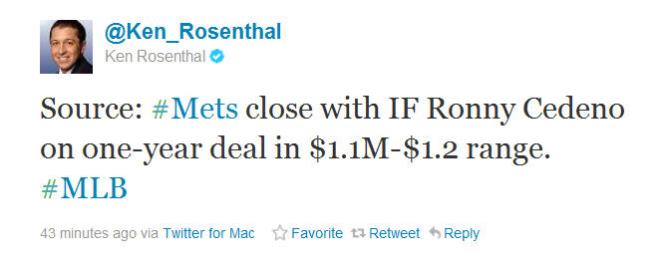
Mets close to signing Ronny Cedeno for some reason

Yeah?

I guess that would mean the Mets feel Cedeno is that much more valuable than Omar Quintanilla at the minimum, and hey — maybe he is. Cedeno can’t hit, but he seems to be a pretty good defender at shortstop and second base. UZR has him a tick above average at short for the last three years, for whatever that’s worth, and Dave the Pirates fan from my baseball game in Brooklyn references Ronny Cedeno whenever anyone makes a nice play on the infield. (Dave’s a pretty astute baseball guy so that probably carries similar weight to UZR.)

Get up for the Ronny Cedeno show. Suck it, Jack Wilson.

I should’ve slept more last night.

Mets hire CRG Partners, Internet explodes

A source familiar with the situation has said that the Mets have hired CRG Partners — the turnaround consultants that handled the Rangers’ bankruptcy sale — and that a team sale with or without bankruptcy is on the table. The Mets have confirmed the hiring, stating that they have “engaged CRG Partners to provide services in connection with financial reporting and budgeting processes.”

Hiring turnaround consultants doesn’t necessarily mean that the team is specifically preparing for bankruptcy and a sale — consultants like these are brought in to figure out how a struggling business can become profitable — but it further underscores the Mets’ moribund financial situation. Also, a turnaround company typically gets only a modest fee if it comes in and merely makes recommendations; it has a considerable economic incentive to push for a huge sale when a sizable commission is in the offing.

Eno Sarris, AmazinAvenue.com.

So there’s that. The Mets confirmed their association with CRG about an hour after Eno published the story, lest you think all my skepticism regarding anonymous sources should fly out the window when the source speaks through someone whose work I clearly appreciate and link all the time — Sarris’ frequent and shameless blasting of Ruben Tejada notwithstanding.

By 6 a.m. this morning, I saw people suggesting the story was being overhyped and/or overblown, but I’d urge anyone thinking as much to read Eno’s original report. I think it’s being subjected to some undue criticism precisely because he took care to qualify everything and make sure he distinguished the facts from his speculation.

I’ll add only that the news shouldn’t really be all that surprising: It’s not exactly a secret that the Mets and their owners are in some pretty serious financial straits, so it makes a hell of a lot of sense for them to be engaging consultants experienced in those matters.