Ah, the Internet

Here’s something I said on the Happy Recap radio show Sunday night:

I think you’ve got to bring Pelfrey back, and I know that frustrates Mets fans to hear. Because it’s frustrating to watch him pitch, and I feel the same way. He’s not, you know, he’s not great. And he doesn’t have a second pitch so he’s not really able to get a lot of swings and misses; he yields a lot of contact which I think is why you see so much fluctuation in his performance.

But I think the value in Pelfrey — and it’s one that really shouldn’t be understated — is he’s healthy. He stays healthy and throws 200 innings just about every year. And that’s not something you can easily find. And if you go about replacing him with the type of guys like Tim Redding, and Brian Lawrence, and the scrap-heap fifth starters, you wind up taxing the rest of your pitching staff a ton. And Pelfrey, as bad as he can be starting, he does have a ton of starts where it’s six or seven innings, three or four runs, and those are worth something.

If the Mets had, if Matt Harvey had been at Triple-A and Familia and Mejia and all those guys were ready to go — if this was next year and all those guys were still progressing — then sure, you cut bait on a guy like Pelfrey. But I think right now, the way the Mets need innings, they’re best suited bringing him back. And maybe if he’s pitching well and those guys are knocking on the door from Triple-A come the middle of the season, maybe then Pelfrey has some value to some contending team that needs a back-of-the-rotation starter and then you can flip him for something. I don’t think it would be wise to just let him walk in an arbitration year.

Here’s how at least one listener interpreted that:

ted berg seems to like pelf a lot……?

Yes, the Mets traded Nelson Cruz

Yes, as everyone seems especially eager to remind you, the Mets once traded Nelson Cruz. LOL.

They traded Cruz straight-up to the A’s on Aug. 30, 2000 for middle infielder Jorge Velandia, who sucked. Velandia spent parts of three seasons with the Major League Mets and posted a whopping .497 OPS.

A few years later, after Cruz had already reached and hit well at Double-A in 2004, the A’s traded him to the Brewers for Keith Ginter, who also sucked. Ginter spent a season in Oakland and posted a downright Jorge Velandian .497 OPS.

Then — then! — the Brewers included Cruz in a deal with a half season’s worth of Carlos Lee, who didn’t suck then, for Julian Cordero, who sucked, Kevin Mench and Laynce Nix, who sort of sucked, and a half a season of Francisco Cordero, who decidedly did not suck.

Cruz spent part of 2006 and most of 2007 with the Major League Rangers, but he sucked then — enough so that the Rangers sent him back to Triple-A for 2008. Cruz beat the hell out of the ball in Triple-A Oklahoma and became a favorite of this guy in the old Flushing Fussing column on SNY.tv, where I wrote:

Any phone calls to the Rangers, though, should start with a question about Flushing Fussing favorite Nelson Cruz. Cruz, a 28-year-old right-hander who struggled in parts of three big-league seasons, has shown that he has absolutely nothing left to prove in Triple-A. Granted, he’s playing in a big-time hitter’s park in Oklahoma, but the dude’s got a .349 batting average with a .442 on-base percentage and 37 homers in 350 at-bats in 2008. If the Rangers don’t want to take any more chances on Cruz, I certainly hope the Mets will. He needs only more time to adjust to the Majors than the Rangers have given him. The guy can rake.

The Rangers finally did take another chance on Cruz late in August after David Murphy got hurt, and Cruz proceeded to not suck. (Except on the road, it should be noted, where Cruz can boast only a .726 career OPS. I normally attribute stuff like that to randomness but Cruz’s home/road splits are pretty consistent.)

Anyway, yeah, the Mets traded Nelson Cruz. So did the A’s and Brewers, and it wasn’t until his fourth season with the Rangers that he became an everyday player. LOL.


Free-agent pitchers

2. David Wells, Red Sox (2005-2006), two years, $8 million dollars

The Red Sox took a chance on the 41-year-old Wells before the 2005 season, giving him a two-year deal. Wells made 30 starts and pitched 184 innings in 2005, going 15-7 and posting a 4.45 ERA (with a 3.83 FIP) for an iffy fielding Red Sox team. That performance right there was worth more than the $8 million Boston paid Wells, with anything else in 2006 being gravy — which was all they got. Wells was injured for most of 2006, but made eight gravy starts for Boston before being traded to the Padres at the August deadline.

Seriously, this is the second-best contract, and it was given to a fat, 42-year-old pitcher making $4 million dollars a year. We could stop here, because that’s probably all anyone needs to know about signing free agent pitchers to multi-year deals.

Patrick Flood, PatrickFloodBlog.com.

Patrick Flood looks at the 10 best and 10 worst multi-year deals for free-agent pitchers. It’s about what you expect if you’re in the camp that says free-agent pitchers are almost always a bad investment, but it’s still pretty eye-opening. Also, if you’re in that camp, I’ll see you at the swimming hole.

Mets hire bench coach. FIRE THE BENCH COACH!

The Mets will reportedly hire Bob Geren as their new bench coach. I wanted Dave Magadan.

WHAT DO THEY HAVE AGAINST MAGADAN? Just another classless move by this organization, disrespecting their history. I guess there’s no formula in Sandy Alderson’s spreadsheets that accounts for MY PERSONAL MISGUIDED RAGE!

I have never met Bob Geren and honestly I know almost nothing about his approach to baseball or even what a bench coach is supposed to do, but I am certain this is the single worst thing that has ever happened to this franchise and the Mets will crash and burn under the incompetent thumb of their new bench coach.

From the mailbag

Has the luster/nostalgia of being a fan worn off since you are now an employee of the team you root for? Is it work for you? I ask this because, as a member of tv production, I would never want something I do for pleasure to feel like work. I would love to hear your take on it.

– Alex, via email.

Not really, no.

A couple of things: First off, I’m not a Mets employee. It seems like the general perception is that SNY and the Mets are two arms of the same entity, but in my day-to-day dealings it’s not like that at all. I have a season credential to cover the team, like many members of the media do, and when I need to set up something specific I go through the media-relations department, as someone from any other media outlet would.

That said, SNY’s ratings and (more pertinent to me) the traffic on these sites depend in many ways on the Mets’ performance. I am benefited professionally by the Mets playing well, which perhaps alters — but certainly does not diminish — the way I root for the team.

I think it’s this part of the job — the writing, which is hardly my primary responsibility — that most impacts the way I follow the team. I suspect that if I just showed up to the office and helped manage and edit the content on SNY.tv without ever publicly expressing my opinions about the club, I’d remain now pretty much the same fan I was in 2005, before I got my first job in media. I would know a bit more about the sausage-factory stuff that goes into a game broadcast, but not really root for the team any differently than I did before I worked here.

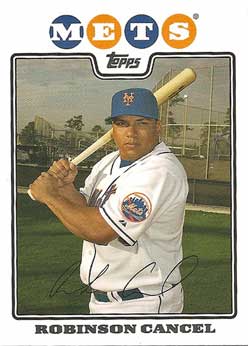
In mid-June of 2008, during the height of the great Internet Val Pascucci Campaign, Robinson Cancel smacked a pinch-hit two-run single up the middle that helped the Mets beat the Rangers. And it immediately pissed me off. I thought, wrote and maintain that Cancel had no business getting pinch-hit opportunities or even being on a third catcher on the Major League roster when the team had Pascucci crushing the ball in Triple-A. So when he got the hit, instead of being thrilled by it as a Mets fan, I was annoyed because it worked against my point.

That led to quite a bit of soul-searching, and the realization that I needed to emotionally divest myself from my writing while watching the games. It’s not the easiest thing to do, but I believe doing it successfully enhances both my enjoyment of the games and the writing itself.

I really, really, really like baseball. When I go on vacation from my job covering baseball, I usually go watch baseball somewhere. Baseball f@#$ing rules. And there’s just nothing I’m going to come across in my professional life that makes me feel otherwise.

Before I worked in this industry, I typically watched every game but ignored a lot of the nonsense surrounding it. I tuned in to the rumor-mill stuff every offseason and near the trade deadline, but I generally avoided most newspaper columns, blogs and WFAN. Not by any hard and fast rule, I just tended to seek entertainment elsewhere.

If I was working somewhere else and I saw that the Mets pulled Jose Reyes after one bunt base hit on the last game of the season, I’d probably shrug a little, say something snarky about bunting, and move on. Now I know that when something like that happens, I’m probably going to feel pressured to address it in some more substantive way. And sometimes that kind of sucks. But it’s still way, way, way better than not having a job writing about baseball.

The late-90s Mets had a “porn room”

Patrick asked Leiter if it was true that the Mets teams of the late-90s and early oughts had a “porn room.”  Which, while it sounds salacious, is really just a way of implying that boys have always been boys and it will forever be thus.  ”Porn room?” Big deal. It’s not like every frat house, locker room and ship in the United States Navy isn’t lousy with such things.

Except the question kind of rattled Leiter. You can watch the video over at SportsGrid.  Anyone who has ever tried to first joke away and then sort of explain away a mildly embarrassing truth will recognize Leiter’s vamping toward an answer.  And Patrick’s smiling.  Whether the Mets really did have a porn room back then was an open question when Patrick asked it, but I think the matter was more or less settled by the time Leiter was done answering.

Craig Calcaterra, HardballTalk.

Alright so who do we think was responsible for the porn room? The only thing I think we can say with certainty is that it wasn’t John Olerud. I’ll take a shot in the dark and guess it was Todd Pratt.

What we troll about when we troll about Wally

If you want to incite uproar on Twitter, mention Wally Backman. Just Tweet something innocuous like, “I saw Wally Backman at my corner store this morning buying coffee and a buttered roll,” and watch the response.

First, people will speculate that the sighting means he’s joining your local Major League Baseball team to fill some vacant coaching position. Some people will think this is terrible news, and other people will argue that it’s great news.

Then, once everyone realizes that the reported purchase of the buttered roll indicates little more than that Wally Backman purchased a buttered roll, people will spin it to fit with whatever they already believe about Backman.

“Coffee and a buttered roll! What an honest, blue-collar breakfast,” one will Tweet. “He’s perfect for this town.”

But then someone else will be all, “Coffee and a buttered roll!? That’s the same breakfast George Bamberger favored, and he was a terrible manager!”

Then the first guy will reply to the other guy like, “You’re ignorant! Many great managers have sworn by coffees and buttered rolls!” And the second guy will say, “Why do you love him so much? I’ll murder you dead!” Then the first guy will respond, “I’m cuckolding you as we speak!”

And it’ll go on and on like that until everyone realizes Twitter is stupid and that buttered rolls have little predictive power for managerial ability.

That’s the main thing: Twitter is pretty stupid. It can be a valuable tool for monitoring breaking news and a fun vehicle of validation for those that try to traffic in succinct one-liners, but it is a miserable forum for debate.

Anything worth arguing at any great length is almost by its nature too nuanced to be stripped down to 140-character bursts, and the immediacy and impersonality inherent in the medium encourage inflammatory implications (and interpretations). But then of course it’s people driving Twitter, and eschewing intelligent discussion in favor of incessant, oversimplified polemics is really nothing new in any forum in which humans interact.

I get sucked in, too, of course. But mostly I resort to sarcastic trolling, extending the most fervent common arguments to absurd heights for easy entertainment. It’s cheap and shticky, but it’s great for that whole validation thing.

Which is to confess: When I blame Carlos Beltran or heap shame upon Jose Reyes or worship at the altar of Wally Backman, I don’t really mean any of those things. I mean rather to mock those that do say and believe those things, especially if they deliver them with a certain Twitterish zeal.

The latter issue is the one currently en Twitter vogue. If you believe what you read, Backman is either very likely or definitely not joining the Nationals as Davey Johnson’s third-base coach and protege. And by now most Mets fans seem certain that Backman will either be the single best or absolute worst Major League manager of all time, when the truth is very obviously somewhere in the middle.

I can attest that Backman has a tremendous knowledge of the young players in the Mets’ system — and not only those he managed in Brooklyn and Binghamton. I believe his players really do respect him and enjoy playing for him, and that he is probably a strong motivator.

But I imagine if he were managing the Major League Mets I would grow frustrated with some of his in-game strategies, and that he might need to temper his temper to avoid the type of back-page nonsense that has tormented the organization in recent years.

I am likely biased a bit toward Backman now because — as some of his staunch allies have been eager to point out — he has been a very obliging and helpful guest for multiple SNY.tv video interviews over the past couple of years, and because I don’t believe there’s any such thing as unbiased journalism (or anything). But it shouldn’t offend Wally or anyone to hear that I expect he would have strengths and weaknesses as a Major League manager, just like everyone else in the entire world.

Wally Backman was an ’86 Met, and his presence in the organization is a pleasant reminder of that year to the legions of fans nostalgic for those dirty-uniformed mustache heroes that dominated the National League.

On and off the field he has suffered trials and enjoyed triumphs. Multiple Major League organizations, including the current Mets, have deemed him worthy of stewarding their precious Minor League commodities. The Diamondbacks saw fit to fire him less than a week after naming him their Major League manager.

If and when he finds a job managing in the bigs, he will be hailed as a hero if his team succeeds and chastised as a goat if they fail. In either case, his effect will likely be overstated, as a manager’s influence usually is.