Ben Berkon at Rising Apple kicks off a hilariously titled (and quite useful) series.
Bad Contract of the Day to Swap Jason Bay With
Reply
Ben Berkon at Rising Apple kicks off a hilariously titled (and quite useful) series.
R.A. Dickey is a man with distinguishing taste in cheese.
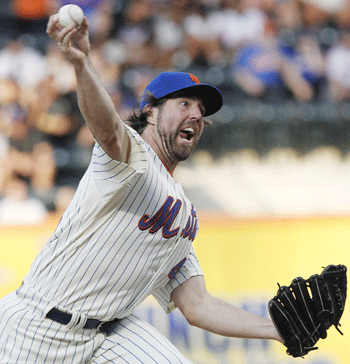 In March, after a video interview with Dickey about his signature array of knuckleballs, I asked him about The Dickster — his personalized sandwich, first Tweeted by Newsday Mets beat reporter and sandwich enthusiast David Lennon.
Dickey told me the Dickster contained turkey, bacon, lettuce, cheese and mayonnaise. As he stepped into the Digital Domain Park clubhouse, I realized I had slipped in my duties as a vigilant sandwich blogger.
“Hey, R.A.,” I called after him. “What type of cheese?”
“Havarti,” he said with a grin.
Not Swiss or cheddar or American or even Muenster or provolone. Havarti: A subtle, buttery Danish cheese, specific enough to suggest it was chosen after careful consideration.
Fangraphs’ pitch-value stat calculates the runs above or below average produced by every pitcher’s offerings. When averaged out for every 100 times the pitch is thrown, the stat shows some predictable returns: Cliff Lee has the game’s most effective slider*; Cole Hamels’ changeup prevents more runs than any other; Roy Halladay throws the most devastating curveball.
Fastball values per 100 pitches tend to be less extreme, somewhat predictably, since the fastball is typically not used to deceive hitters so much as to establish the timing that pitchers hope to betray with breaking balls and offspeed stuff. Still, most of the names near the top of the wFB/c (fastball value per 100 pitches) leaderboard for 2011 should be familiar to anyone who has been following the postseason: Lee, Ian Kennedy, Doug Fister and Justin Verlander sit at places 2-5 on the list.
But atop that mountain of all-stars and Cy Young favorites stands our literary knuckleball, Mr. Robert Alan Dickey. At an average of 84.4 miles per hour, Dickey’s fastball was among the very slowest in the Majors in 2011. But according to the stat, the pitch was 1.84 runs above the average fastball per every 100 times he used it.
Before the Mets’ final game of the season, I presented that information to Dickey.
“Does that surprise you?” he asked.
“It’s the way I use it,” he said. “I might throw six or seven fastballs a day, maybe 10. Usually when I’m throwing it, it’s in counts when they’re not swinging or I’m surprising them with the pitch.”
Despite the well-documented lack of an ulnar collateral ligament in his throwing elbow, Dickey once threw fastballs that reached the mid-90s. In his rookie season with the Rangers in 2003, Dickey still averaged 89.4 miles per hour with his fastball. The pitch’s velocity has withered with the effects of time and a shift in focus, but its effect is amplified by the contrast with his trademark knuckleball.
“It is such a drastic difference from a knuckleball,” he said. “If you see six knuckleballs in an at-bat–”
“The fastball looks like it’s coming in at 110?” I asked.
“I’ve had hitters on the opposition tell our first baseman that,” he said. “So I know it’s effective if I use it correctly.”
For Dickey, the transition from relying on velocity — as he could from his earliest playing days — to relying on deception was not easy.
“Leaving who you were behind and knowing you’re never going to be that person again is tough,” he said. “You have to put your ego on the back burner and embrace something new, and that’s a real challenge.”
This winter, Dickey will re-read Ernest Hemingway’s “The Snows of Kilimanjaro,” and endeavor to climb that mountain. Before he rejoins the Mets in Port St. Lucie in February, he’ll read a Shakespearean comedy — either Much Ado About Nothing or A Midsummer Night’s Dream, he expects — then a few more books from his lengthy reading list.
There are many reasons we like R.A. Dickey. First and foremost: He is a good pitcher on our favorite baseball team. He has led the Mets in ERA+ in both his seasons with the club so far.
He does that while primarily throwing the knuckleball, that last vestige of hope for a Major League career for all of us who could never throw 95 (ignoring, of course, that we could never throw 85 either). Dickey himself put it well, in an interview with Sam Page last offseason: “It’s almost a blue-collar pitch. You’re in the seats and you watch me or [Tim Wakefield] or whoever throw and you’re like, ‘There’s a chance that I could do that.'”
Then there’s all the rest, the stuff that elevates him to folk-hero status in certain sections of the fanbase: He reads books, he rides a bike to Spring Training, he wants to be a ballboy at the U.S. Open, he has a cool beard, he makes a funny face when he pitches, his mom reads Amazin’ Avenue, he loves Star Wars.
Dickey is, on the field and off, an interesting dude. And I suspect we identify with him at least a bit because we all fancy ourselves interesting as well. He is the guy whose fastball is his change-of-pace pitch, subtle Havarti in a league long on assertive cheddar.
*- Technically, Wandy Rodriguez’s slider was worth way, way more on average than any other pitcher’s, but he threw it so infrequently that it seems more likely the pitchFX data used to determine the stat registered a handful of Rodriguez’s curveballs as sliders.
Over at Amazin’ Avenue, Eno Sarris puts together a comprehensive examination of Yu Darvish’s posting and free-agency situation, and asks readers if they’d rather the Mets go for Darvish, re-sign Jose Reyes, or save their money for another starter.
Like many baseball fans stateside, I’ve been mancrushing on Darvish for years now. And if it were a different offseason and the Mets appeared to have more financial flexibility, I’d be all for them taking a big chance on what could be a big arm. Though few high-profile Japanese pitchers have really worked out so far, it’s a very small sample. The Mets lack front-line starting pitching and aces aren’t easy to come by, especially in their peak years.
But right now it seems the Mets are probably best off avoiding such risks. Barring some major change, they’re going to be somewhat cash-strapped for the next couple of years with or without Darvish. So if they did sign him and he got hurt or didn’t prove extremely effective, that would suck hardcore.
Yeah, lots of Twitter Q&A lately. What can I say?
With Toby and Patrick, as usual.
On iTunes here.
I can’t think of a better way to spend 20 minutes this morning than reading Patrick Flood’s very specific set of predictions for this winter and the Mets’ 2012 campaign.
Oh, it’s so good to laugh again!

A little too harried today to craft anything cohesive, so here’s a Twitter Q&A.
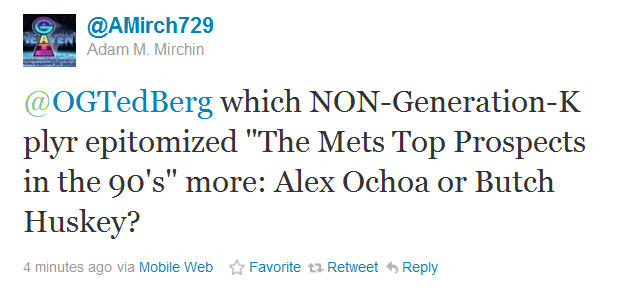 It’s Ochoa. Butch Huskey epitomizes many things, among them the general meaninglessness of Spring Training stats, what a 245-pound man can do to catchers when plowing into them at full speed, and baseball’s rich tradition of great names. But since Huskey enjoyed a couple of reasonably productive seasons as a Met, it’s hard to call him an utter failure as a prospect.
For whatever reason — perhaps because the Mets acquired him in the Bobby Bonilla trade — it seemed like Ochoa came up to a lot more hype than Huskey did. In fact, I remember that Ochoa was the first player I had ever heard referred to as a “five-tool guy,” which was about the most hilarious thing my 14-year-old mind could process.
Soon after the Mets called Ochoa up, I went to a game with my brother and a couple of his friends. We managed to sneak down to the field level in right field, where we proceeded to commend Ochoa for every single thing he did in the game, proclaiming everything as examples of his tools. He took a couple steps toward first base from right field on an infield groundout, and I yelled something about backing up first base from right field being the elusive sixth tool. Stuff like that, all game long.
Eventually Ochoa acknowledged us, and we went absolutely ape. But from there it was all downhill for Ochoa as a Met. Until right now, I had forgotten that he ever put up productive seasons with the Reds and Brewers after leaving Flushing. He did finish fifth in the NL in outfield assists in 2001, strong evidence of at least one tool.
 I don’t drink very often. I know so little about beers that if there’s nothing I recognize on a bar’s tap list I usually panic and wind up with something that tastes like fermented tar, which I sip politely until it’s about 3/4 done then leave it and walk to some other part of the bar hoping it doesn’t follow me.
When I do drink, it’s usually bourbon. And I know plenty of people will judge the hell out of me for saying this, but I rarely drink my bourbon straight. At bars I usually order it with seltzer, and at home I mix it with unsweetened green tea and a little lemonade (about three parts green tea, one part bourbon, one part lemonade). That’s the Ted Berg — order it by name, then explain it to the bartender. I’d like for this to catch on.
I also like a good frozen rum drink, where appropriate.
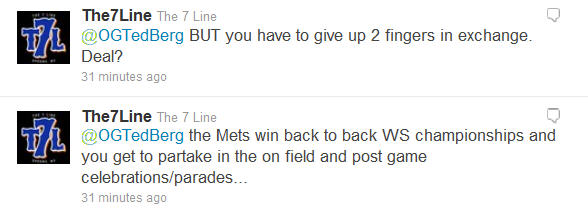 Yikes, that’s a tough one. I’m trying to imagine life without my pinkie fingers, and it’s not great. I don’t use my left pinkie as often as I should while playing the guitar, but I still definitely need it for that. And obviously both pinkies are very necessary for typing with any rapidity. Plus — and not to be Debbie Downer here — I’ve got the MS, so my dexterity is at times already limited, and I don’t know how much more of that I want to give up.
I guess there’s an underlying question of vanity here: Would everyone know I had given up two pinkies for a pair of Mets championships? Like would that be something celebrated at the parade — here’s this guy who for some reason had to give up his fingers for this! — or would I just be some eight-fingered fan in the crowd?
Either way I think the answer is no. Maybe that means I’m not committed enough, but I’d say it’s just optimism. I’m confident enough that the Mets will eventually win a World Series or two that I’m not willing to part ways with my fingers to guarantee it.
Toes I’d do in a second. Especially if it came with the promise that headlines after the fact referred to the Mets’ victory as “digitally enhanced.” I don’t think we make enough digit/digital jokes in general.
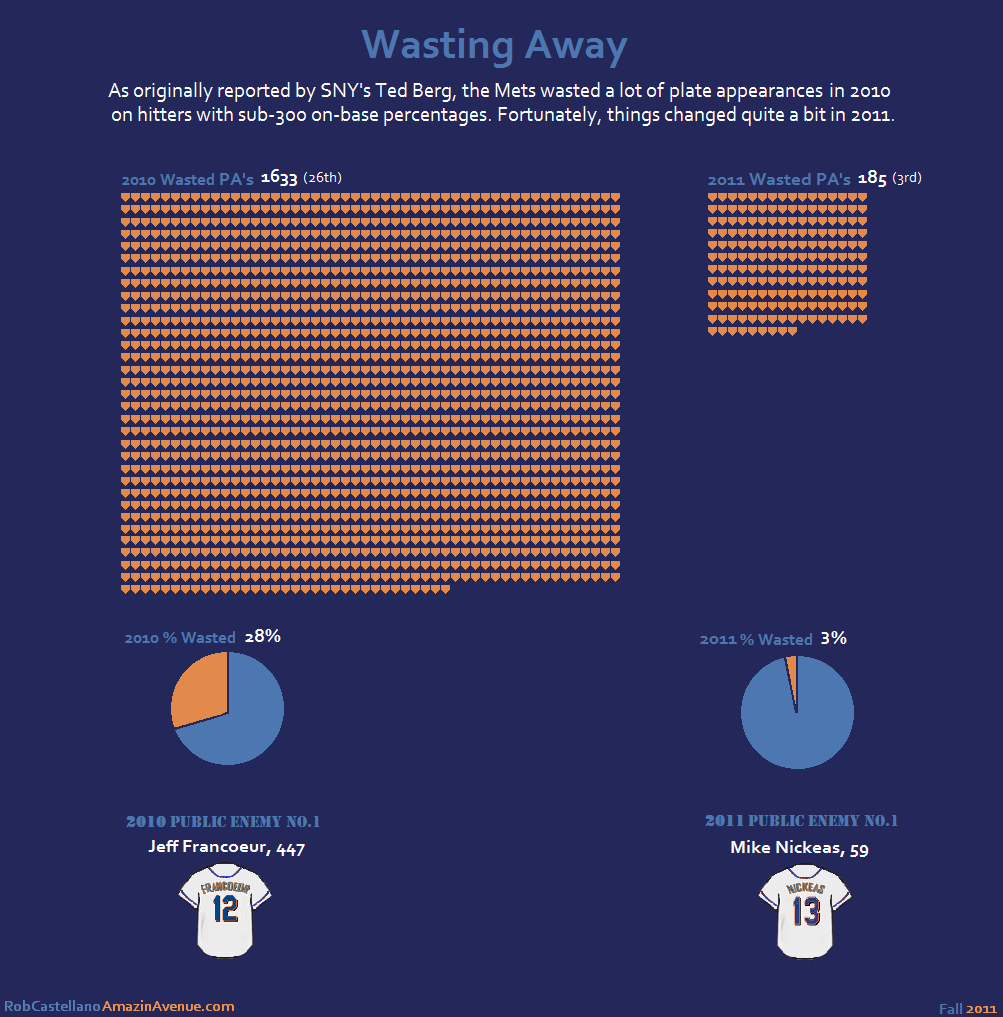
Rob from Amazin’ Avenue hooked us up with a graphic to depict my wasted at-bat watch:
 Tedquarters