The Mets’ five longest home runs of 2011

At Amazin’ Avenue, Chris McShanes ha the Mets’ five longest home runs of 2011. This is the best of them:

That’s about the most vicious thing you can do to a baseball, and of course Beltran did it with typical grace. I laughed out loud when I first re-watched it this morning, and I’ve probably played it about 10 times since.

I saw this one live from the left-field corner in Citi Field, a great seat for admiring the distance. In his previous at-bat, Beltran had pulled one of Dan Haren’s pitches foul into the upper deck in right, so I had a hunch he’d get one.

I brought it up on the podcast this week, actually, when considering our awards for best game and best home run of the season. This was the Mets’ last home game before I went on vacation, and I was worried they’d trade Beltran while I was gone and I’d never see him in a Mets’ uniform again. So I went to watch Beltran, and he did this.

Remember Carlos Beltran?

The Mets were good at getting on base

When we came into Spring Training, one of our main issues was to have a good approach at the plate — to work counts, to get ourselves in situations where we’ve got runners on base via the walks. And I think we did that. I think Dave [Hudgens’] insistence on it — I think the players bought into it as we kept going in to the season. And I look now at the end of the year and we had a lot of guys get on base. I think the approach is going to spread. I think it’ll go through the organization now due to that. To me that’s one of the keys to why we played as well as we did. We got ourselves on base a lot.

– Terry Collins, pre-game Wednesday.

For whatever reason last offseason I started charting the Mets’ “wasted at-bats,” their number of plate appearances by players finished the year with on-base percentages below .300. It’s not by any means a great way to assess an offense — just charting the team’s on-base percentage would be more useful — but it has become a great way to exemplify the improvements at the fringes of the roster brought on by the new regime in Flushing.

Last year, the Mets gave 1633 plate appearances to players with sub-.300 OBPs, by far the most in their division.

This year, the Mets gave 185 plate appearances to players with sub-.300 OBPs.

Outside of the muscly Cardinals, every other team in the National League had at least one single player with a sub-.300 OBP amass at least 185 plate appearances. Several teams have multiple regulars giving away at-bats all the time.

The Mets finished second to those Cardinals in on-base percentage for the season. Despite their home field and general lack of power, they finished sixth in the National League in runs per game, behind three playoff teams and the park-aided Reds and Rockies. By adjusted OPS+, the Mets tied with the Brewers as the NL’s second-best offense.

Of course, nabobs will be quick to point out that the Mets finished 77-85, and maybe their strong on-base skills mean nothing because they can’t grit out clutch hits or something. But the Mets lost 85 games principally because they allowed the fourth-most runs per game in their league. The offense was absolutely not the problem.

Speaking of: Imagine what the Mets offense could have done if it stayed healthy and optimized all season long? What would have happened if the offense looked more or less like this all year long:

Reyes (143 OPS+)
Murphy (125)
Beltran (150)
Davis (123 career OPS+)
Wright (114)
Duda (136)
Pagan (93)
Thole (94)

This is assuming Davis would not have continued his torrid pace and Murphy could have lasted longer at second base than he ever has without getting injured, and it’s purely hypothetical. Injuries are inevitable, but if that lineup could have averaged 450 at-bats apiece, it would have given the Mets about 3600 at-bats’ worth of a 122 OPS+. If the reserves provided about a 90 OPS+ in the remaining 2000 at-bats, the team would have finished with an OPS+ of 111.

Again: This is all shoddy math that I’m endeavoring for my own entertainment. But if the Mets scored 4.43 runs per game with a 102 OPS+, they would score about 4.82 runs per game with the 111 total. Assuming the team could prevent runs at the same rate, using the Pythagorean expectation formula, that would make for about a .525 winning percentage. So, still not good enough to make the playoffs. But hey: better.

New Mostly Mets podcast

Handing out end-of-season awards with Toby and Patrick. On iTunes here. Embedded here:

Breakdown:
2:00 – Home and Road
11:00 – The length of Alderson’s grace Period
15:00 – Building a foundation and minor league walk rates
AWARDS!!
24:00 – MVP
25:00 – Pitcher of the Year
25:30 – Rookie of the Year
32:00 – Best Defender
36:00 – Most Improved
38:00 – Best Facial Hair
41:00 – Best Hair
43:00 – Best Walk-up Music
48:00 – Most Infuriating Moment
53:00 – Best Game of the Year
55:00 – Best Ballpark Food We Ate
58:30 – Best Mets Pitching Performance of the Year
59:30 – Moment that best encapsulated the season
1:00:00 – Bye-bye Braves
1:03:00 – Best Performance by a Mets Opponent
1:08:00 – Best Home Run of the Year
1:11:00 – Player who most precisely met your expectations for 2011

Baseball Show with Mike Nickeas

I told Mike Nickeas about this article on Baseball Prospectus, then we talked about it.

One of the most interesting parts of the conversation actually came after we stopped filming. Jay, one of our video guys, asked Nickeas why an umpire wouldn’t just look at the ball (not the catcher’s movements). Nickeas said the ball’s often coming so fast that if you blink you miss the spot where it crossed the plate, so lots of movement from the catcher would be enough to sway the umpire’s judgment.

He also noted that umpires talk amongst themselves during games, so catchers need be careful about trying to pull balls back in the strike zone. If they’re too obvious with it, the second-base umpire will tell the home-plate guy and the catcher might lose some of the borderline calls. Plus, there’s a good chance said second-base umpire will be behind the plate later that series.

Then we came to the end

In the top of the ninth inning at Citi Field on Tuesday night, with the Mets beating the Reds 4-3 and Manny Acosta vying for a two-inning save, my wife turned to me.
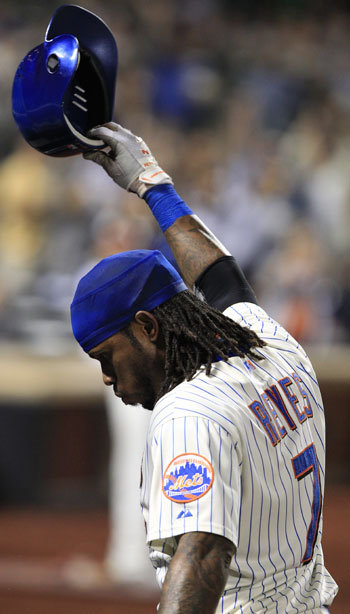
“I kind of want them to score here so we can see Reyes hit again,” she said.

“Well…” I said, turning back to the action. I didn’t tell her, but I felt exactly the same way.

Reyes, who had already hit 790 feet worth of home runs in the game, was due up third in the bottom of the frame. And we both knew — as everyone knows — that he might not have many more at-bats in a Mets uniform.

The Reds did score, tying the game. Reyes came up with two out in the Mets’ half of the inning and singled on a half-swing dribbler down the third-base line, then sped to second when Aroldis Chapman fired the ball wide of first. Sprawled out and smiling on second base, Reyes lifted his arm to flash the spotlight at the Mets’ bench. A couple pitches later, he stole third.

The Mets failed to get Reyes home, so the teams kept playing. With every passing inning, we moved closer to the diamond — starting 27 rows up, then 15, then five. Finally we were right up against the field, close enough that the players stop looking like swift-moving man-shaped uniforms and began appearing like the real, breathing humans that they are.

By the 11th or 12th, the once sparse crowd had dwindled into an intimate gathering of slaphappy die-hards, all savoring the waning moments of the Mets’ 2011 campaign, willing to ignore the next day’s looming obligations to watch the Mets and Reds keep playing.

We — my wife and I, at least — didn’t want to let go, not of the game nor of the baseball season nor of that shortstop.

If only Justin Turner’s one-out, bases-loaded liner with the Mets down 5-4 in the bottom of the 13th eluded second baseman Todd Frazier, or if baserunner Josh Satin hung closer to the bag on the play, we would have been treated to another Reyes at-bat. Maybe even a walk-off hit.

But Frazier snared the ball off Turner’s bat and jogged to second for the double play, ending the game with Reyes left on deck.

People sometimes argue that the Mets shouldn’t re-sign Reyes this offseason or won’t be able to. They say it’s bad business to invest so much in a player with Reyes’ injury history and point to underwhelming returns on similar big-ticket free agents. Or they note the team’s financial straits and the market for 28-year-old elite shortstops and insist there’s just no way the Mets will be able to afford him.

Explaining any of that to a Mets fan watching Reyes on Tuesday night would be like reminding a tourist gaping at the Sistine Chapel’s ceiling about the unfavorable exchange rate. Some things transcend practicality. It’s impossible to consider matters so mundane when in the presence of anything so downright wonderful.

We can remember the times Reyes has been hurt, the spells where he’s struggled and some momentary lapses in his concentration. But when he’s playing baseball like he can, jetting around the bases or rifling the ball across the diamond or beaming on the top step of the dugout, it is a spectacle so enthralling it demands full attention. No time to think about prudent roster construction now: Jose Reyes is dancing off second.

In Wednesday’s season finale, Reyes led off with a bunt single against Edinson Volquez. He immediately left for a pinch-runner, preserving his league-leading .337 batting average. He walked off the field to a light cheer followed by a smattering of boos, presumably aimed at Terry Collins for cheating fans out of a few more of Reyes’ at-bats and for perhaps ending Reyes’ Mets career in such unceremonious fashion.

I can’t speak for those booing, but I suspect some of the disappointment upon Reyes’ departure stemmed from the knowledge that neither art nor science has yet figured a way to capture the way fans feel seeing Reyes round second and slide headfirst into third, the thrill of the dash and the joy upon its completion. We knew we needed to relish it Wednesday — just like we did Tuesday — because we might never have it again. And then before you could even find a beer guy Reyes was gone, slipped from the bearhug in which we hoped to hold him for eight innings more.

In the top of the 9th inning, fans began chanting for Reyes. First it was “please stay, Jose,” then “Jo-se Rey-es” then the familiar “Jose, Jose Jose Jose.” After Miguel Batista wrapped up his two-hit shutout, Reyes joined his team on the field, smiled at the crowd behind the Mets’ dugout, threw his hat to a fan, and walked down the steps into the tunnel to the clubhouse. Some fans stayed and cheered for a curtain call, and eventually Reyes came back.

Maybe in a few weeks, with some distance, I’ll be better equipped to draw up some more rational outline of how the Mets’ should approach negotiations with Reyes in November. But right now, fresh off watching three games at Citi Field in which Reyes went 7-for-11 with two homers and two steals, and daring to consider for a moment the prospect of Reyes doing his thing on a bigger stage for a better Mets club with a more capable supporting cast in just a couple of years, I can conclude only this:

Pay the man.

Sandwiches of Citi Field: The Mex Burger

Named for its creator, my colleague Keith Hernandez, the Mex Burger… oh, I’ll admit it: I just wanted to say “my colleague Keith Hernandez” to make it sound like sometimes I run into Keith Hernandez at the coffee machine and gossip or rap on the TV shows we watched the night before. But that doesn’t really happen, since Keith doesn’t come to the office all that often.

The Mex Burger is a burger with bacon, two slices of cheese — one pepper jack, one cheddar — guacamole, jalapenos and chipotle aioli on a brioche bun. It costs $10 and is available from the “Keith’s Grill” concession on the field level in left field. It looks like this:

It’s pretty damn good. I mean first of all, Keith Hernandez isn’t going to put his name on an inferior burger. Second, it’s got bacon, guacamole and two types of cheese. There’s only so wrong that could go.

The guac is good, too — better and fresher tasting than I expected would be distributed in a stadium. It’s not on par with the stuff they make at your table at Dos Caminos or whatever, but, well, c’mon. It’s a ballpark. And there’s bacon.

But a couple of quibbles: The double-cheese makes this a pretty greasy burger. And despite the fresh jalapenos, pepper jack and chipotle aioli, it’s really not very spicy. A few bites might be called mildly spicy, but there’s no way this burger would get more than one little red pepper on a Thai food menu.

Also, there’s a little too much bun, so the burger gets pretty bready.

The biggest issue of all, of course, is that Keith’s Grill is about 100 yards away from Citi Field’s Shake Shack location. And like most burgers available in the world, the Mex Burger can’t hold a candle to the Single Shack. It’s a decent substitute if you’re unwilling to brave the Shake Shack line, but not a burger you’d write home about unless your parents happen to read your blog post abouts Citi Field sandwiches.