
To enjoy hatred unqualified

Let’s start with the unalienable facts. First, a programming note of sorts: There’ll be no Friday Q&A today and this week’s Sandwich of the Week may be delayed, as I’m heading out of town for the weekend for a rather grown-up obligation down south. I expect I’ll ultimately enjoy myself, eat some delicious barbecue, see some old friends and traverse new swatches of the country. But it is a somewhat grim responsibility regardless, and something unexpected that will pull me away from the sickening lovefest surrounding Chipper Jones’ final visit to New York as an opposing player that was long circled on my calendar.
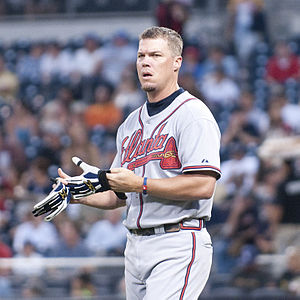
Second: Here on my desk I have a two-page agreement granting ownership and “absolute rights” to “all drafts and versions” and the “blueprints, patterns, instructions, codes and other information necessary to create” a freelance piece I wrote that is not available online about the relationship Mets fans have with Chipper Jones. I haven’t signed it yet because themes covered in that piece – as detailed in the following post – come from the core of my sports-fan soul, and I fear inking away the rights to those blueprints and patterns could in some way damn this career in its nascent stages.

But the check cleared nonetheless, and that sweet freelance cash helps put the sandwiches on the table. Plus said contract flatters me by referring to me throughout as “the artist,” and everyone involved on the editorial side was extraordinarily agreeable throughout the process. So I will have to tread carefully in the following post. The missing scenes in Larry Wayne Jones’ history with Mets fans, omitted here for legal and professional reasons, are the same that are likely burned into the memories of every Mets fan about my age — all those who suffered so frequently and so savagely at the hands of the Braves’ turn-of-the-Millennium dynasty and its prevailing superstar.

Third: Chipper Jones was one of the greatest baseball players of his or any generation. He was an eight-time All-Star and an MVP-award winner, and his 81.5 bbWAR ranks 31st all time. Though injuries slowed him late in his career, he never finished a single season as a below-average hitter by park- and league-adjusted OPS+. He will wind up with a lifetime on-base percentage above .400 and a first-ballot Hall of Famer.

He was straight-up awesome at his job, and I hate him for it. In fact, if pressed, I could probably count on only one hand the people I have never met that I dislike more than Larry Jones who have not committed actual atrocities.

About that: I have twice tried in earnest to meet and speak to Chipper Jones to temper that hatred. This profession, for better or worse, humanizes both the heroes and the villains of your youthful fandom. It’s something you rationally should always know, but something that smacks you in the mouth regardless when you see, on your first day with a credential, a chagrinned but still very friendly Jimmy Rollins taking responsibility for a crucial error, and something that is reiterated every time you see Bryan McCann enjoying a peanut-butter sandwich or Carlos Beltran grimacing in pain or Dan Uggla giggling at a blooper on the clubhouse TV.

The first time I tried to meet Chipper, I stood in a cadre of reporters around his locker in the visitors’ clubhouse at Shea Stadium after a game in 2007. He pulled on a mock turtleneck, turned to the group and somewhat contentiously stated that he wouldn’t be answering any questions that day. I didn’t know it, but he was upset about a headline in the New York Post that had taken something he said out of context to make it seem like he suggested Alex Rodriguez took steroids, so my attempt to ameliorate or modify my distaste for the man would have to wait.

The next time I tried to meet ol’ Larry Jones, I was working on the aforementioned freelance piece earlier this season. I arrived at Citi Field hours before game time and waited at the clubhouse entrance while all his teammates streamed in and did baseball-guy stuff. When he finally arrived, I approached him, alone, and requested some of his time. He asked for a minute, walked over and whispered something to some of his teammates, then skulked off somewhere, never to return. He blew me off. Whatever.

Lest you think this is that particularly obnoxious and oblivious type of media screed that admonishes a player for eschewing the media, I should note that I’ve heard from multiple veteran members of this city’s press corps that Chipper Jones is one of the very best guys – if not the very best guy — in baseball, to the media and to everyone else. My understanding is that he’s typically candid, friendly, funny and approachable — a great teammate, a great family man and a great patriot. And rationally, based on the information I have, it’s easy to believe that behind the beady eyes and loathsome smirk there’s a damned good dude, and that he blew me off that morning to rescue puppies from kill shelters and distribute them to disabled veterans.

But being a sports fan is rarely rational, and to justify the type of emotional toll fandom can elicit requires complex mental leaps beyond the scope of this already too-long post on an afternoon I’m trying to sneak out of town. Chipper Jones was a great player for the Mets’ biggest rival while I was growing up, and he seemed, way more than most, to revel in the hatred his stellar play earned him from opposing fans. That all makes sense to me, even makes me feel like something of a rube for buying so readily into his inarguably vain trolling.

What I don’t get is why one man — and, again, by most accounts a good man and by every account a great ballplayer I should be thrilled to watch play baseball – should somehow still have the capacity to turn my stomach, even now after I’ve learned to understand and make peace with far, far heavier things.

So it seems funny to me, and perhaps perfectly fitting, that adult and professional responsibilities will prevent me from experiencing and reasoning through a catharsis in his final series with the Mets, because none of the ill feelings I harbor toward Larry Wayne Jones are adult or professional. They live someplace deep and demented in my soul – maybe some long-embedded socially coded vestige of tribalism or something – and when I think about it, I have no real inclination to watch the Israelites send the never-felled Goliath off into retirement with a commemoratory cowboy hat or surfboard.

Which is all a long-winded way of saying: Maybe some things are better left not got. Maybe, in my increasingly reasonable, adult, professional and psychologically balanced life, I shouldn’t need to have everything sorted out so neatly, and maybe I’m OK allowing this one remnant of youthful fanaticism to slip through unchecked this one time. Maybe it’ll prove useful somehow, or maybe I’ll just want to remember how it feels to enjoy unqualified hatred.

In other words, good riddance to bad rubbish. F— ‘em.
Since no one asked me

Our analysis shows that while black players are not discriminated against, foreign-born players—of which the vast majority are Latino—find themselves at a disadvantage.

Adam Felder and Seth Amitin, the Atlantic.

Both the Atlantic’s study on racism in broadcast booths and Russell Carleton’s follow-up for Baseball Prospectus are worth reading, and put data to assumptions long since made in many baseball discussions. I believe we are all helplessly biased in every single thing we do, so it’s not surprising to learn that some rather unfortunate biases might play out statistically when so many words are tracked and coded. Of course, those tracking and coding are biased too, and so on.

But that’s besides the point. No one asked me and probably no one ever will, but in neither study did anyone mention the role of language in what’s being attributed to racism in broadcast booths.

It doesn’t say, but I assume the broadcasts being studied were English-language broadcasts. Broadcasters travel with teams and regularly spend time in the home and away clubhouses. When you see a guy every day and communicate with him casually, you develop a relationship with him and, presumably, it becomes way more difficult to go up to the broadcast booth and rip him for his laziness. I’ve had this happen myself: It’s conflicting, but there are players I have been reluctant to criticize even when I feel their play calls for it because they are simply too friendly. Maybe that’s unprofessional, but it’s decidedly human.

So I’d love to see these studies broken down further. Are Latino players who speak fluent English as likely as their monolingual counterparts to be criticized on a broadcast? I suspect not, but then there’s certainly some selection bias present in the group of foreign-born players willing and able to learn to speak fluent English.

Twitter Q&A: Quick ones because it’s Labor Day weekend and no one’s out there and oh I’m so lonely

https://twitter.com/DanDotLewis/status/241590622425849857

Assuming we’re not counting P-Funk and such: Orlando Magic at the arcade. Love Shaq, always, love hearing the NBA Jam announcer guy get all worked up about Scott Skiles. I know most people say “Boomshakalaka!” but to me, “SKILES!” will always be the defining noise associated with the game. On the Sega Genesis I usually used the Supersonics because Shawn Kemp was great for dunking and because in my youth I was randomly a huge Detlef Schrempf fan.

https://twitter.com/MLBoorstein/status/241590576850554881

Who still buys cream cheese in bricks? Is that for baking? I think I’ve purchased cream cheese in a brick like twice in my life and both times in cases of emergency. I can’t remember what the cream-cheese emergency was, but I imagine it was a situation where I had bagels and they were going to go stale if I didn’t eat them soon and the place I went to for cream cheese only had it in bricks. Total disaster.

They’re a total mess, and you usually waste half the cream cheese trying to clean up the edge of the foil with the knife, then ripping the foil, then having to cut back the cream cheese to fit inside the foil. And don’t tell me to just ditch the foil and stick the cream cheese in a sealed container inside my fridge somewhere. Not going to happen. I already do that with butter, and I won’t concede more valuable fridge space and tupperware to a less versatile spread. Just buy the whipped stuff.

https://twitter.com/chrispalm/status/241593005138649091

I have, and I hate to say it but I was a bit disappointed. A bunch of stuff blew up and that was certainly sweet, but it was way too much with the cutesy wink-wink nod-nod hey-we-all-used-to-be-action-stars stuff. It’s such a shame to have awesome Jason Statham and awesome Jet Li and most-awesome-of-all Terry Crews in the movie and have them all take a back seat to Sylvester Stallone, who’s a complete caricature at this point and impossible to understand. Bruce Willis can still hang with anyone, but Arnold Schwarzenegger was so, so bad, and not bad in the good way.

If you read with any regularity you know I love action movies. But part of what I most love about action movies — especially on the big screen — is their ability to completely enrapture me so I get lost in the movie and forget everything that’s happening in the real-life world. And I just don’t think that’s going to happen when post-Governorship Arnold Schwarzenegger is in the movie, especially when he’s all “I’LL BE BACK” even though the movie is not Terminator. Schwarzenegger and Stallone are too famously Schwarzenegger and Stallone to be believable characters in the movie. Same thing happens for me with Tom Cruise now.

https://twitter.com/happyhank24/status/241595231894638592

Do people still say those things? They shouldn’t. People definitely said those things before the season, but I suspect those same people now love the hell out of Whitestone Mike. It’s still a small sample, but Baxter’s got over 200 plate appearances of being a very good big-league player now. And he always hit in the Minors, to boot. He should have a role on the Major League team moving forward. What that role will be depends on what players the Mets can bring in this offseason.

Rollerball and it’s not even close. I wrote about my experience at a free screening of Rollerball here.

As for the worst movie I’d want to remake? Hmm. I don’t know if I’d want to remake any movie at all, and I think if I did want to remake a movie it would be one I considered good even if most people didn’t. Oh — I got it: Brewster’s Millions. Underrated movie, original premise, timeless theme, could use a contemporary twist.

Should the Mets trade R.A. Dickey this offseason?

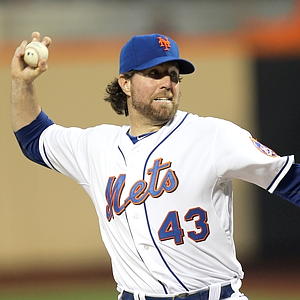
Sacrilege, I know. And beyond the fact that Dickey, as an extraordinary knuckleballer, a diligent worker, a passionate Star Wars fan, a contemplative writer and reader, a dedicated beard man, a distinguishing sandwich eater, an aesthetic revelation and an alley-oop pass for double-entendrists, seems perfectly tailored — almost fictionally crafted — to appeal to the geeky subset of Mets fans that includes this site’s author, every speculative offseason trade needs a willing partner. So the answer to any suggestive and somewhat sensationalized question like the one in the headline above is always that it depends on the deal. Plus, the Mets still have more than a month’s worth of baseball to play before anyone needs to worry about this in earnest. Consider the following blog post merely a thought experiment.

First, let’s consider why the Mets might, ahem, dangle Dickey this winter. Since emerging in 2010, Dickey has pitched like an ace — if not quite in the Verlander/King Felix/Clayton Kershaw stratosphere, than certainly a No. 1 starter on most big-league teams, with a stellar 127 ERA+ over the stretch and the durability to pitch deep into games and amass innings. The Mets have a $5 million option on Dickey’s contract for next season, but by Fangraphs‘ math (which probably undervalues Dickey a little) his performance to date in 2012 should be worth over $18 million on the open market. Put simply, there is no team in baseball that would not stand to benefit by adding Dickey and likely no team that could not afford him.

The Mets, meanwhile, do not appear primed to contend in 2013 as currently constructed, mostly because they do not now have anyone on their roster who looks likely to be an everyday outfielder next season and they will be weighed down by a couple of albatross contracts that don’t come off the books until 2014. Regardless, they could try to give Dickey a contract extension this offseason. Though Dickey will turn 38 in October, he has only improved across his tenure with the Mets as he has honed his signature pitch. And as my friend Mike Salfino has shown, historically, knuckleballers can succeed well into their 40s.

But then there’s really not much precedent for knuckleballers like Dickey, who top out in the low 80s and strike out a batter an inning. And even if Dickey’s arm can shoulder that burden for years, a contract extension means the rest of his body will still need to handle the rigors of Major League play into his 40s. So given the inherent risks, it’s reasonable to at least wonder if the Mets would be best served dispatching Dickey elsewhere to tool up for 2014 and beyond, especially since starting pitching suddenly appears to be one area where the Mets have some relative amount of organizational depth.

Herein lies the rub: Based on recent history, trading an ace pitcher for prospects to replenish the farm system almost never pays dividends so soon and doesn’t always pay dividends at all. Check it out.

Based on quick and not at all exhaustive research, I can come up with four times in the past five years that an ace or near-ace pitcher has been traded with one full year of team control remaining on his contract. “Ace,” obviously, is an utterly arbitrary label, so if you’ve got more examples feel free to chime in.

Johan Santana: The Mets, you probably recall, traded Carlos Gomez, Kevin Mulvey, Phil Humber and Deolis Guerra for Santana. Santana had one year remaining on his contract with the Twins at the time but a negotiating window was included in the trade and the deal was contingent upon an extension, so it’s not a perfect comparison. Still, the Twins’ haul was not great. Gomez played good defense in Minnesota for a couple of years but couldn’t hit at all and was finally traded for J.J. Hardy before the 2010 season. Humber and Mulvey both made a few underwhelming appearances before Humber was released and Mulvey sent to the Diamondbacks as a player to be named later in a deal for Jon Rauch. Guerra is still in the Minors. Even crediting the Twins for Hardy and Rauch andnot docking them for woeful reliever Jim Hoey — for whom Hardy was traded — the entire Santana package was worth 4.7 bb-WAR to the Twins — more than two wins less than Santana’s 2008 season alone.

Roy Halladay: Halladay’s trade from the Blue Jays to the Phillies before the 2010 season also came concurrently with a contract extension. For the Doc’s services, the Phillies sent prized prospects Kyle Drabek, Michael Taylor and Travis d’Arnaud north. All three were on Baseball America‘s top 100 prospects list before the 2010 season, with Drabek and Taylor in the top 30. Drabek made a marginally successful three-start Major League debut later that year but hasn’t done much to speak of since, yielding a 5.34 ERA and an awful K:BB ratio of 1:03 in 34 big-league outings before shutting it down for Tommy John surgery in June. Taylor was immediately traded for Brett Wallace, who was himself then traded for Anthony Gose, a well-regarded young outfielder who struggled in a short stint with the Blue Jays this season. d’Arnaud, a catcher, has mashed the ball in Triple-A Las Vegas — as practically everyone does — and he, Gose and the 24-year-0ld Drabek could all contribute to the Blue Jays in the future. But to date, they’ve been worth about a negative half-win to the big-league Blue Jays, or seven wins less than Halladay was worth in 2010.

Cliff Lee: Traded to the Mariners for three prospects in a flurry of activity around the Halladay acquisition that was often mistaken for a three-way trade, Lee, with one year remaining on his contract, netted the Phillies Minor Leaguers J.C. Ramirez, Phillippe Aumont, and Tyson Gillies. None has reached the Majors*, and none has been ranked in Baseball America’s Top 100 since 2010. Aumont and Ramirez both pitched in relief in Triple-A Lehigh Valley this year, but neither pitched particularly well. Gillies has been pretty good when he has played, but he has missed loads of time stemming from injuries and discipline issues since the trade. Lee was worth 4.8 WAR in 2010.

*- UPDATE: Andrew points out on Twitter that Aumont pitched against the Mets this week. He’s got two innings under his belt thus far.

Javier Vazquez: Not exactly an ace, I know. But Vazquez had a year left on his contract and was coming off a stellar 2009 campaign when the Braves dealt him and Boone Logan to the Yankees for Melky Cabrera, Mike Dunn and Arodys Vizcaino. This trade’s a bit different from the rest because Cabrera was already a somewhat established Major Leaguer, but he did nothing for his reputation with his play in Atlanta — posting a -0.5 WAR and earning a non-tender after one season. Vazquez was awful for the Yankees, but Logan has been good. Dunn pitched 19 good innings for the Braves then helped them land Dan Uggla. Vizcaino, out for the year after Tommy John surgery, was flipped to the Cubs in the Paul Maholm deal.

So despite occasional calls for offseason trades to help the Mets rebuild for the near future, there’s little recent evidence to suggest that trading Dickey — the team’s ace — this winter would pay dividends anytime soon. We are working with an inherently small sample, of course — there are very few ace pitchers and very few of them get traded, so assessing the returns on the handful that do is a fool’s errand. Plus, there’s still some chance the Blue Jays’ haul for Halladay pays off in a pretty big way, since Gose and d’Arnaud could emerge as stars. It just won’t have paid off within three seasons of the trade itself.

If the Mets do not sign Dickey to an extension or trade him this winter, they could opt to deal him during the season. By that same not-at-all scientific research, I can count three recent examples of aces traded during the season with less than one year of team control remaining on their contracts.

CC Sabathia: In early July of 2008, the Indians traded walk-year Sabathia to Milwaukee for Matt LaPorta, Zach Jackson, Rob Bryson and a player to be named later, ultimately Michael Brantley. Sabathia was unreal for the Brewers, often pitching on three days’ rest and amassing 4.7 WAR in half a season. LaPorta and Jackson have been very real for the Indians, combining to be worth -2.1 wins since the trade. Bryson is struggling with his control in Double-A. Only Brantley has turned into a productive player for Cleveland, and he only did so last season.

Cliff Lee: No stranger to this blog post, Lee was traded from the Mariners to the Rangers in July, 2010 with capable reliever Mark Lowe for what was then thought to be a massive package of Justin Smoak, Blake Beavan, Josh Lueke, and Matt Lawston. None of those guys is very good. Smoak is hitting like Jason Bay this year. Beavan is in the Mariners’ rotation and can throw strikes but appears to be average at best. Lawston is 26 and in Double-A, and Lueke is bad in multiple ways. The Mariners salvaged the trade package by flipping Lueke for John Jaso, who has randomly been awesome this year.

Zack Greinke: This one is definitely too soon to know much about, but this July the Angels traded Ariel Pena, John Hellweg and Jean Segura to Milwaukee for Greinke, who will be a free agent after the season. Pena and Hellweg are both 23-year-old Double-A righties with histories of big strikeout numbers and high walk rates. Segura is a well-regarded 22-year-old infielder who is already playing regularly for the Brewers but probably shouldn’t be.

So what’s there to learn? Pretty much nothing — again, this is all small-sample-size stuff. But based on the recent history, combined with the trend across baseball toward valuing prospects and hanging on to young players under team control, it seems like the idea of flipping Dickey for a player or a package of players that could help a contending team in 2014 is probably a pipe-dream. Very few of the young players recently traded for front-line pitchers in the final years of their contracts contributed anything positive to their new teams at all, and basically none did so in the first couple of years after the deal. Just Carlos Gomez, really, and we LOL at Carlos Gomez.

If the Mets do not have the means or, for whatever reason, the desire to sign Dickey to an extension this winter, the smart move seems to be starting the season with him in the rotation anyway. Certainly they do not look likely to contend, but writing off any baseball team before a season starts is silly, and the Mets appear way more apt to make a playoff run with Dickey around than without him — obviously. Though with Jon Niese, Johan Santana, Matt Harvey, Dillon Gee, Collin McHugh, Jeurys Familia, Jenrry Mejia, Zack Wheeler and Mike Pelfrey (should the Mets retain him) in the fold, the team should have plenty of starters, none of those guys seems as likely as Dickey to anchor a staff. Perhaps if Sandy Alderson can cobble together an outfield and a bullpen this offseason, the Mets can have a magical everything-falls-right year even despite their financial inflexibility.

Again: No one’s saying that’s probable, but trading Dickey before the season is a good way to bail on the possibility before you even give it a shot. And with the prospecting business such a gamble anyway, it doesn’t seem like the Mets are appreciably more likely to get back a future contributor before the season than at the trade deadline if they do fall out of contention.

But, of course, it always depends on the deal.