
Season in preview: The outfield

I’m short on time and new ways to say that I’m not sure Jason Bay will ever hit again, so I’m collapsing these three into one. Plus they’re all connected anyway.

The outfielders in April: Jason Bay, Andres Torres, Lucas Duda, Scott Hairston and Mike Baxter.

Overview: How much longer can this go for Jason Bay? How many more questions will be asked, films watched, stances adjusted, words written, sliders on the outside part of the plate missed, jeers dispensed, grounders topped to third, and nice-guy caveats applied before something finally happens?

Bay has been on the Mets for two years, two of the three worst of his career. He has 18 home runs in 792 at-bats and a .386 slugging percentage. He doesn’t get on base like he used to, either. We’re past the randomness/adjusting to a new league/he’ll return to his mean part of it now. Something has clearly gone awry. This you probably know.

What we don’t know — as with David Wright — is how much of Bay’s struggles had to do with Citi Field’s dimensions and the adjustments he made to attempt to hit home runs there, with lingering injuries and the after-effects of the concussion that ultimately ended Bay’s 2010 campaign. What we can figure is that if Bay keeps producing (or not producing) at this rate, on a rebuilding team and with a vesting 2014 option on his contract based in part on 2012 plate appearances*, the Mets probably won’t keep him in the lineup if they’ve got any more enticing internal options.

The team’s top priority, still, should be getting Bay straightened out if that’s at all possible. For one thing, Bay still has way more immediate offensive upside than anyone the Mets have to replace him. If by some odd chance whatever happened to Bay was just the psychological and physical affects of the fences, and now with the offseason’s changes Bay goes back to being the 2009 Jason Bay on a normal decline, he’s one of the best hitters on the team and the Mets offense suddenly looks awesome.

Plus, if Bay starts hitting even a little bit, it should be way easier for the Mets to move his contract. Bay’s got a full no-trade clause, but though I’m not in his head, it’s hard to imagine he’s been so fond of his time in New York that he wouldn’t be willing to waive it for a chance to join a contender that wants a righty bat near the deadline. Even if Bay crushes the ball in the first half the Mets would probably have to eat some of his contract to move him, though.

If both Bay and prospect Kirk Nieuwenhuis open the year hitting like they did in 2011 at their respective levels, expect some sort of shakeup by the All-Star Break.

As for the rest: Andres Torres looks to be sweet on defense. He didn’t hit much last year, but he’ll be batting leadoff for the Mets because center field is one of Major League Baseball’s approved leadoff-hitter positions.

Torres’ batting average and batting average in balls in play in 2011 were well below his usual Major and Minor League rates, which suggests some bad luck. But he also hit for way less power than he did in 2010 and his short Major League stint in 2009, which suggests something worse than bad luck. If Torres can split the difference and post a line like the .249/.331/.419 aggregate of his last two seasons, he still won’t be much of a leadoff hitter but he’ll be about an average offensive center fielder for the NL.

Lucas Duda will hit. Something apparently flicked on for The Dude right around the same time it flicked off for Jason Bay: After hitting 24 home runs total in his first three Minor League seasons, Duda hit 27 of them across three levels in 2010, finishing his season with the Major League Mets. After an April cameo with the big club in 2011, Duda picked it back up in Buffalo. He joined the Major League club for good in early June and hit .306/.381/.505 the rest of the way.

Duda’s defense in right field was way less awesome, though he was playing an unfamiliar position in an oddly configured park. Now he’s more familiar with the position and the park less oddly configured, so maybe that helps. Maybe it doesn’t and the Mets move him to left if and when the Bay/Nieuwenhuis thing all goes down. It doesn’t seem like there’s a way his defense will be bad enough to keep his bat out of the lineup regardless.

Baxter and Hairston both seem fit for their roles.

The outfielders in September: Duda, Torres, Nieuwenhuis, Bay, Baxter. I’m making traids all over the place and figuring someone will want Scott Hairston’s right-handed bat and affordable contract either at the deadline or in the waiver-trade period, and the Mets’ logjam of righties on the bench will force the deal.

Overview: I’d put the Mets’ outfield better than the Nationals’ if Jayson Werth doesn’t get right quick, but worse than the rest of the division. Lots of mitigating factors involved there though.


Season in preview: Third base

The third basemen in April: David Wright, Justin Turner, Ronny Cedeno.

Overview: Man, your guess is as good as mine.

Do I really need to go through the whole thing about how David Wright used to be unspeakably awesome then had three straight weird years, two of them still very good but clearly something less than awesome, the third hampered by a broken back? Because if you’re a conscious Mets fan — and I assume if you’re reading this you’re a conscious Mets fan — you must know all about what happened with Wright the past few seasons.

Well, let me restate that: There’s almost no way you know what happened with Wright the past few seasons. You know the outcome, but it doesn’t seem like even David Wright knows exactly what happened.

The Mets took a stab at it this winter, moving the fences in. And with that, well… we’ll see. Maybe it was that, and maybe they fixed it. But maybe it’s just time. Maybe it’s pressure. Maybe it’s the Matt Cain fastball. Maybe it’s some weird little thing we’d never even think to consider. Or maybe it’s no one thing, just some odd combination of things that teamed up to take David Wright down from superstar to just pretty good.

Here’s what’s firm: David Wright is 29. After an ab injury in February, he is purportedly healthy now. He will play his home games in a park that has been made more favorable to hitters, especially right-handed hitters with gap power. And he’s got a $16 million club option on his contract looming after the season, and, barring an extension, free agency after that. If Wright’s ever going to be That Dude again, he should probably start doing it soon.

That’s not even to mention Wright’s defense, which has been awful by every stat these last three years though still suspiciously average-seeming to the eye. Defensive metrics were invented to help quantify assessments that have always been subjective, but now I suspect they bias the way I watch and assess defensive players. And still I never see Wright make (or miss) plays at third and think, “this guy’s one of the very worst defensive third basemen in baseball.” But then maybe I just don’t want to see it. The Mets-fan mind is strange.

The third basemen in September: Wright, Cedeno. Maybe Zach Lutz if he stays healthy. It makes no sense for the Mets to trade David Wright this season. He will still come up in trade talk once a month, as he has for the past year. The only way he gets dealt is if some… oh just read this please.

Overview: The NL East is a great division for awesome third basemen coming off injury-plagued down years, assuming you count Hanley Ramirez as a third baseman. I’m going to go optimistic with this and guess that Wright rights himself a bit and outperforms one of Ramirez and Ryan Zimmerman, and they all outperform old-man Larry Jones and Juan Francisco in Atlanta and the punchless Placido Polanco in Philadelphia.

Season in preview: First base

I need to make these shorter or they’re never going to get done. Less talk more rock.

The first basemen in April: Ike Davis, Justin Turner.

Overview: Last year, Davis performed like one of the best players in baseball for a little over a month before he fell victim to David Wright’s hardest hit of the 2011 season. Upon his arrival to Spring Training this year, he pronounced his ankle healthy then was diagnosed with Valley Fever, a lung infection common in the area of Arizona where Davis resides that never presents any symptoms in 60 percent of cases but that sidetracked Conor Jackson’s career and had half the Internet writing tearful requiems for the Mets’ first baseman.

Davis seems to be OK. He has played regularly throughout Spring Training and reported no trouble with his health. But the diagnosis combined with his small-sample supremacy last season mean people will inevitably blame Valley Fever if and when he fails to produce a 155 OPS+ over 550 at-bats in 2012. But then people are people, and I really shouldn’t get too hung up on all the stupid things they blame for stuff.

What matters is this: Davis, provided he is in fact healthy and feeling no effects of either the Valley Fever or last season’s ankle injury, should be at least a very good hitter and an excellent defensive first baseman. Over the first 652 at-bats of his career, he has got a 123 OPS+, a mark that’s undeniably trending upward even if you allow that he’s not quite as good as he looked in the first month of 2011.

Davis just turned 25 and the Mets just brought the fences in. If you’re looking for elements of the 2012 Mets you can dream on, here’s one of them: Maybe Davis blossoms into an excellent player, even a superstar. It’s no guarantee, but not a lot of guys hit as well as he did as young as he did.

Justin Turner will back up Davis, mostly, it seems, because Terry Collins doesn’t want to burden Daniel Murphy or Lucas Duda with the job while they’re learning new positions and maybe a little bit because he wants to have Justin Turner on the team and needs to find some good reason to keep him around.

Turner’s fine as a second righty pinch-hitting option (if you think you need two) and fallback plan in case Murphy doesn’t work out at second, but if he’s starting more than once every two weeks or so at first, that’s not so great. But Collins seems to know that too, since he said the team would move Duda or Murphy to first if Davis were to be out for more than a couple of weeks.

The first basemen in September: Davis, Mike Baxter. Playing a hunch that says Turner gets traded, since it seems like he’d have value to a team that needs a second baseman in a pinch. But then, if you’re playing at home, I’m three positions deep and already assuming two traids, and this isn’t a fantasy team.

Overview: I’m going to say Davis will be the best first baseman in the division in 2012. Freddie Freeman hit well for a 21-year-old in his rookie season in 2011 so there’s a chance he’ll outproduce Davis offensively, but Freeman’s something of a butcher in the field. Ryan Howard’s going to miss the first part of the season returning from Achilles surgery and subsequent infection and has been in reasonably steep decline for a while. Gaby Sanchez is pretty good but not great and unlikely to be getting any better.

And the Nationals have… whoa, WTF, the Nationals still have Adam LaRoche at first? WAIT, the Nationals have only had Adam LaRoche for one year and he only played 43 games for them, and Adam LaRoche has only been playing since 2004? I’m sorry; I don’t buy it. Can’t be true. Adam LaRoche has been on the Nationals since they moved from Montreal in 2005, and he was an old man then. I don’t care what these newfangled websites say. And in any case he’s not likely to be better than Ike Davis.

Reggie Miller says he is an “all-world pitcher” and “could play Major League Baseball today”

In related news, the Mets should totally sign Reggie Miller. I secretly love Miller in a Stockholm Syndromey way because he’s responsible for several of the craziest and most heartbreaking things I’ve ever seen on a basketball court — or in any sporting arena, really. And it’d be pretty sweet to have him in the bullpen if the Mets ever needed to square off against the Knicks in some sort of bizarre exhibition.

Via N.Y. Baseball Digest, via Repoz.

Don’t watch this if you haven’t since gone to college and found a basketball team you care about way more to make it sting less:

Season in preview: Starting pitchers

Opening Day is Thursday, and since 20 posts about how great baseball is between now and then would probably grow tiresome, I’ll take up my annual season preview tradition today and try to crank nine more out in the next few days. First come the starters, then around the diamond, then the bullpen.

The starting pitchers in April: Johan Santana, R.A. Dickey, Jon Niese, Mike Pelfrey and Dillon Gee.
Overview: Hey everyone! It’s Johan Santana and he’s pitching baseballs!

That part is awesome. Santana’s actual returns this year seem likely to be less awesome, since he was declining before he got hurt, he’s coming back from a surgery very few pitchers have ever returned from and his velocity is not where it once was. If all goes well for Santana he can still be effective, but it would be a near-miracle for him to again emerge as a true Major League ace.

That role — or something close to it — is more apt to be filled by R.A. Dickey or Jon Niese. The knuckleballer Dickey has fluttered unpredictably to the ranks of the better pitchers in the National League over the past two seasons, posting a 124 ERA+ since joining the Mets by commanding his signature pitch and yielding a lot of weak groundball contact. Since Dickey is 37 and relies on the defense behind him, it’s unlikely he’ll get much better in 2012. But another season like the ones he gave the Mets in 2010 and 2011 would be… well, awesome and bearded and knucklebally.

Niese represents the team’s best hope for improvement. The 25-year-old lefty strikes out a good number of batters, doesn’t walk many, and yields a lot of groundballs, but he has yet to post a performance that matches his peripherals. Maybe 2012 is the year he does, or maybe it’s the year we throw our hands up and decide he’s doomed to underperform his peripherals.

Behind Niese, the Mets have Mike Pelfrey. Many Mets fans hate Mike Pelfrey for his inconsistency, but Pelfrey is quietly becoming my favorite player a) because of his consistency and b) because I’m a massive troll. He can be maddening to watch (unless you love fastballs), but Pelfrey posts remarkably consistent walk and strikeout rates every year. His performances vary based on how many hits and how many home runs he yields. From here it seems just as likely Pelfrey repeats his 2010 success as he does his 2011 struggles. Most likely, he pitches somewhere between the two.

It’s harder to know what to expect from Dillon Gee, besides his ridiculous chin beard. Gee did yeoman’s work in the back of the Mets’ rotation last year and won 13 games despite few strikeouts and a high walk rate and ERA, but the glimmer of hope should come from how he whiffed more than a batter an inning in Triple-A in 2010. Gee doesn’t have overpowering stuff, but since he’s still reasonably young, it’s not outlandish to hope he can improve in 2012.

Top prospects Matt Harvey and Jeurys Familia both appear ticketed to start the season in Triple-A Buffalo. The Mets want their pitching prospects throwing about 130 innings in the high Minors before they reach the big leagues. Though I’m not sure that’s a hard-and-fast number, Familia needs just over 40 to get there and Harvey needs 70. It’s never smart to bank on pitching prospects, but there’s some chance one or both could be in the rotation by August. There are arbitration clocks to factor in, though, and the Mets will want to be careful with their young pitchers’ innings totals.

The starting pitchers in September: Dickey, Niese, Gee, Harvey and Chris Schwinden. Hunches all. I’m going to proceed with skepticism on Santana and hope like hell he proves me wrong. But this figures Pelfrey gets dealt near the deadline.

How they stack up: Again — and obviously — the Mets’ starting pitchers do not actually face off with the other starting pitchers around the division; they face the hitters. This is just a means of comparison.

The Mets’ starting rotation doesn’t look awful, but it doesn’t look great either, and it likely won’t get much help from the defense behind it. And the rest of the teams in the division have some pretty good rotations.

The Phillies’ rotation is the standard-bearer, followed by the Braves’ and Nationals’. The Marlins have the only starting staff the Mets can hope theirs will best, and then only if Josh Johnson struggles in his return from injury, Ricky Nolasco continues to underperform his peripherals and Mark Buerhle suddenly ages.

I would like to take this time to revisit my stance on the Braves’ starting rotation

Wednesday night on the Mostly Mets Podcast , I said I liked the Braves to win the division because of the depth in their starting rotation.

Today, the Braves signed Livan Hernandez, who was just cut by the Astros, to be their fifth starter. Apparently the Braves weren’t thrilled with the way some of their young pitchers looked in Spring Training, plus Tim Hudson’s going to miss the start of the season after back surgery.

I happen to love watching the Livan Hernandez Magic Show, so I’m all for it. But his acquisition probably doesn’t speak well of the depth in the Braves’ rotation I was lauding the other night.

Mike Pelfrey’s Spring Training stats: Still meaningless

In a recent meeting that included the Mets’ executives and coaches, members of the front office suggested releasing Mike Pelfrey before Opening Day, according to two people with direct knowledge of the situation. None of the uniformed staff was in favor of the idea, and it was downplayed….

One team official characterized the recent discussion about cutting Pelfrey as “just what you do in meetings, throwing (stuff) against the wall, and we throw a lot of (stuff) against the wall,” and went on to predict that Pelfrey would have a strong year for the Mets.

Andy Martino, N.Y. Daily News.

A couple of weeks ago, I posted Mike Pelfrey’s annual Spring Training and regular-season stats. Here they are now, after Pelfrey’s strong 6 1/3-inning outing against that thing calling itself the Astros:

Year Spring ERA Spring K:BB ERA K:BB
2008 8.14 0.8 3.72 1.72
2009 7.77 1.67 5.03 1.62
2010 6.15 8 3.66 1.66
2011 5.63 2.25 4.74 1.62
2012* 8.59 1.5

Pelfrey is everyone’s favorite LOLMets whipping boy for a variety for reasons. He was a high draft pick, he licks his hand, he admits to seeking counseling, and he’s not very good. Releasing him on account of any of those things, when he’s consistently above replacement level and the Mets have little in the way of Major League-ready starting pitching depth, would be silly.

Yes, there’s a chance Pelfrey repeats his poor 2011 season and will not be worth the $5.6875 million* he’ll make in 2012. But given his age, his propensity for health, and the randomness inherent in baseball, it seems just as likely he’ll pitch as well as he did in 2008 or 2010 and prove a valuable trade commodity if and when the Mets do have a Major League-ready replacement available.

And I know all about Chris Schwinden, Miguel Batista, Garrett Olson and Jeremy Hefner, and I understand the argument that says you could cobble together 200 innings as good as Pelfrey’s with a collection of guys on the Buffalo shuttle. But it doesn’t seem wise to enter a season like that, since you’re going to need those guys to cobble together Major League innings whenever some starter inevitably gets hurt.

*- Is it weird that Pelfrey’s listed salary goes to the fourth spot after the decimal point? That’s $500. I guess when you’re hammering those deals out to avoid arbitration, the player’s agent is going to fight for every last dollar, but how does that play out? “OK, how about $5,687,000?” “No, way, bro: $5,687,500 or we’re going to the arbiter.” Not a rhetorical question; I really have no idea how those negotiations work. I’m willing to find out if anyone wants to pay me upwards of $5 million to do anything.

Whoa

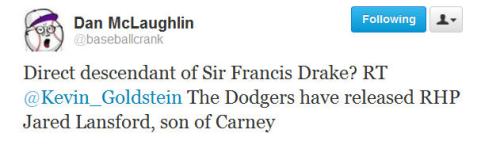
This Tweet blew my mind:


I did some Google research and found this, the back of Lansford’s 1987 Topps card:


But — but! — there’s nothing about Sir Francis Drake on Lansford’s Wikipedia page and in fact, an old edit of the Wikipedia page that’s now archived on a Carney Lansford Facebook fan page says:

According to his 1988 Topps baseball card, Lansford is a direct descendant of the British privateer Sir Francis Drake. However, this is extremely unlikely since Drake is not known to have fathered any children.

And indeed, Sir Francis Drake’s Wikipedia page confirms that he had no children, though who really knows with those pirate types?

Anyway, if the lineage is fictional, I wonder who made it up. I’m not sure if it’d be funnier if the lie came from Lansford himself or from the guy writing the blurb on the back of the baseball card. I feel like if I had that job that’s exactly the type of thing I’d make up and try to slip in there to see if anyone noticed. But then it’s also really funny if one day in 1986 Carney Lansford was all, “yeah, I’m just going to tell this sucker from Topps that I’m a direct descendant of Sir Francis Drake, see if he buys it. I mean, I kind of look like him.”

The least funny scenario is that Carney Lansford’s father or grandfather made it up, and Carney Lansford grew up really proud to be a direct descendant of Sir Francis Drake and is only finding out right now from this blog post that he’s been living a lie. If that’s the case, sorry, dude. Nice mustache.

Mets over-under

Context: 25-year-old Chris Schwinden looks likely to start the season sixth on the Mets’ starting pitching depth chart — pitching every fifth day in Buffalo and getting the first call whenever someone in the big league club’s rotation needs to miss a couple of turns. Schwinden started four games for the Mets in 2012.

The Major League Mets will probably carry Miguel Batista, who could make a spot start here and there. Schwinden is on the Mets’ 40-man roster, as are fellow Triple-A starter Jeremy Hefner and prospect Jeurys Familia. Familia threw 87 2/3 innings in Double-A in 2011 and could start the year in Triple-A as well. Matt Harvey also figures to play into the Mets’ rotation discussion later in the season.

[poll id=”97″]