Though he is now 36 and posted a sub-.550 OPS for the second straight season in 2011, Alex Cora has no plans to retire.
Alex Cora’s reign of terror continues
Reply

Though he is now 36 and posted a sub-.550 OPS for the second straight season in 2011, Alex Cora has no plans to retire.
For years now, I’ve been operating under the assumption that I could boast the world’s most exhaustive gallery of embarrassing photos of Cole Hamels.
The page is the most popular one on this site, and one of the few accomplishments of which I am wholeheartedly proud. Someday I will retire from blogging, and then years later someone will spot some news item about Cole Hamels and say, “Hey, remember all those embarrassing photos of Cole Hamels that guy collected?” And I am that guy. The embarrassing photos of Cole Hamels, I thought, would be my humble online legacy.
But now, thanks to the diligent work of Patrick Flood, I know I have more work to do. There’s another site on the Internet with even more embarrassing photos of Cole Hamels than I have: ColeHamels.com.
Hamels’ personal website boasts gallery upon gallery of embarrassing photos of the man, enough to prove my suspicion that he is either trolling me or just absolutely does not give a s#$! how he is depicted on the Internet.
I’d prefer not to incur a cease-and-desist from the Hamels Foundation, so I limited myself to four photos grabbed from that site to share in the archive. Go check them out, but really, check out all of Cole Hamels’ galleries — especially this one.
And of course, whenever you come to a detour on the road to your goal — whether that goal be collecting the most embarrassing photos of Cole Hamels or some less noble pursuit — remember these words of wisdom from Hamels’ site and, presumably, high-school yearbook: “It is the journey, not the destination.”
So we beat on.

There also is a lot of work being done on creating two 15-team leagues, which is tied up with the sale of the Astros because Houston is the club most likely to be moved from the NL to the AL to even the number of clubs in each league….
That is one reason why the sides want to go to two 15-team leagues. Because it likely would mean clubs from different divisions would play more similar schedules, thus, making the competition for wild cards across divisions fairer. Also, there would be six five-team divisions, which would mean all clubs would be competing against the same number of opponents within their division to make the playoffs.
I’ve said my piece already (many times) about the league adding a second wild card, which Sherman outlines elsewhere in his column. But I’ve noticed some resentment among fans for the idea of two 15-team leagues because it would mean constant interleague play. But best I can tell, there would be a way to do it while actually reducing the total number of interleague games.
Right now, there are 252 interleague games a season, all of them bunched into specific weeks and weekends when all but two teams play against an interleague opponent.
But if there were always one interleague series being played (as necessitated by 15-team leagues) but never more than one, there would actually be a lot fewer interleague games in total — about 162, obviously.
Every team would play three or four interleague series randomly distributed throughout the course of the season, as opposed to the five or six series they have now.
Naturally the league could wind up keeping to 252 games or expanding, since nowhere has anyone said two 15-team leagues would mean reduced interleague play.
I didn’t intend to weigh in on the Moneyball movie because almost everyone else in the whole world already has, but a few people asked me about it so here goes:
 I thought it was kind of boring. I didn’t hate it, I just never got all that excited by anything happening on screen.
Granted, I generally prefer movies where stuff explodes and tough guys crack wise and something crazy happens in front of a drunk guy who then looks down at his drink like, “whoa, this is good stuff.” Obviously none of that happened in Moneyball, but none of that happened in The Social Network either and I enjoyed that one.
I guess I should consider the movie’s perspective from the point of view of someone who hasn’t spent countless hours discussing and arguing over the fallout from and subject of the book. From that standpoint, though, I think I might be left wishing the movie more overtly connected some of the theoretical dots, baseball-wise. It shows that Billy Beane and Paul “Peter Brand” DePodesta wanted to acquire inexpensive players with good on-base percentages, but doesn’t really include much detail about why that stat was undervalued elsewhere or how it contributes to winning.
But then I guess I’m only interested in that stuff because I enjoy baseball the way I do. The movie glosses over some of the technical nerdery in favor of sort of 21st-century Robin Hood story, with the cunning and charming Beane and his band of Not Particularly Merry Men (Man, actually — Brand seems to be the only person in the A’s organization on board with Beane’s plans) working to undermine the wealthy (and not depicted) Sheriff of Yankeeham.
And I guess in a way that did happen, and those types of stories always resonate with people (perhaps especially, I should say, in this economy). But the movie seemed more focused on why he did it — a series of internal and external conflicts — than how he did it. I guess acquiring Scott Hatteberg doesn’t exactly necessitate a heist, but hey, it’s Hollywood.
Oh, and the movie spent a lot of time further exposing just how hot Brad Pitt is, which I guess is a tough thing to avoid if you’re making a movie starring Brad Pitt. But at times Moneyball seemed like a film about Brad Pitt’s arm muscles with a baseball subplot.
The movie produced a couple of hearty laughs — many of which were included in the previews, and Chris Pratt was notably good as Hatteberg. Pitt and Jonah Hill were just fine, and Philip Seymour Hoffman was believable enough as Art Howe to make Mets fans everywhere cringe.
The Moneyball movie was a sort-of faithful adaptation to a book that was itself sort-of faithful to what actually happened. It held my interest for most of its two-plus hour run time, but I never got lost in it the way I do in my favorite movies or the way I do, for that matter, in great baseball games.
I thought it was a terrific movie. Among all the baseball movies of the last generation, this was the baseballest.
– Bill James.
Bill James attended the Moneyball premiere, meaning James watched a movie based on a book based on a series of events inspired by his own book. BusinessWeek’s feature about James watching the movie is good, but I imagine watching just about anything with Bill James would be pretty interesting. Would Bill James figure out a way to objectively assess Wipeout competitors? What does Bill James think about SpongeBob SquarePants?
Via Tangotiger.
Marc writes about the Red Sox at Over the Monster and Tweets @marc_normandin. Here’s me getting shticky:
The Batting Stance Guy catches up with SI.com’s meanest players in baseball:
At Amazin’ Avenue, Chris McShane takes a look at some pending free-agent closers likely to be inexpensive due to recent injury troubles. I especially like this idea:
Jonathan Broxton: The Dodgers, specifically Don Mattingly, may not want Broxton back next year after he spent the grand majority of 2011 on the disabled list with bone spurs in his elbow. He’s had surgery to get rid of the bone spurs, and if his recovery goes as well as other pitchers who had the same procedure, he could be ready for spring training.
Prior to the injury, Broxton was dominant, striking out over eleven batters per nine innings in his career. He’s still only 27-years-old and will turn 28 in June. There was some concern about Broxton’s drop in average fastball velocity in 2010, a 2.5 mph drop, but he still managed a pretty good year out of the Dodgers’ bullpen. If the best Broxton can get this winter is a one-year, incentive-laden deal, he seems like a no-brainer for the Mets.
I mentioned Broxton as a potential fit for the Mets on the Baseball Show a week ago, and the odd comments from Mattingly make it seem less likely Broxton will return to the Dodgers. As McShane notes, Broxton was dominant in the Dodgers’ bullpen as recently as 2009 and still pretty damn good (by peripherals, at least) in 2010.
Broxton also holds the distinction of being the single largest human I’ve seen in a Major League clubhouse. He is listed at 6’4″ and 300 pounds, and in person he appears to be at least that. Maybe his presence in New York would let Lucas Duda feel a little more comfortable in his own frame or give the Jets another option to investigate should they suffer any more injuries on their offensive line.
Some monstrosity believed to be the Marlins’ new logo leaked onto the Internet last week, inspiring all sorts of snark and Twitter outrage — as most things do. I tried a more progressive approach, offering a solution instead of a teardown:
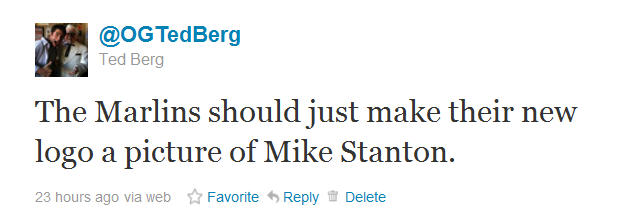 I thought about creating a logo that fit the specifications I outlined, but then I got distracted by something shiny. Luckily, our man Catsmeat mocked one up:
 Well done, sir.
Leo Mazzone vaguely confessed that the great Braves teams of the late 90s sometimes doctored the ball.
But if John Smoltz and possibly Tom Glavine and/or Greg Maddux got away with it, then presumably so too did many other pitchers not anywhere near as good as those three. Yeah, it’s against the rules, but if umpires and baseball weren’t doing a good enough job policing it then the onus is on them. We’ve danced this tango before.
I talked about this a bit on the podcast last night: Looking back now, I don’t have nearly the hatred for the Braves that I now do for the Phillies. Maybe it’s just that the Phillies are the bad guys now and I have a short memory. But in retrospect, those Braves teams appear almost classy compared to the Phillies and all the grit spilling from their ill-advised chin beards.
 Tedquarters