
Sandy Alderson’s in-game interviews are a prism through which we see glory and doom

Sandy Alderson joined Gary Cohen and Ron Darling in the booth during last night’s Mets broadcast on this network. Lest anyone mistake this for criticism of said broadcast, I should note that no matter how Alderson presented himself and what he said, I would rather be watching and listening to the Mets’ general manager discussing the team’s outlook than the sights and sounds of Elvin Ramirez issuing bases-loaded walks in the middle innings of a meaningless September game, so Alderson made for a welcome addition.

A full transcript of Alderson’s interview is here. Reputedly and/or notoriously cautious and collected, Alderson confirmed that the Mets’ front office is aware of a bunch of stuff many Mets fans already know about. Looking a bit spent — as we all are, really — Alderson essentially said:

  • The Mets do not have much power or speed. Early in the season they got on base a lot, but as the year dragged on, due to poor performances and shifting personnel, their plate discipline suffered.
  • Players who do not play good defense need to hit enough to make up for it.
  • The Mets may have to trade from positions of strength to fill areas of weakness.
  • R.A. Dickey and David Wright are both very good and the Mets would like to extend their contracts, but it takes two sides to reach an agreement. If it becomes clear that an extension is unlikely in either case, the Mets will consider trading the player.
  • Matt Harvey was pretty awesome.
  • He does not think reports of Ike Davis’ partying will hurt Davis’ trade value and he hopes they do not hurt Davis’ relationship with the team’s front office, as Davis has power and the Mets need that.
  • Etc.

Alderson has been funnier at times in the past, but not really any more revealing. That’s a good thing: It doesn’t really behoove the front office to divulge any of its offseason plans beyond making the team better. And Alderson has established himself as so careful in interviews that at this point, it seems like basically nothing he says beyond the plain facts will be taken on face.

If Omar Minaya were to pledge to fix the bullpen, we would say, “well, good” — as we once did when he pledged to fix the bullpen. If Alderson were to say the exact same thing, we’d wonder if he meant it or if he were actually planning to fix the outfield and employing some misdirection. If Minaya sat down next to me at a game, handed me a beer and said his fantasy football quarterback sucks, I’d be all, “I hear you, bro, I had Kyle Orton last year.” Alderson does it and I’m wondering if he’s trying to trade me his backup quarterback.

Maybe that’s oversimplifying and maybe it’s not fair, and probably I’m giving too much credit to Alderson and not enough to Minaya — or vice versa if you value disclosure over prudence. Either way it seems silly to read too much into anything we’re hearing out of the Mets’ front office on record about its offseason plans.

Yesterday, a report in the New York Post, citing a team source, had it in rather strong terms that “team brass has resolved to stick with [Jason] Bay” rather than eat the $19 million remaining on his contract for 2013. Less than half of this site’s readers believe it. Why not?

To the Post’s credit, the report is not that Bay is certainly staying, it’s that a team source said Bay is certainly staying. So maybe that’s true, and the team source is being utterly honest with the Post and knows for a fact that the team is committed to bringing Bay back for another go of it in 2013 despite his .525 OPS no matter what happens this offseason. Or maybe the source knows there’s no value in ripping Bay while he’s still on the club, his name’s nowhere on the story so he won’t be held accountable, and Bay’s got about as good a chance at opening the 2013 season in left field for the Mets as he does at the plate after an 0-2 count.

Today we have a report that the Mets’ payroll will remain around $95 million next season and that fans can rule out the offseason pursuit of big-name free-agent center fielders. Based on recent history, that seems a lot more believable than the Bay story. Still, I’m inclined toward skepticism only because I want to be skeptical and I’m a pathetic Mets fan hoping the team can find cash for B.J. Upton — a great fit at the right cost, I think —  in the couch cushions somewhere.

Which is, I guess, the point: So much is reported on the Mets from so many angles based on so many sources that it’s pretty easy to endeavor the mental gymnastics necessary to isolate the news items we want to believe — for whatever reason — and shake off all the rest as nonsense or misdirection. I don’t want to believe the Mets will keep Jason Bay because I don’t want the Mets to keep Jason Bay. I like Ike Davis, so I’ll chalk up the story that the team thinks he parties too hard to either a) a rogue team employee speaking out his ass or b) a sneaky front-office insider trying to motivate Davis or back-handedly up Lucas Duda’s trade value by making the team appear more invested in him.

I don’t know what’s actually true and really it doesn’t much matter. I’ll know what the 2013 Mets look like in 2013. Doesn’t mean I won’t fret like hell about it until then, though.

Revenge is a dish best served using Little Leaguers as waiters

The Long Island youth-baseball manager arrested for allegedly stalking an opposing coach shelled out more than $50,000 to personally finance a revenge team that fell flat on its face, The Post has learned.

Angered after his own son failed to flourish on the Long Island Infernos traveling baseball team for 10- and 11-year-olds, Robert Sanfilippo used his own money to create and fund the Long Island Vengeance to even the score against his boy’s former squad, a law-enforcement source said….

While other Long Island teams had modest equipment, Sanfilippo spent like a Suffolk County Steinbrenner. The Vengeance sported top of the line helmets with airbrushed skull and crossbones insignias that cost upwards of $300 each for a team of roughly 20 kids. The squad also provided each player with two uniforms and baseball bags worth hundreds of dollars.

Selim Algar, N.Y. Post.

Oh man, Robert Sanfilippo hates subtlety. The Long Island Vengeance! Sounds like a wrestling move and/or a drink special at a Park Ave. bar in Rockville Centre.

Also, outside of the whole playing for an alleged stalker thing, it doesn’t sound like such a bad deal for the other members of the Long Island Vengeance. They get awesome gear and a chance to play in this league, and all they have to do is help Sanfilippo enact his bizarre Little League retribution.

I wonder what he would have done if they beat the Infernos, anyway. Would Sanfilippo just drop it? Would that be the end of the Vengeance? “OK, boys, our work here is done. Pack up those bags. Oh, and I’m going to need those bats back.”

Probably it wouldn’t shake out like that because it almost never does with (alleged) psychotic vendettas.

The skull and crossbones logos, it turns out, are awesome. Not in any way appropriate for 10- and 11-year-olds, but awesome. From the Vengeance’s website:

Badass, right?

Via James K.

The Baseball Show: Knuckleball

So this was pretty awesome. If you’re wondering why I didn’t ask certain questions, it’s that Kevin Burkhardt did a long segment with Tim Wakefield, Phil Niekro and R.A. Dickey immediately before we filmed that will air on SNY at some later date. I didn’t want to sit down immediately after and ask them the exact same questions, but Kevin came prepared and covered a ton. Dickey had to leave for a Mets function, so then I told Tim Wakefield he was crazy and impressed Phil Niekro with my knowledge of knuckleballer history. Nice guys both.

http://web.sny.tv/media/video.jsp?content_id=25068611

So how good is Matt Harvey?

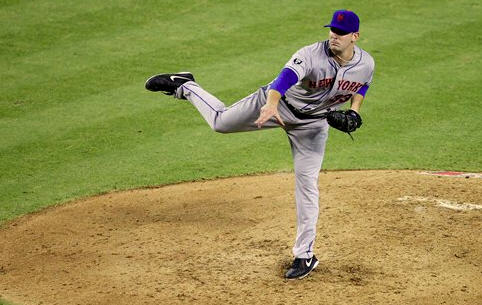
If you’re still watching these woeful Mets — and heaven help us, we’re still watching these woeful Mets — then yesterday you saw Matt Harvey finish his first season with a flourish, striking out Ryan Howard and Carlos Ruiz to end the seventh and close out a one-run, one-hit, seven-strikeout effort on the night the Mets determined would be his last outing of the year. Then, to add awesomeness to excellence, in an interview immediately afterward he said he felt great and not at all tired, and basically suggested he’d pitch tomorrow if the Mets asked him and that he would spend the offseason getting super jacked because he believes six-inning starts are unacceptable. So that was cool.

Despite some rather unfortunate pre-callup comps, Harvey’s first turn around the big leagues went about as well as anyone could have hoped. In 59 1/3 innings across 10 starts, he struck out 70 batters and yielded a strong 2.73 ERA. The only part of his stat line that’s at all troubling is his relatively high walk total for the year, but he mitigated that by limiting hits and in so doing maintained a strong 1.146 WHIP.

But you were watching, so you don’t need stats to tell you this: The guy is great. His fastball’s a bullet. His slider makes you chuckle and his curveball makes you weep. In a once-promising Mets season that fell apart so thoroughly and so triumphantly, he was the One Awesome Thing of the Second Half.

Still, pitchers are pitchers, and young pitchers even more so. Does Matt Harvey’s success over his first 10 starts tell us anything about what we can expect from him moving forward beyond the obvious, surface-level stuff we’ve all seen? Has he set the expectations unreasonably high for himself? I took to baseball-reference‘s awesome play index to find out.

What follows is a lot of lousy math. Since I’m starting at Harvey and working backward, I’m tailoring every search to what Harvey did this year. Every endpoint is pretty arbitrary. I just set out to find if there were good examples from history, based on statistics alone, to compare to Harvey. And Harvey’s 59 1/3-inning sample is tiny. If he threw 40 more innings and they weren’t as good, all the rate stats I used below would change. So he benefits here from how long he stayed in the Minors in 2012.

First, using park- and league-adjusted ERA+, I looked up every rookie starter under 25 years old who threw at least 50 innings and managed at least a 135 mark in that stat since 1951. Fifty pitchers have done that, and not surprisingly they represent a broad range of Major League success — from Wayne Simpson to Mike Mussina. They include great pitchers like Dennis Eckersley and Tim Hudson, the forever-linked Doc Gooden and Mel Stottlemyre, and sad stories like Herb Score and Mark Fidrych.

All told, by my count the 49 pitchers on the list besides Harvey averaged about 18.6 WAR over their careers — roughly as good as one of the group’s most durable innings-eaters, Aaron Sele. Of course, that average includes early flame-outs like Jason Jacome (remember Jason Jacome!) and a slew of guys who are still active, so it’s not really a good indicator of much at all.

Interestingly enough — or maybe not interestingly at all, I don’t know — the group seems to be trending upward, perhaps due to improved knowledge about how to keep pitchers healthier longer, the type we saw in action last night when Harvey was shut down. If you take the same qualifiers but look only at the players who have entered the Majors since 2000, the search returns a group that includes three of the best pitchers going today: Jered Weaver, Felix Hernandez and Stephen Strasburg.

There are crappy guys on there too, but if you exclude Harvey and fellow rookie A.J. Griffin, the ten under-25 rookie starters who have come up to the Majors since 2000 and thrown at least 50 innings with a 135 ERA+ have compiled 206 WAR over parts of 74 seasons, or 2.8 WAR a season — a hair better than Jon Niese has been this year, as a point of comparison. That’s good news. The list of ten includes six All-Stars (those three, Brandon Webb, Roy Oswalt and Barry Zito),  three Cy Young Award winners and one potential first-cousin of a Grammy-nominated pop trio. So that bodes well for Harvey, or at least his cousins’ pop outfit.

And just isolating ERA+ ignores the other aspect of Harvey’s dominance: His strikeouts. So I did the same thing, only searching instead for 25-and-under rookie pitchers who averaged at least a strikeout an inning over at least 50 innings. Most of the guys on this list are active or recent, as pitchers strike out more batters now than they did in the past. The group includes Tim Lincecum, Cole Hamels, Mark Prior and, terrifyingly, Oliver Perez. Because so many of them are active this number is meaningless but I’ll give it to you anyway: They’ve averaged 14.6 WAR for their careers.

Finally, what about rookies who strike out tons of batters and suppress runs at the rate Harvey did? There just haven’t been many of them. In fact, before Harvey there have been all of four rookie pitchers under 25 who threw at least 50 innings with an ERA+ over 135 while striking out a batter an inning: Gooden, Score, Oswalt and Strasburg.

Again, it’s bad math because the endpoints are tailored to Harvey. And all those guys pitched more innings than Harvey did in their rookie seasons, and all but Oswalt were younger. But it’s a pretty great group regardless. Gooden, for all his fortunes are rightfully lamented, still had several good years. Score, sadly, was off to a stunning start before he was hit in the face with a line drive that ultimately doomed his career. Oswalt was great. Things seem to be going pretty well for Strasburg so far, surgeries and ill-considered shutdowns notwithstanding.

I’ve been clicking around the play index for a while trying to find a good way to temper people’s expectations about Harvey. The best I can come up with is Jose DeLeon, whom some of you might remember. DeLeon busted into the league with an excellent part season that looks a hell of a lot like Harvey’s at age 22, then went on to an only OK 13-season Major League career. But an OK 13-season Major League career is nothing to sneeze at.

In shorthand, it looks like Harvey could very well be great. He could get hurt or go crazy, both of which sometimes happen to pitchers — the former way more likely than the latter. He could also be just OK. It seems exceptionally unlikely that he’ll flat-out suck. But then you knew that from watching last night, and Harvey’s his own unique snowflake, as we all are.

On trading Ike Davis, briefly

Word spread this morning that the Mets could consider trading Ike Davis, which prompted me to Tweet this:

https://twitter.com/OGTedBerg/status/248051067835777024

This isn’t about what I tweeted so much as the responses to that Tweet, which included multiple Mets fans decrying the joke idea of trading Davis for awesome awesome McAwesomestein superhuman home-run thing Giancarlo Stanton (which the Marlins would never do, obviously) because it would leave the Mets without a first baseman.

OK.

The Mets don’t have outfielders, and you’re going to have to give something to get something. Also, to all those who’re reading to anoint Ike Davis the first baseman of the future and trade Lucas Duda, remember how you felt in, I don’t know, June. Davis is a better defender than Duda, is a year younger and has a larger sample to suggest he’s a capable Major Leaguer. He also has a better prospect pedigree, for whatever that’s worth (i.e. very little). But to date, Davis and Duda have been almost identical hitters in their careers. Davis has a 115 OPS+, Duda has a 114 OPS+.

Since Duda is indeed a year older, it’s more reasonable to expect improvement from Davis than Duda, whose career line looks a lot like that of average 2012 National League first basemen. But is that extra year of development from Davis, plus whatever value he has on defense at first base over Duda, worth more than the difference between Giancarlo Motherf–

Wait, why am I even indulging this?

Depends on the deal, depends on the deal, depends on the deal.

Knuckleball!

The documentary Knuckleball!, directed by Ricki Stern and Annie Sundberg, opens this week in theaters in New York and Boston and is available on-demand and online. Information on tickets and screening times is available here.

In the film’s opening sequence, the directors use audio clips from baseball and talk-radio broadcasts to establish the way the knuckleball is stigmatized in the game: It is “a trick pitch,” “a mediocre pitcher’s best friend,” something not to be trusted. Next, one of the movie’s stars outlines what is perhaps its central theme:

“You look at the course of my career, it’s been up and down, the good with the bad, the twists and the turns,” says Tim Wakefield. “That’s what my pitch does.”

Using a combination of recent and archived game footage, on- and off-field material shot for the film, interviews and still photos, Knuckleball! follows Wakefield and R.A. Dickey — the big leagues’ only knuckleballers — through their 2011 seasons. But like its namesake pitch and the careers of its practitioners, Knuckleball! swoops and bends and breaks and wiggles in flight, veering into both pitchers’ histories and winding through the mindset the pitch requires and the supportive brotherhood of knuckleballers that help each other maintain it.

Yet through all its twists, the movie never feels disjointed. Rather, it is beautiful for its digressions, for helping the audience feel every high and low and swivel and plunge in a season or a career but still somehow keeping its course. Again, like a knuckleball itself.

One thing no documentary or game coverage can ever quite seem to capture is what a knuckleball actually looks like to a batter or to an observer standing right behind the plate. Undoubtedly if you’re a baseball fan you’ve seen video of pitches flying free of spin, but there’s something about the way they flutter and wobble up close and in person that defies the cameras. I don’t know why this is, whether it’s actual physics or an optical illusion, but occasionally a good knuckleball will even appear to dart upwards mid-flight. There must be an explanation, but to a layman it shouldn’t matter much: Whether it’s actually happening or just appears to be happening, it’s a spectacular thing to behold.

Interviews drive Knuckleball!, so Stern and Sundberg benefit from Wakefield’s workmanlike candidness and Dickey’s professorial panache. But maybe it’s no coincidence that Major League Baseball’s two knuckleballers also come off as two of its most interesting and introspective people: It must take a special type of dude, after all, to do what they do.

Think about what Tim Wakefield did for a minute. After his flare-up and fizzle-out with the Pirates, Wakefield caught on with the Red Sox in 1995. Think of the type of personality it must take to last through the entire length of one of baseball’s greatest offensive eras, pitching in one of its greatest hitters’ parks, in front of a notoriously hostile fan base — them that never quite took to Ted Williams — throwing the same 67-mph pitch over and over again. And yeah, baseball is a game and Wakefield was compensated handsomely for the work he did, no doubt. But baseball breaks people all the time, and Wakefield’s ability to remain upright through his struggles in 2011 shed light on why he was able to succeed as a knuckleballer at all.

If I’m going off on tangents myself: No one in the film comes off seeming as wise or as entertaining as the elder statesman of the knuckleballing community, Wakefield’s mentor Phil Niekro. And for all the justifiable talk about Dickey’s stellar 2012 season, Niekro’s work in the late 1970s might not get enough credit in the pantheon of knuckleball lore. From 1977 through 1979, Niekro threw over 1000 innings in three seasons and amassed 25.2 bbWAR — three more than Tim Lincecum has to date in his entire career.

The action in Knuckleball! closes before the 2012 season began, so Dickey’s current campaign, which now appears to be darting and diving its way toward a Cy Young Award, does not make the film. It is, for the sake of the metaphor, one of those knuckleballs that rocket upward in apparent defiance of documentation and logic and belief.

Dickey has said in the past that he believes the knuckleball resonates with so many fans because there’s something populist about it: Since the pitch does not, on face, require any inhuman strength, everyone thinks he can throw a knuckleball and everyone believes it is his best shot at a Major League career — even if it is in truth nearly impossible to do successfully. But I suspect there’s something else about the knuckleball that grips us, something enormously poignant and universal and something that Dickey alludes to in the film’s final moments. To throw the knuckleball is to live at the whims of the wind, to harness an enormous amount of skill to ultimately yield to randomness as everyone must almost all the time, suffering or succeeding from our slightest slip or lightest touch.

“Once it leaves your hand,” Dickey says, “it’s up to the world what it’s going to do.”

We need to talk about Bryce Harper’s Twitter avatar

Why isn’t this getting more press? What is even happening here? Is Bryce Harper’s idea of fun standing on a rooftop at sunset being pelted by baseballs?

On one hand, he’s 19 and we probably shouldn’t fault 19-year-olds for doing the stupid things 19-year-olds do. On the other hand, he’s really awesome at baseball and plays for a different team in my favorite team’s division. So, you know, get him.

Friday Q&A, pt. 1: Mets stuff

Wait, no stops at all? Because even if I limit my coffee and water intake I can only do at most like five or six hours between bathroom breaks. Plus if I’m driving all the way to Port St. Lucie I’m probably going to want to look up good places to eat along the way, and I’m generally willing to drive a little bit out of the way to eat better food than what’s available on the side of I-95.

In any case, it’s Kevin Mitchell. That’s a long drive, and you’re going to want someone who can keep things interesting. Mitchell seems like the right mix of crazy and well-traveled to have great stories to pass the time. I’d say Carl Everett for similar reasons, but I’ve known people who don’t believe dinosaurs existed (really) and I get incredibly frustrated when they’re around and topic comes up — and I just assume it would at some point on a 20-something-hour road trip. So I suppose I’d have to confirm that Mitch believes in dinosaurs before we set out. Bonus points because I suspect Kevin Mitchell appreciates good Southern barbecue as much as I do.

I’d also consider Tsuyoshi Shinjo, despite whatever language barrier may exist. I assume we could find ways to communicate, and his presence alone would be endlessly entertaining. And I’d totally be willing to be Shinjo’s wingman if we stopped at a nightclub or something.

https://twitter.com/Section518/status/246607341443751939

Bossman Junior. It’s one of my favorite things about B.J. Upton.

Via email, Evan writes:

Watching [Carlos] Beltran do stuff like this as well as just maintaining his general all around awesomeness makes me wish the Mets had given some more thought to resigning him after last year, especially considering the way their outfield situation has played out. I realize hindsight is 20-20 and all, but his contract looks like a steal and his talent is well beyond what seems available in free agent outfielders this offseason. Selfish Beltran not providing Sandy with time travel capabilities to inform his free agent signing decisions. Seriously though, did they ever consider resigning him last year?

I have no idea, but I don’t think so. Remember that the Mets had a very limited offseason budget and a whole lot of money already tied up in one veteran corner outfielder — Jason Bay — with most of us pretty excited about Lucas Duda’s bat in the other corner. I, too, wish the Mets had Beltran this year, if only because I very much enjoy watching Carlos Beltran play baseball. But he wouldn’t have made the difference between these Mets and a winning team.

This much I hope: 1) Beltran, who has struggled recently and been unironically accused of failing the struggling Cardinals in the clutch — classic Beltran-blaming — goes berserk and cements St. Louis’ postseason bid over the next few weeks, then does typical Carlos Beltran stuff in the playoffs. I know as a Mets fan I’m not supposed to root for the Cardinals, but for me it’s Beltran uber alles.

2) Beltran enjoys another strong season with the Cardinals in 2013. When his contract expires after the season, the Mets — still in need of outfielders and power hitters but finally free of Bay’s salary — bring Beltran back on a two-year deal. He performs admirably in 2014, then enjoys a swansong season in 2015. He leads the Mets to the World Series, then hits a walk-off grand slam in Game 7, flips everybody off and retires. Five years later, he enters the Hall of Fame in a Mets jersey.

Two from Chris because he asks good questions.

OK, I’ll bite: Torres yes, Thole yes, Acosta no, Pelfrey maybe, Johnson no.

Torres hasn’t been great for the Mets, but he’s got value in that he’s a switch hitter, he’s performed well from the right-handed side of the plate, and he’s excellent on defense. I don’t think they should plan on him starting in the outfield next year, but they’re so short on outfielders that they could probably use him as a reserve or platoon guy. A lot of this depends on the budget, though: If they’re absolutely strapped for cash, the money it will cost to keep Torres may be better spent elsewhere.

Thole’s too young and, as a lefty-hitting catcher who can get on base, potentially too valuable to just let walk for nothing. I know he’s had an awful season and a lot of Mets fans seem near done with him. Whatever. Look at the catchers in the Mets’ system and the free-agent market for catchers. There just aren’t many obvious better options who might be parts of the team’s next contender. He’s not likely to earn much in arbitration anyway. The concussion stuff is scary so they would be well-served to hedge their bets a bit with a decent righty-hitting backup or two (Kelly Shoppach would be good), but Thole should be back. Always go with the biggest sample: There’s still more evidence that Thole can hit like a Major League catcher than that he can’t.

Acosta has quietly been very good in his most recent stint with the big club, but, really, what’s the market going to be like for Manny Acosta this offseason? It’s hard to imagine him getting a guaranteed deal coming off a 7-plus ERA season, and if he does, you know… peace out. If he doesn’t, bring him back on a Minor League deal and stash him in Triple-A until late July when he randomly gets good every year.

Pelfrey’s a tough call. Since the Mets actually have starting-pitching depth to some extent, it seems like he’s got more value elsewhere. But it also seems like it’d be tough to trade him while he’s still recovering from Tommy John surgery, though certainly that has happened before. Most reports suggest the Mets will not tender Pelfrey a contract but could try to bring him back on a less expensive deal, but I wonder if that’s even possible.

Last year, the Mets had to guarantee Chris Capuano $1.5 million and load up his contract with incentives and he hadn’t pitched a full season since 2006. The A’s gave Ben Sheets $10 million before 2010 after he missed all of 2009. With Pelfrey’s history of good health, the relative reliability of Tommy John surgery, pitching being pitching, and Pelfrey’s affiliation with Scott Boras, it seems possible he’d get as much on the open market as he would in arbitration, and eminently likely that if he’s non-tendered he’ll get a better deal elsewhere than he will with the Mets. I have no idea if I’m reading this one right so I’m interested to see how it plays out. And, again, it all depends on how much money the Mets have to play with. But I’m leaning toward thinking they should tender him a contract, assuming they’ll either have a need in the rotation when he’s ready or be able to trade him for something if they don’t. Also — and this will sicken some Mets fans, I know — I still kind of like the idea of Big Pelf in the bullpen.

Given the uncertainty surrounding Thole, it’d be good if they entered 2013 with better hitting Triple-A catchers than Rob Johnson. Easier said than done, I know, but please: Give it a shot.

Late October.