
Luck led Stanford to a 12-1 record and played brilliantly in a rout of Virginia Tech in the Orange Bowl, confirming the consensus that he would be the top player selected in the draft. Luck also finished second to Auburn quarterback Cam Newton in the voting for the 2010 Heisman Trophy. Luck’s father, Oliver, said his son wanted to complete his degree in architectural design, a rigorous major in the school of engineering. Luck also felt, his father said, the tug of finishing his career with the players with whom he entered school.
“He wants to finish with those guys,” Oliver Luck said in a phone interview. “It’s a great group of players. That was by far the most important factor.”
Oliver Luck was listening to radio hosts criticize the decision and recalled the psychological test in which people perceive different things in inkblots.
I guess people feel the need to criticize just about every decision everybody ever makes, but a college athlete’s choice to stay in college or go pro has always seemed impossible to quibble with one way or the other. I suppose if a guy isn’t ready to go pro it’s one thing, but then people said that about Mark Sanchez and the decision seems to have turned out OK.
The way I see it, there are plenty of good reasons to turn pro and plenty of good reasons to stay in college. When Jeff Green and Greg Monroe left Georgetown for the NBA, I couldn’t fault either because they stood to make a lot of money and they’d risk injury (and jeopardizing their immediate earning potential) if they returned for another year with the Hoyas. When Roy Hibbert stuck around all four years, I thought it was awesome, since the development time in college would clearly benefit his NBA career and because he was able to earn a college degree.
Plus, you know, college is fun and everything. But then probably being a millionaire athlete is pretty fun too.
Essentially, if you’re a star college athlete with big-time professional prospects, you’re in something of a win-win situation. Luck, for his part, gets the opportunity to compete for the Heisman Trophy and a national title and to earn a Stanford diploma. To him, clearly, those were valuable enough to forgo the immediate riches of the draft.
 Twitter is a strange and funny place. Reporters use it to break news, some people try to convey reasonably complex opinions in 140 characters, and some — this guy, say — mostly use it to make jokes and solicit restaurant recommendations.
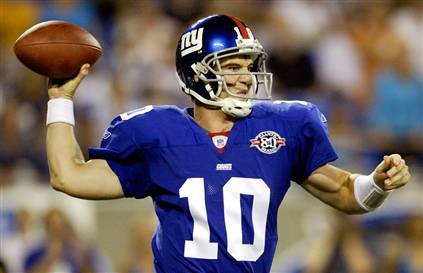 While it’s hard to fault Myers for pointing to the Giants’ second-half struggles under Tom Coughlin, it’s also difficult to determine exactly the source of those struggles. Certainly the ever-present spectre of randomness could play a part.
 Tedquarters