Answers based on some suggestions from Twitter and some of my own. Question intentionally vague.
[poll id=”56″]

Answers based on some suggestions from Twitter and some of my own. Question intentionally vague.
[poll id=”56″]
I’m a big man. I need a big Shredder.
The sandwich: Five-Spice Glazed Pork Belly from Num Pang, two locations in Manhattan. This one came from the 41st St. location near Grand Central Station. The other spot is just south of Union Square (more on that in a bit).
The construction: Five-spice glazed pork belly (obviously) with pickled Asian pear, cilantro, carrot, cucumber and chili mayo on a semolina roll from Parisi bakery.
Important background info: Several items. First: The owners of Num Pang used to run a Cambodian restaurant on the Lower East Side called Kampuchea that was among my favorite places to eat in the city. It served amazing sandwiches. Long before I reviewed sandwiches online or knew much about the Vietnamese banh mi, Kampuchea introduced me to the wonders of the banh-mi stuff — pickled carrots, cucumbers and cilantro, most notably — atop a sandwich.
Second: “Num Pang” means sandwich in the Cambodian language Khmer.
Third: At both Num Pang locations and on the Num Pang website, there are signs reading, “Our sandwiches were created to be enjoyed as they are. Please, no modifications!”
I have mixed feelings about that. On one hand, I appreciate that the chefs responsible for these sandwiches put thought into how the ingredients are going to interact, and that they want the products that represent them to be the ones they actually created. For this reason, I now almost always order sandwiches for review as they’re listed on the menu — I used to modify some (usually by omitting onions). Also, I imagine prohibiting modifications helps keep the line at Num Pang moving at peak hours.
On the other hand, the adamance with which they herald the rule does come off somewhere between pretentious and self-conscious. Plus, if it extends to the chili-mayo (and I’m not sure if it does), I imagine they’re alienating a ton of potential customers who vehemently dislike mayo and don’t feel like having to scrape it off their bread just because the chef said they had to have it on there.
What it looks like (in this crappy, shadowy photo):

How it tastes: Outstanding. Let’s talk about that part first.
The bread is fresh and toasted to just a touch of brownness around the edges, and it’s just thick enough to hold up under the intense moisture of the sandwich without making it too bready. It’s a pretty neat trick the bread pulls, really: Throughout eating the sandwich you feel like it’s so messy you must be losing stuff out the sides and back of the roll, but somehow it all stays contained in there. (Some of that’s on you, of course, assuming you’re the careful and experienced sandwich-eater that I am and you bite at the correct angles to push stuff back inside the boundaries of the bread. It’s not magic bread, fellas.)
The base ingredients that come standard on all Num Pang sandwiches play nicely. The cucumber adds a ton of crunch, the carrot brings some sweetness and the cilantro some bite. The chili mayo helps bind everything together, like mayo does, plus contributes some spice and tangy mayo flavor.
The pork belly is so tender and juicy that it’s almost hard to distinguish from the mushy pear, and they work together in a delicious mix of sweet and savory flavors. There’s something warm and earthy in there — ginger? — and definitely cinnamon. And the combination of the pork and pear is so moist that the juices were dripping down my hand and spilling into the little cardboard dish, making the bread’s ability to hold up under pressure that much more impressive.
Here’s the issue: It’s just not very big.
Yeah, yeah, that’s what she said and all that. Seriously though, I don’t want to sound like a cretin here, and I imagine if I saw the calorie count for this sandwich I might be singing a very different tune, but I do think the size of this sandwich needs to be held against it.
I ate at the Union Square location of Num Pang for the first time on Saturday night with my wife and enjoyed the delicious veal-meatball sandwich. Immediately upon finishing it, I told her that I needed to go back to try to the pork-belly sandwich — the decision that led to this writeup.
Then, after I ate the pork-belly sandwich on Monday, my first thought was that I should go back and try the pulled pork or brisket. Both times, immediately after eating a delicious sandwich, I was thinking about the next sandwich I should eat and not the delicious sandwich I just ate!
Part of that’s on me. Both times I ate a meal at Num Pang it was a couple of hours later than I normally eat that meal, so both times I was quite hungry. And it’s not like they don’t serve sides or the sandwiches are prohibitively expensive.
But at the same time, with a sandwich with this many ingredients, you’re necessarily going to have a limited number of bites that boast the full distribution of stuff. And when it’s this small, it’s like… two. Two bites of sublime, transcendent sandwich awesomeness, and then a bunch of others that are various sub-combinations of the delicious ingredients, hints and notes of the greatness to keep you involved while you search and push and rearrange to try to recapture that grandeur.
Which is to say: It’s a sandwich that leaves you wanting more. Or at least that it’s a sandwich that very decidedly left me wanting more.
What it’s worth: $7.75 plus tax. That might seem steep for a sandwich of this size, but it’s an adequate lunch if you’re not a glutton, plus it’s pretty easy to tell from the taste that they’re using excellent ingredients.
How it rates: 88 out of 100. If you don’t have my appetite you could easily put this in the Hall of Fame though.
The pictures are pretty amazing, even if a) the only one of these I’ve had probably does not rank among the top 10 sandwiches I’ve eaten and b) at least one of them pretty clearly isn’t a sandwich.
Right now if I were making a “World’s 10 Best Sandwiches” photo gallery I’d probably just show ten breaded steak sandwiches from Ricobene’s. Man, I really need to eat that again. There’s almost no way it’s going to live up to my memory/expectation/fantasy.
Via Tom.
Weather the pre-baseball doldrums with lots and lots of cheese.
The candidate: Kentucky Hot Brown from Bar Americain, 52nd street between 6th and 7th in Manhattan. Only available at lunch.
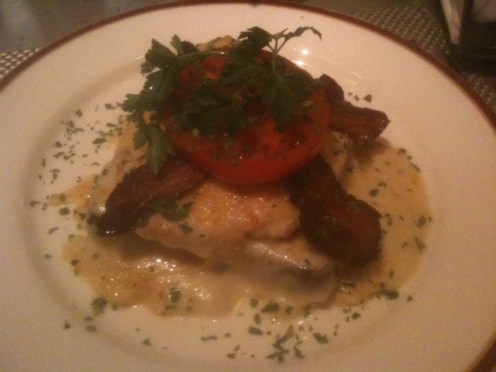
The construction: One thick-cut slice of bread topped with turkey, some sort of creamy cheese sauce (Mornay?), melted cheese, bacon and tomato.
Arguments for sandwich-hood: It’s on bread. The Wikipedia page for Hot Brown calls it a sandwich.
Counter-arguments: Since there’s only one slice of bread, nothing is properly sandwiched here. Also, it’s decidedly a knife-and-fork type dish, far from the convenient and portable food concept envisioned by ol’ John Montagu.
How it tastes: Amazing.
Allow me a brief aside: Some significant percentage of the members of my generation, I am certain, have spent some significant percentage of their waking hours sharing, discussing and giggling over a certain set of silly names given to rumored but probably infrequently performed lewd acts. For me, those conversations occurred during slow times at the deli: my co-workers and I tried constantly to one-up each other with the most bizarre and creatively titled bedroom behaviors that we had heard of or could make up ourselves.
And for anyone who has resorted to such discussions to stave off boredom — and, like I said, there are lots of us — I think it is impossible to hear the term “Kentucky Hot Brown” without considering the many ways in which it sounds like some particularly gross sex act: Its nomenclature so perfectly fits the typical place/descriptor convention of that weird set of jokes. But, of course, people eat it anyway.
After this paragraph, I want you to stop reading for a few minutes. First, think of several of the filthiest, most outrageously vile words and concepts you can imagine, then come up with some way to combine them into a singular phrase. Take your time with it and probe the darkest places of your imagination; get creative. It can incorporate the universally disgusting — say, I don’t know, bloody rat mucus — or something more personal if you need — grandma belches. Play around with it in your head until you’re satisfied you have something so viscerally repulsive that just the thought of it would make Chuck Palahniuk vomit, then write it down or type it out. Email it to me if you have to. It’s important that you see what it looks like in print.
Once you’ve done that, imagine going into a restaurant, opening up the menu and seeing that same term — the most revolting thing you could imagine — listed under “entrees.” You work up the courage to say it out loud and ask the waiter what it is, and he tells you it’s a slice of bread topped with turkey, cheese sauce, melted cheese and bacon.
I can’t speak for you, but I’m going to order it anyway. Hell, the waiter could stand over me while I ate it repeating its sickening name every time I took a bite and I’d still enjoy the hell out of it. That’s the thing about tons of cheese and bacon.
Point is — and the underlying problem with this whole exercise, really — is that it doesn’t matter what you call something as long as it’s delicious.
And this Kentucky Hot Brown is certainly that: The turkey is moist and steamy hot. The cheese sauce is rich and plentiful, and reminiscent of the earthy, wine-y flavor of a good cheese fondue. The melted cheese is melted cheese, plus it works to contain the cheese sauce on top of the bread and turkey. And the bacon is crisp and perfectly prepared. Do a strong enough job slicing this thing up and distributing the sweet, juicy tomato and you get an outrageous array of flavors and textures in every forkful. It’s just good.
The verdict: But it is not in any way a sandwich. The Wikipedia can call it whatever it wants, but nothing about eating this feels like a traditional sandwich-eating experience. Not only can you not pick this thing up, but the turkey and cheese are piled on thick enough that it’s sort of a chore to eat with a fork and butter knife. It’s a big, delicious, sloppy mess with not even a pretense toward portability. I move that the term “open-faced sandwich” is an oxymoron.
What it’s worth: The Kentucky Hot Brown at Bar Americain is $18 — a bit steeper than most of the meals discussed here, but not if you’ve got a friend in your industry with an expense account willing to chalk it up as a business lunch. And it is much appreciated.
Today’s contender is the Kentucky Hot Brown from Bar Americain on 52nd St. between 6th and 7th in Manhattan. It is a piece of bread (battered in egg, I think) served “open-faced,” topped with turkey, cheese sauce, melted cheese, bacon and tomato.
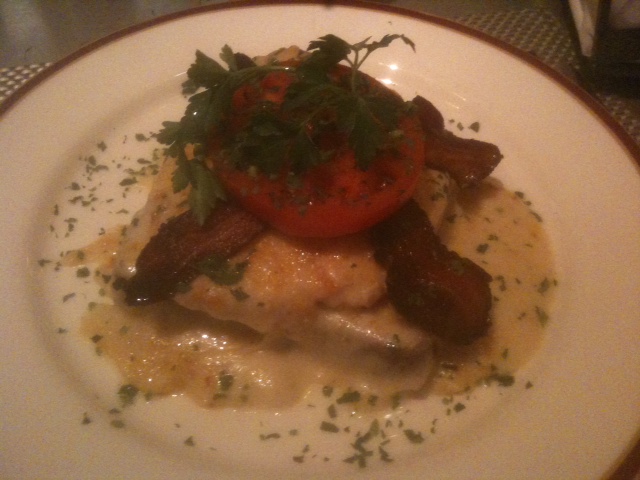
But is it a sandwich?
[poll id=”55″]
A dollar slice isn’t hard to come by in this city. A good dollar slice is a different story altogether.
The best dollar slice in the city has arrived, and it’s at Percy’s — a cozy pizzeria at 190 Bleecker St., in Greenwich Village.
I haven’t had Percy’s yet, though it seems inevitable that I will at some point. It seems like the most common response to the burgeoning dollar-slice pizza craze is, “Hey, that’s a pretty good slice of pizza for a dollar,” or “wow, you know this really isn’t that bad.”
 And it’s true: Most of the dollar (or 99-cent) pizza I’ve tried really isn’t that bad. Better than most national chain pizzas, though that isn’t saying much. Plus most of the places are open late, found in convenient locations, and serve the pizza hot and fast. And, of course, you can’t beat the value. It’s a near-meal or a very solid late-night drunken snack for a single dollar.
So the trend is welcome as long as it doesn’t have any affect on the real, non-dollar pizza places the city is famous for. True story: I skipped dinner one night while Christmas shopping and realized I was famished just as I was walking past the 99-cent pizza place in my neighborhood. I stopped in for a slice and ate it on my walk home, thinking all the things I always think about how it’s just not that bad and it’s such a good deal for 99 cents.
But I was still hungry when I finished, so I ducked into a regular-old three-dollar-slice pizzeria and got a second slice there. And then… oh, right: Pizza’s not supposed to be not that bad. Pizza — good pizza — is f@#$ing amazing. Every single aspect of the more expensive slice blew away its 99-cent counterpart: The sauce was tastier, the cheese stretchier and less rubbery, the crust crispier and more flavorful.
There are a hell of a lot of hungry people in this city and most of them rightfully want pizza. So ideally the local economy can support both the 99-cent slice places and the traditional pizzerias, since they both offer something valuable. They offer very different things, like Taco Bell and actual Mexican restaurants or McDonald’s and anyplace that serves burgers that isn’t McDonald’s. And though perhaps in the case of the pizzas the distinction is a little more subtle, there should be room on our streets and in our stomachs for both styles.
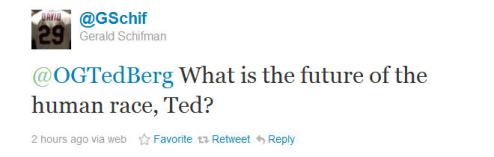 OK, I need to stress again that I’m operating on very little sleep, but I believe it goes something like this: At some point within the next 100 years, we achieve technological singularity. In the subsequent explosion of new advances, the supercomputers building better supercomputers always operate to forward the best interests of the human race, since humans programmed the computers in the first place and the computers exist to help us prosper.
But it turns out people are stupid and weak and need to be coddled, so the ultimate fallout from the singularity is that computers start taking care of more and more of our daily tasks. That’s pretty awesome at first, but eventually technology advances so far that pretty much everything is automated. The computers never become self-aware or turn malicious — fundamentally they must do what is best for humanity — but their plans go awry.
The computers start genetically engineering people — or insisting that people genetically engineer themselves, I’m not really sure yet — so that they’re most efficiently built for the new, post-singularity worlds. Future, computer-controlled people have no need for any semblance of excess fat, musculature, hair or skin tone, so those are all bred out. I don’t know why you can’t just keep having hair, but the whole point is that the computers are way smarter than us so you just have to trust them on this one. Eventually, people pretty much look like this:

Oh, for some reason we also need really big eyes in the future.
Eventually, due to some impending traumatic event, the computers recognize that the now-pitifully weak human race is in jeopardy. But because the future humans are now so unlike their hearty ancestors, the supercomputers have to develop time-travel devices for us and send us back to the U.S. around the turn of the 21st century to find people at their very fattest. By a completely random series of coincidences, all the 21st-century people that get probed for genetic material happen to be insane.
Then the future people go back home and make babies that look like crazy Kansans and feed the benevolent Matrix.
 Well, sure: Quantum physics explains the way matter behaves and pitchers are made of matter.
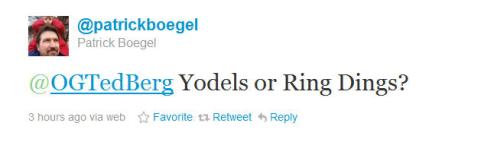 Yodels. Felt like they had the highest frosting/lard:cake ratio of the Drake’s Cakes.
I’m at my friends’ place in Virginia for the Super Bowl, helping break in their new 60″ TV — which is ridiculous. I brought my smoker down for the trip, and the tentative menu for tonight looks like this:
Wild boar and bacon sausage pigs-in-the-blanket
Bacon-wrapped jalapenos stuffed with cream cheese
Macaroni and cheese with bacon
Applewood-smoked baby back ribs
Smoked brisket chili
Plus, you know, chips and stuff. We also have some collard greens and baked beans from excellent area barbecue standby Rocklands but fear not: they’re also loaded up with pork. That’s all for like six people. Tomorrow: Salad.
As if I needed an excuse to eat Chick-Fil-A.
The candidate: The Chicken Biscuit from Chick-Fil-A, which counts as breakfast at Chick-Fil-A.
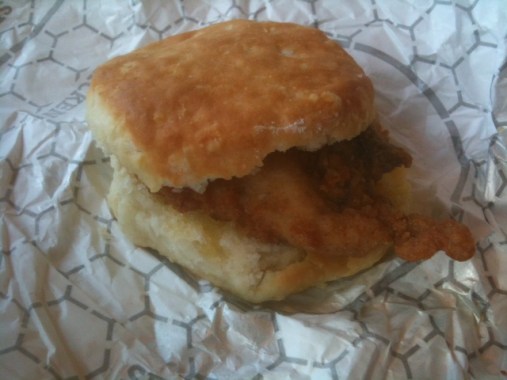
The construction: A fried white-meat chicken cutlet on a biscuit. That’s all.
Arguments for sandwich-hood: It’s a piece of meat sandwiched between two pieces of a form of bread. You can pick it up with your hands. It is at least as much about the chicken (the inside) as it is about the biscuit (the outside), so it doesn’t violate the bagel/cream-cheese rule.
Counter-arguments: I’m not even sure. I guess that it’s on a biscuit, and a biscuit isn’t regular bread? Also, it’s not called a sandwich
How it tastes: Pretty good, though not quite up to the standards of the regular Chick-Fil-A chicken sandwich, if you ask me. The biscuit, while amazing, is so buttery and rich that it actually sogs the chicken cutlet a little, so the fried part of the cutlet doesn’t really maintain any of its chicken-fried crispiness.
The breading instead just sort of attaches to the biscuit and thickens the outer layer of soft, greasy breadstuff, which doesn’t do much for diversity of texture. There’s a salty, mushy, buttery outside and a piping hot, moist, chickeny inside. It’s great, don’t get me wrong, and it’s fantastic that someone has decided I can eat this for breakfast. But the straight-up chicken sandwich provides so much more. Like pickles.
What it’s worth: $4.85 including tax with a large coffee and hash browns.
The verdict: This is definitely a sandwich. I’d love to indulge the people who believe otherwise by paying some mind to the counter-argument, but I’m not sure I even understand what it is. Because it’s on a biscuit?
“Biscuit” itself can be a pretty vague term, and are we really going to distinguish between the way the bread product for a sandwich is prepared when the ultimate effect is clearly sandwich? And if we’re excluding sandwiches on biscuits, how many other obvious sandwich-meat delivery vehicles would we have to exclude?
No, it’s a sandwich. Meat between two pieces of bread, regardless of what the bread is called. Don’t overthink this.
This is the chicken biscuit from Chick-Fil-A. It is the simple showpiece of their breakfast menu: A fried chicken cutlet on a biscuit.
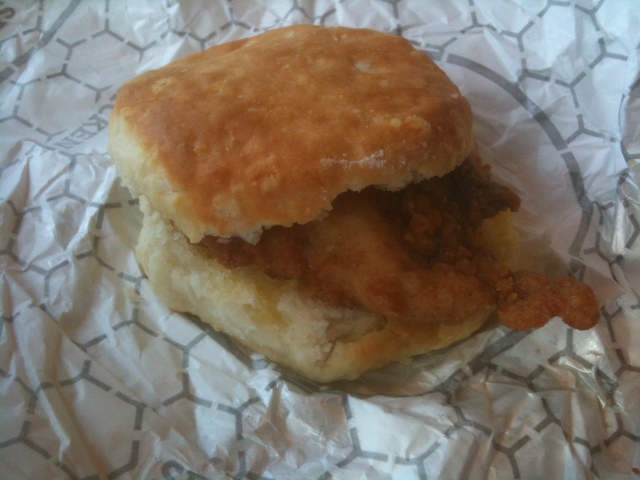
But is it a sandwich?
[poll id=”54″]
 Tedquarters