
What does Lloyd Christmas have to say about all this?

[Rex Ryan and Mike Tannenbaum] denied, with straight faces, that this trade had anything to do with Mason complaining with other receivers to Ryan about the offense, as reported in the Daily News, or Mason’s critical comments about the offense after the Baltimore loss.

“It’s not like we’re singling out anybody …,” Ryan said. “It wasn’t that he wasn’t buying in … I was the most excited guy in the building when Derrick signed here. For whatever reason, it wasn’t working.”

The Jets keep looking dumber and dumber on this, denying the existence or impact of events that surely influence their decision-making process. Ryan, as much as he hates to admit it, turns out to be like most other pro football coaches when the temperature flares. He has his limits. And the Jets are not so very different from the other members of the No Fun League after all, despite the happy talk and the be-yourself rhetoric.

Filip Bondy, N.Y. Daily News.

So if you’re following at home: The Daily News reports that three Jets receivers, including Derrick Mason, enact a mutiny against Brian Schottenheimer by complaining to Rex Ryan about the team’s offense. The Jets deny these reports, but bench Mason and trade him a few days later. The Daily News asserts Mason was traded because of his role in the mutiny. The Jets deny that too.

Who really cares? What does it matter how Ryan and Tannenbaum publicly justify the move as long as the move was made to better the Jets?

Mason is a 37-year-old receiver whose output has been in sharp decline since 2007. The Jets signed him to a two-year deal late in the weird offseason. For whatever reason, he never got in sync with Mark Sanchez and never contributed much to the offense, and Ryan and Tannenbaum felt he didn’t offer them much as a fourth receiver since he did not play on special teams. When the Jets found a taker for his contract, they made the trade.

The news item in the same paper cites a source saying that Mason struggled to grasp the playbook, but Bondy chastises Ryan and Tannenbaum for claiming they traded Mason because of his performance. Isn’t that just semantics? If you don’t grasp the playbook in the NFL, you don’t perform well.

One of Rex Ryan’s greatest strengths as a coach appears also to be his greatest weakness: He believes in his guys and wants everyone else to believe in his guys, too, and he must expect his players will in turn believe in him and strive to live up to his lofty expectations. (I suspect this works especially well on players with daddy issues.) It seems every time someone mentions a Jet to Ryan, the coach insists that guy is the very best at his role in the NFL. This player is the best backup tackle in the NFL. This one’s the best coordinator. This other dude is the best placekick holder this league has ever seen.

And that’s fine. It’s a good way for a coach to be. If Ryan were to come out and say, “yeah, we screwed up — Vlad Ducasse pretty much sucks,” maybe his candor pleases some in the media and fanbase (though it inevitably enrages others). But that would do Ryan no favors with the players in his locker room and the ones around the league he will someday woo.

Where Ryan struggles, it seems, is in recognizing when some Jet is not in fact the best player in the league in his role. Colin Baxter is not the best backup center in football. Eric Smith is not the best safety in the league. Brian Schottenheimer is not the best offensive coordinator. Derrick Mason certainly was not the game’s best slot receiver, nor would he have caught the 90-100 passes Ryan once predicted.

So it seems, then, that the Jets’ willingness to move Mason is a good sign, in that it shows that Ryan and Tannenbaum can tacitly admit a mistake and hold players accountable when they fail to meet the expectations. That they did so — and chose to compliment Kerley instead of scolding Mason — hardly seems dumb.

Wait hold on

But it sure seems to me that purely as a baseball question, you would much rather give a guy a bigger and shorter contract than stretch it out over six or seven or eight years, where everyone finds themselves facing an awkward ending when the player isn’t worth the money anymore and the team has to figure out how to handle it, the player has to deal with the abuse, and so on.

Honestly, in some cases, I’d rather give a guy four years at $100 million than six years at $100 million.

Joe Posnanski, SI.com.

I enjoy Posnanski’s writing as much as you probably do, but I’m not sure this makes any sense. Why would a team want to lock up a guy for four years for the same amount of money with which they could lock him up for six years? Is the awkwardness he refers to really so intolerable that teams should give up the chance they’ll get two extra years of production from the player for no additional cost?

I think the problem is only perception: Since teams almost always reap most of the returns on a free agent deal in its first couple of years, they (and their fans) should approach the deals that way and consider anything they receive from the player on the back end as gravy. Actually I wrote almost exactly this same thing in June.

The biggest reason I can figure for any awkwardness is that teams are often hesitant to part ways with sunk cost. I realize there are human interactions involved, and maybe it’s too hard a PR hit for a team to just up and cut a former star player it expects won’t give them any more production than some available replacement. But it happens pretty frequently in football (since large parts of contracts aren’t guaranteed) and somehow the NFL soldiers on in spite of any ill-will created by disloyal franchises.


What we troll about when we troll about Wally

If you want to incite uproar on Twitter, mention Wally Backman. Just Tweet something innocuous like, “I saw Wally Backman at my corner store this morning buying coffee and a buttered roll,” and watch the response.

First, people will speculate that the sighting means he’s joining your local Major League Baseball team to fill some vacant coaching position. Some people will think this is terrible news, and other people will argue that it’s great news.
Then, once everyone realizes that the reported purchase of the buttered roll indicates little more than that Wally Backman purchased a buttered roll, people will spin it to fit with whatever they already believe about Backman.

“Coffee and a buttered roll! What an honest, blue-collar breakfast,” one will Tweet. “He’s perfect for this town.”

But then someone else will be all, “Coffee and a buttered roll!? That’s the same breakfast George Bamberger favored, and he was a terrible manager!”

Then the first guy will reply to the other guy like, “You’re ignorant! Many great managers have sworn by coffees and buttered rolls!” And the second guy will say, “Why do you love him so much? I’ll murder you dead!” Then the first guy will respond, “I’m cuckolding you as we speak!”

And it’ll go on and on like that until everyone realizes Twitter is stupid and that buttered rolls have little predictive power for managerial ability.

That’s the main thing: Twitter is pretty stupid. It can be a valuable tool for monitoring breaking news and a fun vehicle of validation for those that try to traffic in succinct one-liners, but it is a miserable forum for debate.

Anything worth arguing at any great length is almost by its nature too nuanced to be stripped down to 140-character bursts, and the immediacy and impersonality inherent in the medium encourage inflammatory implications (and interpretations). But then of course it’s people driving Twitter, and eschewing intelligent discussion in favor of incessant, oversimplified polemics is really nothing new in any forum in which humans interact.

I get sucked in, too, of course. But mostly I resort to sarcastic trolling, extending the most fervent common arguments to absurd heights for easy entertainment. It’s cheap and shticky, but it’s great for that whole validation thing.

Which is to confess: When I blame Carlos Beltran or heap shame upon Jose Reyes or worship at the altar of Wally Backman, I don’t really mean any of those things. I mean rather to mock those that do say and believe those things, especially if they deliver them with a certain Twitterish zeal.

The latter issue is the one currently en Twitter vogue. If you believe what you read, Backman is either very likely or definitely not joining the Nationals as Davey Johnson’s third-base coach and protege. And by now most Mets fans seem certain that Backman will either be the single best or absolute worst Major League manager of all time, when the truth is very obviously somewhere in the middle.

I can attest that Backman has a tremendous knowledge of the young players in the Mets’ system — and not only those he managed in Brooklyn and Binghamton. I believe his players really do respect him and enjoy playing for him, and that he is probably a strong motivator.

But I imagine if he were managing the Major League Mets I would grow frustrated with some of his in-game strategies, and that he might need to temper his temper to avoid the type of back-page nonsense that has tormented the organization in recent years.

I am likely biased a bit toward Backman now because — as some of his staunch allies have been eager to point out — he has been a very obliging and helpful guest for multiple SNY.tv video interviews over the past couple of years, and because I don’t believe there’s any such thing as unbiased journalism (or anything). But it shouldn’t offend Wally or anyone to hear that I expect he would have strengths and weaknesses as a Major League manager, just like everyone else in the entire world.

Wally Backman was an ’86 Met, and his presence in the organization is a pleasant reminder of that year to the legions of fans nostalgic for those dirty-uniformed mustache heroes that dominated the National League.

On and off the field he has suffered trials and enjoyed triumphs. Multiple Major League organizations, including the current Mets, have deemed him worthy of stewarding their precious Minor League commodities. The Diamondbacks saw fit to fire him less than a week after naming him their Major League manager.

If and when he finds a job managing in the bigs, he will be hailed as a hero if his team succeeds and chastised as a goat if they fail. In either case, his effect will likely be overstated, as a manager’s influence usually is.

How to cut sandwiches

On the note of this webcomic, what is the proper way to cut a sandwich (in this case, clearly not including heroes)?

– Ben, via email.

Triangles, and it’s not even close. Anytime you’re working with a sandwich made on two square pieces of bread, it should be cut diagonally.

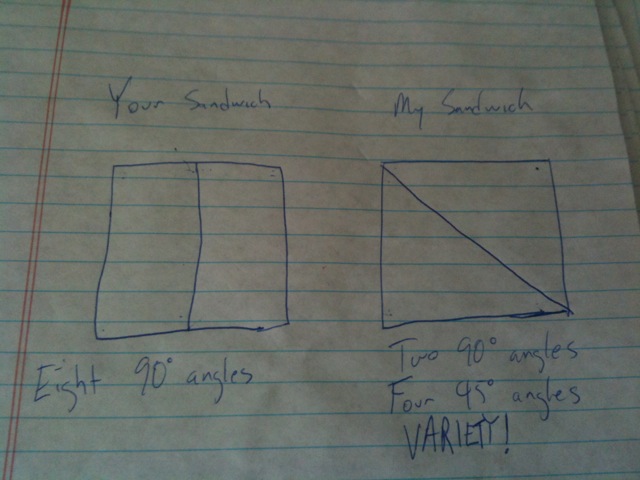
A sandwich cut into two rectangles presents only 90-degree angles from which to take the first bite. That’s suboptimal. The 45-degree angles created by a diagonal slice allow you to stuff way more sandwich into your mouth for the first bite, which is well-known to be the most important bite of the sandwich.

This is all assuming you start all your sliced sandwiches at a corner, which you probably do unless you’re seven years old. And it further assumes you eat those sandwiches from the inside out, finishing with the crust, because you’re not some sort of freak.

To help with this study, I drew this handy and very scientific diagram:

Our literary knuckleballer

R.A. Dickey is a man with distinguishing taste in cheese.

In March, after a video interview with Dickey about his signature array of knuckleballs, I asked him about The Dickster — his personalized sandwich, first Tweeted by Newsday Mets beat reporter and sandwich enthusiast David Lennon.

Dickey told me the Dickster contained turkey, bacon, lettuce, cheese and mayonnaise. As he stepped into the Digital Domain Park clubhouse, I realized I had slipped in my duties as a vigilant sandwich blogger.

“Hey, R.A.,” I called after him. “What type of cheese?”

“Havarti,” he said with a grin.

Not Swiss or cheddar or American or even Muenster or provolone. Havarti: A subtle, buttery Danish cheese, specific enough to suggest it was chosen after careful consideration.

Fangraphs’ pitch-value stat calculates the runs above or below average produced by every pitcher’s offerings. When averaged out for every 100 times the pitch is thrown, the stat shows some predictable returns: Cliff Lee has the game’s most effective slider*; Cole Hamels’ changeup prevents more runs than any other; Roy Halladay throws the most devastating curveball.

Fastball values per 100 pitches tend to be less extreme, somewhat predictably, since the fastball is typically not used to deceive hitters so much as to establish the timing that pitchers hope to betray with breaking balls and offspeed stuff. Still, most of the names near the top of the wFB/c (fastball value per 100 pitches) leaderboard for 2011 should be familiar to anyone who has been following the postseason: Lee, Ian Kennedy, Doug Fister and Justin Verlander sit at places 2-5 on the list.

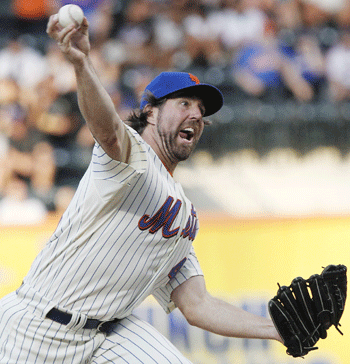
But atop that mountain of all-stars and Cy Young favorites stands our literary knuckleball, Mr. Robert Alan Dickey. At an average of 84.4 miles per hour, Dickey’s fastball was among the very slowest in the Majors in 2011. But according to the stat, the pitch was 1.84 runs above the average fastball per every 100 times he used it.

Before the Mets’ final game of the season, I presented that information to Dickey.

“Does that surprise you?” he asked.

“It’s the way I use it,” he said. “I might throw six or seven fastballs a day, maybe 10. Usually when I’m throwing it, it’s in counts when they’re not swinging or I’m surprising them with the pitch.”

Despite the well-documented lack of an ulnar collateral ligament in his throwing elbow, Dickey once threw fastballs that reached the mid-90s. In his rookie season with the Rangers in 2003, Dickey still averaged 89.4 miles per hour with his fastball. The pitch’s velocity has withered with the effects of time and a shift in focus, but its effect is amplified by the contrast with his trademark knuckleball.

“It is such a drastic difference from a knuckleball,” he said. “If you see six knuckleballs in an at-bat–”

“The fastball looks like it’s coming in at 110?” I asked.

“I’ve had hitters on the opposition tell our first baseman that,” he said. “So I know it’s effective if I use it correctly.”

For Dickey, the transition from relying on velocity — as he could from his earliest playing days — to relying on deception was not easy.

“Leaving who you were behind and knowing you’re never going to be that person again is tough,” he said. “You have to put your ego on the back burner and embrace something new, and that’s a real challenge.”

This winter, Dickey will re-read Ernest Hemingway’s “The Snows of Kilimanjaro,” and endeavor to climb that mountain. Before he rejoins the Mets in Port St. Lucie in February, he’ll read a Shakespearean comedy — either Much Ado About Nothing or A Midsummer Night’s Dream, he expects — then a few more books from his lengthy reading list.

There are many reasons we like R.A. Dickey. First and foremost: He is a good pitcher on our favorite baseball team. He has led the Mets in ERA+ in both his seasons with the club so far.

He does that while primarily throwing the knuckleball, that last vestige of hope for a Major League career for all of us who could never throw 95 (ignoring, of course, that we could never throw 85 either). Dickey himself put it well, in an interview with Sam Page last offseason: “It’s almost a blue-collar pitch. You’re in the seats and you watch me or [Tim Wakefield] or whoever throw and you’re like, ‘There’s a chance that I could do that.'”

Then there’s all the rest, the stuff that elevates him to folk-hero status in certain sections of the fanbase: He reads books, he rides a bike to Spring Training, he wants to be a ballboy at the U.S. Open, he has a cool beard, he makes a funny face when he pitches, his mom reads Amazin’ Avenue, he loves Star Wars.

Dickey is, on the field and off, an interesting dude. And I suspect we identify with him at least a bit because we all fancy ourselves interesting as well. He is the guy whose fastball is his change-of-pace pitch, subtle Havarti in a league long on assertive cheddar.

*- Technically, Wandy Rodriguez’s slider was worth way, way more on average than any other pitcher’s, but he threw it so infrequently that it seems more likely the pitchFX data used to determine the stat registered a handful of Rodriguez’s curveballs as sliders.

Yu and the Mets

Over at Amazin’ Avenue, Eno Sarris puts together a comprehensive examination of Yu Darvish’s posting and free-agency situation, and asks readers if they’d rather the Mets go for Darvish, re-sign Jose Reyes, or save their money for another starter.

Like many baseball fans stateside, I’ve been mancrushing on Darvish for years now. And if it were a different offseason and the Mets appeared to have more financial flexibility, I’d be all for them taking a big chance on what could be a big arm. Though few high-profile Japanese pitchers have really worked out so far, it’s a very small sample. The Mets lack front-line starting pitching and aces aren’t easy to come by, especially in their peak years.

But right now it seems the Mets are probably best off avoiding such risks. Barring some major change, they’re going to be somewhat cash-strapped for the next couple of years with or without Darvish. So if they did sign him and he got hurt or didn’t prove extremely effective, that would suck hardcore.