China cloning earthquake-resistant super-pigs

Chinese scientists have reportedly cloned six piglets from a pig that survived the devastating 2008 earthquake in Sichuan province. The piglets’ DNA is identical to that of their father, Zhu Jiangqiang, or “Strong-Willed Pig,” who is something of a national celebrity in China….

Zhu was hailed as a hero after the magnitude 8 earthquake in May 2008, which claimed tens of thousands of human lives and left millions more homeless. The 330-pound hardy hog was trapped beneath rubble for 36 days, but survived by drinking rainwater and chewing charcoal, the AFP reported.

Rebecca Boyle, PopSci.com.

You know what happens next right? One of these pigs survives another disaster, then someone clones that pig. Then one of those clones survives yet another disaster, and someone clones that pig, and so on until someone produces a pig clone so hearty and cunning that it learns how to clone itself and suddenly it’s the pigs serving us on a platter with apples in our mouths.

The Braves were cheating

Leo Mazzone vaguely confessed that the great Braves teams of the late 90s sometimes doctored the ball.

But if John Smoltz and possibly Tom Glavine and/or Greg Maddux got away with it, then presumably so too did many other pitchers not anywhere near as good as those three. Yeah, it’s against the rules, but if umpires and baseball weren’t doing a good enough job policing it then the onus is on them. We’ve danced this tango before.

I talked about this a bit on the podcast last night: Looking back now, I don’t have nearly the hatred for the Braves that I now do for the Phillies. Maybe it’s just that the Phillies are the bad guys now and I have a short memory. But in retrospect, those Braves teams appear almost classy compared to the Phillies and all the grit spilling from their ill-advised chin beards.

Jose Molina awesome at catching

In case you haven’t seen it yet, go check out Mike Fast’s analysis of catchers’ abilities to get borderline strike calls, expanding on work done at Beyond the Boxscore. There’s margin for error, but Fast suggests that the best catchers could earn their teams as many as 15-20 runs a season with the opposite true for the Jorge Posada end of the spectrum. Also: Jose Molina is awesome at it.

Because you’re wondering: By Fast’s data, both Josh Thole and Ronny Paulino have been slightly above average at getting borderline strike calls. I wonder, though, how knuckleballs — a significant portion of the pitches Thole has caught in the last two seasons — affect the outcome.

Mr. Alderson to tear down that wall?

We’re not looking for an advantage with respect to home runs versus visitors’ home runs. At the same time, I think there is some sense that the park is a little more overwhelming to a team that spends half its time there as opposed to a team that comes in for three games and doesn’t really have to alter an approach or think about it too much and leaves.

Sandy Alderson.

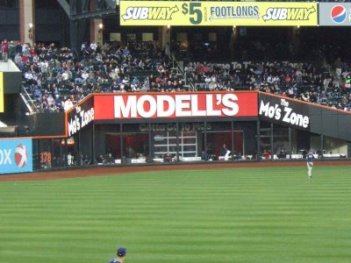
Alderson spoke about making changes to the outfield wall at Citi Field during last night’s game and then again after it. He said any changes were “not likely to be subtle,” and that the team has “tried to do as much analysis as [it] possibly can.”

Is it reading too much into Alderson’s comments to consider how a change in the size of the park would affect the Mets’ offseason plans? If Alderson believes that Citi Field can be “overwhelming” to a team that has to play half its games there, it would seem silly to make changes to the roster based on assessments of overwhelmed players.

In other words, here’s yet another reason the Mets should not and likely will not move David Wright. If Wright is affected by Citi Field’s dimensions — physically, psychologically, however — then trading him immediately after changing those dimensions would be positively nuts. The Mets can use 2012 to assess the way players perform in a better hitting environment instead of selling them off at the nadir of their value.

The same goes, to some extent, for Jason Bay. If the park has actually gone to Bay’s head and the Mets think unsubtle changes will help him out of the two-season power drought he has endured since joining the club, the team will likely be wary of eating too much of his contract to pawn him off.

Since Bay plays a replaceable position I imagine the team would still move him if the terms were at all reasonable. But if they think he’ll legitimately improve in the reconfigured ballpark, they’d be wise to hold on to him for a few months to see if he becomes more tempting to trade partners. They might wind up with a couple million dollars’ worth of salary relief by shipping him off on a Gary Matthews-type deal in the offseason, but much more if he starts off the year hitting like he used to.

Of course, there remains a strong possibility certain Mets’ offensive struggles have nothing to do with their home park’s dimensions, so adjustments to the park fail to improve their park-adjusted performances. Bay remains the utterly average hitter he has been, and Wright carries on in his prime years as a very good player short of the greatness he showed in his youth. And if that happens, the Mets lose the ol’ fence argument at the negotiating table, for whatever that’s worth.

At the very least, we can hope the unsubtle changes render the wall itself more subtle. The incessant, unnecessary nook-and-crannying bothers me more than the dimensions themselves, even if I — like the hitters — would like to see a few more home runs.

Oh and as for Jose Reyes and his triples: When Reyes is going well he’s going to hit triples pretty much anywhere. For his career, Reyes has 51 triples at home and 48 on the road. Plus, you can bet Reyes likes hitting home runs, too. In his last three years at Shea Stadium, Reyes averaged a home run roughly every 43 at-bats. In three injury-riddled years at Citi Field, he has averaged a home run every 68 at-bats.

From the Wikipedia: Graham Cracker

I was enjoying some graham crackers last night and got to thinking, “man, if graham crackers are called that because they’re made with graham flour, and graham crackers are delicious, why don’t we have more stuff made with graham flour? Where’s the graham cake and graham cookies?”
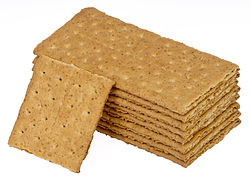
So I consulted the Wikipedia, only to find that the history of the graham cracker was way more interesting than I expected.

From the Wikipedia: Graham cracker.

Graham crackers were invented in 1829 in Bound Brook, New Jersey, by a Presbyterian minister and early dietary reformer named Sylvester Graham. Graham accurately argued that white bread from commercial bakeries, growing in popularity at the time, contained unhealthy additives and lacked the nutritious value of bread made from whole-grain flour.

Only Graham had more in mind than helping Americans enjoy the cardiac and gastroenterological benefits of a high-fiber diet. He believed that healthier lifestyles would cleanse his congregants of lustful thoughts, and in particular quell one indecent but ever-popular habit he referred to as “self-abuse.”

So to stop people from touching themselves, Graham began producing flour that incorporated course-ground wheat germ and bran in addition to the fine-ground endosperm of white flour. From this he created graham crackers — originally marketed as “Dr. Graham’s Honey Biskits” — to be a staple of his eponymous diet.

Graham’s followers, called Grahamites, reaped the rewards of frequent bathing and the daily brushing of teeth — neither yet a common custom in the early 19th century — believing uncleanliness to be a source of impure thoughts. Per the Wikipedia, Graham “felt that all excitement was unhealthful, and spices were among the prohibited ingredients in his diet.” The Graham diet grew popular enough that it became mandated at Oberlin College, where a professor was fired for bringing contraband pepper to faculty meals.

The Grahamites ate tons of graham crackers and tried to suppress carnal urges until Graham himself died at age 57 in 1851. But Reverend Graham’s beliefs later caught on with the brothers Kellogg, who invented Corn Flakes in the 1890s in part because they thought their cereal would help extinguish sexual desire.

Yes, if you’re playing at home: Both graham crackers and Kellogg’s cereal are named for people who thought they could end the masturbation epidemic with bland foods.

Of course, the delicious graham crackers we enjoy today would have the Reverend Graham spinning in his grave (while taking care not to arouse himself in the process). Most mass-marketed graham crackers are made with far more sugar-type stuff and far less whole-wheat flour than the originals. Many do not use graham flour at all, which answers my graham-flour question that started the Wikipedia tangent.

And today the Internet delivers all sorts of vile and debased porn instantly to every corner of the country, and we coat graham crackers with an impious amount of sugar to serve them as breakfast cereal and crush them up to use as crusts for sinfully rich cheesecake. Because this is America, bro.

Plan A?

Conventional wisdom suggests that Ruben Tejada is quickly maturing into the perfect Plan B at shortstop if the Mets lose Jose Reyes in free agency this offseason.

But Sandy Alderson, along with the rest of the team’s decision-makers, are concentrating on Plan A, which involves pairing Tejada with Reyes deep into the next decade….

Not only have the two developed a mentor-pupil type of relationship, they share the same agent, Peter Greenberg, and already have made plans to work out together this offseason at the Long Island facility Reyes uses.

David Lennon, Newsday.

As recently as a few weeks ago, I figured that if the Mets re-signed Reyes they’d be best served sending Tejada back to Triple-A to play everyday and using some combination of Daniel Murphy and Justin Turner at second. The way I had it, Tejada’s superior defense at second wouldn’t be enough to make up for the difference in offense.

But Tejada keeps hitting — slap-hitting, but hitting nonetheless — enough so that it’s no longer clear that Turner is even a better offensive player. The two share an identical .314 wOBA, with Tejada’s driven by a higher on-base percentage and Turner’s by more power. Turner has much more production on his Minor League resume, but Tejada has been extremely young for every level — including the Majors now.

Murphy will outhit both of them and by a great enough margin that if the Mets believe he can capably and regularly play second without again getting injured, he should see most of the playing time there. But since Murph can also play first and third, and might yet get another go of it in left field, the Mets shouldn’t have too much trouble finding semi-regular opportunities for his left-handed bat.

Perhaps the best solution would be using a combination of Tejada and Murphy at the keystone, with Tejada starting behind the heaviest ground-ball guys — Jon Niese and R.A. Dickey — and Murphy also seeing time in left field against tough righties and at third or first whenever David Wright or Ike Davis need a day.

An infield of Davis, Tejada, Reyes and Wright should represent a strong defensive upgrade over most combinations the Mets have used in 2011, and Terry Collins should have little trouble finding chances for a viable, versatile left-handed hitter like Murphy (consider that the less viable [but more versatile] Willie Harris has 243 plate appearances in 2011).

That would leave Turner either coming off the bench as a better, less expensive fit for the Alex Cora role or spun for pitching in the offseason. Both could help the club.

Of course, all of that is predicated on the Mets re-signing Reyes — far from a safe bet right now.

The save stat, nutshelled

“I couldn’t believe they were cheering me for hitting into a double play,” Swisher said. “I said: ‘Whoa, what’s this? And then I looked at the bullpen and saw Mo coming out and I said: ‘Now I get it!’ This was the greatest double play of my life.”

“Runners at first and second…it was unbelievable,” Rivera said. “I don’t ever want my teammates to do bad so I can pitch, but this time I was happy for the opportunity. I’m listening to the fans and I said: ‘Wow, these guys are into it!'”

N.Y. Daily News.

Syracuse concedes defeat in rivalry

Fearing embarrassment in forthcoming conference matchups with the mighty Georgetown Hoyas, the pathetic Syracuse Orange will flee the Big East like petrified children.

“We’ve been mulling this move for a long time, and we think it’s best for our program,” Athletic Director Daryl Gross probably said. “The truth is, the rigors of Big East play and Georgetown’s ever-looming presence made this decision easy for us.”

Syracuse’s departure clears the way for the remaining basketball-only teams in the Big East to form a new, way better conference unsullied by the ever-filthy, perpetually overrated, and utterly detestable Orange.

“I suppose this renders our conference’s future uncertain,” Georgetown coach John Thompson III could have said. “But at least I never have to set foot in that godforsaken hellhole again in my life.”

“I’m a big stupid jerk,” added Syracuse basketball coach Jim Boeheim, presumably. “Look at my jerk face! Waaaah! Waaaah!”