You can exhale: The Mets locked up Tim Byrdak

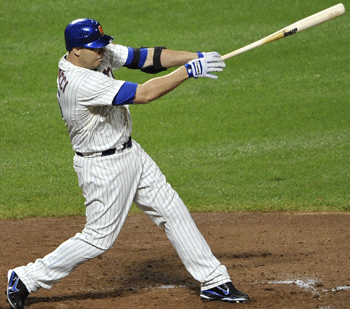
The Mets announced yesterday that they agreed to a one-year contract extension with Tim Byrdak. The news came right on the heels of the lefty’s second win of the season.

After a rough start to the year, Byrdak has capably served his role for the Mets. He has held lefties to a .208/.260/.323 line and though he’s 37 now, he’ll likely again be a solid lefty one-out guy in 2012.

After the announcement, Sandy Alderson stressed that the Mets now have two left-handed relievers locked up heading into the offseason: Byrdak and Daniel Herrera. But since Herrera also seems to profile as a LOOGY, it’s tough to imagine the Mets carrying both pitchers on the 25-man roster.

Wait, that’s not true. It’s easy to imagine them doing so, it’s just tough to imagine how it would be a good idea. Unless the team believes Byrdak or Herrara can regularly retire both lefty and righty hitters — Jerry Manuel’s much-coveted “crossover” guy, carrying both would mean committing a pair of rosters sports to maybe 90 total innings. Unless they have a great rotation — which they won’t — that would likely wind up putting a lot of stress on the other arms in the bullpen.

For long parts of this season, much was made of the Mets’ need for a second lefty in the bullpen. That makes sense, given some of the strong lefty hitters in their division and Terry Collins’ worship of platoon matchups. But ideally one of those lefties would need to be able to work more than part-inning stints lest the bullpen collapse on itself (even more).

Also worth nothing: Byrdak is hilarious. Sometime in the next couple weeks I’ll post a montage of his videobombs on teammates.

Kafka metamorphs* into first-string QB

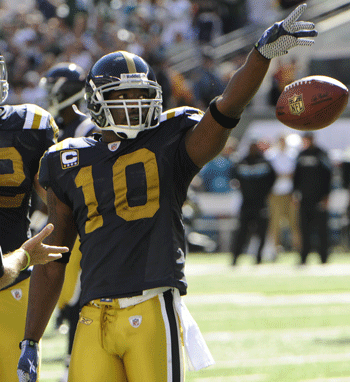
After Michael Vick left last night’s game with a head injury, the Eagles turned to a quarterback named Mike Kafka. The broadcast didn’t make nearly enough jokes about his name.

In 2006, I watched a pitcher named Ari Kafka enter a game for the Everett AquaSox of the the Northwest League. It was the AquaSox’ season opener, and Kafka faced several hitters and left without retiring any of them, finishing the day with a rather Kafkaesque infinite ERA.

*- I don’t think this is actually a word. Is there a verb form of metamorphosis, or is it just morph?

Jets poach Jaguars

That was pretty much the way the Jets drew up their defense before the season started. They got a good push from their pass rush, run defense that held Maurice Jones-Drew in check, and typical shutdown coverage from Darrelle Revis that forced Luke McCown to look elsewhere — mostly to Jets’ defensive backs. Of course, McCown appeared blessed with a rare combination of awful judgment and stunning inaccuracy, often throwing in the general direction of but nowhere actually close to receivers in double coverage. The Jets made four interceptions and dropped a host of others en route to the 32-3 victory.

Brian Schottenheimer and the Jets’ offense continued running on most first downs, a frustrating pattern until you consider this: By my count Mark Sanchez was 6-of-8 for 74 yards and a touchdown while throwing on first down, success obviously aided by the Jaguars’ efforts to stop the run. And one of Sanchez’s two incomplete first-down pass flew over the head of a wide-open Plaxico Burress in the end zone, a failure in execution but neither in judgment nor play-calling.

Sanchez threw a couple of interceptions, one marked by a great defensive play, the other by a poor pass into traffic.

But the big issue looming for the Jets’ offense involves the health of center Nick Mangold, who left the game late in the first quarter with an ankle injury. Mangold’s replacement, rookie Colin Baxter, looked downright awful. Not only did he twice botch the snap counts, he got pushed around by Jacksonville’s defensive linemen and missed multiple blocks that led to broken plays.

It was Baxter’s first NFL game, so it’s reasonable to hope he will improve once he adjusts to the speed at the new level. But subbing in a replacement-level center for one of the game’s best will hamper the Jets’ ground game and ability to employ complex blocking schemes. Baxter only appeared competent in straightforward pass-blocking assignments. If Mangold is out for any extended period of time, the combination of Baxter and tackle Wayne Hunter will turn the offensive line, one of the Jets’ preseason strengths, into a weak spot.


Awesome article about Jeopardy!

“The show has definitely changed,” said Friedman. “But it’s very much changed along with the times.” In other words, that movement seen above from “World Travel” to “My Son, The Doctor” is not willed into existence. Rather, it’s a growing with culture. Jeopardy! changed, and changed productively (compare its success to other long-running and flailing stalwarts like the nightly news and soap operas), because TV changed. HBO, DVDs, and the web happened, and in the process, we’ve moved from a norm, sometimes called Least Objectionable Programming, to one in which viewers are trusted with the possibilities of the medium as showrunners explore complexity and nuance.

The continuing evolution of Jeopardy! lets us see this shift happening in real time, providing a constant basis of comparison that isn’t there if we just look at, say, Full House beside The Sopranos. From a straightforward trivia contest predicated on a set of largely academic knowledge, the show has become a repository for jokes, references (both to pop culture and to itself), and language games. The questions have become dense tangles of allusions that rely on contestants’ ability to make connections and inventively parse language. Over the years, the show has been able to take advantage of the new complexity audiences were willing to accept, and the writers have seized the opportunity to turn this trivia show into something that intuitively probes the ways in which we understand the world.

Mike Barthel, GQ.

This is an awesome article about Jeopardy!, focusing on the show’s oft-overlooked but excellent writers.

Batting average with balls in play

Can a newly single A-Rod smack more doubles and triples?

The Yankees slugging third baseman is due back in the lineup Friday night against Toronto for the first time since his split with Cameron Diaz – and fans hope the heartbreak means home runs….

Rodriguez, who was also linked with Madonna after his divorce, memorably dated “Almost Famous” actress Kate Hudson during the Yankees’ 2009 championship run.

The blond Hollywood honey received much of the credit when A-Rod reversed a disastrous post-season slump as the Yankees won the World Series.

Larry McShane, N.Y. Daily News.

A-Rod’s hitting line, by celebrity girlfriend:

Madonna (August 2008 – end 2008): .258/.366/.511 in 50 games.

Kate Hudson (Late May 2009 – end 2009): .302/.419/.560 in 129 games, including postseason.

Cameron Diaz (July 2010 – Sept. 15, 2011): .274/.349/.498 in 156 games.

By my best estimates of when he started dating each based on the maximum number of celebrity-gossip articles I could stomach.

It’s worth noting that while dating Hudson, A-Rod enjoyed his best batting average with balls in play.

Oh, indeed.


Florida man arrested for wanting tacos

Terry Kimball was drunk Tuesday night and wanted Taco Bell. Understanding the dangers of driving while intoxicated, he set out on foot for the 137th Street location in Largo, Fla., a quarter mile from his home.

When he got there he found the dining room closed, so he walked up to the drive-thru window only to find the restaurant unwilling to serve pedestrians. Hungry and frustrated, he responded in the only sensible way: By calling 911.

“It’s not an emergency,” he said. “However, can you — can you put me through to dispatch? I’m at the Taco Bell, and I walked in, and I left my car on purpose, so I wouldn’t drink and drive. I walked up, they wouldn’t serve me. So, I’m at the Taco Bell at 137th and Walsingham and I just want some tacos. That’s it.”

Kimball spent the next 11 minutes pleading his case before police arrived on the scene to arrest him for misuse of the 911 system.

“Certainly calling 911 because you didn’t get your tacos is not something that would constitute an emergency,” said Largo police Lt. Mike Loux.

But it’s all relative, no?

People lucky enough to live within walking distance of Taco Bells should not be punished for attempting to act as responsible citizens. If I were named CMO of Taco Bell, I would work to rectify this injustice. Terry Kimball’s suffering will not be in vain.

Hat tip to Catsmeat.

Sandwich of the Week

Katherine’s excellent Sandwich of the Week map has been, well, compromised. A well-meaning reader removed all the sandwiches he wasn’t planning on eating without realizing he was editing the public version of the map. I emailed Google to see if they have any sort of cache for these things, but they never responded.

I added a few of them back, but if you want to help out by finding an old sandwich review from this site’s archive and adding it to the map, well, that’d be very cool of you. Just follow Katherine’s color code and copy relevant info from the review into the description part. And I realize you don’t owe me anything, of course. But if every sandwich-eating TedQuarters reader helps out with just one map marker, it should be complete in no time. Then we all have a map with which to chart sandwiches I’ve eaten, and obviously that’s something you want.

The sandwich: The Original 1762 from Earl of Sandwich, 52nd street between 5th and 6th in Manhattan.

The construction: Roast beef, cheddar cheese and horseradish sauce — mayonnaise and horseradish — on house-made bread.

Important background information: The Earl of Sandwich, you may know, is a chain owned by the 11th Earl of Sandwich, a descendant of John Montagu, the actual Earl of Sandwich credited with inventing the meal. The store claims The Original 1762 is the sandwich for which all sandwiches are named, though I’m skeptical that the original had so much mayonnaise. It is possible, though, since the Wikipedia says mayonnaise first made its way around Europe after a French victory over the British in a Seven Years War battle at Minorca in 1756.

You hear that a lot, incidentally: The cross-cultural exchange of foodstuffs during wartime. And I wonder how that goes down. Did soldiers storm through villages raiding pantries for unfamiliar condiments? Like, “Hey, this might turn out to be useful on a dish someone will invent six years from now!”

But then I suppose if I were a soldier in 1756, that’s exactly how I’d play it. John Montagu was a military type, and since we know him to be a culinary pioneer it’s entirely possible he asked his underlings to bring him any new sauces they pillaged.

What it looks like:
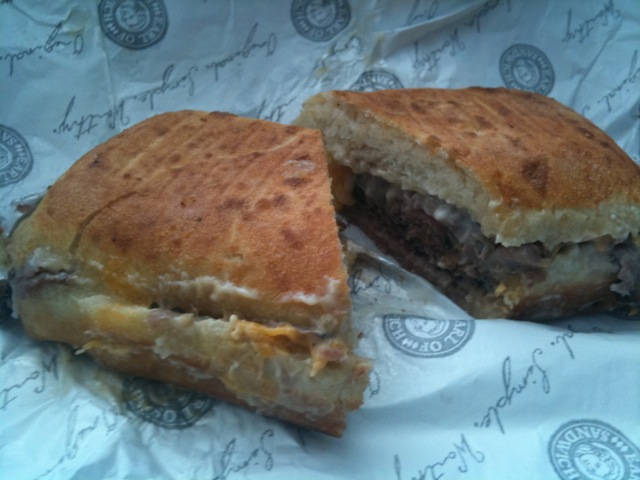
How it tastes: Like horseradish sauce, mostly. Which is fine — the horseradish sauce is good, assuming you like the commingled flavors of horseradish and mayonnaise. But it’s by far the strongest taste on the sandwich.

The beef is there and adds bulk to the thing, but it could just as easily be sliced chicken or turkey or anything meaty and a little chewy that can be drenched in horseradish sauce. Earl of Sandwich toasts all of its sandwiches, so the cheese is warm and melty, adding a nice texture if not enough flavor to distinguish it from the sauce.

The bread is delicious. From the looks of it, they put it onto the toaster-belt thing slightly undercooked, so it comes out tasting fresh-baked and with a nice, toasty crust. Easily the highlight of this sandwich, and, for that matter, the two other sandwiches I’ve had from The Earl of Sandwich since it opened a couple weeks ago.

What it’s worth: It costs $5.99, which is a very good deal for lunch in this part of Midtown.

How it rates: 65 out of 100. This is better than everything I’ve had from the big-name chain sandwich stores, so relative to the competition it’s great. But it’s a bit too monotonous to hold up to any of this city’s finest offerings.



Why do rosters expand in September?

During a brief conversation in the bowels of Citi Field last night, the topic of MLB’s September roster expansion came up.

It’s a weird wrinkle, unlike any other I know of in professional sports. Managers spend the first five months of a season with 25 players to work with, then the last month with up to 40. It can lead to seemingly interminable games like Tuesday’s 13-pitcher affair between the Mets and Nationals, but it provides some relief for tired players down the stretch and gives teams and fans an opportunity to preview of some of the prospects that might soon contribute to the big-league club more regularly.
I got to wondering when and why the tradition started, figuring it must have been a product of some collective-bargaining agreement of yesteryear.

It turns out late-season roster expansion dates back to the earliest days of baseball. By 1910, teams kept active rosters of 25 guys for most of the season and could expand to 40 starting Sept. 1.

But why?

I emailed official MLB historian John Thorn for help. He writes:

I can only speculate that as minor-league seasons tended to close earlier than major-league ones, September seemed to be a good time to reward high-performing aspirants perhaps less expensively than inviting them to spring camp. The extra-manpower feature surely was not as important in the early days, when staring pitchers tended to complete a high percentage of their games.

That makes sense. I’d love to find a newspaper article or something from 1910 stating the exact reasons, but I have no idea what microfiche I’d have to pull up.

Some have complained that the rule creates an uneven playing field, in part because the league’s more cash-strapped teams might not have the resources to pay all the extra Major League salaries.

But as John Schuerholz points out in the linked article, it’s not as if teams are all working with the same payroll in the other five months of the season. And if a GM thinks September call-ups are enough to make a difference in a pennant chase, he could allot room for them in his budget before the season.

HT to @OldBiscuitPants, who points out that Lou Gehrig was a September call-up in 1923 and 1924.

Sandwiches of Citi Field: Pastrami on rye

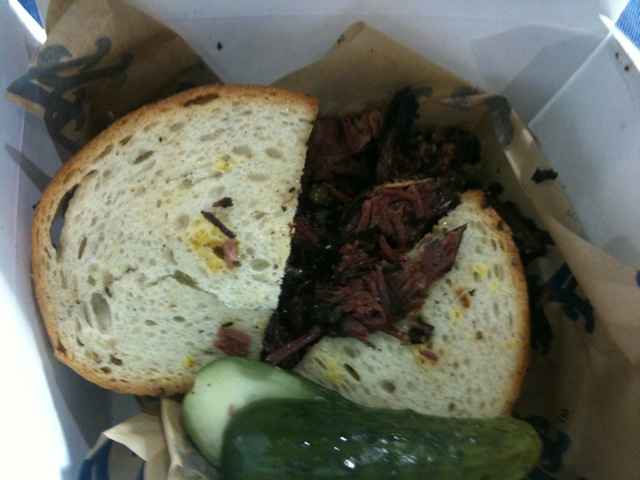
New to the Citi Field menu this year, the pastrami sandwich is available at a concession stand on the Field Level concourse behind left field. It’s also available elsewhere, but I’m pretty sure this is the one you want.

Every sandwich is made with meat hand-sliced fresh from the brisket, weighed out on a scale to six ounces — plenty of meat for a sandwich on regular-sized bread*. The guy making my sandwich then squirted mustard on one slice of rye and pressed it up against the other, ensuring even mustard distribution across both slices. That’s going the extra mile. Oh, and it comes with a pickle:

I don’t normally eat a lot of pastrami, but even as a novice I can tell this is a hell of a pastrami sandwich. The big challenge I’ve always found in cooking brisket is keeping it moist, but that’s not an issue here. This is meatjuice-dripping-down-your-arms moist. Tasty too, by no means overseasoned but with the flavor of coriander lingering after every bite.

The bread is soft — maybe too soft. I generally prefer rye that’s chewy around the crust, and this wasn’t exactly that. It didn’t take anything away from the sandwich, but I think good, strong, flavorful rye can often add something. The mustard tasted like mustard and the pickle was predictably amazing.

It’s $10.50, which is a lot. But then the touristy deli stops in Manhattan charge way more. They also give way more meat, but that seems like more of a gimmick than an effort at a well-proportioned sandwich.

*- Speaking of which: When I worked at the deli we were told to aim for about 1/3 pound of meat for sandwiches on bread or regular rolls and 1/2 pound for sandwiches on heroes. We never measured it out because with a couple weeks’ worth of meat-slicing experience it becomes pretty easy to eyeball amounts. I always tended to go a little bit over on my sandwiches, figuring people could always take meat off the sandwich.

But one time, in my first week, a guy asked for an “American.” That wasn’t on the menu, but he meant the standard ham-turkey-roast beef-cheese combo familiar from six-foot catering heroes. I kind of lost focus while slicing the guy’s ham and gave him about a full sandwich’s worth, and the roast beef we had was tough to slice thin, so he wound up with a lot of that. Then I wanted to make it look even so I gave him a lot of turkey too.

He wound up with a full pound of meat on his sandwich. I know because he took it back and showed it to my boss after he opened it, and I got my first (and only) stern talking-to about sandwich construction. Looking back on it now: Why’d you sell me out like that, guy? I gave you a pound of meat! You could take half of it off the sandwich and have enough to make another massive sandwich later in the day. C’mon, guy.