Mets just want the game scored correctly, is all

The Mets contacted Major League Baseball’s central offices in Manhattan after Saturday’s game, requesting a review of Andrew McCutchen’s third-inning “hit” in a 3-2 loss to the Pirates, a league source told the Daily News.

The team wants the ruling changed to an error, which would deduct two earned runs from R.A. Dickey’s line. The process will not likely be resolved until mid-week.

Andy Martino, N.Y. Daily News.

Wait: Why?

I thought it should have been an error, sure, but it was hardly the most egregious official-scoring decision I’ve seen. And it’s not like changing the ruling is going to change the outcome of the game. Someone must really care about R.A. Dickey’s ERA.


The Wright move?

Since Reyes is having an MVP-like year, I started thinking about the future makeup of the team. Nowadays, scoring is down and pitching is once again king. I believe that the Mets should keep Reyes and make him the centerpiece of the franchise. Build the Mets like the way the old Cardinals of the 1980s – pitching, defense and speed. Trade David Wright to get either pitching or position players who fits the mold. Build the team to take advantage of Citi Field’s dimensions. You probably need just one very good slugger to complement the offense. What do you think about this idea?

Willie, via email.

Well here’s the first part: I’m still not convinced the Mets need to choose between David Wright and Jose Reyes. So if you’re suggesting the Mets trade David Wright to clear salary to re-sign Reyes, I’m not sure it’s necessary. If you’re saying trade David Wright for pitching and/or players who fit a certain mold, to that I’d say this:
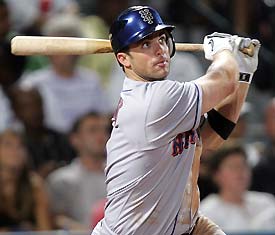
There are many ways to construct winning baseball teams. Certainly offense is down around baseball, but I’m not sure that means teams should go about trading good offensive players — in fact, it might mean exactly the opposite. If runs are at a premium, so are the players who produce them, no?

Right now, our perception of David Wright is tainted by his rough start to the year. Though logically we know how good Wright can be, our most recent memories of Wright show an injured, struggling player, so it’s easy to start hammering out trade proposals dispatching the third baseman.

But with Wright hurt and coming off the two worst seasons of his career, his value has likely never been lower. Plus, the team option on Wright’s contract for 2013 belongs solely to the Mets, meaning any potential trade partner would only have Wright locked up through 2012.

That makes Wright way more valuable to the Mets than to any other team. In other words, it seems unlikely that any competing club will offer the Mets enough for one year of Wright for it to be worth them giving up two years of Wright.

As for building a club to the park: I’m on the (very deep, asymmetric) fence. What’s the best way to tailor a team to Citi Field? Certainly you want good defenders in the spacious outfield.

Beyond that, what do you do? Do you stock up on pitching, or do you amount that opponents aren’t going to score many runs against you and focus on finding players that will produce in a tough run-scoring environment? Do you look for fly-ball pitchers? If so, what about all those road games they’ll have to pitch? Do you entirely eschew the home run, find line-drive hitters with speed and hope for rallies, or do you seek dead-pull sluggers since it appears the park is a bit more favorable to them? How many of these assessments do you base on eyeball estimations, and how many on data? And which data?

There’s a lot to it, and if I had to bet, I’d imagine when you work it all out it’s going to turn out that you want to put the best nine players you can find on the field. And I find it difficult to envision many scenarios in which Wright is not among the best nine players the Mets can find. I get that some of the crannies of Citi Field’s fence don’t suit his opposite-field power and that many believe the park has gotten into his head, but Wright — even the lesser Wright we watched in 2009 and 2010 — is still really, really good at baseball.

And from 2005-2008, Wright was a full-blown superstar. The troubles he has endured the past few seasons have been for the most part more nebulous than the ones Jose Reyes faced in 2009 and 2010. But in Reyes we now see a pitch-perfect example of how quickly and how emphatically a talented player in his late 20s can turn things around, given full health and the right situation.

Wright can do the same. It’s going to take more than a big park and a couple of rough years to convince me otherwise.

Goodbye, Dale Thayer’s mustache

After Saturday night’s game, the Mets cut reliever Dale Thayer and with him, his amazing mustache.

Thayer’s mustache appeared in four games for the Mets. The mustache defied both description and the telephoto lenses of any AP cameramen covering those games.

Thayer will head to Buffalo, but where the mustache goes from here is anyone’s guess. Perhaps it catches on above another Major League lip or takes time off to travel.

Or maybe Dale Thayer’s mustache retires into the sunset, remembered only in Flushing folklore and a couple of screengrabs.

Maintaining appearances

The Mets are at least going to give the appearance that they are trying to reach the playoffs this season, especially with the team playing scrappy baseball under Terry Collins, and probably wouldn’t deal K-Rod until close to the July 31 trading deadline.

John Harper, N.Y. Daily News.

First, I guess the Mets are kind of playing “scrappy” baseball, huh? Generally, when used to describe a specific player, “scrappy” is synonymous with “bad,” but I suppose it’s a reasonable way to characterize a club that scores a bunch of runs without often hitting home runs. Plus they’ve been playing good defense and getting solid pitching performances (the bullpen notably excepted) from a bunch of guys without overwhelming stuff. So yeah, all signs point to scrappy.

Dammit. Don’t get me wrong: Wins are the most important thing, but I miss home runs and Johan Santana.

Second, the time for assessing the Mets’ ability to contend hasn’t come yet, but I imagine if they’re really in it, they won’t just be maintaining the appearance that they’re trying to make the playoffs but actually trying to make the playoffs. And I know they’ve got financial limitations, motivation to trade a bunch of their players and some reasons to believe the starting pitching won’t hold up as well as it has so far.

But right now, even sitting in fourth place in their division, there’s still plenty of time for the Mets to assert themselves as a legit contender — as odd as that may seem to anyone who read even a single published report about the club in April. They’re winning games without Santana, David Wright and Ike Davis, and they’re hoping to get all three back before the trading deadline.

If all that crumbles, then Sandy Alderson and his crew can get about forgoing appearances and focus on improving the club’s future.

Is it time to close the locker rooms?

Truth be known, the same notion skitters across the minds of sportswriters and athletes, too, who wonder if this ritualized behavior is worth the trouble. Before and after games at virtually every stadium and arena, reporters dutifully trek to the locker rooms for a quote or two, a postmortem, an injury update or a sliver of insight. Later comes the dash back to the computers for the deadline assault….

Let’s be clear: This is not a Woe Is Us story. Access is hardly a reporter’s entitlement, unless the assignment is the White House or City Hall. Even then, the willingness to wait out a story is a compulsory part of the job. Imagine, too, the view of an athlete, not yet showered and still absorbing a blown save or a missed shot, confronted by a swarm of notepads and microphones and pressed to answer the brain-numbing question: How do you feel?

“What do they expect you to say to that?” asks LaTroy Hawkins, a veteran relief pitcher. “And could they let you get your pants on?”

Craig Wolff, Wall Street Journal.

Wolff’s whole piece is worth reading so I urge you to click through. Essentially, it asks whether the time-honored tradition of allowing reporters into locker rooms before and after sporting events is one worth continuing.

With new facilities with deeper clubhouses springing up around sports, players can more often avoid interacting with reporters if they choose. Wolff notes one such experience at Yankee Stadium, and the same is generally true before any Mets home game. Players appear at their lockers to dress, then head to the field to do baseball stuff or recede into some other, presumably way more awesome part of the clubhouse.
Who could blame them, really? Often times, the pre-game scene in the Mets locker room features 40-odd members of the media standing around just sort of waiting for something to happen and one or two players sitting quietly at their lockers, occupied by cell phones or iPads. It’s… well, a bit weird. And I say this as one of those 40-odd members of the media.

Plus access often colors coverage. It’s no secret — especially to media-savvy Mets fans — that the players who provide good quotes and ample time to reporters often seem to receive preferential treatment in certain media outlets. I am not certain this is as nefarious as it appears; reporters become fond of the players that are friendly and well-spoken, and thus less inclined to criticize them when they struggle. See Jeff Francoeur for details.

Still — and I can only speak for myself, here — I have no doubt that access to players and the inside of locker rooms has provided me perspective that has advanced my understanding of baseball and its personalities, if not necessarily my writing.

Via Craig Calcaterra.

Talking about the Duda, here…

Mets officials are considering promoting Lucas Duda from Triple-A Buffalo….

The thinking is that Justin Turner, unaccustomed to this much consistent playing time at the major league level, is showing signs of wearing down at third base. Turner is 0-for-7 in this series, and hitting .220 in his past 10 games. So Daniel Murphy can see some action at the hot corner, opening first base for Duda.

Adam Rubin, ESPNNewYork.com.

I’ve made my stance on this matter pretty clear here and here, but with Duda destroying Triple-A pitching and the Mets demonstrating a wholesale lack of non-Beltran power in the lineup, calling up the 25-year-old corner bat makes a lot of sense. As Rubin notes, the Mets can still find plenty of chances for Daniel Murphy and Justin Turner at second and third, plus Duda can spell Jason Bay in left field some while everyone figures out what the hell is up with Bay.

The Mets designated Nick Evans for assignment after last night’s game to make room for Duda. Like many Mets fans, I’ve got something of a soft spot for Evans, but I suppose as long as Terry Collins is locked in to platoon matchups for pinch-hitting spots, he wants to keep the lefty-hitting Willie Harris on the Mets’ bench.

Of course, I could point out that Harris has a .545 OPS against righties this year. But while Evans torched the ball across two levels last year, he did not hit in Buffalo or in his 17 plate-appearance stint in the bigs in 2011.

Anyway, now Duda gets more chances to show what he can do at the Major League level after posting a 1.003 OPS over parts of the past two seasons in Triple-A. This is good.

Like I’ve said, Duda is the age at which he should be expected to start contributing to a big-league club, and since the Mets have their starting first baseman on the disabled list, their left fielder in an awful funk and their right fielder likely headed for the trading block, now’s as good a time as any to try to assess what they’ll get from Duda moving forward.

Outscoring your opponents is the new Moneyball

This must be the new definition of Moneyball.

The Mets don’t score many runs, and their bullpen has nearly placed the manager in a straightjacket. But the starting rotation seems almost like money in the bank.

Mike Puma, N.Y. Post.

I guess it depends on your definition of “many,” but the Mets really haven’t had much trouble scoring runs this year. They’re scoring more than the average National League team in 2011, and, adjusting for the park, their offense is top five in the circuit.


Wikipedia either wrong or missing vital information

OK, so don’t ask how I got there, but I wound up on the Wikipedia page of Charles Osborne, an Iowa man famous for a bout of hiccups lasted 68 years.

But here’s the thing: According to the Wikipedia, Osborne’s hiccups ended in 1990, but he died in 1991. What gives?

Also, I imagine Osborne’s life would have been a whole lot less complicated if someone told him about the so-called Morrison Method, as practiced by my high-school band director and named for some kid named Morrison that must have gone to my high school years before me. Turns out drinking a glass of water while someone plugs your ears cures the hiccups every time. Only problem is it’s so silly that you often giggle enough to get the hiccups again.

Maybe Osborne came to enjoy having the hiccups. They were his claim to fame, after all. And maybe he woke up one day in 1990 without the hiccups like, “oh, man, no more talk-show spots for me!”

But probably his relationship with the hiccups was a bit more complicated than that.

Well that’s random

Don Maynard may have picked up a thing or two about trash talking from Rex Ryan.

After hearing the current Jets head coach call Darrrelle Revis the greatest player in team history, the wide receiver told ESPN.com that he and Joe Namath would have done just fine, thanks, against the cornerback.

“Oh, yeah,” Maynard said. “It doesn’t matter if it was him or anyone else. I had a guy named Namath throwing me the ball. If he goes left, I go right. If he goes right, I go left — the ball would be there. And I’ve never been caught from behind. That’s why my book is called, ‘You Can’t Catch Sunshine.’ (Revis) is like Deion Sanders. I would’ve loved to have played against those guys.”

New York Post.

Well that’s random.

Maybe if Don Maynard came up in the same generation as Revis, with access to all the same training methods and everything, this might be worth debating. But if you’re talking about picking up the Don Maynard that led the NFL in receiving yards in 1967, putting him in a time machine, suiting him up and getting him on the field to square off with Revis today, c’mon. No way.

Granted, I never saw Maynard play. I’m just going to go ahead and assume. Revis is almost unspeakably awesome, even for a modern NFL player.

Can’t blame Maynard for jawing though. Turns out Hall of Famers develop some pretty healthy egos.