Jason Bay, oof

Jason Bay is hitless in his last 23 at-bats. He does not have a hit in the month of June. He has a .585 OPS, second lowest of any position player on the Mets’ roster — ahead of only Nick Evans, who has 12 at-bats. And nearly every day Bay plays left field, purportedly an offensive position.

Before yesterday’s game, Terry Collins said he planned to be patient with Bay and did not intend to change or limit the outfielder’s role.

The managerial vote of confidence is a good thing, but I hope that behind closed doors Collins, Dave Hudgens and whoever else need be consulted are considering solutions beyond just leaving Bay in the lineup and hoping he comes around. It’s not like Bay was hitting before the current ofer stretch, and it kills the club to carry a massive hole in the middle of the lineup every night.

Problem is, there’s no obvious answer. A vision test? A few days off to rest his body and clear his mind? One of those phantom Ollie Perez injuries and a rehab stint? A Steve Trachsel voluntary jaunt to the Minors?

I’m no hitting coach and I’m not in Bay’s head. But man, at some point something’s got to give. Lucas Duda keeps destroying the ball in Triple-A. Getting Bay straightened out should be the club’s top priority, but if the Mets are serious about winning baseball games, it’s soon going to become impossible for them to maintain that Bay is their best everyday option to play left field and bat in the middle of their lineup.

I hate to sound reactive and impatient, especially over a guy with so much evidence to show he really can crush Major League pitching — hard as that is to believe with how he’s going right now. But it sure seems like whatever the Mets and Bay are doing to fix the problem isn’t working.

The Kid

Carter is sick now, news that has devastated the Mets’ family and fan base. And the Mets face a disquieting choice now. Even an operation as tone-deaf as this ought to know that it should finally step up and do the right thing, have a day sometime in the next few months, put Carter’s 8 up on the wall next to 37, 14, 41 and 42.

Would it look like they would be reacting to the horrific news of Carter’s brain cancer? Maybe. And you know what? That’s tough. The Mets could’ve done the right thing on their own years ago. Now they need to give their fans an opportunity to thank and salute Carter, whether he is physically up for the task or not. And because the Mets couldn’t identify the right thing to do if it was a neon sign, then shaming them into doing the right thing will have to do.

Mike Vaccaro, N.Y. Post.

I’ve left this one alone because Carter’s health issues sort of hit close to home for me, though I suppose cancer hits pretty close to home for most people. And I’m not interested in getting into a whole thing about whether Carter’s contributions to the Mets in his five-season tenure with the club merit retiring his number, because retired numbers are a pretty subjective thing on the whole.

But here’s what I’m wondering: Has anyone asked Carter if he wants his number retired?

Carter has inoperable glioblastoma, an aggressive form of brain cancer. He is currently enduring radiation and chemotherapy treatments, which do brutal things to the body to try to slow the spread of the disease.

I don’t know Carter and I certainly can’t speak for the man. And one thing I’ve learned from this job is that baseball players — especially those of Carter’s caliber — are programmed a bit differently than I am.

But… I don’t know. Man. I guess I don’t understand why so many people seem to assume a guy staring at brain cancer wants some relatively meaningless (and inevitably grim) ceremony in his honor when he’s going through what he’s going through.

Is this something people want for Gary Carter or is this something people want for themselves? Is it all about honoring a Mets legend and “making it right”? Or does some part of this great campaign to retire No. 8 have something to do with our own sadness — not just for Carter and his situation but for ourselves and the crushing fragility of everything — and some human need to provide life with a neat climax to help us better process something that’s damn near impossible to process?

Or maybe that’s just me. Maybe I’m extrapolating too much. I loved Gary Carter when I was a kid, and if the Mets want to retire his number and he’s up for it too, then great.

Any recent news on Carter’s health has come via updates from his daughter to his family’s private website. Carter released one statement on the matter, after his diagnosis. It said this:

My wife, Sandy, and our children and family thank you for your thoughts and prayers. We ask that you please respect our privacy as we learn more about my medical condition.


But how much?

So Jose Reyes is awesome. That much we know.

The Mets’ shortstop leads all players not named Jose Bautista in WAR. He is tops in the National League in batting average and triples, seventh in OPS+, second in stolen bases, and he plays a premium defensive position. We are watching a 27-year-old Reyes benefiting from full health, a full Spring Training and an organization, manager and hitting coach that seem committed to handling him correctly. And it is spectacular.

It won’t always be this good, of course. But Mets fans witnessing how good it can be are understandably clamoring for more, begging the club not to trade the homegrown star, demanding the front office pony up the cash necessary to re-sign him to a long-term extension.

That all makes sense: When a big-market team like the Mets gets its hands on a player of Reyes’ caliber, it should build around him, not trade him for prospects or allow him to flee in free agency. It’s impossible to expect any young player returned in a trade or selected with a compensatory draft pick to develop into half the talent that Reyes is, and since Reyes is still only 27 — he turns 28 on Saturday — he likely has several seasons of being awesome ahead of him.

Even if you have already written off the 2012 Mets for whatever reason, you must realize that a well-run team can turn things around in two years. And in two years, Reyes will be 29, turning 30 — hardly an old man, even in baseball terms.

Thing is, great players makes lots of money in free agency. Last year, both Carl Crawford and Jayson Werth took home deals that seemed particularly pricey — Crawford’s for seven years and $142 million, Werth’s for seven and $126 million. Neither is a perfect comp for Reyes since neither entered free agency with Reyes’ recent injury history, but both play corner outfielder positions where their production could be more easily replaced.

It could be that those deals were a couple of outliers, GMs going rogue in a strange offseason. Or the deals could indicate a new trend in free agency. If more teams are locking up young players to team-friendly contracts early in their careers, fewer elite players will hit the open market while they’re still young. Plus those teams will have more money to spend on the free agents that do come around.

Which brings me to the poll I posted here a couple weeks ago, asking readers the maximum deal they’d be willing to offer Reyes. Of 381 responses, 72.4 percent wouldn’t give Reyes more than a six-year, $110 million deal.

Again, Jayson Werth — a 31-year-old corner outfielder — got a seven-year, $126 million deal last year. And at the time just about everyone agreed it was a huge overpay, and that Nats GM Mike Rizzo probably had to offer Werth that much to get him to agree to join a franchise like the Nationals. But it only takes one Mike Rizzo, right?

I’m not sure I have any strong conclusion except to say that if you’re shouting, “pay the man,” you might want to specify how much. Because though the Mets should always be able to spend money, being a huge-market team with this here TV network and all, they should always spend money wisely. And though my emotional side wants Reyes back at any cost, I recognize that if the Mets are going to be working with finite resources — i.e. continue not being the Yankees — there has to be a limit to the amount they’re willing to give any player.

One more thought: It seems like teams spending on the free-agent market must do so knowing that they’re almost certainly going to get burned on the last couple of years of a contract. I wonder if GMs approach it that way: Think as if you’re paying the guy the whole sum of the contract for the first few years while he’s still playing at an elite level, and just hope he remains productive enough on the back end of his contract to cull some additional value out of those final seasons. But then I guess it doesn’t really matter much, you just hope for as much total production as possible over the length of the deal.

In conclusion, Jose Reyes is sweet. Pay the man.

 

Twitter Q&A-type thing, part 2

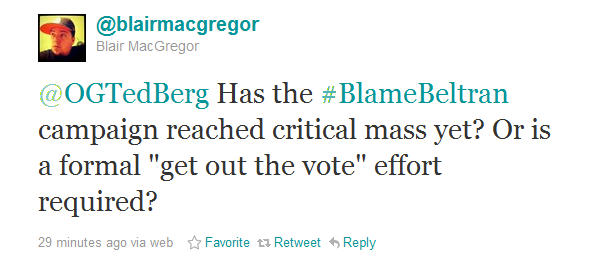
I should tread lightly here because I always find it annoying when people spend too much time deconstructing their own jokes (not that I have any exclusive claim to the blame-Beltran thing, for that matter). But pretty frequently now I’ll make some sarcastic comment blaming Beltran for something and someone will reply — with no lack of vitriol — to let me know that the joke is dead and I’ve killed it.

But killing it is kind of the point, no?

I don’t know. Come to think of it, I don’t really want to explain why I think it’s funny or why I think repeating punchlines ad infinitum is funny because I’m concerned trying to put it into words will make it stop being funny. But right now it still cracks me up to blame Carlos Beltran for ridiculous stuff, and as long as that’s the case it’ll continue. And I also think it’s funny when people who don’t think the jokes are funny get all riled up about them, because I have innate troll instincts. So, you know, SPOILER ALERT: Probably not going to stop.

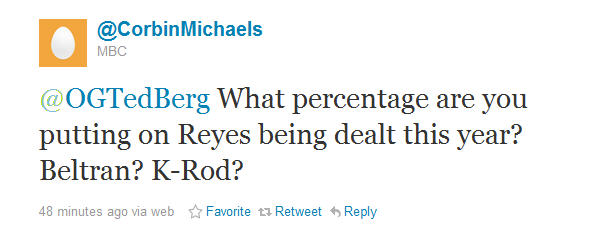
Hmm… let’s see. Total guesses, obviously: I’ll say 15 percent chance Reyes gets dealt, 65 percent chance Beltran gets dealt, 30 percent chance Rodriguez gets dealt. That sound right?

I know many Mets fans and media think Reyes’ departure is a done deal, but it has never seemed that way to me. Obviously there’s some chance he goes because he’s in the last year of his contract and he’s awesome, but since the Mets will need to get something back that’s better than two high draft picks, it’s going to take a pretty big deal. And I’m still not convinced they won’t make a run at re-signing him.

Beltran, sadly, seems most likely to go. He’s in the last year of his deal, he’s hitting, and he has a clause in his contract that (selfishly) prevents the Mets from offering him arbitration after the season to collect the draft picks if he leaves in free agency. I have no idea what he’ll return in a trade.

I didn’t put the percentage higher than 65 because a) he could get hurt, b) the Mets could stay on the fringes of contention and determine he’s worth more to them, even for a couple months, than whatever he’d bring back in a deal, and c) working out trades is difficult for front offices, and though the Mets will have plenty of motivation to deal Beltran if they’re not near contention, he does have a reasonable amount of money still coming his way this year that could limit flexibility, plus the no-trade clause.

The 30 percent number might be optimistic for Rodriguez. I’m sure they’ll try.

Well first of all, I’m going to go ahead and argue that if the egg is on the outside of the sandwich, it’s not a sandwich. Looking at you, croque madame. I know a lot of people will bill that as a sandwich, but that’s a messy meal you need to eat with a fork and a knife, and once you’re picking up utensils you’re basically spitting on the grave of John Montagu, the 4th Earl of Sandwich. There are plenty of delicious sandwiches that can be a bit unwieldy, sure, but to me a sandwich by definition has to at least make an effort toward portability.

As for an egg inside the sandwich, that I’m fine with. At least in concept. It just so happens that I’ve been down on eggs lately for some reason. It happens sometimes; I eat a bunch of egg sandwiches and then I get sick of eating eggs. But in the past, at times when I am enjoying eggs, I’ve certain enjoyed them atop burgers.

One time I had a fried chicken sandwich with an egg on top, which felt like a great way to demonstrate our species’ dominance over the chicken. Sadly, the sandwich was a bit disappointing, because it turns out chicken doesn’t really go that well with egg, and the runny egg yolk got the fried-chicken breading all soggy.


Twitter Q&A-type thing, part 1

We’ve got to roll at least two deep on this because good questions are streaming in.

Kielbasa, and here’s why: While “kielbasa” can apparently refer to many different variations of sausage around the world, here in the U.S. when you order a kielbasa you have a pretty good sense of the sausage you’re getting, and it’s pretty reliably delicious.

Because there are so many variations of chorizo and we haven’t settled on one particular variety to be called “chorizo” yet in this country, when you order chorizo you risk winding up with a sausage that can actually be kind of gross. And I know that sounds like heresy, but there are some nasty sausages out there, and I’ve definitely seen some of them billed as chorizo.

Don’t get me wrong: Some of the most delicious sausages I’ve eaten have been called chorizo too, and at a reputable establishment selling good chorizo it is often the case that the particular chorizo is better than most kielbasa. But though I could argue that chorizo has a higher ceiling than kielbasa, it decidedly has a much lower floor. So if we’re dealing in abstractions here I’d have to choose the Polish offering, at least if we’re only talking about the reasonably standardized version we encounter here in North America.

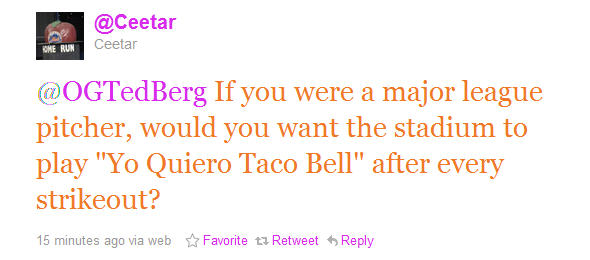
No, because if we’re so far removed from reality that we’re imagining a world in which I could throw harder than 60 miles an hour, we might as well go for it and fantasize that I’m mowing guys down, in which case the Yo Quiero Taco Bell thing would probably get pretty annoying.

Instead, I think a nice way to pay homage to Taco Bell and celebrate all my strikeouts would be to play the sound of the Taco Bell that rings when you hover over the logo on TacoBell.com. Also, if I were a closer, that would tie-in nicely with my preferred choice of bullpen music, Dr. Dre’s “Keep Their Heads Ringin’.”

Oh indeed:

Apparently we’re talking about the fence again

Sandy Alderson makes measured rather than rash decisions. He even brought Oliver Perez and Luis Castillo to spring training to observe those players before dumping them, despite public clamor for their immediate ousters. So it is entirely consistent that Alderson left Citi Field’s measurements unchanged for the 2011 season, his first presiding over the team as general manager.

That does not mean alterations will not take place next winter.

Adam Rubin, ESPN.com.

Rubin digs up some good quotes from Sandy Alderson from the time Alderson reworked the fence at San Diego’s cavernous Petco Park and gets data from Greg Rybarczyk of hittrackeronline.com, so the whole piece is worth a read.

It’s worth noting that according to most park-factor metrics I can find, Citi Field has hardly been the most extreme pitchers’ park in the league. I’ve found five sites charting park-factor stats online: ESPN.com, baseball-reference.com, seamheads.com, parkfactors.com and statcorner.com.

All of them show Citi Field playing as at least a slight pitchers’ park, but none of them put it at the bottom or even in the bottom three for run-scoring environments. And I seem to remember fans almost unanimously hoping for a pitchers’ park before the place opened in 2009. Also — and this is a big thing people seem to overlook all the time — visiting teams have to hit in Citi Field too.

Most of the sites do show that Citi is a tough park to hit home runs in, which, naturally, our eyes also show. Of course, it is an especially hard park to hit home runs in when you’re trotting out a lineup full of guys that don’t often hit home runs, as the Mets frequently do. And there’s a lot more to how a park plays than the distance of its fences: the batter’s eye, the amount of foul territory, the lights, the wind.

Regardless, there’s little doubt the perception around baseball is that the park is damn-near impossible to hit the ball out of, and at this point there’s nothing you or me or Troy Tulowitzki can do to dispel that. Many suggest the stadium has had psychological effects on certain Mets hitters, but I try to avoid armchair psychoanalysis here.

What I would say is that if Alderson concludes that some minor alterations to the wall would in some way benefit the team for the long haul — enticing free agents, drawing more fans to the park because chicks (and many other people) dig the longball, whatever — then why not? I was never a fan of the current fence aesthetically from the start, with the weird and unnecessary nooks and crannies, so maybe the Mets can upgrade the park cosmetically and eliminate a talking point that has probably always been a bit overblown.

Thanks to @sky_kalkman, @thomasTSKH, @jeffpaternostro and @nmigliore for helping me find park-factor stats via Twitter. Dan at Baseball Crank put together a useful roundup of the Mets’ home/road splits since they started playing at Citi Field in 2009.

Mets draft some guy, then some other guy

With the 13th pick in the Rule 4 draft, the Mets selected outfielder Brandon Nimmo. With the 44th pick, they chose pitcher Michael Fulmer.

Both players are 18, so we should have a much clearer picture on whether they’ll contribute anything meaningful to the Major League Mets in about five years.

Notably, both were committed to play at Arkansas, meaning the Mets seemingly drafted based on talent over signability, which appears to be a positive sign. And maybe Paul DePodesta just wanted to wave a big middle-finger at the Razorbacks’ program for some reason, ivory-tower hotshot that he is.

Toby Hyde and Mike Diaz, who actually know about this stuff, have much more on Nimmo and Fulmer over at MetsMinorLeagueBlog.com. Alex Nelson has the scoop for Amazin’ Avenue.

Mets fans all over the Internet have strong opinions on the picks because people always feel the need to have strong opinions on everything. Twitterer @RobertJamis is doing vigilant work retweeting all the most negative reactions, many of which are pretty entertaining.

Naturally, if and when the Mets sign Nimmo and Fulmer and they start performing in the low levels of the Minor Leagues, Mets fans everywhere will become unduly hyped about both and start inking them in to the team’s future plans. Then if they do advance to the Majors, they will be deemed busts if they’re anything less than superstars.

Whoa

This day got away from me quickly.

The MLB draft is tonight. You might remember that I don’t get too fired up about the event, mostly because I know next to nothing about the players involved and won’t have any idea if they’re good Major Leaguers for several years.

But hey, if the draft is your thing, enjoy it. Toby Hyde and Mike Diaz have done a ton to preview it at MetsMinorLeagueBlog.com and should be on top of news tonight, so follow along with them if you somehow don’t already.

Lucas Duda mashing

Over his last 10 games, Lucas Duda has a .405/.512/.938 line for the Buffalo Bisons. In 104 Triple-A games, Duda can now boast a .306/.393/.591 line. That’s very good.

Duda has five home runs in his last ten games. The Mets have two. Last night, the Mets’ last healthy viable home-run hitter, Carlos Beltran, fouled a ball off the inside of his troublesome right leg and crumbled to the ground in pain. X-rays on the leg came back negative and the team says his recovery is day-to-day, but the Mets could have used another power hitter on the club even before that.

I’m repeating myself, I know. And thanks to the contributions of Jose Reyes, Justin Turner and Daniel Murphy near the top of the batting order, the Mets haven’t had a ton of trouble scoring runs of late.

But teams can always stand to score more, and it sure seems like adding Duda to the roster would be a good way to go about that.

Duda is 25, so it’s hard to argue that he needs to be in the Minors playing every day to continue developing — especially given his success at Triple-A over the past two seasons. Plus with injuries all over the place and Jason Bay looking lost, it shouldn’t be that hard for Terry Collins to find the lefty-hitting Duda semi-regular at-bats at first base, in left field and as the primary bench bat when he’s not starting.

Beyond that, giving Duda an opportunity to show what he can do or not do at the big-league level gives the Mets a chance to assess what they can expect from him moving forward. Though small samples abound, we’ve already seen signs that both Murphy and Turner could emerge as viable (and versatile) cost-controlled Major League contributors — valuable commodities on a team that has too often surrounded its star players with replacement-level dreck and a club that must be mulling whether to extend a massive and potentially financially limiting contract to its superstar shortstop.

Continuing to give chances to 33-year-old Willie Harris teaches you nothing unless you haven’t learned from the first 2597 Major League plate appearances that Harris isn’t much of a hitter.