Mark Sanchez not locked out of being awesome

With a lockout looming, Sanchez was savvy enough to load up highlights after the season to his laptop to use precisely for this camp. He structured a plan by using concepts in an old Jets playbook before adding some new elements. He made copies for each of the 14 teammates who showed up. With no contact with teams allowed, he called agents, uncles and anybody else he could think of to make sure rookies such as Jeremy Kerley received an invitation. “He sounds like a coach in the meeting rooms, telling everybody what to do, what to expect,” said LaDainian Tomlinson. “Even watching film, he sounds like a coach.”

Manish Mehta, N.Y. Daily News.

Well that’s pretty awesome. I think mental preparation — studying the playbook, understanding the offense and defense, analyzing film, communicating — is more important in football than in any other major sport. So good thing Mark Sanchez worked the phones this offseason.

Sandy Alderson is a pretty smart dude and he probably has more than one tool with which to assess ballplayers

I keep making snarky references to the Alderson-only-cares-about-OBP meme on Twitter and people keep taking them seriously, so I’m going to be as straightforward as I possibly can:

Sandy Alderson, like every Major League GM, has more than one tool at his disposal with which to assess baseball players.

You may have heard about or even read the book Moneyball, which details the way the Oakland A’s front office identified a market inefficiency that existed in baseball in the late 80s and early 90s — namely that most teams did not properly value the ability to get on-base, the most important offensive skill.

And so, even though — in part because of the book Moneyball — that inefficiency no longer really exists, you apparently assume Alderson only looks at on-base percentage when evaluating players.

That is certainly not the case. When I suggest it is on Twitter, I am being sarcastic.

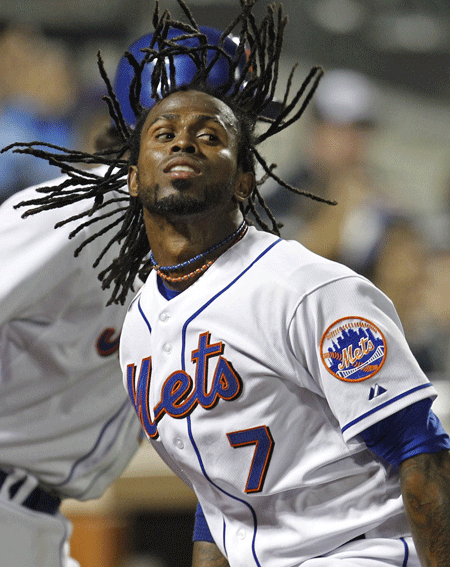
It is true that Jose Reyes’ on-base percentage has historically not been outstanding compared to those of other leadoff hitters.

But Reyes plays shortstop and very few shortstops hit as well as he does. In fact, dating back to 2006, really only three shortstops have hit better than Reyes: Troy Tulowitzki, Hanley Ramirez and Derek Jeter. All three are locked up to long-term contracts, and Jeter appears to be tanking rather rapidly.

Alderson, I assume, knows all this and will use the information to inform the Mets’ decision on how to approach Reyes’ future with the club.

The kroddiest inning

Giants ninth. F.Rodriguez pitching. Burriss hit an infield single to shortstop. Burriss stole second. Ford hit an infield single to third, Burriss to third. Rowand fouled out to first baseman I.Davis, Ford to second. Tejada popped out to second baseman Dan.Murphy. Fontenot was intentionally walked. Posey flied out to center fielder Pridie.

STATS Gameview

It’s tough to completely kill Francisco Rodriguez for loading the bases in the top of the ninth last night. Neither of the two hits left the infield. Darren Ford might have been out at first on his bunt if Daniel Murphy didn’t drop David Wright’s throw. Stuff like that.

Still, by loading the bases and escaping without allowing a run — as our man Catsmeat pointed out last night — Rodriguez managed to both raise his already massive WHIP and lower his puny earned-run average. If you’re playing at home, he now can boast a miserable 1.833 mark in the first metric — a rate to make Oliver Perez blush — and a 1.50 ERA.

This is why we know the sample sizes are still too small to make any judgments. Stuff like this can’t last.

Just for fun, I used the baseball-reference Play Index to look up how many guys have thrown at least 20 innings in a season with an ERA below 2.00 and a WHIP above 1.50. This is for a full season, so it’s not a fair assessment of the rarity of K-Rod’s stretch. Presumably many more players have gone 12-inning stretches with absurdly high WHIPs and low ERAs, the stats just got buried in the larger samples.

Anyway, it’s not a long list. And it turns out there was a pitcher named Crazy Schmit:

Rk Player WHIP ERA IP Year Tm Lg
1 Jeff Keener 1.701 1.61 22.1 1982 STL NL
2 Bobby Castillo 1.603 1.11 24.1 1979 LAD NL
3 Hal Kelleher 1.520 1.80 25.0 1935 PHI NL
4 Larry Casian 1.629 1.93 23.1 1995 CHC NL
5 Claude Willoughby 1.609 1.96 23.0 1925 PHI NL
6 Harry Otis 1.671 1.37 26.1 1909 CLE AL
7 Pete Appleton 1.551 1.82 29.2 1927 CIN NL
8 Crazy Schmit 1.809 1.99 22.2 1901 BLA AL

Reminder: Me doing stuff

Just a friendly reminder that I’ll be co-hosting a live streaming web show from the Citi Field McFadden’s with Matt Cerrone this afternoon at 5 p.m. If all goes according to plan, John Franco and WFAN’s Ed Coleman will join us. I’ll be the ridiculously handsome guy.

I’ll have a link for you here closer to the time, or you can access the stream from SNY.tv.

Don’t cross the streams… It would be bad.

From the Wikipedia: Man vs. Wild

I have never seen this show. Maybe it is good.

From the Wikipedia: Man vs. Wild.

OK, here’s the thing: Man already beat wild. Beat the living tar out of it. Man beat wild so thoroughly that we have to set up parks and wildlife preserves just to make sure man doesn’t beat wild all the way into oblivion. A TKO. Not the type of outcome that merits a rematch.

We haven’t yet figured out how to deal with the various difficulties posed by the proliferation of our own species. But wild — as long as we’re defining “wild” as something distinct from “man” — for most of us, is taken care of.

I am fortunate to spend nearly every night in a bed under the shelter of a roof with the temperature regulated at around 65 degrees by either air conditioning or heat. Every weekday I wake up, check my email, take a shower, eat breakfast, and walk to the train station unimpeded by nature. Sometimes it rains, but I can prepare for that. I get on the train and it speeds to New York City, where I then proceed to my office undeterred by fauna or flora.

In day-to-day life, the only time I could ever be reasonably endangered by wildlife is if I hit it with my car. About once every five years I get stung by a bee and it hurts for a few minutes. My neighbor’s dog bit my wife in the leg while she was out running last week; she got a small cut and a bruise but she was able to finish her jog.

In my kitchen, I have the flesh of at least eight different types of animal. Eventually I’m going to eat it. But it’s no rush — I have a freezer, an innovation that ensures I can keep food for months without it spoiling. I never need to hunt or forage. At a supermarket within a mile of my home, I can use paper money or a plastic card to purchase everything I need to keep me sustained.

According to the Wikipedia, on the show Man vs. Wild this guy Bear Grylls gets “stranded” in a different remote location every episode. That never happens to me. He’s not really stranded, either, of course. He’s there with a whole production crew, there’s often a helicopter nearby, and supposedly he sometimes spends nights in hotels. Those probably have mini-bars and breakfast buffets in case he gets hungry.

Apparently Grylls is briefed on the dangers present in each locale beforehand by a local expert. If you are ever really going to be stranded somewhere, make sure to hook up with a local expert first, because I bet that background information is awfully convenient.

But again, if you’re lucky enough to be in some situation that permits you to be reading this website on a Tuesday afternoon, you probably run little risk of being involuntarily ditched in any remote location, or even voluntarily winding up alone in any remote location unless you specifically want to test your so-called “survival” skills. And because of that, it seems weird to call them survival skills at all. Optional recreational strategies, really.

I live a remarkably sheltered life — as evidenced, like I said, by the suburban shelter under which I rest at night. One time I had to hitchhike on the side of I-95 and another time I had to pull out some Die-Hard stuff to break into my own apartment via the fire escape when I had been locked out. But really, the only survival skills I have ever needed are the ones that have helped me land and maintain a job in this economy, and the ones, I suppose, that prevent me from killing myself with drugs, alcohol and deep-fried food.

Perhaps that’s pathetic and I am somehow less masculine for having no urge to convene with nature in the pseudo-dangerous way Grylls apparently favors. Or maybe our forefathers, the real frontiersmen of yesteryear, would — once they came to grips with the oddities of time travel, electricity and broadcast television — watch Man vs. Wild and yell, “Holy hell man, what are you doing? We did this so you don’t have to, you crazy bastard.”

Anyway, the show has been on for six seasons so a lot of people must find it pretty entertaining. Not trying to hate or anything. Just sayin’s all.

Mejia as closer?

The way Mejia pitches to me just simply is not the makeup of a major league starting pitcher. He isn’t made to be throwing 100+ pitches every 5th day. This is why I think when Mejia returns from Tommy John in ~1 year it’s time to start grooming him as the long term closer for the New York Mets. Before you get mad that I am converting the team’s #1 prospect to a closer, remember that your own Francisco Rodriguez was once the #1 prospect in the Angels system and he’s done quite well for himself.

Joe DeMayo, St. Lucie to Flushing.

Gotta disagree with Joe here. First things first: No human is really made to be throwing 100+ pitches every fifth day. Yeah, Mejia’s currently limited arsenal does seem to lend itself to shorter stints, what with the great fastball and less-great secondary stuff, but I’d say it’s too soon to commit him to a bullpen role.

Is there evidence yet that starting is worse on the arm? (That’s not a rhetorical question; I’m straight-up asking.) Starters throw more innings, obviously, but relievers are often asked — as Mejia was last year — to throw on three or four straight nights, and can never develop a starter’s routine.

Thing is, starting pitchers are much, much more valuable than relievers, even closers, in part because starting pitching is a lot more difficult. That’s why, as Joe points out, so many of the great relievers are former (and in most cases failed) starters. It’s a hell of a lot easier to fool batters for one inning than for seven.

Part of the fallout from the Omar Minaya administration’s rushing and hyping of prospects is that we hear about young Mets for so long that they seem close to washed up when they haven’t even reached the age at which they should be expected to contribute to the Major League club.

Jenrry Mejia is six months younger than Matt Harvey. Mejia has a whole career ahead of him, and whenever he returns from the elbow injury he should be given further opportunities to prove his worth as a starting pitcher. Only when he demonstrates for sure that he cannot handle it should he be moved into a relief role.

Watch me do stuff

As you may have seen on MetsBlog, Matt Cerrone and I will be co-hosting a live streaming web show from the Citi Field McFadden’s tomorrow afternoon at 5 p.m., previewing the Mets’ series with the Giants and talking about stuff. It should take about a half hour, depending on how long we go with our guests. And it’ll be live, cutting out that pesky delay between when I think my real-time thoughts and when you can access them on this blog.

There’s still no such thing as a pitching prospect

Jenrry Mejia was examined at the Hospital for Special Surgery today and diagnosed with a complete MCL tear in his pitching elbow. Doctors recommended surgery, but Mejia will seek a second opinion. That doctor will probably also recommend surgery.

If you’re playing at home that’s Tommy John surgery, which likely means a year on the shelf for the Mets’ top prospect. And it means Mejia should probably no longer be referred to as “the Mets’ top prospect.”

Poor kid.

The good news, I suppose, is that the injury is not to Mejia’s shoulder. Pitchers way more often successfully return from elbow issues. Still, it sucks.

R.A. Dickey still being R.A. Dickey

One bat is called Orcrist the Goblin Cleaver and the other is Hrunting. Dickey, an avid reader, said that Orcrist came from “The Hobbit.” Hrunting — the H is silent, Dickey said — came from the epic poem “Beowulf”; it is the sword Beowulf uses to slay Grendel’s mother.

Tyler Kepner, N.Y. Times.

Well that’s kind of awesome, and predictably R.A. Dickeyish. I think if I were a Major Leaguer, though, I’d give my bat a really common everyday name like “Steve” or something. Credit for this idea goes to my wife, who recently suggested “Richard,” in a discussion of good potential dog names (we’re not getting a dog or anything we were just talking about dog names).

Come to think of it, I keep two bats in the trunk of my car for Brooklyn baseball and they are still pathetically anonymous. What am I doing? OK, here we go: The 32″ maple bat is Larry and the 33″ ash bat is Ron. I have a 1.181 OPS in two games since switching to Ron, incidentally.