
Season in preview: Third base

This one won’t take long.

The third basemen in April: David Wright, Daniel Murphy.

Overview: That’s the other thing about these 74-win type predictions: You remember the Mets still have (among others) David Wright, right? And yeah, I know he wasn’t the same player in 2009 and 2010 that he was from 2006-2008, and that one good player does not a great team make, but it’s like everyone has gotten so caught up in Wright’s weird fluctuations at the plate that they’ve forgotten that even at worst he’s still awesome.

Wright’s 131 OPS+ was second best among NL third basemen in 2010. He can boast the Majors’ highest cumulative fWAR at his position since 2006. He is 28 years old.

Yes, the increasing strikeout totals over the last two years are worrisome, what with the flailing at pitches on the outside part of the plate and the ducking away from curveballs on the inside half. People have blamed Howard Johnson and Matt Cain. I’ve got no great explanation. I only know that none of it has yet prevented Wright from being a great hitter, and that, despite watching two years of his relative “struggles,” I will always, always bet on David Wright triumphing over any adversity he meets at the plate.

Even if Wright has another year like 2009 or another year like 2010 (I distinguish them because they were, for him, very different years), he will still be among the very best third basemen in the game. If, under a new manager and hitting coach, Wright reverts to the form he showed from 2006-2008, he may be the best.

The third basemen in September: Wright, maybe Murphy.

How they stack up: Wright is better than Placido Polanco, Donnie Murphy and, at this point, Chipper Jones. Ryan Zimmerman has probably been better than Wright over the past two seasons, in large part because of his far superior defense. Zimmerman did seem to benefit — at least in part — from a batting average on balls in play a bit better than his career norms, but it’s hard to confidently say he won’t be as good or better than Wright in 2011. But even so, there’s really no shame in being the second best third baseman in the division when the first has been among the best players in the game for two straight seasons.

Brief conversations about equipment, part who knows

Faithful readers will remember that last month I wrote about the nanshiki ball, a softer safety baseball used in many Asian amateur leagues.

I asked Chin-Lung Hu about the ball this morning, specifically about if he believes it affects players’ development at all. He said that in Taiwan, they stop using the ball by junior high so he wasn’t sure it really made a difference. He said it’s probably best for keeping young kids safe and on the field.

I pointed out that the ball bounces differently, and he agreed it might help players develop quick reactions on defense and more willingness to get their bodies behind the ball. He said he found playing with the ball frustrating because of the way it comes off the bat — if it is not hit perfectly on the sweet spot of the bat it does not travel far — but amounted that perhaps it helps players learn to better square up on pitches.

Ike Davis on Chick-Fil-A

I spotted Ike Davis eating something out of a Chick-Fil-A wrapper in a corner of the visiting clubhouse at Space Coast Stadium yesterday. Dedicated sandwich investigator that I am, I asked him about it this morning.

Davis said he likes the traditional fried chicken sandwich on a whole wheat bun with hot sauce and no pickles.

They didn’t have many Chick-Fil-A restaurants in Arizona while Davis was growing up, but he developed a taste for the Georgia-based fast food chain while playing in the Minors.

“They’re right outside pretty much every hotel you stay at in the Florida State League,” he said.

Davis also enjoys Chick-Fil-A’s chicken salad sandwich. He is aware that there is a single Chick-Fil-A in New York City — inside an NYU food court — but he has not been there.

This concludes today’s sandwich-based Mets reporting.

Season in preview: Second base

It’s pronounced E-miss, not E-moss or E-mouse.

The second basemen in April: Brad Emaus, Daniel Murphy, Chin-Lung Hu.

Overview: You might know I was an advocate of the brief and ill-fated Justin Turner Lobby, which ended when the red-headed infielder was officially dispatched to Triple-A earlier this week. Unlike the Rule 5 pick Emaus, Turner could be sent to Buffalo without first being offered to other organizations, so the Mets’ front office opted to keep Emaus around to extend his audition into the season — maximizing organizational depth.

So that’s good.

I’m not sure how Emaus will turn out. There are questions about his defense and his ability to hit outside the Pacific Coast League.

What I know for sure, though, is that he’s not Luis Castillo. He’s not Argenis Reyes or Damion Easley or Luis Hernandez either. He’s a guy that might actually contribute to the Mets’ next contender, an unknown preferable to the known-to-be-bad. Emaus showed great plate discipline in the Minors, always a good sign for a young hitter. He doesn’t look awful at second base in drills and Spring Training games. Maybe he’ll stick around a while.

I keep using that phrase: “The Mets’ next contender.” I should add that I don’t know when that’s coming, but I’m not sure it’s as far off as some people think. I’ve seen columnists — people paid to opine about sports — actually dismiss the Mets’ chances for this year and next. That’s crazy. Have you never seen baseball? I made the mistake of writing off the Padres before last season and it’s not one I’m aiming to repeat. Well-run teams, with or without massive financial resources, can turn things around in a hurry.

I’m not sure how Emaus will turn out because no one is sure how Emaus will turn out. But the decision to make Emaus the starting second baseman to open the season shows that perhaps the Mets are past their perpetual myopia and are now making the right choices to benefit their current and future rosters.

Perhaps this is just fanboy optimism because Sandy Alderson hasn’t yet lost the benefit of the doubt, but I feel confident that if Emaus can’t handle the job, the Mets will keep searching until they find someone who can.

Maybe that’s Murphy, no matter how bad he looks at second to the untrained eye. Maybe it’s Turner or Reese Havens. Maybe it’s some guy in some other organization that we haven’t heard of yet. Who cares, really? The important thing is that it looks like the Mets’ front office now bases its decisions on evidence and foresight.

The second basemen in September: Havens, at least one of the guys currently on the team.

Now there’s some very distinct fanboy optimism. Havens has yet to stay on the field for a full season. Call it a weird gut feeling, or a hope based on his numbers that if he stays healthy he’ll move quickly through the Minors.

How they stack up: Hard to say since Emaus hasn’t played much. I bet — and I’m really going out on a limb here — he’ll be better than Luis Castillo and worse than Chase Utley, whenever he returns. Despite crappy defense, Dan Uggla will still hit enough to be better than anyone the Mets trot out in 2011. New Marlin Omar Infante is likely to regress from his All-Star 2010 campaign. Nationals prospect Danny Espinosa will eventually hit a bit, but he strikes out a lot. I’ll guess the Mets’ second basemen wind up playing fourth best in the division, better than one of Infante or Espinosa but not as well as Utley or Uggla.

Season in preview: First base

Less talk more rock:

The first basemen in April: Ike Davis, Daniel Murphy

Overview: Was there a more positive development for the Mets in 2010 than the emergence of Ike Davis as a viable Major League first baseman? (I guess you could say the departure of Omar Minaya if you want to be like that, but I don’t.)

Davis didn’t exactly destroy the ball by first baseman standards — in fact, his 115 OPS+ was below league-average for the position. But he hit in the big leagues at age 23 and with only half a season above A-ball on his resume. He demonstrated power that would not be contained by Citi Field, and played great defense by the eye and stats. And after slumping massively through most of July and August, Davis showed the ability to adjust to Major League pitching and scorched the ball in September, for whatever that’s worth. He even hit lefties better than anyone expected, and in fact better than he hit righties.

It’s all good stuff. Now 24 and under team control until the latter part of the decade, Davis appears ready to be a cornerstone player for the Mets for years to come. A star? Maybe not, but he’s young enough that it’s still a possibility. And based on his strong 2010 campaign, Davis is probably at worst a pretty good Major Leaguer.

Behind Davis, the Mets have a cadre of dudes from his generation ready to fill in. Murphy will serve as the primary backup first baseman with the big club, but Lucas Duda and Nick Evans — should he clear waivers — could join the team from Triple-A if injuries arise. Obviously none has any Major League production as promising as Davis’ 2010 on his resume, but none appears a downright terrible option either. Gone are the days of Mike Jacobs.

The first basemen in September: Davis and Murphy.

How they stack up: Fun fact: By WAR, Davis was better than Adam LaRoche, Gaby Sanchez and Ryan Howard last season, and Braves’ first baseman Freddie Freeman has only 24 Major League at-bats. Freeman looks like he could be a stud, but since he’s still 21 and hasn’t yet proven anything at the big-league level, I’ll say Davis will be a better player in 2011. I’ll take Davis over LaRoche and Sanchez, too.

WAR is not a predictive stat, in part because it heavily weighs defensive metrics, which change greatly from year-to-year. And I’m not at all comfortable saying Davis is currently a better player than Howard. He’s certainly a better defender, and due to age and contract status I’d rather have Davis on my team, but there’s just way more evidence that Howard can hold up as a Major League hitter. Yes, the cracks in the Phillie’s game have been showing for a while now, and his OPS has been on a pretty steady downward trend since his MVP season in 2006, but, you know, he’s still Ryan Howard.

Mets roster set; all sorts of things happening

Sandy Alderson just spoke to reporters and said the Mets told players this morning that they finalized the roster.

Blaine Boyer will be added to the roster as the last man in the bullpen. Jason Isringhausen has been offered the option of sticking behind in Port St. Lucie to build up arm strength for a couple of weeks while the Mets assess their Major League bullpen. Alderson said that if Isringhausen got a Major League opportunity from another team in that span, he would be let go.

The Mets’ bench will include Mike Nickeas, Daniel Murphy, Chin-Lung Hu, Scott Hairston and Willie Harris. This confirms: No Nick Evans.

Your 2011 Opening Day bullpen: Francisco Rodriguez, Bobby Parnell, Taylor Buchholz, D.J. Carrasco, Tim Byrdak, Pedro Beato,
and Boyer.

Alderson cannot legally speak about players on waivers, but he indicated that the team will know by 1 p.m. today if players placed on waivers had cleared.

Meanwhile, Jason Bay felt discomfort on the left side of his ribcage during batting practice and was scratched from today’s game. He is en route to Port St. Lucie for an examination. The only revocable type of waivers, Alderson said, are trade waivers, and few players are put on trade waivers at this point in the year. That means Evans cannot be pulled off waivers to join the team in Bay’s stead.

Of course, no one said Bay will need DL time; Alderson opted not to speculate.

So what does it all mean? Well, it means the Mets preferred Harris to Evans to start the season, for better or worse. Toby Hyde wrote an epic post about this today, reiterating many of the points I made earlier this offseason. Harris seems redundant on the bench with Hairston around to be an extra outfielder and Murphy as a left-handed bat, but perhaps the team valued Harris’ defensive versatility over Evans’ cult-hero status.

This morning, Boyer did not sound eager to go to Triple-A, so the team must have determined he would take the opt-out in his contract after all. As I’ve pointed out here on multiple occasions, Manny Acosta has actually been better in the Majors than Boyer has.

If Evans clears waivers, he’ll likely start at first base for a Bisons team loaded with viable near-Major League ready players in their young- to mid-20s. That marks a massive departure from the last few years. With Evans at first, Justin Turner at second, Zach Lutz at third, Ruben Tejada at short and Lucas Duda, Kirk Nieuwenhuis and Fernando Martinez in the the outfield, the people of Buffalo might finally get to enjoy some players on their way up, not the Quad-A mashers worshiped only in this space.

So it seems like we’re done quibbling over the fringes of the roster for now. If Bay needs DL time and Evans stays in the organization, either Evans or Lucas Duda will likely take Bay’s spot on the Opening Day roster.

The other news from Alderson is scarier: Ronny Paulino’s bloodwork confirmed what Alderson described as a stomach/colon issue, and treatment for the issue could cause the catcher to miss time beyond his season-opening suspension. No word on the exact nature of Paulino’s condition, but in terms of the Mets’ roster, that means Mike Nickeas gets a longer stint with the big club than previously expected.

So there’s all that.

Bullpen picture clearing up

Isringhausen, 38, had been against the idea, but he told the Mets he would consider the possibility. He has said he will not pitch in Class AAA once the season starts.

The Mets have also discussed the idea of asking another right-handed reliever, Blaine Boyer, to accept a minor league assignment. He has an opt-out in his contract that would allow him to become a free agent if the Mets do not put him on the 25-man roster.

David Waldstein, N.Y. Times.

Waldstein’s report seems to jive with something I wrote last week: Yes, Boyer has an opt-out, but if the team is confident he will accept an assignment to Triple-A instead of taking the out, the Mets are probably best served keeping Manny Acosta on the roster and stashing Boyer in Buffalo until they inevitably need a bullpen arm. Though Boyer has enjoyed an impressive spring, Acosta has been a more effective pitcher across his career. If the team can figure a way to keep both pitchers, it should.

Sure sounds from this report like the Mets are doing everything they can to keep as many viable Major League options in house as possible, a process that never seemed to go smoothly on Omar Minaya’s watch. If Isringhausen is willing to stick around in extended Spring Training, the Mets may yet be able to hold on to all the pitchers once competing for bullpen roles (except Oliver Perez, of course) while keeping Bobby Parnell in the big-league setup job he has rightfully earned.

But we shall see.

Airborne

I am flying right now. I will land in West Palm Beach in the late afternoon then drive to Port St. Lucie.

I hoped to have the first-base preview done by now but it isn’t. I ate a chili dog instead. My apologies. I regret nothing.

Once again, I’d love to hear what you’d like to read from the Mets’ last two days in Port St. Lucie and their opening series in Miami. I got some good suggestions last time I posted this, so here it is again in case you missed it that time.

← Back

Thank you for your response. ✨

Warning
Warning
Warning
Warning

Warning.

Season in preview: Catchers

In 2010, Mets catchers combined for a .665 OPS. In 2009, it was .685. The team’s backstops have not bettered the paltry league average for catchers since 2007, and that was mostly thanks to Ramon Castro’s outstanding production in 153 plate appearances.

Under Omar Minaya, we heard many times, the Mets viewed catcher as a defensive position. Too often this excused catchers who couldn’t hit at all, some of whom weren’t even particularly good defenders. In 2011, one of the fruits of Minaya’s first draft (combined with a fellow perpetually rumored to be on Minaya’s radar) will look to exonerate the former GM of his inability to find catchers that could hit.
The catchers in April: Josh Thole, Mike Nickeas.

Overview: I think David Wright and Jose Reyes spoiled us. We forget that it took Reyes two and a half seasons to reach his All-Star form, and we expect every player that comes through the system to quickly achieve the type of success that Reyes and Wright enjoyed early in their careers. It’s almost unbelievable that the Mets were able to develop two legitimate All-Stars in such a short time, yet now we hope every prospect can immediately reach that level.

But no team entirely consists of All-Stars, and good teams need guys, too. A frequent point of contention with Minaya’s administration was that the Mets too often complemented their great players with terrible ones, casting misplaced blame on the Wrights and Carlos Beltrans of the world when meanwhile Jeff Conine was still getting important at-bats. Great teams need dudes: Low-cost, generally homegrown contributors that can benefit a roster without vacuuming up the payroll that should be dedicated toward the All-Stars.

And I think Josh Thole might be a dude. In his first 286 Major League plate appearances, Thole has a solid .286/.357/.373 line. It’s a small sample and his power numbers won’t make anyone forget Mike Piazza, but Thole has nonetheless hit like a better than average catcher whenever he has been in the big leagues. Moreover, the numbers aren’t terribly out of line with his Minor League stats; Thole has always been a patient hitter with doubles power.

The knock on Thole is his inexperience behind the plate — he caught in high school but mostly played first base in the Minors from 2005 to 2007. But Thole now has three full seasons of catching at the professional level. By Beyond the Boxscore’s catcher defense rating, he was well better than average in 2010, thanks in part to his throwing out 44% of would-be basestealers. Plus, Mike Pelfrey and R.A. Dickey both praise Thole’s game-calling ability.

Thole is still young and reasonably new to Major League play, so he could endure an adjustment period at the plate in 2011. But we should be patient. He has hit in the Minors and worked to become a solid defender behind the plate. Cost-controlled catchers with an above-average ability to get on base don’t come around every day, and even if Thole needs some time to develop at the big-league level, he is likely good enough and young enough to contribute to the Mets’ next contender.

Nickeas starts the season on the roster while Ronny Paulino finishes his PED suspension. Nickeas has not hit much in the Minors, though he enjoyed a very Thole-esque .276/.389/.382 line in 2010, mostly due to the strength of his performance at Double-A Binghamton. At 28, he’s unlikely to ever become a Major League regular, but he has a reputation as a good defensive catcher and seems like a pretty sharp guy. Perhaps if he proves he can get on-base a little at the Major League level, Nickeas can join baseball’s fraternity of itinerant backup catchers.

Paulino is currently shut down due to something that came up in his blood work, which is a bit scary. I don’t know what that means or how long he’ll be out. When he comes back, he’ll mash left-handers. He has a career .881 OPS against southpaws, meaning he can spell Thole against tougher lefties and give the Mets an offensive boost. He, too, scored well on Beyond the Boxscore’s catcher defense rating.

The catchers in September: Thole and Paulino.

How they stack up: Bryan McCann is one of the best catchers in the Majors and the class of the NL East. The Marlins gave John Buck a three-year, $18 million deal coming off the best season of his career, but Buck has a career .301 OBP. The Nats will use a combination of Ivan Rodriguez and Wilson Ramos behind the plate. Ramos is a well-regarded prospect and is still quite young, but he very rarely walks and hasn’t hit much above Double-A. Pudge can’t hit at all anymore. Carlos Ruiz enjoyed a great year for the Phillies in 2010 with a OPS about 100 points higher than his career line.

I’ll take Thole over Buck and the combo in Washington. And I’ll hold out hope that Ruiz, at 32, regresses to something closer to his lifetime .260/.353/.396 line and that he and Thole are more or less equals.

Next up: First base.

Sandwich of the Week

While I wait out the laundry cycle.

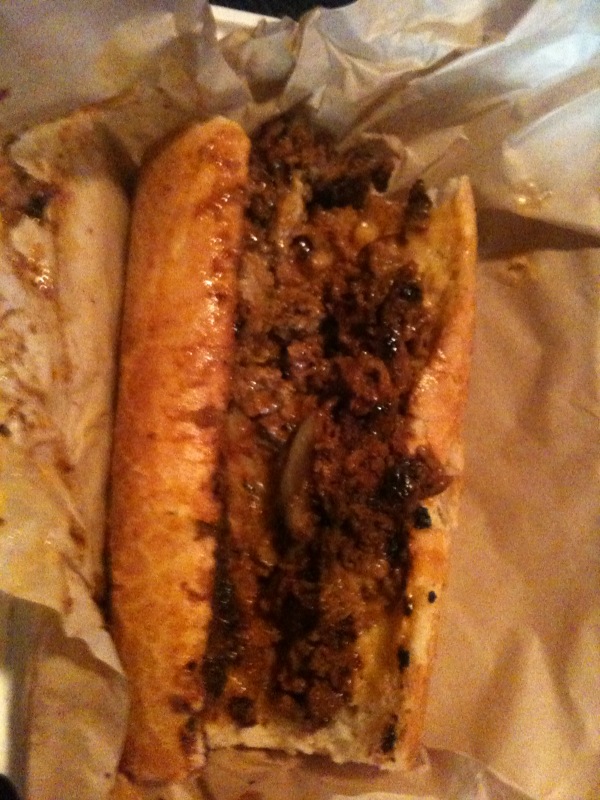
The sandwich: Spicy pork kim-cheesesteak from the Kimchi Taco Truck, 46th and Lexington on Fridays, elsewhere other days.

The construction: Korean spiced pork tenderloin with Cheez Whiz and kimchi on Italian bread.

I had the choice of Cheez Whiz or provolone, as is often the case with cheesesteaks. I chose the former because I had reservations about the way provolone would go with kimchi. The guy in the truck offers spicy or mild sauce as he bags your order; I asked for one of each. More on that to follow.

Important background information: Kimchi is a Korean side dish of spicy, fermented vegetables — usually cabbage.

I don’t think I’ve ever had a cheesesteak of any variety made with pork before. I’ve obviously had regular ol’ steak cheesesteaks, and I’ve had a bunch of chicken cheesesteaks too. But somehow I never thought of or had the opportunity to eat one made with pork. So there’s that.

I ate this sandwich on Friday, when, as I mentioned, I was quite busy. There was a bit of a line at the truck, and it turned out for whatever reason sandwiches take longer than other orders. I did a lot of standing around waiting for this sandwich, then once I got it, I was already late for a session at the studio to tape some Minor League Reports that’ll roll out next week. I had to hustle up five streets and across four avenues, all the while concerned that the studio guys were getting pissed at me and my sandwich was getting cold. This was a high-anxiety sandwich.

What it looks like:

How it tastes: Hell and yes.

When I got to the studio, I threw the sandwich down on the table they use for Daily News Live, unwrapped it, photographed it and took a bite. I secretly hoped our guys would have some sort of technical problem that might give me more time to convene with the sandwich. They didn’t. I got pulled away from it two bites deep. And I couldn’t complain; I’m the one that showed up late.

I knew from the first bite that this was a great sandwich, but I don’t think I realized quite how great until I had to step away.

Now I have to stand here so you can adjust the lights when that delicious thing is staring at me, just barely out of reach? Can’t we get a crash test dummy for this?

There’s a familiar flavor in Korean barbecued pork that I can never precisely identify. It’s a sweet, almost smoky flavor; I think it’s a combination of something and ginger. I want whatever that something is so I can bring it home and pair it with ginger. It’s a really good flavor. And this sandwich had a lot of it.

It was difficult to distinguish the kimchi flavor from the pork, and the Cheez Whiz mostly served as a creamy bonding agent for the meat and cabbage, creating a uniform texture throughout the inside of the sandwich: A big, delicious pile of vague Korean pork goo.

The mild sauce didn’t add much; it also got drowned out by the amazing pork flavor. But when I added the spicy — a peppery red sauce that tasted like a more liquefied Sriracha — holy hell. A perfect complement to the sweetness of the pork.

The sandwich got all the texture it needed from outstanding bread, crispy and flaky on the outside, toasty and soft on the inside. Even after it sat out on the table for a while, the roll held strong under the grease from the cheese and pork.

I stole bites between takes. Video producer Jeff had to keep reminding me to slow down when I read from the TelePrompter. Easy for him to say; he didn’t have an amazing sandwich waiting.

When I heard that phone-in guest Toby Hyde needed to finish something up and wanted a little more time before we filmed his parts, it was about the best news imaginable. I powered through the end of the still-warm sandwich. If the segments were framed differently, you’d notice a continuity error: a stain would appear on my right pants leg for the parts of the segments with Toby on the phone, then disappear during the wraps. Luckily my pants are not in the shot. Unluckily they are stained with delicious sandwich. Hazards of sandwich writing.

What it’s worth: Cost $7 and maybe a mile walk, plus a little bit of stress.

How it rates: 91 out of 100. Not an inner-circle Hall of Famer, but undoubtedly a deserving one. It has been added to the sidebar.