
Dignity in humanity’s demise

Watson has lots in common with a top-ranked human Jeopardy! player: It’s very smart, very fast, speaks in an uneven monotone, and has never known the touch of a woman.

Ken Jennings.

A few big takeaways from the Jeopardy! IBM Challenge: First, the first two days of the show were kind of annoying. The computer’s cool and all, but show the circuits and move on. I tuned in to watch Jeopardy!, not an IBM commercial.

Second, clearly Watson’s big advantage was on the buzzer. At some point it became clear that Jennings and Brad Rutter were just trying to buzz in as quickly as they could and then think of the answer, just to beat Watson to the draw. That didn’t seem entirely fair; there were plenty of clues that Watson didn’t know or got wrong, but the computer got the opportunity to buzz in first on almost every answer on which it was confident. I wonder how it would have fared against Jennings and Rutter in a written trivia quiz, like bar trivia or something (and yeah, I realize it was designed to play Jeopardy!).

Third, Ken Jennings is awesome. He’s hilarious on Twitter, for one thing. Also, upon conceding to Watson in Final Jeopardy!, he referenced the Simpsons — “I for one welcome our new computer overlords.” Awesome. Plus it turned out it was Jennings’ initial run of remarkable Jeopardy! success that inspired the Watson project in the first place; a bunch of IBM designers were eating in a restaurant trying to come up with something awesome to do when they noticed everyone in the restaurant empty into the bar to watch Jennings dominate some suckers. That begat Watson.

I’m disappointed and a little surprised that machine beat man in the IBM Challenge, but at least Jennings has a good sense of humor about it. Plus they say the computer’s going to help humanity in the long run, so that’s cool.
You’re purchased?

The Wilpons said they will not sell a controlling stake, and Trump isn’t known to be a passive investor.

“That’s been the rumor,” he said.

Asked whether he would consider investing without gaining control, Trump responded: “I haven’t thought that far down the line. We’ll see what happens.”

Major League Baseball has rules against casino ownership by its team owners, which could prove an impediment if Trump chooses to make a deal with the Wilpons.

“If I can help, great,” Trump said. “And it not, that would be OK.

Ronald Blum, Associated Press.

A couple people asked me about this so I figured I should weigh in. My opinion: Meh.

Sure sounds to me like another case of, “Hey, here’s a famous rich guy with ties to New York, let’s ask him if he wants to buy the Mets” and then the famous rich guy being like, “well, now that you mention it, I am really rich, and I do like being famous, so let me say nothing particularly committal to see if I can get my name in the headlines for a couple of days because I so enjoy that.”

In other words: I’d be pretty surprised if Donald Trump ends up with a minority or majority share of the Mets anytime soon. For one thing, and as I’ve said before, there are lots of non-famous rich people out there who are probably equally likely to buy a share of the team (and who would presumably be more content to be silent partners) as any famous rich people. Second, I bet that casino thing is a pretty big deal for MLB. The league does not look kindly upon involving the sport with gambling.

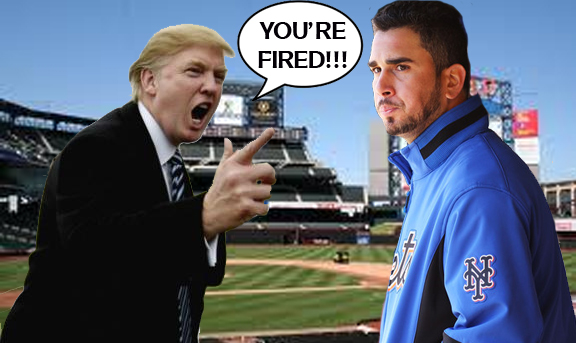
People seem to have pretty strong opinions about Trump one way or the other, but I haven’t followed enough of his business ventures or TV show to know much about him besides that he’s got silly hair and seems like something of a blowhard. Some say he singlehandedly ruined the USFL. While I go read about that, enjoy this Photoshop from reader Glenn:

OK, help me here

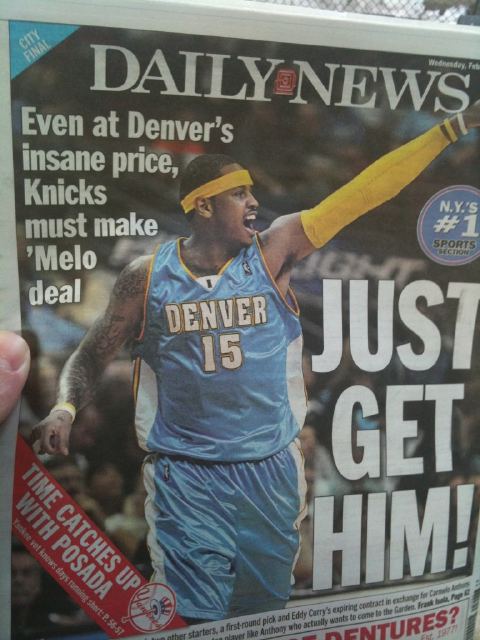
The back cover of my Daily News this morning:

The article inside explains what the cover says: Even though the Nuggets’ asking price is “insane” — three starters, a draft pick and Eddy Curry’s expiring contract — the Knicks must trade for Carmelo Anthony.

OK, I’ll admit that I’m far from an expert in the workings of NBA front offices and I’m consistently baffled by the salary-cap maneuvering and everything else, so help me out here: Why is it so advantageous for the Knicks to get Anthony now?

Put aside for now the idea held by some that Anthony is overrated, a one-dimensional scorer. For the purposes of this discussion, let’s amount that he’s a great player who will help the Knicks win and will absolutely deserve the max contract he’ll soon receive from someone (either in free agency or as a more lucrative extension).

So to acquire ‘Melo now, the Knicks would reportedly have to give up five valuable properties including three starters, all of whom are pretty young and pretty good. Replaceable? Probably, but probably not with guys currently on the roster. Chauncey Billups, rumored to be part of the deal, would help.

But the Knicks are currently above .500 in February for the first time in lord-knows how long, and appear in good position to make the playoffs as currently constructed. ‘Melo brings in marketing dollars and sells tickets and all that, and I suppose that’s a consideration. But he has stated, I believe on multiple occasions, his interest in joining the Knicks.

Doesn’t that mean they’d have a pretty good shot at landing him this offseason, when the price would only be money? And couldn’t they always take their chances with their current squad, then try to trade for and extend Anthony between the end of the season and June 30, when the cost in players will presumably be much less?

It kind of reminds me of this thing, again. Trading for Anthony now is giving up an “insane” package for a few months and the exclusive right to sign him to an extension, when you might very well be able to secure that same right after the playoffs end or just sign him as a free agent in the offseason. Am I missing something? Does Donnie Walsh’s apparently tenuous hold on his position somehow factor in?

About anonymous sources

Are there any real journalistic standards when it comes to identifying sources and are sports reporters following those standards anymore? I always thought that some insight into how the source may have gotten the information and/or their motivations for disclosing the information was required.

I mean we hear so much of stuff like “a source within baseball” or “a source close to the negotiations” these days, which tells us nothing at all about the source or the potential reliability of their information. Aren’t they required to provide at least some sort of background on the source?

– Chris, via email.

Good question. I didn’t go to journalism school so I never learned any ethical guidelines for that type of stuff. I consulted friend of TedQuarters and one-time Award Winning SaxaCenter Program correspondent Gina, who did go to journalism school, and she said it all depends on the editor and the specific case. That seems to make sense.

From what I understand, a good deal of anonymous sources in baseball — especially when it comes to contract negotiations — are agents or employees of the agent, or as they’re better known, “sources with knowledge of the negotiations.” A couple years ago, Rich Lederer at BaseballAnalysts.com did a nice job running down the details of one apparent association.

So as Chris suggests, it’s right to be skeptical of any anonymously sourced story. Keep in mind always that the source probably has a reason for divulging the information beyond just wanting to see his words in print. Since all baseball journalists — and really all journalists, I suppose — compete for pageviews, editors are likely less motivated to pull a juicy tip out of a story even if it comes straight from an interested party.

But since we’re all here on the Internet craving information, I’m not even sure it’s a bad thing. It is what it is, as they say. The onus falls on us to sort out which journalists (and sources) are more credible and to try to determine who’s feeding what to whom. Then we digest all the information and form our own opinions.

It’s b.s. that I still have to pay for my own shoes

Erin Andrews, who signed an endorsement deal with Reebok last month, is not the only ESPN personality or member of its “College GameDay” team to have a contract with a major shoe company.

Chris Fowler, Kirk Herbstreit and Lee Corso have deals with Nike that Corso described as a joint arrangement that largely involves speaking engagements for the athletic shoe and apparel company.

Richard Sandomir, New York Times.

Sandomir goes on to investigate whether the endorsement deals present conflicts of interest for the ESPN personalities. Honestly I can’t imagine it could really be that big a deal unless, while discussing highlights of Cam Newton running all over the SEC, Lee Corso started yelling, “It’s gotta be the shoes!” or something.

The big issue here is that I still have to pay for my own shoes like some sort of chump and/or sucker. I’ll have you know, Nike, that I keep a sports and sandwich blog of moderate repute and host a modestly regarded web-based baseball video series. Also, since we’re on the topic, Nike, I never wear your sneakers because they don’t fit me right. So either you make the Air Ted Bergs custom-fitted to my feet or I take my talents to Saucony.

Speaking of: Saucony, we can do this right now. I’ve been wearing your Jazz sneakers almost exclusively in all non-athletic sneaker-requiring situations since the turn of the Millenium. And now they’re hard to find at the mall and I have to order them at Zappos. That’s the type of commitment to your product that should be rewarded with an endorsement deal, I think. Just send me free sneakers and I’ll tell everyone how comfortable they are, and how they help make my size-13 feel look at least vaguely proportional to my 5’10” frame.

Same goes for you, Dr. Marten. I know your monopoly on the goth-kid market crumbled sometime in the early 1990s, but I’ve been wearing your oxfords to work since I stopped having jobs at which it was acceptable to wear Sauconys. We can make this happen. I am the host of the Baseball Show for cryin’ out loud! I WEAR YOUR SHOES WHILE I TALK TO CERRONE ON SKYPE! That’s a landmark sponsorship opportunity.

I never made a conscious decision to just keep buying the same shoes once a year every year, it just kind of happened. At some point in the late 1970s my dad apparently did the same thing.

A.J. Burnett goes all Rickey, except of course for the ridiculously awesome at baseball part

I look back on it and I’m not saying A.J. Burnett is the reason we didn’t win the World Series, nothing like that. But without being cocky and arrogant, I think if I would have pitched up to my par it would’ve been a lot smoother going into the postseason and we’d have had a lot better chance. I really felt, damn, they really could’ve used A.J.

A.J. Burnett.

Burnett goes on to refer to himself in the third person twice more in the same Daily News article, for an impressive total of four. Not bad, sir.

Also of note: Burnett and his wife both find the band Disturbed worth traveling for.

Food for thought

We all know at this point that long-term contracts for pitchers are very risky; after all (to paraphrase one of your recent posts), pitchers get hurt a lot.  Given that fact, let’s entertain a hypothetical scenario: Let’s say an ace hits the free agent market in his prime, and teams are lining up to woo him.  Conventional wisdom says that, most of the time, the team that ponies up in dollars and years will get the prize, right?  Well, what if a rogue team took a different approach, and instead of offering, say, a six-year, $140m deal, offered a three-year, $90m deal instead?  What do you think would happen?  Would the pitcher scoff at the lower total contract, or would he be interested in the higher annual payout and the lure of another round of free agency in three years?  I’d bet the pitcher would at least think twice about it.  As for the team offering those terms, it would be mitigating the risk of injury to the player; it would save itself money in total dollars committed; and it would have greater flexibility in player personnel decision making in the medium-to-long term.  Food for thought.

– Nate, via e-mail.

Hmm. Hmmmmmmmmmm. That is some tasty food for thought.

It seems like a reasonable enough idea that I’m trying to figure out why it hasn’t happened. I suppose it mostly depends on the pitcher: If he has been so thoroughly injury-free that he and his agent are confident he will be healthy in three years, a deal like that would make  a lot of sense for him. Of course, if that were the case, the team would also probably be reasonably confident that the pitcher would be healthy in three years and might prefer to lock him up for less money per year over a longer term.

I guess the only even vaguely comparable situation is when Roger Clemens signed a couple of massive part-year deals with the Astros and Yankees in 2006 and 2007 (Ed. Note: And he is BAAAACK!), but in those cases I’m pretty sure it was Clemens limiting the length, doing his own version of the Favre festering-boil thing, only in Clemens’ case with an actual festering boil.

Otherwise, maybe it has something to do with the way teams want to structure payouts? As Mets fans have all now seen, teams can invest and earn interest on the money they owe players in the latter years of contracts, so perhaps it behooves the team to avoid giving a player so much money so quickly?

But really, I don’t know. If I had to guess, I would figure it is the agents — smart enough to vote down a confident player who believes he’s invincible — that get in the way of that type of deal. They probably convince the pitchers — rightfully — that they’re in a dangerous trade, and that the security of a $140 million deal (in this example) is better for them and their families. But I’m probably missing something. Some union thing? Any ideas?

Until recently, CC Sabathia ate Cap’n Crunch every day

Turns out the secret to CC Sabathia’s 25-pound weight loss this winter was another guy with the same initials.

“Not eating Cap’n Crunch every day,” Sabathia revealed when asked what changes he made to his diet to help him trim down from 315 lbs. to 290 since the end of last season. “I’m actually what it says on the back of my card.”

Mark Feinsand, N.Y. Daily News.

Wow.

I’m in no position to judge anyone for his dietary choices, it’s just a bit surprising to me that anyone would waste so much space and calories on Cap’n Crunch. It’s not even close to the Top 3 sugary cereals. Those are, in order: Lucky Charms, Cinnamon Toast Crunch and Golden Grahams. And I avoid even those, because if I’m going to destroy my body it’s going to be with bacon dammit, not breakfast cereal. I generally start my days with a bowl of Kashi Honey Sunshine, which is actually shaped just like Cap’n Crunch, and is clearly not as good for me as it purports to be because it’s decent-tasting.

Cap’n Crunch reminds me of dog food, and for a very specific reason: My late dog, Muffin, ate Cap’n Crunch for breakfast every morning even though no one else in my family did. I don’t really know how it started — I was 7 or so — or why we had the cereal in the house to begin with, but she wouldn’t even eat Purina or whatever she was supposed to eat. She just wanted Cap’n Crunch. Also: Burgers. Dog ate a lot of burgers. Shockingly, she weighed twice as much as she should have and eventually died of dog diabetes. Good dog, though. Very chill. Slept a lot.

Anyway, good for the big fella for dropping down to his listed weight. No idea if it will actually impact his pitching at all, but you figure it’s got to help with his already impressive stamina.

Never bet against Ken Jennings

At Brad’s and Ken’s gods-throwing-lightning level, the difference between winning and losing usually isn’t mental agility, but the ability to time the milliseconds between the moment Alex finishes the clue and one of the producers activates the buzzers, slamming your thumb down with either (a) near-perfect reflexes at the off-camera lights telling you the buzzers are go, or (b) a near-perfect guess at the off-stage producer’s timing.

Since a computer can obviously react to the “go” lights more rapidly and consistently than any human, it will probably win. My two cents, anyway.

The only alternative I can imagine is if Watson is given a human-like randomness in buzzing of a few milliseconds, but there’s no report I can find of any such delay. Apparently, if its algorithms generate a feeling of suave cockiness, dudebox can buzz in instantly.

Combined with Watson’s inhuman inability to forget anything or stress out, I don’t see how any mere primate has a prayer. (And that’s a measure of the amazing accomplishment of IBM’s engineers. Big applause to them. Still, the human ego has a fallback: as Ken has noted, Watson still couldn’t write a clever Jeopardy! clue to save its backside bus.)

Jeopardy! champion Bob Harris, Boing Boing.

This is a good point, and good insight into how that works. Any Jeopardy! fan will tell you there’s a rule that you can’t buzz in until Alex Trebek is done talking, but I never was quite sure if there was some sort of prompt or what. Turns out it’s a light. That explains the delay before contestants buzz in for audio and video clues, too.

But I am not betting against Ken Jennings in a Jeopardy! match, whether against man or computer or beast or whatever. Remember that he is the O.G. Jeopardy-dominating machine, and as far as we know he is yet to glitch out.