Bill Gates’ “obsession with polio”

Recently, Richard Horton, editor of The Lancet, the influential British medical journal, said via Twitter that “Bill Gates’s obsession with polio is distorting priorities in other critical BMGF areas. Global health does not depend on polio eradication.” (The initials are for the Bill & Melinda Gates Foundation.)

And Arthur L. Caplan, director of the University of Pennsylvania’s bioethics center, who himself spent nine months in a hospital with polio as a child, said in an interview, “We ought to admit that the best we can achieve is control.”

Those arguments infuriate Mr. Gates. “These cynics should do a real paper that says how many kids they’re really talking about,” he said in an interview. “If you don’t keep up the pressure on polio, you’re accepting 100,000 to 200,000 crippled or dead children a year.”

Right now, there are fewer than 2,000. The skeptics acknowledge that they are arguing for accepting more paralysis and death as the price of shifting that $1 billion to vaccines and other measures that prevent millions of deaths from pneumonia, diarrhea, measles, meningitis and malaria.

Donald G. McNeil Jr., New York Times.

Pretty fascinating read from the Times on Bill Gates’ efforts to eradicate polio. The argument raised in the excerpt suggests that Gates is so focused on ridding the world of one disease that he’s missing opportunities to save many more children than might fall victim to polio.

Of course, Gates disputes those assertions, and it’s probably best to defer to Bill Gates when math is involved. To his credit, it seems reasonable that though eradicating the disease now may be extremely tedious and expensive, ending polio would ultimately save a lot more children for less money than palliative care of other illnesses now.

Also, it seems odd to me to insist that a man who’s donating billions of dollars to a worthwhile cause donate those billions of dollars to some other worthwhile cause. Perhaps Gates would really like to be remembered as the man responsible for ending polio. There are worse legacies.

Finally, allow a haphazard segue: On the Colbert Report last night, Dr. Paul Offit mentioned the 500,000 Americans who cannot be immunized for medical reasons and need to rely on “herd immunity.” I am among that 500,000. If you’re basing decisions on whether to immunize yourself and your family on something you read in a sports and sandwiches blog you’ve got other problems. But if you’re looking to put a face on the large group of people that stand a better chance of enjoying a happy and healthy life if you get all your shots, feel free to use this handsome one.

Some stuff about Ben Roethlisberger

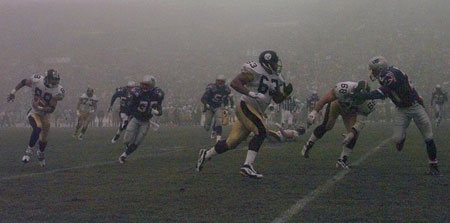
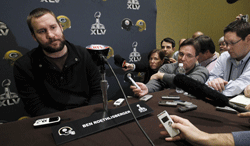
For the marquee attraction of media day is Ben Roethlisberger. The Steelers’ quarterback will again face questions about his four-game suspension for violating the NFL’s personal conduct policy resulting from an alleged sexual assault on a drunk, underage coed in the bathroom of a Georgia nightclub. This was his first step on his road back to Super Bowl glory. These questions and the way Roethlisberger answers them – or doesn’t – will be another part of the alleged redemption process. It’s not like Roethlisberger hasn’t had to answer questions on this subject before. The difference here is the interview is not being conducted in a police station or some locker room. Tuesday’s session will be held on the biggest of all stages inside Cowboys Stadium. And unlike situations where he’s strictly dealing with football media, the interlopers Golic dismissed will be asking questions about Roethlisberger’s controversial, sleazy past. “That’s why he needs to show regret, but determination as well,” said a public relations executive who counsels athletes and media honchos. “He has a chance to reach a wider audience. He needs to be humble and respectful.”

Bob Raissman, N.Y. Daily News.

The thesis of Raissman’s column, I’m pretty sure, is: The way Ben Roethlisberger responds to media inquiries today about his alleged sexual assault of a 20-year-old girl in March will show whether he has learned a lesson from all the fallout from that event.

So begins an inevitable week-long what-the-f**k-athon, in which sports reporters everywhere feel obligated to mention Roethlisberger’s recent history, but carefully avoid coming right out and calling him a rapist since, as we know, he was ultimately not charged with anything besides violating the NFL’s nebulous personal-conduct policy.

It is hard to fault the columnists in this case. Roethlisberger is the quarterback on a Super Bowl-bound team. If they ignored the pesky detail of his sexual-assault charge wholesale, we’d accuse them of whitewashing their coverage, of ignorance, and maybe of some subtle racism too. But if they assume guilt where the courts and cops could not prove it, they sidle up toward libel, and that’s also bad.

So we’re left with suggestions that the way Roethlisberger handles the media during Super Bowl week has any bearing at all on how he now feels about, or what he may have learned from his alleged misbehavior, even though it doesn’t. And implications that if he helps the Steelers win the Super Bowl, Roethlisberger will redeem himself to the city of Pittsburgh, even though no one ever claimed he raped Pittsburgh.

Unlike the standard NFL offseason marijuana-possession arrest, the crime for which Roethlisberger was detained and questioned had a real victim, a college student that — without recanting her accusation — asked the district attorney not to pursue charges against the quarterback out of concern for her own privacy.

And so it’s somewhere between puzzling and terrible that the same media types that have no trouble drumming up sanctimony over allegations of performance-enhancing drug use tread lightly around similar sentiments when covering a guy accused of sexual assault. I’m not one for sweeping value judgments, but I can say without hesitation that rape is worse than using steroids. Way, way, way worse.

Again, we don’t know what Roethlisberger did or didn’t do in Milledgeville, Georgia. We know there is a lot of evidence and a group of eyewitnesses that suggest he attempted to either intimidate or force a drunk girl into having sex with him. It is an act and a behavior that lies so far outside the boundaries of sport that it’s plain absurd to expect the outcome of a game — no matter how big — or the content of an interview to demonstrate anything meaningful about the perpetrator’s past and future conduct and lifestyle.

But I suppose that doesn’t make for a good story or a compelling column.

Lunchmeat superstar

Prosciutto di parma and jamón ibérico might hog all the porkcentric attention, but what some chefs are really excited about these days is a bit more déclassé. Mystery meats like pork roll and Spam are making somewhat subversive inroads on inventive menus around town, spurred on by both the quest for novelty and a nostalgic embrace of regional-American roots.

Robin Raisfeld and Rob Patronite, NYMag.com.

I’m all for more access to a larger variety of meat products, processed or otherwise, so I welcome the presence of these supposedly subversive options on fancy menus. But I will say that Taylor Ham’s inclusion here among mortadella, SPAM and bologna does not speak well for the Jersey favorite I have not yet tried.

SPAM is not my thing and I haven’t enjoyed bologna since I was 10 years old. And mortadella grossed me out more consistently than any product outside of head cheese and olive loaf at the deli. I just don’t get it at all. It’s like bologna, only with big chunks of visible fat and totally random-seeming pistachios throughout. What the hell are pistachios doing in my lunchmeat?

I should say that an egg and cheese sandwich with a slice of grilled mortadella and a little hot sauce isn’t completely terrible, but it’s the type of thing you’d only want to eat if someone ordered it at the deli where you worked and then never picked it up, which happened one time, which is how I know.

Still gotta try that Taylor ham. One of these days, Jersey. One of these days.

The pros and cons of prospective part-owners

A number of candidates have emerged as potential suitors for the 20-to-25-percent share of the Mets the Wilpons are supposedly selling. Should Mets fans be rooting for any in particular to buy a piece of the team? Let’s investigate:

Vodka maven Martin Silver: As part-owner, Silver could be an entertaining side show in boring seasons. He has a thing for publicity stunts, which could perhaps forebode some Veeck-esque promotions at Citi Field. Another upside: He has access to an absolute ton of vodka. Plus he’s a lifelong Mets fan.

On the other hand, Silver wants a say in the day-to-day operations of the team and has previously said he would offer up decisions to Internet voting, which means we would say goodbye to all the best players on the Mets while a Joe Benigno-led junta cheered their departure because they were soft or unclutch or bad in the clubhouse. Also, Silver plastered pictures of his own daughter’s ass on Georgi ads all over city buses. That’s weird.

Vitaminwater founder Mike Repole: Repole obviously knows a thing or two about business, as he and his partners sold Vitaminwater to Coca-Cola for over $4 billion. And he loves the Mets and hates the Yankees.

But Repole has said that one of his goals in life is to be the GM of the Mets, and the Mets already have a GM that appears plenty competent. Also, another of his goals is “to win the Kentucky Derby and the Triple Crown,” and that’s redundant. Plus, he made a fortune convincing people that sugary fruit drinks are good for them. That’s shrewd by business standards but perhaps not so tempting to the Wilpons if they’re looking to avoid future dealings with those prone to chicanery.

Martin Luther King III: The upside is that King is above reproach, mostly because you’re not allowed to say anything bad about someone named “Martin Luther King.” I think that might be in the constitution. I can’t tell you the downside.

Dawson’s week

I can’t say I’m all too worked up about the upcoming balloting for the football Hall of Fame. It’d be cool if Curtis Martin got in because he was a great Jet and all.

But if I had to come out in support of one candidate, there’s no doubt whom I’d pick: Dermontti Dawson, the former Steelers center. Got to give the linemen some.

Dawson made seven straight Pro Bowls in the 90s. He wasn’t big by the standards set for NFL offensive linemen, but he had great feet, he positioned himself perfectly and he always seemed among the smartest players on the field. By the latter part of the decade, the Steelers relied on Dawson to pull and serve as lead blocker on most of their sweeps and screens — rare for a center.

Since I did the same in high school (also in the late 90s), I emulated Dawson as best as I could. Needless to say, I wasn’t as good.

Big East gone nuts

As you may have heard by now, the unranked St. John’s men’s basketball squad beat — nay, destroyed — the No. 3-ranked and nationally reviled Duke team yesterday at Madison Square Garden.

On Saturday, No. 21 Georgetown beat No. 8 Villanova in Philadelphia. No. 23 Louisville beat No. 5 Connecticut in Connecticut. Unranked Marquette hosted and beat No. 9 Syracuse. And No. 2 Pittsburgh eked out a three-point win over unranked Rutgers.

The Big East is crazy this season, as it is seemingly every season nowadays. I have nothing more insightful to say, I just wanted to point it out.

Sandwich of the Week

I ate a bad sandwich from a good restaurant on Friday night. I was going to write about it, since I figured at the very least it would shut Russ up about all the sandwiches being rated in the 80s.

But I realized a couple things: I liked the place and the people there seemed friendly, plus all the other food I had was good, so I’m not eager to rip it in print. Second, Sandwich of the Week is to revere the greatness of sandwiches, not lament their shortcomings.

So I went out Sunday and found a sandwich worth celebrating.

The sandwich: Chili Cheese Dog from Hubba, nee Pat’s Hubba Hubba, nee Texas Quick Lunch on Main St. in Port Chester, N.Y.

The construction: A hot dog split lengthwise and grilled with chili and American cheese on a hot dog bun. I added ketchup.

Important background information: Hubba is a tiny storefront on a main drag in Port Chester, a cramped space consisting only of a long counter with about 10 stools. The walls are papered in bills, most of them American dollars, many of them marked on.

I understand Hubba’s is a popular late-night spot, but there was only one party there when I entered and I’m pretty certain it included Tim Teufel. That is to say I saw Tim Teufel and his family eating at Hubba. (Should I not write this? Is this too TMZish?) I didn’t say anything; the last thing I want to do is bother Teufel while he’s enjoying greasy, chili-smothered food with his family. But then I realized I’ve actually spoken to Teufel on multiple occasions and there was some reasonable chance he recognized me.

That made me feel a little uncomfortable. I didn’t want to insult Teufel’s intelligence by assuming he didn’t remember me, but at the same time I recognize Tim Teufel probably meets a fair share of reporters and that I probably resemble any old schmo who might be alone in a greasy spoon on a Sunday afternoon, waiting on a chili-cheese dog. And there was some chance it was just some guy who looks a lot like Teufel, since Teufel’s not exactly Gheorghe Muresan in terms of distinctiveness of appearance.

Because the thought of sitting down next to Teufel — remember it’s a small place so there weren’t any other seating options — and either acknowledging him or not acknowledging him was too awkward to handle, I scrapped plans to eat in Hubba and placed my order to go. Then I stood and tried to estimate how many dollars were on the walls and ceiling. I figure it’s about a couple thousand.

Then I thought, wait a sec, Tim Teufel was on the ’86 Mets. No way a world champion should be paying for his own chili dog. Isn’t that part of the deal? My understanding is you win the World Series and everything you ever eat within a 50-mile radius of the home stadium is free. That seems reasonable, at least.

But by this point I had already paid for my order and the guy was putting my food in a bag, and plus I had no idea how to smoothly offer to pay for Tim Teufel’s meal (without paying for the rest of his party, because if Teufel’s wife wanted a free hot dog she could have gone 4-for-9 with a homer in a World Series too). So I bailed and went to chow down in my car.

Incidentally, if you had told me five years ago that in 2011 I would spot Tim Teufel in a hole-in-the-wall hot dog place and it would prompt professional awkwardness, I would have marked you as a crazy person.

What it looks like:
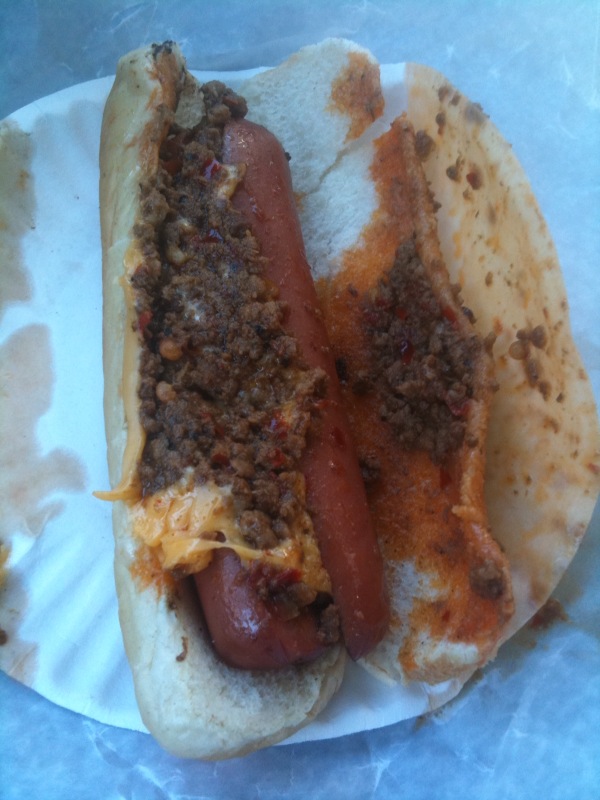

How it tastes: It’s a chili-cheese dog, for sure. And that’s obviously a good thing.

The chili is the highlight. It’s pretty much just ground beef, grease and really finely chopped hot peppers, with some seasoning that turns the grease orange the way it is when you make tacos at home with one of those kits. It’s got a good bit of spice to it, and because there are no beans and the peppers are cut so small it essentially has a consistent texture, which makes it a good topping.

The cheese tastes like American cheese. Obviously it complements the chili and hot dog well, because, you know, chili cheese dog.

As for the wiener: Splitting hot dogs lengthwise and grilling them seems to be a Westchester thing, and it’s one I appreciate. It usually — or at least it is intended to — give the hot dog a little more snap, a quality which, to me, separates the great hot dogs from the bad and the merely OK.

At Hubba, though, the dog itself is a bit soft, even after grilling. It’s not bad — the flavor is good and appropriately hot-doggy — it just doesn’t have much crunch to it.

With the ketchup adding sweetness, the salty hot dog and the spicy chili and creamy cheese combined to provide a pretty excellent array of flavors in each bite. This is a very good sandwich, even by chili-cheese dog standards.

What it’s worth: Super cheap. It’s not a ton of food, mind you, but the chili-cheese dog and a decent-sized order of fries ran me only $5. Not sure how it broke down, to be honest.

How it rates: 77 out of 100. This is a tasty sandwich, but for something as straightforward as a chili cheese dog to reach Hall of Fame or near-Hall of Fame levels it would have to far exceed my already high standards for chili cheese dogs with near-perfect execution. And that means a snappier hot dog. Still delicious and certainly a meal worthy of a world champion Met, but it didn’t do enough to distinguish itself from other great chili cheese dogs I’ve had. In other words: Call me when you’re Ben’s Chili Bowl.
Prospective Mets owner proposes worst idea ever

A lifelong Mets fan and season ticket holder, Mr. Silver organized a team of investors in 2009 after the team gave poor performances both on the field and financially.  He offered a multimillion dollar pledge and changes such as a computer-based system of voting for Mets fans, which would have been the first time in history that a baseball team would be ruled by popular opinion the internet.  Georgi Vodka is number one selling vodka in New York State, and Star Industries sells over a hundred different brands of liquor.

– Press release

I can’t tell which parts of this press release are tongue-in-cheek and which are serious, but basically this guy — Martin Silver, the owner of Georgi Vodka — announced his plans to make an offer to buy the Mets. He’s holding a press conference tomorrow at Jack Demsey’s bar in Midtown at 11:30 a.m.

I guess the upside to making roster decisions based on Internet voting would be that my job would suddenly seem much more important. The downside is the way that would inevitably shake out. And I mean no offense to anyone — I’m not saying I’d vote for the right decisions either.

Twitter Q&A-style product

Yesterday, when stuck for topics for this blog, I asked Twitter for help with suggestions and questions. Here are two:

If you haven’t heard, Gil Meche retired rather than continue to collect way too much money from the Royals to be a subpar or injured pitcher in 2011. Though he was owed $12 million, Meche said he didn’t feel right accepting money he wasn’t going to earn, even if the Royals understood the risk when they signed him to a big contract before the 2007 season.

What Meche did sounds noble, for sure, and it is such a distant outlier in the realm of regular human behavior that it has prompted a lot of hullabaloo the last couple of weeks. Mets fans, for one, are wishing that Ollie Perez opts to do the same.

But though that would be nice, neither Perez nor Meche should have any obligation to return money to the team that signed them. I never agree when fans fault players for the size of their contracts — the player should want as much money as he can possibly make, it’s the GM’s fault if it proves to be way too much.

Meche suggested he simply didn’t feel right taking money he didn’t deserve, and I appreciate that sentiment. But did he retire with the understanding that the Royals would re-invest his salary in the team? Because giving money back to an enormously wealthy person — Royals’ owner David Glass — seems a bit weird too.

I won’t into too much boring detail, but SNY is part-owned by Comcast and technically I am a Comcast employee. When news of the NBC/Comcast deal first came down over a year ago, I got a package at my house with a letter essentially saying, basically, everything’s cool, nothing’s changing for you and we should all be excited.

Something along those lines. I didn’t really read it all that closely; I was distracted because with the letter came — as special gift celebrating the deal or something — DVDs of Kindergarten Cop and The Bourne Ultimatum.

I figured they must have just sent an army of interns down to some DVD liquidation warehouse somewhere in the bowels of NBC and had them all shove two random movies into every package. And so I thought it was pretty funny that I happened to get Kindergarten Cop and The Bourne Ultimatum, since the former is absolutely hilarious in every way and the latter is a sequel and thus a funny thing to randomly send to someone.

Then  I came into work the next day and asked some of my co-workers what movies they got, and they all had Kindergarten Cop and The Bourne Ultimatum too. Why those two movies? You figure it had to be an overstock thing, right? But then does that mean they so overstocked those two movies that they had enough to send them to every Comcast employee? How many copies of Kindergarten Cop could they have possibly produced?