So it goes

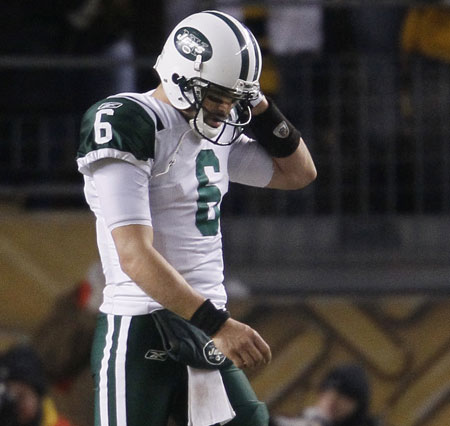
So that’s the end of the Jets’ season then. I suppose if you’re a Jets fan and you’re reading this you don’t need a recap. You’re probably already replaying all the different little things that might have made the five-point difference that cost Gang Green the game: Mark Sanchez’s fumbling, Ben Roethlisberger’s scrambling, the ridiculous play-calling down on the goal line.

Whatever. What happens happens, I suppose, and there’s no real sense playing the what-if game now. I imagine Brian Schottenheimer will emerge as the goat for this one, for passing the ball twice when the Jets needed a yard to score, for the miscommunication with Sanchez over play calls, for eyebrow-raising decisions all season long.

It’s disappointing, of course. But somehow not as disappointing as it would have been if they just rolled over and died in Pittsburgh like it seemed they were about to. And two straight seasons in the AFC Championship is nothing to sneeze at.

The good news is Rex Ryan will be back and Sanchez will be back and D’Brickashaw Ferguson and Nick Mangold and Darrelle Revis will be back. People like to say the Jets are a “win-now” team because they do have a bunch of old players. But their core — their best players — are still in the thick of their primes.

Of course, first things first, we have to know there’ll be football at all next season before we worry about Jets football. But then I have a feeling things will get hammered out. Everyone involved stands to lose a whole lot of money if there’s no football.

Anyway, now we get the Packers and Steelers in two weeks and then less than a fortnight until pitchers and catchers. Hold your head up, Mark Sanchez. Your Taco Bell is on me.

Sandwich of the Week

This sandwich, from a pizza place, comes on recommendation from former intern Jimmy, a former pizza-place employee who knows a thing or two about pizza places. Incidentally, if you’re a college student eligible for college credit, you too could have the opportunity to work here for no money and recommend sandwiches to me — especially if you have a background in web design or programming. I don’t hire our interns, but if you email me your resume I’ll put it in the right hands.

The sandwich: The “Tuesday” sandwich from Previti Pizza, 41st St. between Park and Lexington in Manhattan.

(Note: This sandwich is only available on Tuesdays and Thursdays. I don’t know what happens if you go in and ask for it on a Wednesday, but you could always try and then fall back on the delicious-looking pizza if you can’t get it. Plus if they have a Tuesday sandwich then it stands to reason they probably have a Wednesday sandwich, and maybe that’s really good too.)

The construction: Roast beef with jus, fresh mozzarella cheese, garlic butter and sour cream and onion potato chips on house-baked bread.

Yeah, you read that right. Sour cream and onion chips. On the sandwich.

Important background information: I am Italian and I love garlic. One time I smoked a bunch of garlic cloves in my home smoker, and though I intended to use them in more involved concoctions, I wound up just eating most of them as snacks. When a recipe calls for garlic, I generally double the amount. My wife and I have spent time discussing whether anything could really be too garlicky, since I’ve never reached that mark with anything I’ve made at home.

What it looks like:


How it tastes: Really good, and really garlicky. Maybe on the cusp of critical garlic, that ever-elusive “too garlicky” distinction. Not quite there, because it was still quite tasty. Just don’t plan on spending your afternoon making out with anyone who hasn’t also eaten this sandwich.

The bread is the highlight here. I’m not sure if it’s just a ball of pizza dough baked to crispiness and sliced in half or not — it tastes like it could be — but it’s got a great, crispy crust and a nice doughy inside that soaks up all the roast beef and cheese juices. It’s clearly fresh, and it comes piping hot. The one thing, though, is there’s some sort of powdered seasoning on the outside part of the bread that gets all over your fingers and also might be responsible for taking this thing up to that garlic threshold. Salty, too.

Inside the sandwich, the roast beef, cheese, potato chips and garlic butter all kind of ooze together into a delicious meatcake. Because it’s all hot, the roast beef is more toward the well-done side and doesn’t have that rare redness on the inside that a lot of roast beef enthusiasts are partial too, but then if you’re looking for a sandwich that emphasizes the roast beef your probably in the wrong place. The essence of this sandwich is the combination of textures — crispy bread, meaty beef, gooey cheese, crunchy chips — and though you can taste all the elements, the most powerful flavor, by far, is the garlic.

The sour cream and onion chips, I should mention, are an inspired addition. They don’t hold perfectly hold their crunchiness because of all the juices inside the sandwich, but then there’s a heck of a lot of crunch from the crust of the bread anyway. And the seasoning gives it a nice, familiar, potato-chippy aftertaste. Really clutch for those of us who like to accompany sandwiches with potato chips, because now you don’t even have to bother opening the bag and eating them one by one, they’re already on there so chow down brother.

(Incidentally — and I know this sounds gross — crumbled up Nacho Cheese Doritos go pretty well on a hot dog. Try it before you judge it.)

What it’s worth: It came with a can of soda, and I believe it ran me $8. And since it’s right near Grand Central and I ate it for lunch on a day I was coming in late, it wasn’t really out of my way at all. Certainly well worth the cost — especially when you consider the price of lunch in Midtown.

How it rates: Russ from programming is going to get on me about this, but I’ve got to put it in the 80s. It clearly needed something more to make the Hall of Fame — perhaps some sweet element like a marinara? — and maybe a bit less saltiness and garlic flavor. But it was still really good, as all sandwiches in the 80s are.

That’s the thing — I normally eat way more sandwiches than I review here, so only the notable ones get written up. I bring a sandwich for lunch most days that’s probably in the 50s. I had a sandwich from the deli around the corner last night that was probably high 60s. I imagine sandwiches could be charted on a bell curve of excellence, so there are more sandwiches in the 70s than the 80s and more sandwiches in the 80s than the 90s. So shut up, Russ. Also, that meeting you run is excruciatingly boring. You should consider PowerPoint or a musical interlude or bringing in the Knicks City Dancers or something. 83 out of 100.

The thrilling conclusion

Although the analysis is complicated, the lessons it teaches us are straightforward. Streaky seasons undoubtedly exist, but it appears that there is no such thing as a streaky or unstreaky player. Rather, the truth seems to be that all players are streaky players. Being human, they have their ups and downs, and they are inherently streakier than random chance would dictate. They are not dice, and they are not random number generators. If Murray Chass ever read Fangraphs, I’m sure he’d be thrilled to hear that. But, again, there is no evidence whatsoever to suggest that a player who is especially streaky in one season will continue to be so in the next.

Seth Samuels, Fangraphs.com.

The conclusion of Seth’s research I’ve mentioned here several times. Read the whole thing because the analysis is interesting and the scatterplot is money.

If park factor is so important, why don’t they put it on the scoreboard?

Citi Field is a damn joke.

Jeff Francoeur.

OK, Jeff Francoeur, I don’t want to come off as mean-spirited here or anything so please, don’t take this the wrong way. But here’s the thing, bro: You’re a terrible hitter.

Not terrible by regular human being standards. You’re definitely a better hitter than I am; I could never drive a 95-mph fastball 370 feet, something you’ve accomplished on numerous occasions. But by Major League standards, and the standards generally set for Major League corner outfielders, you’re just straight-up bad, dude.

Like, awful. Out of 26 qualifying right fielders in 2010, your wRC+ — probably the best offensive stat we have, even if it’s not on the scoreboard — was dead last. And by a lot. Actually, if we tally up all the stats from 2006 when you came into the league, you’re still at the very bottom of the list. Way below Kosuke Fukudome, way below Randy Winn, way below the pathetic shell of Shawn Green that the Mets trotted out in 2006 and 2007. You are baseball’s worst-hitting right fielder, by far.

That stat, I should add, is adjusted for the park in which you play your home games. Your struggles had nothing to do with Citi Field, and everything to do with you. You swing too much, and every pitcher in the league knows it. You’re doing it wrong, sir.

You can blame your struggles on any exterior source you want. And indeed, the Mets’ home park appears to be a difficult one in which to succeed offensively. But if the stadium’s dimensions were the source of your offensive inadequacy, why, I wonder, were nearly all of your teammates much better than you at hitting?

You can say anything you want about Citi Field, but — and again, I’m not trying to be mean because I understand you’re a really nice guy — you are the joke.

Honestly. At this site and many others, we laugh at your expense because you’re so bad at hitting and so good at somehow staying in the Major Leagues. Start thinking of factors you can blame in Kansas City — I don’t know, too much barbecue, maybe — because you’ll almost certainly need to explain why you don’t hit in 2011 either.

Whatever

Excuse me for not caring much one way or the other that Terry Collins named Mike Pelfrey his Opening Day starter, something that sparked at least a little bit of bluster in the blog- and Twitter-sphere yesterday.

I suppose, yes, it’s early to do so, but then pitchers are creatures of schedule and they’ll need to start mapping out the Spring Training rotation to line up with the regular season soon enough.

And Pelfrey is at the very least the most proven of the starters likely to be in the Mets’ rotation, since R.A. Dickey and Jon Niese have only a year apiece of Major League success and Chris Capuano and Chris Young are coming off injury. I don’t think anyone’s expecting to pitch like Johan Santana just because he’s technically the No. 1 guy in the Mets’ rotation.

Again, like so many annoying arguments in baseball analysis, it comes down to silly and meaningless labels. Pelfrey shouldn’t be handed the Opening Day starter’s job because that’s for True No. 1s and Pelfrey is not a True No. 1. What is that? As long as he’s healthy coming out of Spring Training, he’s going to be in the rotation, right? So what difference does it make if he starts Friday, April 1 or Sunday, April 3?

Jerry Manuel would say — and did a bunch of times last year — that because of schedules the No. 1 pitcher will often match up with the opponent’s best. Problem is, that’s not really true.

The Mets’ Opening Day starter last year, Johan Santana, matched up with opponents’ Opening Day starters eight times in 29 starts in 2010. Take out Opening Day — when it is inevitable — and it happened once in every four of his starts. And one of them was Vicente Padilla and another was Zach Duke.

You’re hardly condemning Pelfrey to run a gauntlet of Hall of Famers by starting him on Opening Day. And it’s not like they have any pitcher that’s obviously better suited than Pelfrey to run a gauntlet of Hall of Famers anyway.

If the Mets are going to compete in 2011, it’s very likely they’ll have to do so with depth in the rotation but without a brand-name capital-letter True Ace Starter, at least not before Johan Santana returns from surgery. And since Pelfrey has proven himself durable and capable of pitching deep into games, he’s as good a choice as any to pitch the opener.

Now this

It’s a loophole for the athlete – turning drug tests into intelligence tests. You have to be stupid to fail one. The benefits of deer antler – or more specifically the substance IGF-1 that comes from it – are clear. IGF-1 is banned by everyone.

“It’s one of the proteins that is increased in human growth hormone … it’s considered performance-enhancing,” Danaceau said.

“It’s similar to HGH in that it aids in recovery. It helps build tissue, and strengthen tissue – more than you can ever do by training alone. Any preparation that is not naturally occurring is banned. Taking IGF-1 through deer antler is banned as well.”

Dan Wetzel, Yahoo! sports.

This story comes via Craig Calcaterra: Apparently pro athletes are spraying freeze-dried ground-up liquefied deer antlers into their mouths as a performance enhancer. And some lab director who works with the World Anti-Doping Agency is certain that this is bad.

I have many questions.

First of all, who the f@#$ thought to grind up deer antlers and turn the powder into mouth spray to be sold to professional athletes for $68 a bottle? Damn. That’s a living if I’ve ever heard of one.

Second, before we go about banning it and getting all sanctimonious, do we even know it works? I mean, are any international anti-doping agencies investigating the use of those silly Phiten necklaces?

(Hey, everyone: I’ve got an amazing new diet potion for you. It’s crystal clear and it tastes just like water, but if you combine it with an exercise regimen and a strict, low-calorie diet I guarantee you will lose weight! And now it can be yours for only $10 a bottle. Call me!)

And even if spraying ground-up liquefied deer antler into your mouth really does help you recover faster from injuries, why exactly should that be illegal? By Danaceau’s definition, it’s because it’s “not naturally occurring.” But are 3,000-calorie protein shakes “naturally occurring”? Vitamin pills? Tommy John surgery?

I guess the point is, if there’s no evidence that something is dangerous or even at all effective, I don’t understand why we assume it’s bad. Plus, athletes are perpetually going to be one step ahead of the testing.

Yes, it’s important for sports’ governing bodies to enforce restrictions on drugs — or anything, really — that endanger their athletes. But those efforts would probably be a lot more effective if they educated their athletes about exactly how the products jeopardize their health, and if there’s no evidence that they do, then I don’t understand what’s exactly wrong with them.

More Yankee weirdness

It’s not my team. I don’t own it. They do. I’m a big boy. . . . In any job you better be prepared for every decision to not go your way. That’s part of being an employee. There were internal debates and discussions on it and disagreements in terms of how you should proceed, and ultimately Hal’s in charge of making the final call in what he feels is the best direction at that time frame. He made that call. This is Hal Steinbrenner’s and his family’s franchise. It’s not mine and it’s never been, obviously.

I’m in charge of making recommendations, and there’s a chain of command that certainly was followed. But this is not something that was done without me being aware of it. I had my say.

Brian Cashman, on the Rafael Soriano signing.

Beyond the obvious comparison to be made with the Mets — with all the hand-wringing over meddling ownership — this is just straight-up weird.

I’ve certainly heard it suggested before that a team’s owner has overruled the GM in contract negotiations (Vernon Wells in Toronto and Eric Byrnes in Arizona come to mind), but I’m not sure I’ve ever heard a GM explicitly say he didn’t advocate a deal.

Maybe Cashman’s just being completely forthright here, since he does have a habit of letting certain would-be private details spill out into the press. But I wonder why he’d be so eager to distance himself from the contract, even if it is one that would be irresponsible if signed by any of the 29 teams with finite resources.

If I resist speculating about the Mets’ internal politics without concrete evidence, I should extend the Yankees the same courtesy. But certainly this suggests that Cashman is not operating with the autonomy I previously assumed he had been since George Steinbrenner’s health started failing.

Prince is awesome

I saw Prince last night at the Garden. There’s a lengthier recap here, but here’s what you need to know:

Prince is awesome. He dances like Michael Jackson with the showmanship of James Brown and the guitar playing ability of, I don’t know, Slash maybe. It’s crazy. If you have an opportunity to see Prince, see Prince.

Dispatch from Mets Fantasy Camp

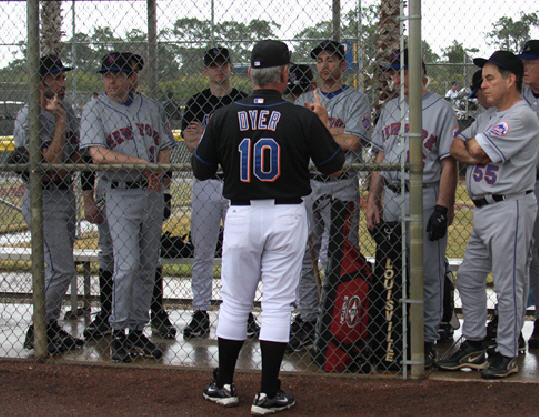
On Friday afternoon in the batting cages at the Mets’ Minor League facility in Port St. Lucie, Fla., Tim Teufel pitches to a righty-hitting college-aged kid in blue mesh shorts and a t-shirt.

A clutch of guys in Mets jerseys looks on, but none among them can peg down the identity of the kid. They know his name is Mike and that he’s not among their ranks at Fantasy Camp. They think the kid knows Teufel. One says he’s Teufel’s son. Another suggests he’s Teufel’s son-in-law. A third says he’s Teufel’s son’s friend. No one is certain.

But they see that he is awesome. He lashes line drive after line drive, every ball darting off his bat toward left-center field, slicing into the cage’s net and pulling it taut against its supports, then ricocheting back near where Teufel is throwing.

His contact produces a Major League sound. It is something different than the clichéd “crack of the bat.” That familiar sound, at stadiums, is filtered by distance and crowd rumble, limiting the spectrum of noise that hits the eardrum.

Here, up close, you can hear the sizzle and whoosh as the kid’s hands and bat and the ball all speed into the zone at the same time, then an oaky baritone report when they all come together. Thwock, thwock, thwock. It is magnificent.

“You know what’s wrong with this kid’s swing?” one camper asks another.

“What?”

“Nothin’.”

Only Lenny Harris sees something amiss. The familiar pinch-hitter extraordinaire, fresh off his own BP session in the next cage over, stops Teufel and jumps in the cage. The kid, he says, is cheating forward with his lower half before he swings, costing him balance — presumably passable in batting practice but the type of thing good pitchers will eventually exploit.

“You see it, Teuf?” Harris asks. Teufel nods and steps over to the batter’s box. He explains the importance of keeping flexible through the hips, swiveling his own as he does so. A few of the Fantasy Camp group chuckle; they have enjoyed a brief, exaggerated version of the Teufel Shuffle.

Harris pulls over a tee to teach the kid — and Teufel — a drill to help hitters stay back in the box. The kid hits more line drives toward left-center, shots that look and sound a lot like the earlier ones. Harris, a Minor League hitting coach these days, can see the adjustment, and he seems satisfied.

In the next cage over, one of the camp-goers takes his cuts off Pete Schourek. Long and lean and probably in his early 30s — one of the youngest in attendance — his swing appears steady, if lacking power. But he is missing the ball, swinging over it. The few he connects with veer straight down into the artificial turf.

Jim McAndrew walks into the area from one of the back fields. He watches the hitter struggling, then speaks up.

“Put your bat on your shoulder,” he says.

The guy looks confused, and a bit tentative. Little League coaches everywhere earn their pay reminding hitters to take the bat off their shoulder. Now, a member of the 1969 Mets — a pitcher, no less — is telling him otherwise. He pulls his hands in uncomfortably close to his body, elbows bent so tight his forearms almost graze his biceps, then swings and misses again.

“No, no. Just place the bat on your shoulder. Relax,” McAndrew says. The guy heeds his advice. Line drive.

The people at Mets Fantasy Camp are dentists and lawyers and doctors and teachers in real life. They range in age from about 30 to 70. Most of them are men, but there are a few women peppered throughout. Most come alone, but there are some kids and wives and parents milling about. They have in common only a love of baseball and a learned understanding that Major League Baseball players are really, really, really good at it.

The former players, too, seem to delight in the sport as much as the campers do, and the place becomes like a weeklong mid-Winter celebration of its grandeur. It’s January, and you’ve missed baseball. Here, you watch baseball, you play baseball, you talk baseball, you revere it.

“After October, you just kind of sit around,” says Al Jackson, a veteran of some 50 years in various positions in professional baseball. “This gets you ready for Spring Training. It breaks up the monotony.”