Final Frenchy Tracker

Unless there were some N.Y. newspaper sidebars I couldn’t dig up on Google News, the Frenchy Tracker stopped dead in its tracks at eight.

That means Francoeur did finish the ALCS with an impressive 5:4 at-bats-to-articles ratio, and enjoyed only four times as many features as he did times on base in the series.

In the meantime, the Frenchy Tracker has been misconstrued as some kind of personal attack against Francoeur. It certainly is not. I have nothing personal against the man, only something against watching him hit.

More, the Frenchy Tracker only meant to reflect my wonderment with Francoeur’s ability — through smiles and charisma — to convince the media of his value to his club as a baseball player, and the media’s willingness to look past all the evidence suggesting otherwise.

I find it vaguely amazing that Francoeur still plays baseball and has not yet entered the world of politics. It strikes me that he is way, way better at making people like him — a skill, no doubt — than he is at laying off breaking balls. I suppose baseball pays better.

Anyway, here are your eight Jeff Francoeur articles from New York papers during the ALCS, in case you want to revisit the series through the prism of Francoeur:

Oct. 14: Jeff Francoeur happy to be playing meaningful baseball in New York…
Oct. 14: Francoeur enjoying life with Rangers
Oct. 14: Francoeur Misses his Friends but is Happy in the Playoffs
Oct. 15: Francoeur thrilled at shot to star in Texas
Oct. 15: … ex-Met Jeff Francoeur finds grass is greener in Texas
Oct. 16: Francoeur finds a role in Texas
Oct. 19: Francoeur fitting in nicely for the Rangers
Oct. 21: Jeff Francoeur says mistakes cost Rangers in Game 5…

Wither the Phillies?

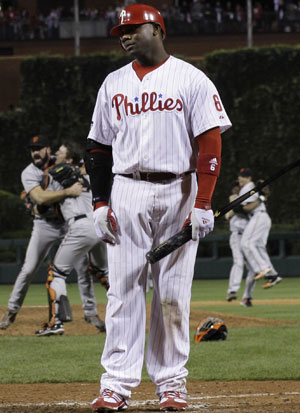
Optimistic Mets fans everywhere, this one included, spent all day Sunday considering the symbolic value of Ryan Howard’s caught-looking strikeout that ended the Phillies’ 2010 World Series hopes. “Just like Beltran,” we said, hoping Howard and the hated Phils would suffer the same fate Beltran and the Mets did after the 2006 NLCS.

The Situations were far from identical, of course. The Phillies won the World Series in 2008 and got back there in 2009. Howard earned the love of the Philadelphia fanbase with three home runs in that series, and — though these things can turn quickly — probably will not soon suffer the same nonsensical and misdirected hostility from the fans and media that Beltran endured.

Many Mets fans tend to overrate the Phillies’ intangibles (underrating at the same time their very-tangibles). The Phillies have been the bad guys in the N.L. East for four seasons now, so we look at them like they’re 25 T-1000s, ignoring their humanity and trumpeting their apparent inability to be destroyed, citing their arrogance and their will and their remarkable capacity to overcome injuries.

But no team is invincible in a five- or seven-game series, and though Brian Wilson hardly cast the Phillies into a vat of molten steel, that 3-2 slider on the low-outside corner reminded everyone that the Phillies might not be so mighty after all, and inspired columns like this one and this one examining wounds in their mechanism that might not heal themselves instantly.

(OK, enough of that metaphor. </terminator2>, if you will.)

Truth is, the Phillies will still have Roy Halladay, Roy Oswalt and Cole Hamels at the front of their rotation next year, and a trio that good makes them unlikely to collapse completely. And if we — me — here at TedQuarters are unwilling to accept that Beltran and the Mets became magically unclutch and weak-willed upon the Wainwright curveball, we must recognize that the same will be true for the Phillies.

But since we’re in a celebratory mood, we can look down the road with rose-colored glasses on and find more important similarities between those Mets and these Phillies.

Those Mets locked up a ton of payroll in some longterm deals that rendered them financially inflexible. These Phillies already have $143 million spent for 2011 and and $89 million committed to seven players in 2012. Both clubs thinned their organizational ranks with a series of trades aimed to help at the Major League level. Injuries, you already know, took their toll on those Mets teams. Jimmy Rollins and Chase Utley, both on the long side of 30, both missed time with injury this year.

So though it’s probably silly to expect the Phillies to fall apart as dramatically as the Mets did in 2009, it is certainly reasonable to expect that they won’t be able to dominate the division much longer.

The Braves, I am concerned, could be a problem.

Sandwich of the Week

The thing about making pulled pork, it turns out, is that then you have an absolute ton of pulled pork you get to eat. That’s a good thing, no doubt, but it requires a pretty serious commitment to pork-eating. You don’t want any of that pork going bad — especially not after you labored over it for 13 hours or whatever — so you’re going to have to come up with a bunch of ways to prepare it: pork tacos, pork and eggs, creamed pulled pork on toast, pork chili.

None are better than the O.G. pulled pork sandwich, though. I had this for five consecutive non-breakfast meals.

The sandwich: Pulled pork sandwich from the TedQuarters kitchen.

The construction: Smoked pulled pork on potato bun with sliced pickle, barbecue sauce and cole slaw.

For the buns I used Martin’s hamburger buns, a good, consistently soft potato bun. The sliced pickle and cole slaw were store bought. The sauce is something I sort-of made. It’s what barbecue guru Steve Raichlen calls a “doctor sauce,” made by combining other barbecue sauces then adding honey, vinegar, apple juice and spices. The recipe is here. I recognize it’s not a traditional Carolina-style barbecue sauce that would typically top this sandwich, but I had some left over from an earlier barbecue project and thought it was pretty delicious.

Important background information: I fear that sandwiches are never quite as good when you make them yourself as when someone else makes them for you, even if you are — like me — unbelievable at making sandwiches. Still delicious, mind you, but I think there’s something deep inside our minds that knows the sandwich is a significantly less convenient meal if we’ve had to construct it from its elements, which in turn makes us appreciate the sandwich ever-so-slightly less.

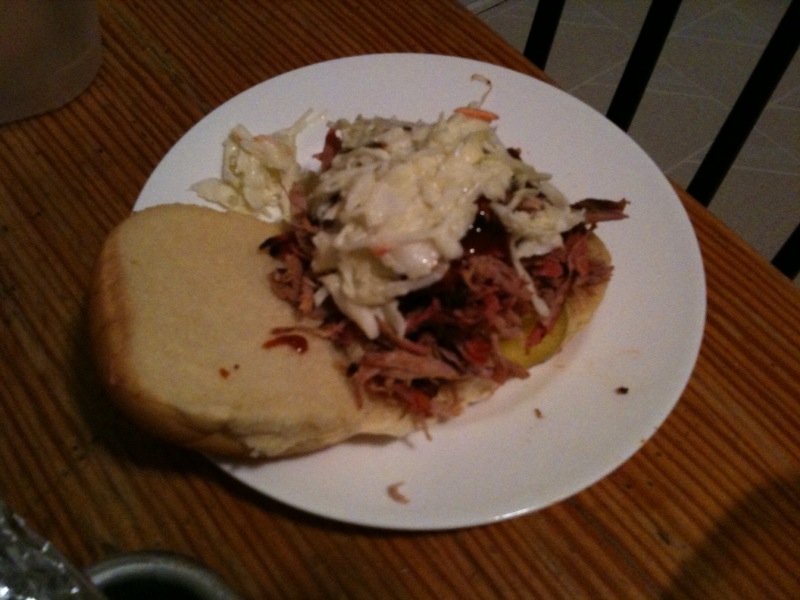
What it looks like:
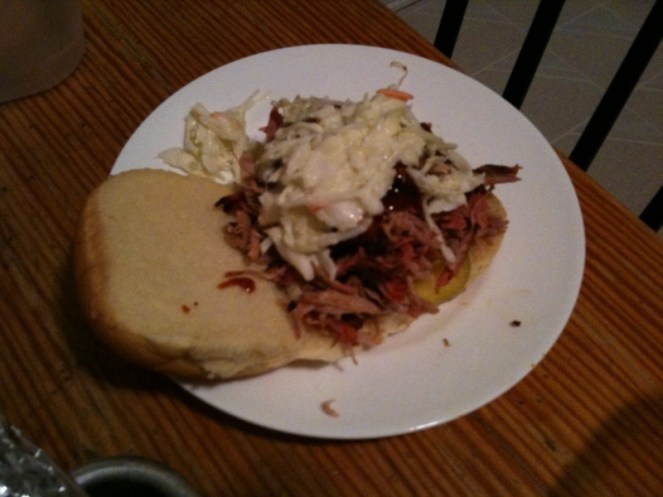
How it tastes: Good. The pork is outstanding; really caught a lot of the smoke flavor without being overwhelming, and the cut of pork itself turned out to be moist (read: fatty) throughout. The crusty outside parts add nice spice from the rub and some variance to the texture. Real delicious stuff we’re talking here. I mean, it’s pulled pork.

But despite that, and despite tasty and fresh ingredients throughout, I never managed to make a Hall of Fame sandwich in the five pulled-pork sandwiches I endeavored. Maybe if I were preparing them for guests I would have gone a little further to make sure the pork was warm, the barbecue sauce was room temperature and the pickle was crunchy, but at home, negotiating all the ingredients from my refrigerator, I don’t know. I guess I knew the sandwich was going to be awesome if I just piled on the right proportions of each ingredient — and don’t get me wrong, it was awesome — but I never took the type of care I should have to maximize its sandwich potential.

I think the pickle was at least part of the problem. I used sandwich-stacker pickles that had been sitting in my fridge for months, so they were never really crunchy. Plus I think I would have been better off with a couple slices of bread and butter pickles or something, which offer more skin, more surface area, and so, more crunch. The cole slaw — which was good, but unexceptional, just cole slaw — adds some crunch, but the pork is so soft that it’d be nice to have it bookended by crunchy things, and the pickle didn’t pull its weight. Plus it sogged up the bun with pickle juice. Delicious, delicious pickle juice.

The bun was really good though. So was the barbecue sauce. Honestly, if you’re bored, try that recipe. It’s easy to make and spicier than most barbecue sauces (depending on what rub you use, I suppose), plus adding all that vinegar really gives it some tang.

What it’s worth: The pork wasn’t all that cheap and there was a lot of labor involved here, but the pork butt yielded so much meat that the total cost of this sandwich, to me, was probably less than $3. Pretty amazing when you think about it. All you need to do is spend 13 hours smoking a pork butt and commit yourself to only eating pork for a week.

How it rates: 80 out of 100. A tantalizing sandwich with the potential to be an all-time great, but sidetracked by poor work ethic and unable to maximize its talents. There are a ton of baseball players like that, but not many I can find from North Carolina. So I’ll call this the Otis Nixon of Sandwiches, even though Otis Nixon is probably not an 80, but mostly because I’ve always wanted to create “the Otis Nixon of Sandwiches.”

Mets narrow search

We are bringing back Josh Byrnes and Sandy Alderson for a second round of interviews with Fred, Saul and me. Josh is scheduled for Monday and Sandy for Tuesday as we continue our search for the next General Manager of the Mets.

John Ricco and I spoke personally with Allard Baird, Rick Hahn, Logan White and Dana Brown earlier today to thank them for their interest and taking the time to interview with us.

– Jeff Wilpon, Mets press release.

First of all: Cool. Byrnes’ record in Arizona isn’t perfect, but he seems like a better choice than, well, Allard Baird. This article from 2008 provides some background.

Second: Is it weird that we keep hearing every detail of the Mets’ GM search directly from the Mets? Do other teams do stuff like this?

From strictly the blogging perspective, it’s a hell of a lot better this way than sorting out endless anonymously sourced rumors and speculation, I suppose.

On Davis for Fielder

Matt Cerrone brought up the Ike Davis-for-Prince Fielder debate that I touched on nearly a month ago, and now debate over whether the Mets should make that deal (should it even become available to them) is spreading through the blogosphere.

Here’s your answer: No.

That’s not because Davis is currently a better player than Fielder or because I believe Davis will certainly be a better player than Fielder soon. Fielder is one of the league’s best hitters, and the Mets should be thrilled if Davis ever puts up an offensive season as good as the one Fielder posted in a down year in 2010.

Davis can boast superior defense and a body that appears better suited to long-term success, which mitigates the difference between the two players at least a little. But Fielder now has four years’ worth of evidence to show he is a great offensive player and is still only 26, so he’s a reasonably safe bet to continue being one of the league’s better power hitters into the latter part of this decade. Davis, coming off one season of just below league-average production for a first baseman, offers no such assurance.

It comes down to money.

Fielder is entering his final year of arbitration, meaning any team that acquires him will likely work to sign him to a contract extension at market rate, like the Mets did when they got Johan Santana.

I have no idea what it will cost to extend Fielder’s contract, but it won’t be cheap. Ryan Howard will earn $25 million a season from 2012-16. Mark Teixeira will get $22.5 until 2016. Miguel Cabrera — $19 mil and change through 2015.

Even if Fielder doesn’t command quite as much as his fellow young, slugging first basemen, he’ll inevitably require a hefty chunk of the acquiring team’s payroll for the multiple years.

Davis, meanwhile, won’t even be eligible for arbitration until after the 2012 season. If he continues improving, the Mets could look to buy out his arbitration years — a deal that would still likely be favorable to the team and well, well below what it would require to extend Fielder. Keeping Davis instead of trading for and extending Fielder would probably save the Mets at least $10 million a season in payroll into the second half of the decade, money that could be allocated toward free-agent signings that could more than make up the difference between the two players.

Throw in that Davis is, as mentioned, a much better defensive player and quite likely to improve, since he came to Flushing in 2010 with only 42 plate appearances above Double-A ball, and trading him for Fielder doesn’t even seem like a topic worth debating.

The final sticking point is that there remains some reasonable chance that Fielder and Adrian Gonzalez hit the open market next winter. Since the Mets’ chances of contention in 2011 appear long anyway, it seems crazy to dispatch one of their most valuable cogs in a trade now when they may be able to find an upgrade for only money next offseason, dangling Davis as trade bait then or forcing his once-discussed move to right field.

Patrick Flood on Sandy Alderson

A former lawyer and marine, he quietly might have been the most important baseball executive of the last twenty-five years. Front offices using sabermetrics? He introduced Billy Beane to Bill James’ work. Building a championship team simply by out-spending everyone else? Alderson might be indirectly responsible for the Yankees. Ever see umpires huddling up to discuss a call? Alderson encouraged them to do that when he worked for the commissioner’s office. Questec, the system MLB uses to grade an umpire’s strike zone, was also brought in by Alderson. His current job is cleaning up corruption in the Dominican Republic’s amateur player system, because Sandy Alderson is a man who Gets Things Done. In the future, there will be hoverboards; there will also be several interesting books written about Alderson’s influence over the game of baseball. He is an agent of change.

Patrick Flood, PatrickFloodBlog.com.

Flood makes a pretty convincing case for Alderson, who appears to be the fan favorite, the media favorite, and, at this point, the odds-on favorite to get the job.

Don’t count out a late push from Jimmy McMillan, though.

A-Rod once again unclutch

Through the first five games of this series, the Texas Rangers have succeeded for the most part in stifling Mr. Rodriguez, the Yankees third baseman. He has just three hits in 17 at-bats for a .176 batting average and hasn’t hit a home run.

Mr. Rodriguez, who earlier this year became the youngest player to reach the 600-home run mark, was supposed to have buried the notion that he wilted amid the pressure of October baseball. He batted .365 with six home runs in 15 postseason games last year, and Yankees manager Joe Girardi said Thursday that this season has been easier for Mr. Rodriguez because he hasn’t had to answer similar questions about his playoff performance.

Mike Sielski, Wall Street Journal.

The excerpted portion isn’t really a fair representation of Sielski’s piece, since it later examines the way the Rangers are approaching A-Rod and considers the possibility that he’s just not getting too much to hit.

But it’s completely baffling to me that A-Rod’s performance just last postseason didn’t seem to teach anyone anything about the nature of that stigma. Rodriguez now has a .927 career postseason OPS and a .958 career regular-season OPS.

I’m sorry this story sucks: Sample size. Sample size. Sample size. Even great players, the best of their generation, endure rough 17 or 28 at-bat stretches sometimes. When they are isolated and magnified by a short playoff series, we fixate on them and assume that they are somehow meaningful.

Also — allow an only tangentially related rant — Mike Lupica’s column on the same subject is epically Lupica-esque. Allen Barra produced this monumental and must-read bit of trolling earlier this week, exposing Lupica’s tendency to belabor the obvious, and it helped me grasp exactly why I find Lupica’s stuff so frustrating to read. In this particular piece he uses nearly 1,000 words to say, essentially, “A-Rod should hit a home run tonight.”

From the Wikipedia: Nachos

It’s International Nacho Day. Why? Well, I’ll have to consult the Wikipedia.

From the Wikipedia: Nachos.

The Wikipedia defines Nachos as “a popular corn based food of Mexican origin associated with Tex-Mex cuisine,” which really understates it, but whatever. The Wikipedia probably assumes everyone coming to Nachos’ Wikipedia page knows what Nachos are.

Nachos got their name from their inventor, Ignacio “Nacho” Anaya, the maitre d’ at a restaurant in a town on the Mexican side of the Texas-Mexico border called Piedras Negras. So when the Wikipedia says “associated with Tex-Mex cuisine” it means, literally, that Nachos are like the most Tex-Mexican thing imaginable.

Like so many great snack foods — the Buffalo wing and ice-cream cone come to mind — Nachos were born of necessity. A group of 10-12 wives of U.S. soldiers came into Anaya’s restaurant, hungry after a long day of shopping.

The restaurant was closed for the day and nearly out of food, but the enterprising Anaya made the women a snack from what he had left in the kitchen. He cut tortillas into triangles, shredded cheddar cheese over them, broiled them for a while to melt the cheese and brown the chips, then added sliced jalapenos.

He called the dish “Nacho’s especiales” — Nacho’s specials — and presumably the women were overwhelmed, because, you know, no one had ever eaten nachos before.

Nacho Anaya soon took his recipe to a different restaurant, then later opened a restaurant of his own. Word of nachos’ awesomeness spread swiftly through Texas, and they started showing up in cookbooks before the decade was out.

By the late 70s, nachos were well enough established in the Lone Star State that Texas stadiums began serving ballpark-style nachos, with the processed dipping cheese and everything. They gained exposure on the national stage thanks to Howard Cosell, who took to mentioning nachos on Monday Night Football broadcasts.

Nachos are now served with many toppings, way more than just cheese and jalapenos, and the Wikipedia page includes a list of the more popular ones. Nachos are now served all around the world and are delicious in most places. It sucks when nachos come with a disproportionate amount of toppings to chips or vice versa, but that’s not stated on the Wikipedia page.

Nacho Anaya died in 1975. There is a bronze plaque in Piedras Negras in his honor, presumably a worthy mecca for nacho lovers. After his death, the town declared October 21 — this day — the International Day of the Nacho. No word on why October 21, but I guess now seems like as good a time to be eating nachos as any.

What constitutes a quote?

This brings to mind a conversation I’ve had from time to time with coworkers: Are you quoting something if you don’t mean to do so? That is, if you use a direct quote from a movie/TV series/whatever, but are just using it to mean what it says, rather than as a quote per se? Like, if I’m frustrated with my office computer (as often happens) and I exclaim “COME ON!”, am I quoting GOB in Arrested Development if my intention isn’t to quote him, but simply to express my frustration? Alternately, am I quoting him if my intent is to express my frustration, but my inflection in pronouncing “COME ON!” is influenced by the way Will Arnett said it?

– Josh, comments section.

That’s a good question, and I don’t really have an answer. I guess it’s quoting, sort of. Some sort of late-period language acquisition?

Whatever, probably just semantics. What I know for sure is that I do this all the time. Sometimes I feel like I entirely speak in vague movie and TV references — allusions, Michael! — and I use the same Arrested Development Josh mentions with some frequency, as well as a bunch of others (most notably, “her?” and the way Tony Wonder says, “it’s f***ed up”).

On this site, I often use the construction, “because hey, (something good),” which is ripped off from Jack Handy but so entrenched in my linguistic toolbox that I no longer really consider the source.

But certainly the biggest pop-culture influence on my spoken (and maybe written) language are Adam Sandler’s first two albums — They’re All Gonna Laugh at You and What the Hell Happened to Me? — which I wore out in my youth. There are countless quotes from those albums that I started using ago with the appropriate inflection, but have since become so much a part of the regular arsenal of things I say that now they just sound, even to me, like me.

Frenchy Tracker update

Pretty poor job by the New York papers last night. Jeff Francoeur not only had a hit, but his trademark cannon-arm fired a costly error in the Yanks’ second-inning rally.

And yet we’re only treated to one Frenchy sider, courtesy of the Daily News. That puts the tally at eight, and it’s starting to look good for anyone who had the under on 20.

Shocked to read not a single recap of Francoeur’s stay in New York, with his old apartment and favorite restaurants and everything. Maybe those are forthcoming, or maybe — heaven forbid — the papers are actually going to focus on all the exciting real baseball stuff.

And if you’re the type of person who cares about these things — and I bet you are — Francoeur now has a grand total of 10 ALCS at-bats and two hits to only eight articles. This man needs a bigger stage.