Two-timing Chilean miner Yonni Barrios went from being trapped a half-mile underground to real trouble when the first person who greeted him after he was rescued Wednesday was his mistress — not his wife.
Barrios gave a smiling Susan Valenzuela a smooch seen around the world moments after he was released from the rescue capsule.
Smiling broadly even as the TV cameras broadcast his betrayal of wife Marta Salinas, Barrios did not appear perturbed that his love triangle had exploded into a soap opera with an international following.
Seriously? So the Daily News apparently set out to find the seediest possible angle to the most heartwarming story in recent memory, and the best they could dig up was that one of the 33 miners was separated from his wife and now has a new girlfriend. This gets the front page, with the incredible headline “HOLE-Y SNIT!” and an overlay reading “RED HOT IN CHILE!”
Amazing.
I mean, not to get all high and mighty or anything, but this guy was trapped in a f#@$ing mine for 70 days. Now you’re plastering the details of his personal life on the cover of a paper thousands of miles away? I don’t know what type of freaky escapade he’d have to endeavor immediately upon surfacing to get me to judge him, but it’d have to be something way, way more foul than kissing his girlfriend because he’s separated from his wife.
I love this newspaper. I really do. I know I rip it a lot here but it’s only because I read it every morning. I thought about splurging for the Times today because I knew not a lot happened in sports last night and I wasn’t all that excited to read even more about A.J. Burnett, but I’m so happy I stayed loyal. The gray lady covered the same story, but without the News’ trademark punch.
And it’s comforting to me to know that — though I haven’t checked — the Post has likely already assigned Yonni Barrios some ridiculous nickname like “The Cavern Casanova” and by tomorrow will be three cycles past his current marital issues and onto sordid details of the orgies he hosted in college or something.
To The Common Man, it suggests that perhaps TBS was asked not to make a big deal out of potentially missed calls. This would seem to jive with an earlier play in the San Francisco-Atlanta series, where Buster Posey was clearly out at 2B, but announcers refused to acknowledge it, in spite of the video evidence to the contrary (and Posey saying after the game “it’s a good thing we don’t have instant replay).
If this is the case, it seems likely that the commissioner’s office has made conscious decision not just to ignore the loud cries for expanded instant replay, but to tacitly suppress them by denying these voices additional evidence with which to make their case.
Calcaterra adds:
I thought the Posey thing was totally bizarre, and was made even more bizarre when Mat Winer, the studio host, said he thought Posey was safe and was basically laughed off the stage by David Wells, Cal Ripken and Dennis Eckersley. Winer would be beholden to a TBS/MLB mandate in ways that Eck, Ripken and Boomer really wouldn’t be.
So is there a conspiracy at play here? Did Major League Baseball ask TBS announcers to downplay discussions of bad umpiring?
I’m going to go ahead and say no.
Now perhaps I’m biased, since I’m occasionally the subject of similar conspiracy theories myself. And you must allow the small possibility that, as a representative of a team-owned network, I am part of the machine and have been assigned by Bud Selig to quash these rumors before they gain too much steam.
But that’s not actually the case, and I’m guessing neither Selig nor anyone in his office told anyone at TBS anything about what to say in the broadcast. I’d go with Occam’s Razor, like Calcaterra suggests.
If anything, I’d guess their producer told them that harping too much on a few bad calls diminishes the drama inherent in the actual sport part of the sport, which the announcers have to play up — not so much to benefit the league office as to keep people watching the damn broadcast.
Plus, the game’s moving forward; TBS has to show the next pitch, the broadcasters have to focus on what’s happening in front of them and all the folks in the production truck have jobs to do that might preclude them from replaying the same bad call ad infinitum.
Also, really fleshing this conspiracy theory out, I’m not sure it even benefits Major League Baseball to protect its umpires this October. If there are really going to be discussions about how to better umpiring and incorporate instant replay this winter, why enact some nefarious scheme that only works to the advantage of the umpire’s union?
Certainly it protects the product on the field, but Major League Baseball must realize that it has a monopoly on professional baseball, and it’s going to take a hell of a lot of bad umpiring before people start tuning out.
So I’m sticking with no. But of course, they could be paying me to write that.
How’s this for a suggestion? How about not spending anything, and keeping the roster mostly intact?
Let me clarify. While the Mets will surely not bring everybody back, with some trades and signings likely to happen, they should not invest much money into the 2011 roster….
By 2012, the Mets, with a year under a new GM and manager, will get an idea of the direction their franchise is heading. By then the Mets will have a concrete idea of where they should allocate their money.
Let’s get this out of the way first: metfandan74, you f#@$ing shill! Obviously the Wilpons put you up to this, poisoning the minds of the fanbase into thinking saving their money this offseason is a good idea. CLIFF LEE OR BUST!
Sorry.
Seriously, though, I’m glad this came up at Mets360 first because I’ve been trying to come up with a reasonable way to suggest something similar here. We’ll have plenty of time to delve into this during the proper offseason and obviously the first concern is hiring a GM. But the Phillies will return basically their whole club save Jayson Werth in 2011, and its hard to imagine any reasonable series of moves that would guarantee the Mets could contend in the NL East next season without the full health and productivity of the guys already on the team and without seriously jeopardizing their future.
There will be plenty of minor moves and roster tweaks to improve the team that should help the Mets’ chances in 2011 so I don’t think they should sit idly by all winter. We know enough about baseball’s whims to understand that every once in a while, everything just sort of falls right for well-constructed teams and squads that look great on paper break down, so there’s no sense throwing in the towel on next season before it even starts.
But the Mets, with so many contracts coming off the books after next season, will not only be in a much better position to spend come next winter, they’ll also have a much stronger sense of where they need to allocate their resources. Will Johan Santana ever return to being anything like Johan Santana? Will Jason Bay hit home runs again? Are any or all of Josh Thole, Ruben Tejada, Daniel Murphy, Lucas Duda, Dillon Gee and Bobby Parnell viable Major League contributors?
As it currently stands, the Mets look set for 2011 at first base, third base and shortstop. Bay’s contract means he’ll be slated to return in left field, even if the nature of his injury murks things up a bit. Angel Pagan should be back. Carlos Beltran we’ve discussed.
Mike Pelfrey, Jon Niese and R.A. Dickey earned spots in the 2011 rotation with their performances in 2010, even if Niese faded down the stretch. The bullpen will need help, but when doesn’t a Major League bullpen need help?
Thole’s first 90 Major League games have been good enough to earn him the benefit of the doubt for 2011, but the Mets would be wise to sign a catching complement good and healthy enough to play regularly if Thole falters.
They will certainly need at least one middle infielder capable of starting at second base while the club determines if one of Tejada, Murphy, Reese Havens, Justin Turner and Josh Satin could eventually man the position in the bigs.
And they’ll need starting pitching, too — someone to eat innings and take strain off the bullpen and depth to ensure that the last rotation spots are earned, not pre-ordained.
But none of those acquisitions should require the type of imprudent, big-ticket expenditure that fans will inevitably begin clamoring for the day after the new GM is named.
It’s not about rebuilding or retooling or re-whatevering. Don’t worry about labels. It’s just about doing what’s best to create a sustainable winner as swiftly as possible. And the way to do that, as we’ve seen, is not always to try to win as swiftly as possible.
Rebuilding the bullpen will be a tough nut for Andrew Friedman, but I don’t mean to be overly blasé about that when I say that bullpens come and bullpens go and the Rays have just as much of a chance of having a good one next year with a new cast as they do having it fall apart altogether—there is very little science in the collection of relievers.The Rays have pitchers in their system, including hard-throwing Tommy John recovery case Jake McGee (who can start but made it up to the pen this year) and can probably cobble something together out of minor leaguers and inexpensive free agents.
That leaves the arbitration-eligible players, whom the team might chose to non-tender rather than risk going to the mats. Jason Bartlett, B.J. Upton, and Matt Garza are due for insta-raises this winter. Reid Brignac, a better offensive and defensive player, can replace Bartlett without the team suffering at all. Losing Garza would hurt, but if the team can deal James Shields, that would leave some room to absorb his increased salary and slip the promising Jeremy Hellickson into the rotation. Failing that, Hellickson replaces Garza and the team prays for a Shields recovery.
Goldman makes a series of great points here about the Rays’ chances of competing again next year, most notably: That they probably will. Carlos Pena, like he points out, appears eminently replaceable. They’ll need to revamp their bullpen, but Goldman argues the case I’ve made here at least a dozen times — bullpens are fickle, and good ones can be constructed of flotsam.
The big loss, obviously, is Carl Crawford, an excellent player coming off a career year. The Rays will look to replace him with Desmond Jennings, a top prospect unlikely to produce anywhere near Crawford’s level for at least a couple of seasons.
The Rays might make up the difference by improving in the starting rotation, though, with top pitching prospect Jeremy Hellickson ready to replace one of their five starters, former top pitching prospect Jake McGee waiting in the wings, and pending top pitching prospect Matthew Moore primed to move quickly after striking out 12.9 batters per nine innings in High A ball.
The interesting thing about that for Mets fans is that the Rays will very likely part ways with one starter or another this offseason. Goldman suggests they might either non-tender Garza to save money or trade Shields.
Though I have no idea what it would take to get either — Garza in free agency or Shields via trade — the Mets’ next GM should be intrigued by whichever pitcher becomes available. Both are still reasonably young and both are dependable for 200+ innings, and both should stand to benefit from leaving the AL East.
But beyond the next few weeks, you have to wonder where this is all heading for Chamberlain. Even though Joba still occasionally cranked up his fastball to 95-96 mph this season, Yankee people privately admit that since injuring his shoulder in 2008, he hasn’t had the same life on his heater or the same bite on his once-unhittable slider.
It doesn’t mean Chamberlain can’t be effective. He finished the season with a 4.40 ERA, but that was due mostly to some blow-up innings in the first half. As Girardi said Tuesday, “He had hiccups just like everyone else, but his hiccups were usually a little bigger, lasted a little longer.”
Chamberlain was better in the second half, posting a 2.15 ERA over his final 30 appearances.
You can’t really blame Joe Girardi for slotting Kerry Wood above Joba Chamberlain on the Yanks’ postseason bullpen depth chart. After all, Wood posted a 0.69 ERA in 26 innings after joining the Yanks. Sure, he probably enjoyed a little bit of luck — he struck out an impressive 31 batters in that stretch but walked 18 — but it’s hard to argue with those results.
And I’ll add that, though Chamberlain’s average fastball velocity isn’t far off his mark from 2008 — it was 95.0 then and 94.6 in 2010 — as Harper asserts, there’s a chance that shoulder troubles have impacted its movement and effectiveness. Neither his fastball nor his slider rates as well as it did in 2007 or 2008, and he induces fewer swinging strikes.
But all that said, Chamberlain is still a good pitcher and there’s a whole lot of evidence to suggest he suffered a great deal of misfortune this season. He struck out more than a batter per inning and walked only 22 guys in 71 2/3 frames, and his FIP, xFIP and tERA were all more than a run lower than his ERA. And it’s easy to forget that he’s still only 25.
If the Yankees are silly enough to have devalued Chamberlain because of a rough season ERA-wise, some team would be wise to make a move for him this winter, expecting he’ll return to form. The Yankees usually don’t work like that, though.
The car is a project of Google, which has been working in secret but in plain view on vehicles that can drive themselves, using artificial-intelligence software that can sense anything near the car and mimic the decisions made by a human driver.
With someone behind the wheel to take control if something goes awry and a technician in the passenger seat to monitor the navigation system, seven test cars have driven 1,000 miles without human intervention and more than 140,000 miles with only occasional human control. One even drove itself down Lombard Street in San Francisco, one of the steepest and curviest streets in the nation. The only accident, engineers said, was when one Google car was rear-ended while stopped at a traffic light.
Autonomous cars are years from mass production, but technologists who have long dreamed of them believe that they can transform society as profoundly as the Internet has.
OK, a lot of stuff here. I’ve made no secret of the fact that I’m pretty much terrified of Google, for a variety of reasons. Their corporate mantra, after all, says, “Don’t Be Evil,” which suggests they’ve at least considered being evil. So I’m a little concerned to hear they’re testing debatably legal robot cars in secret on the streets of San Francisco. Believe me, the last thing we want is Google partnering with the machines this early in the game.
Second, I happen to love driving, but I’ve endured the particularly harrowing trek from New York to D.C. enough times to have considered at length the possibility of a self-driving car.
And it strikes me that it’s not really worth putting one on the road unless it is absolutely foolproof and requires almost no human interaction beyond initial directional programming. It will be far too tempting to sleep, eat, text, drink — whatever — in a self-driving car, so it seems like the first step is entirely eliminating the need for an alert driver. Especially since once we all get used to having our cars drive themselves — and new drivers come of age never knowing any different — our skills behind the wheel will atrophy.
My friend Charlie and I once envisioned some sort of motorized track along the side of interstates — sort of a glorified version of the car-wash thing — to let drivers coast along at 40 mph or so while they snoozed in their seats overnight. But then we never came up with a good plan for how you get on or off that thing, or how to avoid the inevitable pileups at the end.
Or more to the point, the so-called home-field advantage in the postseason is just that — so-called. So far this postseason it’s been proven to be completely false. Three out of the four American League playoff teams, the Yankees, Rays and Rangers, are a combined 6-0 on the road while, in the National League, the Phillies clinched their series against the Reds with a sweep-completing victory in Cincinnati and the Giants closed out their series with the Braves by winning twice in Atlanta.
Which brings us back to that nagging question, which commissioner Bud Selig has been loathe to address until just recently: With home-field advantage clearly not that much of an advantage, doesn’t there need to be more of an incentive not to settle for the wild card? I’m not sure if Girardi and the Yankees’ seemingly cavalier attitude about trying to win the division — and then winning their two games in Minnesota — was what finally prompted the commissioner to admit he’s taking another look at the postseason format. I only know when Selig says he’s going to consider adding two more wild cards to the process, to create a playoff between them to advance in the postseason, you can pretty much go to the bank on it happening. Soon. As in next year.
Ugh. First off, it would take hundreds of games to prove that home-field advantage doesn’t exist in the playoffs and not, like, ten. Look at the league splits this year: Home teams boasted a .559 winning percentage. Last year? .549. 2008? .556. 2007? .542. And so on.
Second, while adding a second Wild Card team in each league would have made this year’s boring AL pennant stretch a bit more exciting — adding an all-Sox battle to the mix and providing the Yanks with incentive to take the division — it also would have severely cheapened the end-of-season drama on the other coast in the Senior Circuit, allowing the Giants, Braves and Padres into the postseason instead of forcing the three teams to compete for two open spots.
And creating a system wherein Wild Card teams had to square off in either sudden death or best-of-three series to advance to the division series would only make the entire process significantly less fair.
In the case of this season, it would mean the Yankees — who compiled the second-best record in the American League while playing an unbalanced schedule in the toughest division in baseball — might see their world-championship hopes vanquished at the hands of an inferior team because of the whims of a short series or, even more ridiculous, a single game.
And then, from that point, it really wouldn’t be any safe bet that said inferior team didn’t go on to itself win the World Series, as — like Madden mentions — Wild Card teams sometimes do.
That’s what Madden is missing here. A five- or seven-game series among two good baseball teams is not nearly long enough to distinguish the clearly better club, and so the playoffs often come down to the whims of randomness — which team gets hot, who gets a few good breaks, what week Jeff Weaver decides to pitch like Cy Young.
That’s fine. It’s exciting, and it’s part of why we watch October baseball. But the 162-game schedule is a huge part of what makes the Major Leagues so awesome — it’s almost always long enough to firmly establish which teams deserve to continue playing into the postseason. Extending the playoffs to more teams would cheapen the first six months of baseball and only increase the likelihood that a less-deserving champion emerges at season’s end.
I guess you can probably tell I’m happy about the outcome of last night’s Jets game. There’s not much to say, I think, except that the Jets probably should have won by a lot more — it was a bit frustrating that the Vikings held them to field goals on so many drives.
Mark Sanchez, for all his handsomeness and Taco Bell appreciation, did not play his best game. It seemed like he was having some understandable trouble with the wet ball at points, and it was a little baffling why Brian Schottenheimer kept calling pass plays down near the goal line in the torrential downpour.
Still, Sanchez didn’t turn the ball over, which is way, way better than Brett Favre could say. And Favre’s epically Favrey interception couldn’t have come at a more perfect time, obviously. Thrilling. Just awesome.
Antonio Cromartie played an amazing game, mostly quieting Randy Moss and helping Jets fans ignore how shaky Darrelle Revis looked at the other corner. Revis said afterward that his hamstring is still sore, which comes as no surprise.
Favre and the Vikings made a game of it late with the big flukish bomb to Moss and a couple of nice drives, but the Jets so effectively stopped Adrian Peterson and the Minnesota running game that they forced Favre to throw the ball, and when Favre has to throw he’ll inevitably just start chucking it. So that happened, so the interception happened, then Dwight Lowery returned it for a touchdown for good measure and to cover the spread, much appreciated.
The Jets head to Denver on Sunday with the opportunity to pick up their fifth straight win entering their bye week. But the Broncos, quietly, and with Kyle Orton of all people at the helm, have established a high-flying passing attack that will test the Jets’ secondary, especially if Revis is out or otherwise playing at sub-Revisian levels. They can’t really run the ball at all, which should help.
Going with a three-man rotation during the final two playoff rounds last season was a less complicated call for the Yankees. For one thing, they did not have a better alternative for Game 4. Chad Gaudin was an unappealing candidate who was never truly considered, and in that light, Sabathia was the only possible choice.
This year, the Yankees have Burnett, whose 5.26 E.R.A. was the highest in franchise history among pitchers who threw at least 180 innings. Girardi was noncommittal when asked whether Burnett would start in the A.L.C.S., but giving him a start in a seven-game series would be less risky, especially because the postseason schedule is not nearly as favorable.
Last year’s A.L.C.S. had an extra day off between Games 4 and 5 that allowed Sabathia, in a dominant Game 4, to be the only one to pitch on short rest. Burnett worked Game 5 on normal four days’ rest and Pettitte, after a rainout, started Game 6 on five days’ rest. Barring rainouts, no such flexibility exists this year. Major League Baseball, bowing to complaints that last year’s series took too long (6 games in 10 days), eliminated that superfluous off day. It means that over a potential seven games for the Yankees — if they committed to using three starters — their final four games would be pitched on short rest.
We should all have such problems. But at first consideration, it strikes me that the Yankees — and for all I know this flies in the face of game theory — should reserve a decision on what to do in Game 4 until they know what happens in the first three games.
If they emerge from those contests up 2-1 or 3-0, then they might as well roll the dice with Burnett in Game 4, knowing that at very worst they’ll be looking at a best-of-3 series with their three best pitchers on regular rest.
If they’re down 2-1 or with their backs to the wall, then they probably need to go with the big fella, as there’s almost no chance they should risk burying themselves with Burnett on the mound.
The problem with that, I imagine, is that Sabathia, Hughes and Pettitte would have to prepare differently if they were planning to start on three days’ rest than on regular rest. So, you know, nevermind.
As promised, I went to Taco Bell on Saturday to sample the two new taco-sauce flavors and the new XXL Chalupa, seen here:
I should note that the in-person Taco Bell reviews have slowed here because I happen to live near the Worst Taco Bell in the World, in Elmsford, N.Y., a fact corroborated by JMU Chris in the comments section here not long ago and by some obviously stoned guy in the Taco Bell the first time I ate there.
I considered driving about 20 minutes past the local Taco Bell to Yonkers to try the new products. That’s how bad my local Taco Bell is. They haven’t yet produced a red shell for a Volcano Taco. I only ordered two items in this particular trip, and they managed to screw up one — I got a crunchy taco instead of a soft, which, is fine because crunchy tacos are still delicious — and it took the woman at the register about five minutes to figure out how to process my request to have my XXL Chalupa without the tomatoes and onions, something that finally happened only because I copped to knowing that the tomatoes and onions are in the Taco Bell computer as “Fresco Salsa.”
But that’s a subject for another day.
Anyway, now to the important stuff. First the Salsa Verde. Here’s what it looks like:
Not particularly appetizing, I know. But pretty tasty regardless. Apparently green salsa has been available in some forms in certain Taco Bells — especially out West — forever, and many claim you could find it even on the East Coast upon request. I can’t speak to that. I can say that added a nice sweetness to the taco, with that familiar green-chile tang I encountered first in Denver. Mild, but appealing. A nice complement to the existing array of sauces.
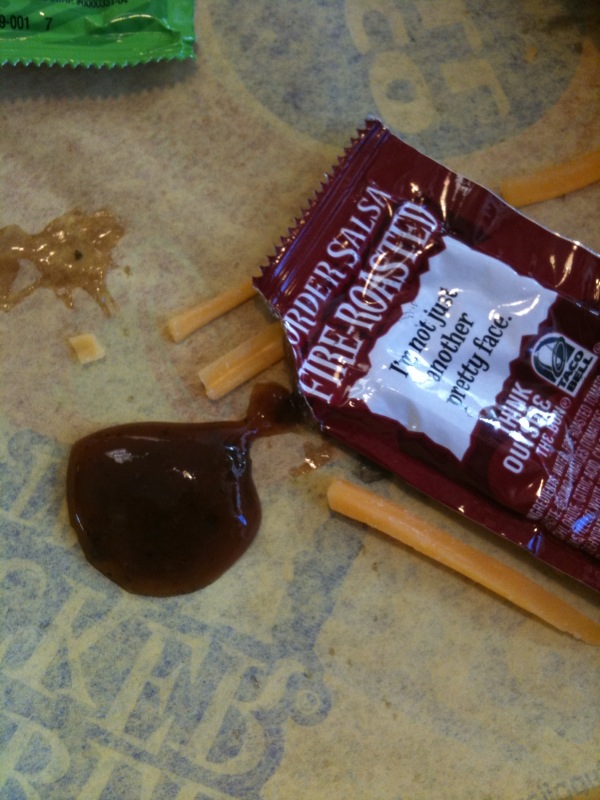
And the Fire-Roasted Salsa:
I guess I had pretty high hopes for this sauce, and at first taste I was impresed — it’s definitely smoky tasting. Probably more toward Liquid Smoke than if it were actually from smoked tomatoes, but I’ve always thought Liquid Smoke did at least a reasonable job capturing smoke flavor, and, you know, it’s Taco Bell. My beef with the sauce, though, was it wasn’t as spicy as I would’ve liked.
It seemed like they took mild sauce and added smoke flavor and a little color, and I would’ve preferred if they ramped up the hot sauce instead. Maybe I should mix it with Fire sauce next time for a spicier hybrid, but I think it speaks to my disappointment that when it came time to sauce my XXL Chalupa, I went back to old familiar Hot.
Speaking of, the main event:
Clearly not as neat as the one in the commercial, but I suppose a lot of things are messier for mortals than they are for Mariano Rivera.
My initial concern about the XXL Chalupa was that the proportions would be off and there would be too much beef, but that wasn’t the case. Everything came in about the right amount, I’d say, the only problem was the construction.
This might be an issue with a one-item sample or with the particular Taco Bell, but I imagine when you’re dealing with a chalupa of this magnitude you’re inviting a great deal of ingredient entropy. On a regular crunchy taco with the right amount of beef, cheese and lettuce, there’s a pretty good chance you get beef, cheese and lettuce in every bite. The XXL Chalupa is so unwieldy that no one topping covered the breadth of the shell, so my first taste was mostly nacho cheese and my last was almost entirely sour cream.
I should note that both of those, as well as every one in between, were unutterably delicious because everything I ate was from Taco Bell. But if you’re looking for a consistent Taco Bell experience, the XXL Chalupa probably isn’t for you. Unless you happen to go to the same Taco Bell that Mariano Rivera frequents, in which case you’re golden.
Also, a special nod to the crunchy red strips, perhaps the most wildly underrated and frequently overlooked Taco Bell ingredient. I really don’t understand why the crunchy red strips aren’t on everything. So crunchy, so red. Such a convenient way to add crunchiness to otherwise uncrunchy products, and thus a great way to make a driveable Taco Bell order crunchy.
I will reiterate here a campaign I have been waging since the debut of the crunchy red strips in the now-defunct Chicken Caesar Grilled Stuft Burrito way back when: Please, Taco Bell, put the crunchy red strips in more stuff. They are delicious. Thank you.

 Amazing.
 I’m going to go ahead and say no.
 Sorry.
 The big loss, obviously, is Carl Crawford, an excellent player coming off a career year. The Rays will look to replace him with Desmond Jennings, a top prospect unlikely to produce anywhere near Crawford’s level for at least a couple of seasons.
 Second, I happen to love driving, but I’ve endured the particularly harrowing trek from New York to D.C. enough times to have considered at length the possibility of a self-driving car.
 Second, while adding a second Wild Card team in each league would have made this year’s boring AL pennant stretch a bit more exciting — adding an all-Sox battle to the mix and providing the Yanks with incentive to take the division — it also would have severely cheapened the end-of-season drama on the other coast in the Senior Circuit, allowing the Giants, Braves and Padres into the postseason instead of forcing the three teams to compete for two open spots.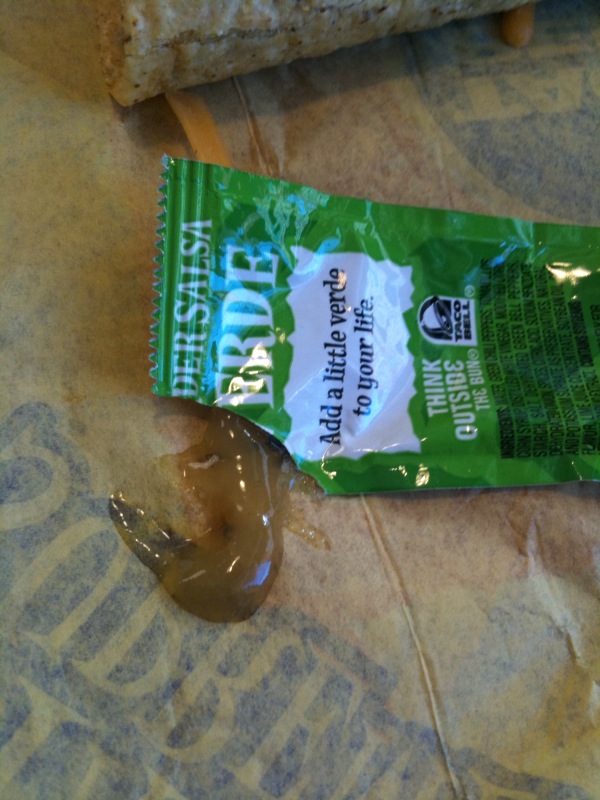

 Tedquarters