Well here’s what I don’t understand

That said, his decision to stay with the Tigers is downright idiotic . . . or there is some larger force at work.

I keep playing this out in my head, and none of it makes any sense. Why would Damon want to stay with the moribund Tigers when he had a chance to join the Red Sox for 5 1/2 weeks of stretch-run fun? Why try to keep hitting at cavernous Comerica Park when he could return to friendly Fenway? Why play games that don’t matter when you can play games that still matter?

Dan Shaughnessy, Boston Globe.

There are a lot of things about Dan Shaughnessy that don’t make sense to me, but one thing I’ve never understood is questioning a player’s motivations when he is unwilling to waive his no-trade clause.

He has a no-trade clause! There’s got to be a reason he got it put in there and if I had to take a guess, I’d bet it’s because he doesn’t want to be traded.

And look, you can say whatever you want about Johnny Damon’s desire to win or whatever just like I can go to my grave maintaining that he’s a huge sellout just for shaving the beard and going to the Yankees after 2004, even if I understand full well that baseball’s a business and he was just doing well by his family and everything. That’s all within our rights as fans.

I have no inside information or anything, but I’d bet Johnny Damon probably didn’t waive his no-trade clause because being traded is a huge pain in the ass and something he doesn’t want to deal with at this point in his career.

Hat tip to Can’t Stop the Bleeding.

Unqualified excellence

Any Mets fan will tell you that one of the big positives this year — one of the few shining beacons of goodness in this otherwise crummy season — is the breakout performance of Angel Pagan. Pagan showed talent last year, of course, but not like this year. Too often in the past he frustrated everyone with his mental mistakes, silly baserunning blunders and terrible routes in the outfield. In 2009 he played like a fourth outfielder overwhelmed, they’ll say, and now he is proving himself a real Major Leaguer, and a good one, to boot.

And look: Maybe Pagan has learned a thing or two. There’s some empirical evidence to back it up. We know he studied under Carlos Beltran this offseason. And we see him chat up umpires during at-bats, asking about the strike zone, questioning always about the location of pitches at which he swung and missed. Pagan clearly appears to be a ballplayer intent on bettering himself.

But the stats don’t show any improvement. Not at all, actually. According to nearly every measure, Pagan hasn’t had a breakout season because he’s almost exactly the same excellent player he was last year.

Pagan hit .306 in 2009 with a .350 on-base percentage and a .487 slugging while posting a 7.0 UZR across the three outfield positions. This year, he has hit .301 with a .356 OBP and a .460 slugging with a 8.3 UZR. He has been appreciably better on the basepaths this year, mostly because he is stealing bases more frequently and at a higher rate. But otherwise, he has remained remarkably consistent across the seasons.

So what could account for the perceptual difference? Certainly Pagan has made some adjustments, and perhaps he was just a few tweaks away from winning the hearts of Mets fans everywhere. But maybe the audience has adjusted to Pagan a bit, too.

Consider when Pagan first began playing every day. We saw him a bit in 2008 and last May, but he didn’t break into the lineup for good until July of last season, a couple of weeks after Carlos Beltran went on the shelf.

It seems natural, I think, to compare Pagan to Beltran. Pagan looks up to Beltran, as we know. And they’re both multidimensional, switch-hitting Puerto Rican center fielders, and Pagan in effect replaced Beltran in the Mets’ outfield last year.

But it would be difficult to find two players with similar skill sets (though not identical, since Pagan lacks Beltran’s power) at the same position with aesthetic differences so severe. Beltran’s game, I have written, is at its best like minimalist art. It is efficient and understated, subtle. Even his blunders are quiet ones. The Blame-Beltran set will remind you of the time he failed to swing, the time he didn’t slide.

Pagan, we now know, is the Crazy Horse. His game is kinetic, almost theatric — though he’s hardly a ham. Pagan unfurls in the batter’s box, his stride strong and his backswing massive. And he does a funny thing with his batting helmet when he reaches base safely, grabbing it with his hand and tucking it towards his shoulder, kind of like Michael Jackson did with his hat. In the field, he continues his gallop long after he has snared fly balls in the gap and seems to throw his whole body weight with the baseball on outfield assists.  Pagan’s mistakes, the ones we lamented last season, come from too much energy: overrunning the base or the baseball.

So while it seems like Pagan has cut down on those mistakes, for sure, I wonder if Mets fans have taken to Pagan this season because we understand those mistakes a little better when they do happen, now that we’ve grown more accustomed to his style and more appreciative of his excellence. In other words, we now have a large enough sample of Angel Pagan to know what he is about, and we see that it is good.

On Oct. 3, the Mets will walk off the field after their last game. If I’m there, I’ll think, hey, David Wright, he didn’t have his best season but at least he hit more than 10 home runs. And hey, Jose Reyes, he might not have had his best year on paper but at least he came back healthy and finished strong. And I’ll go through each guy like that, and bargain and brightside and make myself feel better because I’m a Mets fan and that’s my nature. I beat myself up all year long then rationalize it at the end.

And then I’ll get to Pagan and think about the way he played this season, the talent he demonstrated and the consistency. And there’ll be no buts or at leasts or qualifiers of any sort.

The perfect foil, you say?

Rex Ryan is the perfect foil. He’s a pompous, arrogant, irreverent, classless, mouthy gasbag. And for that I hate the man. Yet for making me hate him, I love him. I love every chin on his chubby little face. Because say what you want about the big buffoon… and believe me I have… no one can accuse him of being dull. On the contrary, he’s like a breath of hot air.

Jerry Thornton, WEEI.com.

Really? Lovable Rex Ryan is the perfect foil? Because last time I checked, your quarterback is a butt-chinned, model-impregnating, Movado-watch-wearing, three-time Super Bowl champion who looks like he got bumped from an Adam Sandler movie for seeming like too obvious a casting choice for the villain role.

Awesome article on Japanese baseball

Nomura, who is 75 years old and has managed for 24 years, is known as an astute baseball mind but is also associated with outdated ideas such as distracting opposing players by yelling through a megaphone and arguing against announcing starting pitchers in advance because it eliminates guesswork for opponents.

- Brad Lefton, New York Times.

OK, first of all, let me go on record as saying I’d do a lot less complaining about Jerry Manuel if he’d only pick up the ol’ megaphone to distract Shane Victorino every once in a while. I can’t believe that’s going out of style in Japan.

I love reading about the various local particulars of baseball in foreign lands. This article is awesome for that. Turns out Japanese baseball players consider fielding a ball backhanded taboo. Who knew?

Though it is not stated in the article, I have also been told that sacrifice bunting is much more prevalent in Japan — even among a team’s power hitters. And the person who explained it to me — a smart and respected baseball analyst — presented it as cultural: fear of failure runs so strong in Japanese culture that productive outs (ie not failing) are preferred to the risk of strikeouts or double plays.

I have no idea if that’s true or racist or anything, but I’m certain it’s fascinating. And I’d love to study baseball all over the globe to examine the various intricacies, on the field and around the game, and how they relate to local culture.

Doesn’t that sound like an awesome book? Plus you could catch up with baseball globetrotters like Jason Rees, an Australian fellow who played college ball in Kansas, then professionally in Israel and the Netherlands.

So in conclusion: Please someone give me a massive advance and I will gladly write the crap out of that book. And yeah, I realize that there’s no built-in market for something like that, and that it would be really expensive to fly me all around the world and put me up in posh accommodations (I have Champagne tastes, I should note), and that print is more or less dead. But you might as well go out with a bang.

What I was talking about yesterday

I’ve gotten a few emails in response to my post yesterday about Johan Santana, so I figured I should follow up here. Here’s the point people are contending with:

Sure, it’d be nice if the Mets could win some more games, but a strong finish for Santana could help convince everyone that landing a No. 1 starting pitcher doesn’t have to be the No. 1 priority this offseason.

I guess I was specifically referring to pending free-agent Cliff Lee, who seems destined to get a massive and lengthy contract somewhere.

I wrote that yesterday imagining the inevitable demonstrations and petitions and sit-ins clamoring for the team to shell out big bucks to a 32-year-old pitcher likely to be an albatross by the end of his deal, just because of some notion that the team needs an “ace to pair with Santana” now that Santana is no longer “an ace.”

Which is not to say the Mets can’t use starting pitching, of course. All teams need starting pitching, and seldom does a team have enough. The Mets — with Santana, R.A. Dickey, Jon Niese and Mike Pelfrey set to return — look to be in at least decent shape in the department, but could certainly stand to beef up. After all, it’s no safe bet that any of those guys will maintain the success they’ve had in 2010, and at least one will likely regress a bit.

My objection is with the idea that the Mets need an ace, just like it would be if someone told me they need a closer or they need a slugger or they need a table-setter. What the Mets will need is to maximize the resources they have at their disposal to put together the best baseball team possible.

If that means adding pitching to strengthen their rotation, then yes, by all means. But going into the offseason with blinders on searching for players who fit a certain specific label is about the worst approach imaginable.

There are many ways to construct winning teams. Having dominant starting pitching is one of them. It is far from the only one.

The best player on the free-agent market isn’t always the smartest acquisition. Winning the battle of offseason perception pales in comparison to winning actual baseball games.

Certainly there will be much, much more on this to follow.

OK, it’s probably Lucas Duda time

I was trying my best to avoid buying into Lucas Duda’s absurd destruction of Triple-A pitching, but since it simply hasn’t stopped, it’s probably time the Mets call him up and see what he’s about.

Apparently there’s a subscriber-only piece about Duda up at Baseball America that explains how he’s finally changed his approach back to pulling the ball after breaking his wrist in 2005. Something like that.

Who knows? Duda has a .322/.394/.643 line in Buffalo and a .307/.401/.586 line for the season. At 24, he’s hardly a baby, but he’s still clinging on to prospect age.

Duda is not on the Mets’ 40-man roster, but the club could, I believe, make room for him by moving John Maine to the 60-day DL or parting ways with Extra-Base Omir Santos.

Or maybe, you know, he just does that

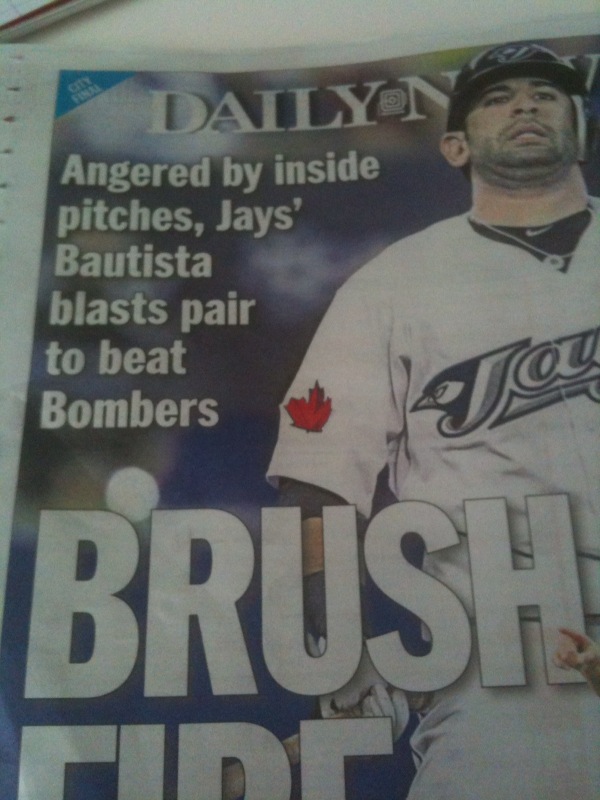
Back cover of today’s Daily News:

Clearly Bautista was angered by the inside pitches last night. But did that make him more likely to hit two home runs? I don’t know. Seems to me like he kind of just hits a lot of home runs.

And that, actually, is way weirder than being angered into hitting home runs. Jose Bautista. Who saw that one coming?

How to eat at the U.S. Open

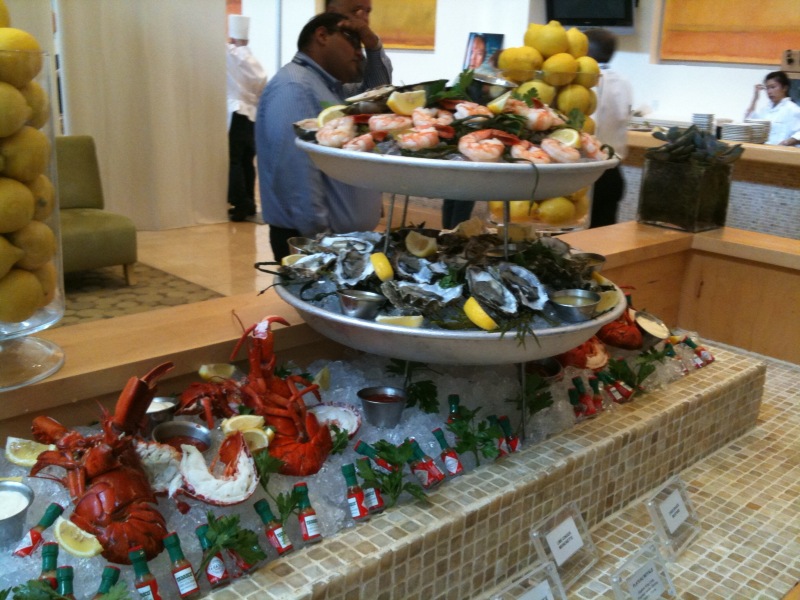
I’ve been in this business for four years, but every time I wind up someplace like the VIP Tasting Event at the US Open, I feel like I snuck in. Part of it, this time, is probably because our video team bailed out and I was flying solo. Part of it is because I really know very little about tennis. Part of it is because I can’t figure why anyone would be so eager to serve me fancy food on some odd Monday.

USTA employees led media through the stadium to the dining room in small groups as construction crews put finishing touches on last-minute renovations. “It never seems like they’ll finish, but it always gets done,” our guide said, laughing as maintenance men furiously screwed in light bulbs and scrubbed floors.

Enough nonsense. Food. On to the food, Berg.

As I stepped into the room and saw the place settings I knew immediately this would not be the chaotic feeding frenzy I had grown accustomed to from two years of annual tasting events at Citi Field. Smart lighting, small plates, delicate dishware. Hell, someone even brought me a fizzy pink beverage.

The Collins glass listed the past U.S. Open winners down the sides. That’s good. Study up, slugger, they might quiz you.

As I took a sip and scanned the room, I noticed all the slacks and blazers. Blazes! I was underdressed. I could tuck my shirt into my jeans to blend with the more casual among the media, but that would expose my odd choice of belt; in my haste to leave the house, I had grabbed the first thing I found suited to hold my pants up: the royal-blue elastic Rawlings belt I use for baseball on Saturdays.

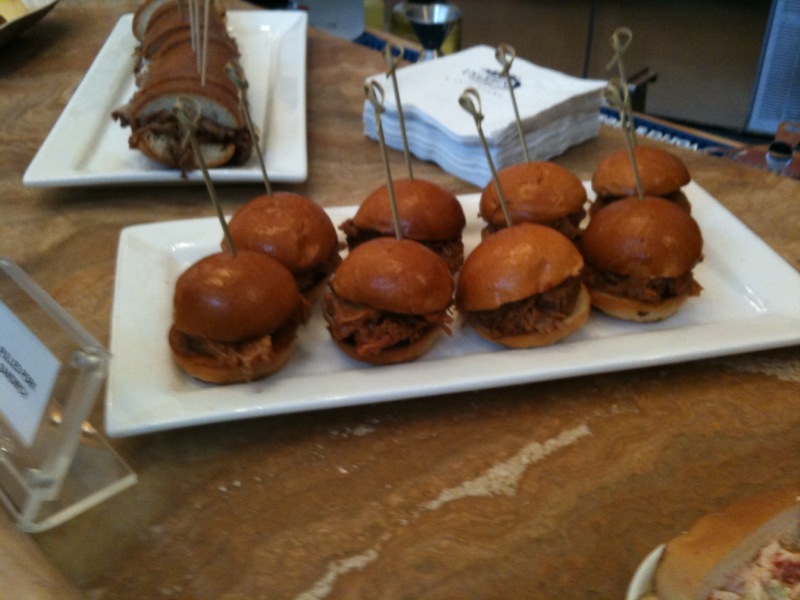
There wasn’t even time for shame before someone rounded up the lot of us to parade us past the food. Professionals with telephoto lenses sized up the lighting and angled for the best perspective on the pulled-pork sliders while I tried not to drool on the steak sandwich I hunched over. iPhone photos suffice when you do business on the Internet, you just look like something of an amateur is all.
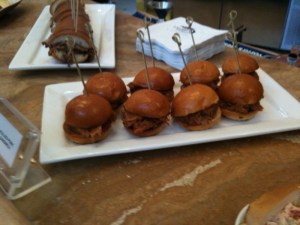
A chef came out and described the creations. Delicious buzzwords all about: grass-fed, Niman ranch, ginger goo, brioche. He explained where each item would be available, at in-stadium restaurants with names like Champions, Aces, Mojito. I tried to keep track as I awaited the call to the post. Good lord, why didn’t I bring a notebook?

Soon we were seated and the main event began. It started slowly, a waiter arriving with a lobster BLT. As I took a bite and considered what twisted genius first thought to bacon up the lobster, a second waiter arrived with a crabcake.

And thus began a furious onslaught of culinary awesomeness. Holy hell, these tennis folks can eat. It was getting in the ring with George Foreman. No dancing, no nonsense. Ever watch Foreman box? Just relentless.

Those crabcakes? Straight lump crabmeat, hardly anything else. Delicious. But don’t eat too much of it, because there’s a garlicky, buttery tender baked clam waiting on your table behind it. Oh, almost done chewing that? Here’s the custom-grind beef burger, so juicy it soaked through the bun once you cut it in half (because you can’t handle all of this, can you?). And make sure there’s room for the soft, flavorful buffalo mozzarella, delicately seasoned with salt, pepper and balsamic vinegar. Now comes the waitress with the BLT with avocado on toasted sourdough, and holy crap, I think I like tomatoes now.
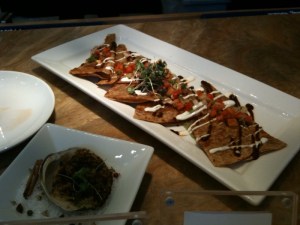
And of course, it wouldn’t be tennis if there weren’t lobster served in all sorts of other ways. Would it? Damned if I know. At this point I’m not even sure they play tennis here. But lobster quesadillas came too, and lobster sushi. I can swear I saw straight-up lobster making its way around somewhere, too, just didn’t get to me.

After some twenty minutes of gluttonous fury, the coma began to set in. Some of the chefs – famous chefs from Top Chef, people I’m supposed to know about – made their way around the room to answer questions. The only one I could muster up was this:

“Do you have any more pulled pork sandwiches?”

One said he’d look, but I didn’t pursue it. I found a respite between plates and slinked out of the place, sated, defeated.

Good show, tennis. Good show. Allow this post to serve as spirited but polite applause.

If you make your way out to the U.S. Open in the coming weeks, make your way to one of the restaurants. Once you’re in, you’re on your own. Everything was good. My recollections of the event, even only a few hours later, are too dizzied to distinguish any dish in particular.

From the TedQuarters San Francisco desk: Red Velvet Fried Chicken (yes, you read that right) review

As soon as Josh tipped me off to this item in the Daily News earlier this week, I dispatched familiar TedQuarters Giants insider Dailey McDailey with photographer Will McWill from the TedQuarters San Francisco desk to undertake a difficult yet important task: eating red velvet fried chicken.

I am happy to report that their mission was successful. Dailey reports:

A very satisfying meal.  Even ignoring the red velvet part, it was well-prepared fried chicken.  The brining made it very juicy, and it was cooked consistently all the way through.  The red velvet skin was interesting, but unobtrusive.  I could always tell I was not eating standard fried chicken, but was not overwhelmed by the cupcake flavor.  My one complaint was that the red velvet flavor was not consistent all over the chicken.  Some spots were more heavily coated than others.  The cream cheese mashed potatoes on the side were also excellent.  Very creamy with big chunks of potato in them.  The staff seemed like sweet girls, but were not fully prepared for two dudes to come bursting in at 10:31am on a Saturday morning demanding chicken.  We ended up having to leave, come back half an hour later, and then re-order and wait 15 more minutes before we were served.  $13 for a breast, thigh, and wing plus potatoes and slaw was not the best deal, but far from a rip off.  Also, the cupcakes were good.  I recommend the mocha.

Via text message, Will confirms. He added that the reports of lines out the door and the store selling out of the product were clearly overblown, though I probably should have warned them that the Daily News is like that.

Please, world, spread the word of red velvet fried chicken. Demand it at restaurants and then act surprised when they don’t have it. This needs to become a thing so I can try it somewhere near here. Alternately, I need to go to San Francisco so I can try it there. Or, one other possibility, I need to figure out how to make red velvet fried chicken.

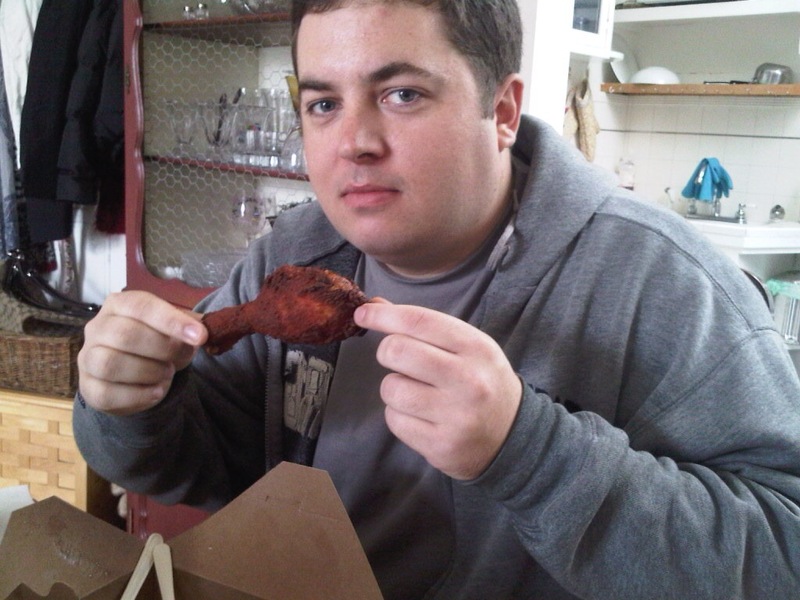
Here is a picture, courtesy of Will, of Dailey eating red velvet fried chicken. Note how red velvety it looks, despite the fact that it is clearly fried chicken. Also try not to get lost in Dailey’s eyes:

What I care about more

Matt Cerrone mentioned Johan Santana’s run of bad luck on MetsBlog earlier today, which is funny to me because earlier in the season, sabermetricians everywhere were rapping about Santana’s run of good luck.

Remember when Santana was walking more batters than he was striking out, yet somehow keeping his ERA down, and everyone was all, “Johan Santana sucks now, the results are illusory,” and waiting for the other shoe to drop?

Well something different happened: Santana seems to have returned to being Santana. Granted, his rates for the season are still atypical due to his performance for most of the year. His K/9 is way below his career average.

But in five starts in August, Santana has struck out 43 batters in 39 1/3 innings while walking nine. He has allowed five home runs — more in line with his normal rate than the low total he allowed earlier in the season — but has a 2.29 ERA over that stretch.

It’s a very small sample, for sure. And maybe I’m grasping at a reasonably arbitrary set of starts to try to prove to myself that a once-great pitcher still under lucrative contract for several more seasons with my favorite team has a lot left in the tank.

Or maybe Santana is still building up arm strength after offseason surgery or fixing some mechanical hiccup or not tipping pitches anymore. I don’t know.

All I know is that, in a season when the Mets’ wins and losses don’t really matter a hell of a lot anymore, I care a lot more about seeing Santana right, striking out lots of batters and dominating opponents, than I do about his win-loss record. (Which is not to say Matt doesn’t.)

Sure, it’d be nice if the Mets could win some more games, but a strong finish for Santana could help convince everyone that landing a No. 1 starting pitcher doesn’t have to be the No. 1 priority this offseason.