You tell ’em, Cowboy

“They’re two of the best teams in baseball. Why are they playing the slowest? It’s pathetic and embarrassing.”

Umpire Joe West, as told to the Bergen Record.

West’s comments are meant to defend his colleague, the widely reviled Angel Hernandez, for not granting time to several Yankees and Red Sox during Tuesday’s game in Boston.

I watched, and it did look weird to see Hernandez denying Derek Jeter time. How dare he! Then again, it looked pretty weird to see so many Yankees and Sox calling time so frequently, but I wasn’t sure if I was just noticing it more than I normally would because Hernandez wasn’t granting it, so I was paying attention.

Either way, West’s probably right. I’m not sure if the Yankees or Sox step out of the box or more frequently than any other teams, but if he and his crew are under the gun to speed up games, then by all means, deny Jeter his precious batting-glove adjustment time.

It’ll ameliorate all the sportswriters who are so bent out of shape about the length of the games, at the very least.

It does, however, fly right in the face of something Cowboy Joe West himself says on his spoken word album about baseball, Diamond Dreams:

It’s the only sport where you can manage right along with the manager. In no other sport can you do that.
You can’t do it in basketball, because you don’t know what play they called.
And in football, as soon as the ball is snapped, everybody’s running into each other.
But in baseball, it’s all pretty, and it’s all out there for you to see it.
And this game’s not run with a clock; it can last forever.

More importantly, umpire Joe West has a spoken word album. I’m obviously buying that.

UPDATE: I really thought I’d be the first to bring to the blogosphere, or at least refresh to the blogosphere, news of Joe West’s musical exploits. But then, upon finishing this post, I went to my Google Reader and noted that Big League Stew beat me to the punch. Check that site out for more on this West thing.

Walks and excitement not mutually exclusive

Not long ago The Rivalry was about Manny and Papi. Jeter and Mo. It was about bloody socks, Pedro tossing Zimmer and everyone hating A-Rod on both sides of the field.

Now the symbol of Yankees-Red Sox is Nick Johnson looking at pitches….

He fit the style the Yankees want to play, the style that now defines the Chinese Water Torture aspect of The Rivalry.

Johnson’s walk gave the Yanks the lead, Cano homered in the ninth, and Alfredo Aceves, Joba Chamberlain and Mariano Rivera delivered strong relief. So there is a rubber match tonight in this season-opening series. The over-under already has been established at 300 pitches, bring some Red Bull.

The Rivalry is now Nick Johnson. Walk don’t run.

Joel Sherman, N.Y. Post.

OK, first of all — and maybe this is something personal, something about the way I enjoy baseball — I find walks plenty exciting. Maybe not exciting in the way I find a Jason Statham movie exciting, but there’s something thrilling about a marathon at-bat ending in a walk, like the one David Wright drew after nine pitches from Josh Johnson on Monday.

Also, command of the strike zone is a big part of what made all the great players Sherman cites in the Rivalry so awesome — especially Pedro and Rivera.

Moreover — and this is the important part — taking pitches makes you a better hitter. Johnson’s ability to not swing at balls should be lauded, because it forces pitchers to throw him strikes, meaning he will either see pitches to hit or get on base via walk. That’s like the whole point.

That’s basically why they made the rule about walking in the first place, back whenever baseball was invented. Otherwise there’d be no impetus for pitchers to ever throw anything worth swinging at, and games would be way, way more boring than the ones Sherman laments.

I play in a pickup baseball game in Brooklyn on weekends. Many of the players involved — myself included — suck hilariously, but because the level is so low, it provides insight into the derivation of some of baseball’s fundamental logic, and how perfectly woven the rules of baseball really are.

Because, in this game, everyone prefers putting the ball in play to taking a base on balls, early on — before I started playing — the game’s organizers decided that batters should have the option to not take a walk if they earned one, instead resetting the count so they would have the opportunity to swing the bat more.

Unbeknown to me, walks became stigmatized, and so when I started jogging down to first base upon looking at a 3-1 pitch well off the plate in my first plate appearance, the catcher followed me and gently told me that no one really ever takes bases in the game — everyone opts to reset the count, especially the first time through.

That remained the norm for a while. But in time, guys who had no business being on the mound started pitching more frequently, since there was no penalty for wildness. At-bats and innings became interminable, and playing the field downright boring. Eventually, the leader dudes decided we had to eliminate the resetting rule and force people to walk again.

After a few Ollie Perez-style walk-fests, the wildest “pitchers” quit trying.

Now, only pitchers who can get the ball over the plate pitch, and so every player gets what the guys were hoping to achieve with the optional-walk rule in the first place: a whole lot more good opportunities to swing the bat and put the ball in play. Walks fundamentally make baseball more exciting.

Obviously Nick Johnson is playing baseball on a whole different level than I am, but Red Sox pitchers — like everyone else — know by now that he won’t swing at a pitch that’s not over the plate. He forces them into a decision: They can nibble around the corners and risk handing Johnson a free pass, or put pitches over and hope Johnson doesn’t beat them swinging.

Johnson might not always make the most of his opportunities when he does swing the bat. He doesn’t have the power of Manny or Ortiz or the speed of Jeter. But Johnson, thanks to his discerning eye, secures better opportunities for himself to drive the ball and, by getting on base so much, for his team to score runs.

That’s exciting, I think.

The Internet wins again

Something in John Harper’s column about Jorge Posada today caught my eye:

Molina, the Blue Jays’ backup this season, is one of the best in the game at such subtleties. Last season David Cone, the ex-Yankee pitcher and broadcaster, said of Molina, “I think he gets more borderline strikes for his pitchers because he’s so good at framing them than just about any catcher in the game.”

Reading it, I realized that with pitchFX data widely available and the sample of pitches even a backup catcher receives so great, this must be something that might be measured with some reasonable degree of accuracy.

And lo, it has. Two weeks ago, to be specific, by Bill Letson at Beyond the Boxscore.

The Internet rules.

And perhaps the real winner here? David Cone. By Letson’s comprehensive study, Jose Molina ranked first among all catchers who received at least 1000 pitches in framing pitches in 2008 and second in 2009. Good eye, Coney.

What’s more, the data seems to show that the difference between the best and worst catchers at framing pitchers could make a pretty significant impact on a team across the course of a season — as in multiple, perhaps even double-digit wins.

That seems nuts, I realize. Letson admits he has no way to separate the catchers in the study from the set of pitchers they’re receiving, and admits there’s work to be done in the study to see how it holds up over time. But it’s a remarkably thorough piece of analysis, much of which flies way over my head.

As for the guys on the Mets these days? Both Rod Barajas and Henry Blanco ranked out slightly above average in 2008 and 2009. Both Josh Thole and Omir Santos were slightly below in 2009. Thole was a bit worse than Santos, but still not as bad, according to the study, as a good number of more established Major League catchers like Gerald Laird, Kenji Johjima, Rob Johnson and Ryan Doumit.

Brian Schneider, incidentally, ranked ever-so-slightly below average in 2008 and 2009, closer to the middle of the pack than Thole and Santos. It will be interesting to see how he fares compared to the rest of the Phillies’ catchers in 2010 — it could be that he’s actually good at framing pitches but something about the movement of balls thrown by pitchers on the Mets’ staff made them difficult to frame.

A-Rod, Derek ready to have sleepovers again

A huge hat-tip to Steve Lombardi for pointing out this column from Kevin Kernan in the Post today. Classic:

The bond of winning a championship together has created a tighter bond between Alex Rodriguez and Derek Jeter.

They drove here together yesterday from Tampa for the Yankees’ split-squad 6-0 win over the Pirates. And they left together. Before the game they played catch and long toss together, ran together in the outfield and even walked into the clubhouse together along the right-field line at 12:01 after they were done with their early work while a group of Yankees were still taking batting practice.

“They’ve definitely grown closer,” one Yankee official told me.

They are laughing and joking together more, and during Sunday’s workout in Tampa they spent a lot of time talking in short leftfield on a back field. They are enjoying being teammates.

Isn’t it just the sweetest thing imaginable? Remember that, in their halcyon days as bright-eyed young shortstops, long before their well-publicized falling out, when egos and contracts and world championships got in the way, A-Rod and Jeets used to have sleepovers five times a week.

Spring Training is a beautiful time for hope and redemption. Jeter and A-Rod’s friendship is in the best shape of its life.

Just trust the Daily News on this one, blood-spinning treatment is controversial

I read the print edition Daily News every day on my commute into Manhattan. I realize, of course, that I could get all of it online on my iPhone, but I like the effect of seeing the front and back pages, plus I don’t think reading on such a tiny screen is good for my eyes or back.

Anyway, with all the Tony Galea stuff going on that vaguely involves Jose Reyes, Alex Rodriguez, Tiger Woods and now Carlos Beltran, something keeps jumping out at me: The Daily News consistently refers to the platelet-rich plasma therapy that Reyes underwent in June as “controversial,” but it never explains why the treatment is controversial, and I don’t remember it being controversial in the summer.
And it’s always in news stories, too. Actually, the columnists who have mentioned the story — Mike Lupica and Hank Gola — have avoided the term “controversial” when discussing blood-spinning, but just about every reporter mentioning the therapy has not. Check it out:

Michael O’Keefe: “controversial but legal therapy known as ‘blood spinning.’

O’Keeffe and Teri Thompson: “a controversial technique called platelet-rich plasma injection therapy, also known as ‘blood spinning.’

Thompson and Adam Rubin: “the controversial ‘blood-spinning’ or plasma-replacement therapy

Thompson, O’Keeffe, Mark Feinsand and David Saltonstall: “the controversial – but legal – therapy known as ‘blood-spinning.’

Thompson, O’Keeffe, Nathaniel Vinton and Christian Red: “a controversial blood-spinning treatment.

I could continue. In all, platelet-rich plasma therapy has, by my count, been noted as controversial 13 times in the Daily News without any mention of the nature of the controversy surrounding the method.

And then there’s this, from a Gola column in December:

“It’s well-established in the sports medicine community to do this,” [Dr. Lewis] Maharam said. “The Steelers’ team physicians have done it with Hines Ward. The team physicians for the Giants have done it. I’ve done it on my patients. People at NYU have done it. It’s all over the country. I call it almost a magic bullet in sports medicine equivalent to when we first got MRI.”

So even though Maharam, the Daily News‘ sports-medicine expert on call, doesn’t note anything controversial about the treatment, the treatment can’t be noted in terms of Woods, A-Rod, Reyes or Beltran without mention of the massive, mysterious controversy surrounding it?

I’m confused. Certainly it’s bad if Galea was distributing HGH and other performance-enhancing drugs, because that’s illegal. And it’s bad if he was practicing medicine without a license, as he allegedly was in Florida, when he performed the platelet-rich plasma therapy on Woods.

And I’ll allow that it’s a little weird that all these guys had to go to Canada to get this treatment, which sounds, from all the reading I’ve done, like a relatively simple procedure.

But this New York Times article from last February makes it sound like the only potential controversy surrounding the treatment is whether or not it works.

And the treatment was not controversial even by the Daily News’ standard in September, when Sean Avery had the treatment, nor a couple of weeks before that when Katie Charles wrote a feature on the subject.

And platelet-rich plasma therapy did not seem controversial in any of the nine times it was mentioned in the Daily News before that, including when Reyes underwent the treatment in June.

Maybe I’m missing something, or I entirely missed something, or the Daily News neglected to cover some story that exposed to the world how blood-spinning therapy is a giant hoax or a stealthy way to inject patients with mind-control drugs or something. The only vaguely fishy thing I can dig up on it is that Brits call it “Dracula Therapy.” (Ed. Note: DRACULA THERAPY!)

Either way, since none of the 13 stories mention why exactly the treatment is controversial, since the treatment was apparently not controversial until it involved a slew of favorite N.Y. media whipping boys, and since several of the reports specify that the treatment is “legal” or “not illegal” — implying that its legality should be even in question — it strikes me that more than just blood is being spun.

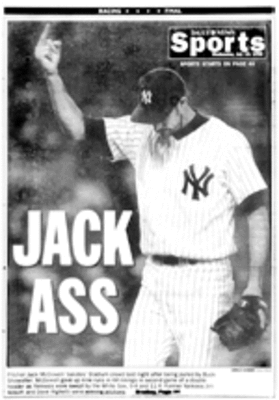
Middle fingers of yesteryear: Jack McDowell

Former Cy Young Award winner and alternative rock guitarist Jack McDowell’s one year in Yankee pinstripes was marked by 15 wins, 157 strikeouts and one extended middle finger.

His was the disillusioned, Kurt Cobain variety of the gesture, the depressed grunge-rocker wildly and ineffectively firing back at a world he felt could never truly understand him.

But it was a cathartic middle finger, it turned out:

“That incident actually helped set things straight between me and the fans, to let people know where I was coming from. I truly believe that once all the BS was put aside and everybody was done trying to make more out of that than it was, that’s what came out of it.”

In 17 starts that season before giving fans the finger, McDowell went 7-6 with a 4.87 ERA. In 13 starts afterward, he went 8-4 with a 2.81 ERA.

Makes you wonder why the guy didn’t flip off fans a month or two earlier.

Much later, a band called The Baseball Project featuring R.E.M.’s Peter Buck wrote a song about McDowell called “The Yankee Flipper,” and confessed that part of McDowell’s frustration could have been due to a long night of drinking with members of the band.

Today, McDowell writes a blog about the White Sox for ChicagoNow.com.

The Big Unique

You might have heard that Randy Johnson retired last night, giving me as good a reason as any to link up this guy. This might be the craziest thing that’s ever happened:

That moment has honestly been the subject of as many late-night debates amongst me and my friends as any in history.

One of my buddies is absolutely convinced it should serve as proof of the existence of some higher power because, as he points out:

A) How many times have you ever seen a bird fly between a pitcher and a batter during a pitch before, and so what could be the chances that the one time it does, the bird (briefly) occupies the exact same space as a baseball moving 100 miles per hour?

And B) What are the chances that if, should any pitcher hit a bird with his fastball, it’s going to be Randy Johnson, the guy with the reputation for throwing about as hard as anybody in baseball who just so happens to LOOK EXACTLY LIKE A SCARECROW, a device created to discourage birds from entering an area?

It’s as if Randy Johnson wanted to up his scarecrowing game to a whole new level and wanted to make an example of that one bird to make sure that no other bird ever dares come anywhere near a pitcher’s mound again. Because that one bird, ahh… it didn’t work out so well for that one bird.

Anyway, I’m not trying to hate on Johnson with the scarecrow stuff because I really did love watching the guy pitch, which is odd as I usually prefer smaller, puppetmaster type pitchers like Pedro, Santana and Maddux.

But how Johnson looked was a big part of what made him such a sight to behold, plus I always got the feeling it fueled his fastballs at least a little bit.

I’ve got no evidence, of course, but looking at that pockmarked face and that awkward body, I couldn’t help but assume every one of those heaters came with a little bit of extra mustard from so many lonely middle-school lunches.

And so I read stories like Jeff Pearlman’s, asserting that Johnson was a jerk who deserves to be treated as such, and I actually just feel bad for the guy. And I read anecdotes like this totally unconfirmed one in the Amazin’ Avenue comments section and I really hope they’re true, and that Johnson’s just some misunderstood metalhead with a heart of gold who’d help you out when you’re sick and is interested in photography, because that’d all jive a lot better with the sad former seventh-grader Randy Johnson I’ve created in my head. Although I guess that guy could grow up to bully reporters, too.

Anyway, his baseball legacy is as follows: one of the greatest pitchers of his generation, one of the greatest lefthanders ever, that really tall dude, anecdotal evidence that tall pitchers mature late, the guy who’ll be labeled “the last 300 game winner” until the next “last 300 game winner,” World Series hero to Diamondbacks fans, postseason goat to Yankees fans, and, of course, that guy who totally destroyed that bird that time.

A glimmer of hope

The inimitable John Harper on the Javier Vazquez deal, in this morning’s Daily News:

Isn’t this the type of creative dealing the Mets should be doing?

Or is it simply that they are in denial about their need to upgrade their pitching to have any real chance at contending next season?

It could be that, yes.

It could also be something better for Mets fans, and a sign of a more progressive organizational philosophy being either espoused by or forced upon Omar Minaya.

On paper, the Yankees made a major upgrade to their rotation by dealing Melky Cabrera, a young but thus-far unspectacular outfielder likely to continue being decent and inexpensive for the next several seasons. Melky’s a fan favorite, but since the Yankees just acquired Curtis Granderson and still have Brett Gardner in the fold, he’s easily worth trading for 200 guaranteed decent innings from Vazquez.

But also dispatched in the deal, and not even mentioned in Harper’s column, was 19-year-old pitcher Arodys Vizcaino. Vizcaino was recently ranked the Yanks’ third-best prospect by Baseball America and second best by Kevin Goldstein at Baseball Prospectus.

He’s 19 and hasn’t pitched in full season ball yet, so it makes sense for the Yanks to include him in a deal for a pitcher of Vazquez’s caliber, even if Vazquez will be a free agent after this season. Scouts apparently love Vizcaino’s upside, but he’s far from a sure thing, and the Yanks are a lock to contend for their division title in 2010.

For the Mets, though, would it really make sense to deal Jenrry Mejia, probably the closest comp in their system, for one year of solid starting pitching?

I doubt it. The Mets should be looking to improve for 2010, of course, but with as much uncertainty as they have thanks to players coming off injury and down seasons, they absolutely must not do it at the cost of their farm system.

All trades are, to some extent, gambles. The Yankees, in making the deal, are gambling that Vazquez provides enough to their title run in 2010 to make up for whatever they give up down the road in Vizcaino. The Mets, not nearly as likely to make a title run in 2010, should not be making that sort of gamble.

Plus, for all we know, the Mets were in no position to even make that sort of deal. Calling the lefty relievers involved more or less a wash, it would probably take Angel Pagan and Mejia just to equal the Yanks’ offer. And would the Braves trade Vazquez in division for an equal offer?

I don’t know. I like Vazquez a lot, but I’m happy it didn’t happen because the Mets can not mortgage their future for a playoff run in 2010.