
Colonel Tillinghast L’Hommedieu Huston

The Yankees once considered making their home on 42nd Street in bustling Midtown, according to a remarkable 1915 letter penned by team co-owner Colonel Tillinghast L’Hommedieu Huston.

A New York auction house just got its mitts on the historical gem — in which Huston, hat-in-hand, begs American League brass to help keep the then-financially struggling franchise afloat.

Huston, on behalf of his business partner, Col. Jacob Ruppert, asked AL President Ban Johnson for a meeting to hash over their plans to build a new stadium on 42nd Street.

David K. Li, N.Y. Post.

Well that’s kind of awesome to consider. I guess the important thing to remember is that it’s not just plopping Yankee Stadium and the 2011 Yankees down on our current conception of 42nd St. Obviously the histories of both Yankee Stadium and Midtown Manhattan since 1915 would have been altered had the team moved.

The letter doesn’t say where on 42nd St. the stadium would have gone. The Wikipedia tells me that in 1915 there were elevated trains crossing 42nd on Second, Third, Sixth and Ninth Avenues. The main branch of the New York Public Library was already at 42nd and 5th. The current incarnation of Grand Central Station went up on 42nd St. in 1913.

I’m out of my element here, but presumably the best place to put a baseball stadium on 42nd St. in 1915 would have been on either where all those new high-rises and old warehousey buildings are on the extreme west side or where the U.N. building is on the extreme east side. Historians?

And I suppose we could extrapolate from there: If the Yankees moved to the west side of Manhattan and still managed to secure Babe Ruth and become a massively successful baseball franchise, maybe Times Square extends all the way west now? I don’t know what that means for the 1980s pre-Disney incarnation of Times Square, when it was all peep shows and street preachers. But then the Yankees weren’t exactly these Yankees in the 1980s either.

If the Yankees moved to the east side, is there a Second Ave. subway line by now? Probably. Actually, you’ve got figure the entire infrastructure of the city would be altered pretty significantly by a baseball stadium placed there in 1915. But then I’m also not an urban planner.

Since we’re talking Yankees owners and New Yorker history, a little bit on a subject in which I am an expert: Me.

My new place is not far from a very small park named for Ruppert, a German whose family owned a brewery on the location. My great-great grandfather Adolph Von Berg — also, believe it or not, a German — worked as a brewmeister at Ruppert Brewery until prohibition.

Adolph, who dropped the “Von” from his last name at some point and forever impacted my middle-school seating assignments, had a son named Eric who contracted scarlet fever and lost his hearing before he learned to speak. Eric learned American Sign Language and Adolph spoke only German, so the father and son only communicated through gestures.

Eric and his wife, who was deaf from having been kicked by a horse in childhood, bestowed upon their third son the unfortunate name “Winfred Millard” — the joke in my family was that they never heard how bad it sounded (though “Win” made for a pretty sweet nickname). Winfred, my grandfather, entered school with very little language and failed kindergarten multiple times. But he grew up to be an engineer and inventor and earned 60-something patents. Plus he was a pretty hilarious dude.
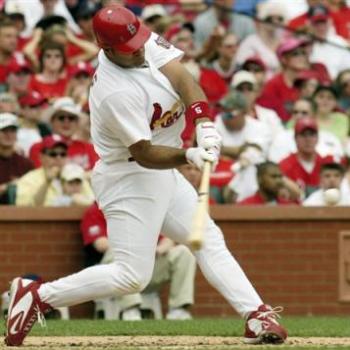
I want to revist this now

The Albert Pujols vs. Babe Ruth debate was silly enough that I figured I’d drop it and move forward, but then someone mentioned it today in an email and now I’m fired up. And I know the game has changed so much as to make the whole conversation essentially pointless, but whatever. It’s on my mind.

So I’ll state this again: Albert Pujols is a better hitter than Babe Ruth was.
Not relative to their eras. No Major Leaguer was ever better than Ruth when held up against the players against whom he played. That much is obvious. But I’m talking about right-now Albert Pujols vs. 1930 (or 1927, or 1920, or whenever) Babe Ruth.

And not “oh but what if Ruth had this advantage or that advantage that Pujols now has?” He didn’t. That’s part of the point. I’m talking time-travel scenario: Ruth hits his third home run of the 1928 World Series and as he crosses the plate is magically transported to April, 2011, then gets traded to the Cardinals since the Yanks already have Nick Swisher.

Ruth doesn’t match Pujols in 2011. No way.

Let’s consider some of the factors. The only reason I didn’t pursue these in more depth the last time around is that I thought I was making a pretty obvious point.

There were only 16 teams then and there are 30 now, so that might mean Ruth faced a higher concentration of talent. But consider that by the 1930 US Census, there were 122 million people in the country, compared to 308 million in 2010.

There are nearly three times more people in this country now, and nearly all of them grow up exposed to baseball in some form or another. In 1930 there were no Major League teams west of St. Louis, and lots of people in the U.S. still got polio and stuff. It was a very different time, and one in which the road to the Majors was more difficult to traverse.

Obviously a lot of people still played baseball, and yeah, back then baseball didn’t have to compete with as many other sports for a young athlete’s attention. Still, there was certainly nothing like the type of youth baseball structure we have now, with the fundamental instruction and competition that begin when kids are 5 or 6.

If a kid in the US has the ability and desire to become a Major League Baseball player in 2011, he will almost certainly get an opportunity to prove himself in organized ball with somewhat knowledgeable coaches, not by impressing the townsfolk playing against old men in the local farm-league game. Professional-caliber players can’t slip through the cracks these days.

And that doesn’t even consider the impact of the game’s global popularity on the Major League talent pool. 125 guys from the Dominican Republic alone played in the Majors in 2011. You know how many foreign-born players there were in 1930?

Six: Two from Cuba, two from Canada, one from Norway and one from Austria-Hungary. Six dudes born elsewhere, and no doubt at least a few of them grew up in the ol’ U.S. of A.

But that’s all just about the talent pool. What about the game itself?

In 1930, teams scored on average 5.55 runs per game. In 2011, it was 4.28. Pitchers walked guys at about exactly the same rate, but struck out about half as many as they do now. Teams got more hits but fewer home runs, and defenders made nearly twice as many errors.

You can explain all that in a variety of ways: Maybe guys struck out less because they were more focused on hitting for contact than power, and maybe official scorers of the 1930s were harder on infielders.

But the way it looks to me, and the explanation I’m certain is correct, is that the Major League game was just crappier across the board in 1930. I’m sorry if that offends your sense of nostalgia.

Pitchers struck out fewer batters because they couldn’t boast the same arsenals as their 2011 counterparts, and more balls in play meant more hits and more errors because the fielders weren’t very good either. Not by today’s standards, at least.

I could go on, but I’m getting bored and I imagine I’ve long since lost you. But the important thing is this: Major League Baseball keeps getting better. As the talent pool grows, so does the competition for spots on rosters. Advancements in medicine, nutrition, scouting and communications help players become faster, stronger and smarter.

That’s not to take anything away from Ruth. Ruth was unutterably awesome, and deserves any praise directed his way. I have, and probably will again, called him the greatest player ever, because I think that term implies “relative to his competition.” But it is only relative to his competition that he is the greatest player ever.

Lance Berkman is probably right

[Albert Pujols is] a better hitter than Babe Ruth and Reggie Jackson and there’s no doubt about it. I’m dead serious. Babe Ruth, as great as he was, played in an all-white league. Now we have the best talent pool we’ve ever had and he’s doing it in that environment.

Lance Berkman.

This is one of my favorite things to think about. Relative to their respective eras, Ruth was a far better hitter than Pujols. Ruth finished with a park- and league-adjusted 206 OPS+, by far the best of all time and 36 points above Pujols.

But like Berkman pointed out, Ruth faced a very limited talent pool. Also, he did so before nearly a century’s worth of advancements in training and instruction, and, you know, computers and stuff.

I’m reasonably certain that if Ruth somehow time-traveled from 1927 to 2011 and replaced Berkman in right field for the Cardinals, he’d prove a well inferior hitter to Pujols. Probably worse than Berkman too, especially if the time-travel mechanism is at all taxing or traumatic.

My question — and the best argument for human cloning, as far as I’m concerned — is: If Ruth were born today and raised with all the trappings of 21st century life, would he again become the best hitter in baseball? Would he again become the best hitter ever?

Get on it, science.

The Yankees suck now

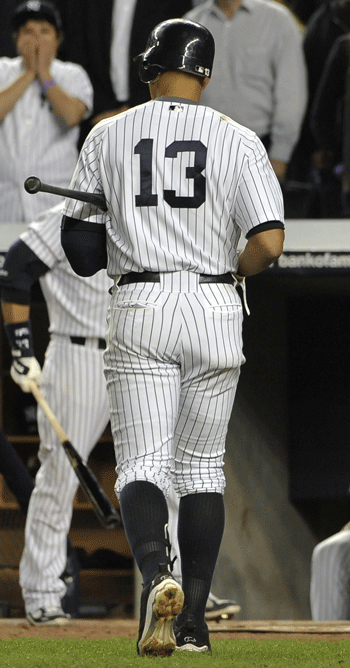
It makes more sense to call [Alex Rodriguez] the same kind of October bust he was for the Yankees before he had his one shining moment in 2009….

Benoit struck him out, swinging.

Two outs now. Still a big swing from Mark Teixeira – who has so often been as small as a jockey in his big games for the Yankees – would bust the game open. Only Teixeira seemed perfectly content to take a walk in that moment, take the walk that made it 3-2.

Mike Lupica, N.Y. Daily News.

A Mostly Mets podcast listener emailed in a good question last week about the Mets’ worrisome home-road split in 2011. He wondered why the Mets went 31-44 at Citi Field this season and 42-36 on the road.

The obvious, satisfying answer is that the park got into the Mets’ heads. All year long we heard about the psychological effects Citi Field’s distant home-run fences had on the Mets’ hitters, and then late in the season we even heard from Dan Warthen say that the dimensions let some of the team’s pitchers grow comfortable throwing bad pitches they felt they could get away with due to the spacious outfield.

And maybe that’s true, despite the randomness suggested by Patrick Flood’s research. Maybe some of that did happen, or maybe it happened even a few times — enough to convince the team’s coaches that it happened frequently, and then, you know, confirmation bias and all that.

Either way, it’s not likely to continue happening. In 2010, in fact, the Mets finished 47-34 at home and 32-49 on the road. Jerry Manuel suggested then that the team’s hitters pressed on the road, swinging too hard for the home runs they knew they wouldn’t compile in Citi Field. In 2009 they finished 41-40 at home and 29-52 on the road. They were much better at Shea Stadium than elsewhere in 2008, but much worse at home than on the road in 2007.

Perhaps calling any of that random statistical noise is too easy. Maybe there was something unique about the makeup of each of those teams and their coaching staffs that could explain the way they performed at home and on the road, even if rosters (and sometimes coaching staffs) tend to be fluid throughout a season.

Point is, none of it appeared to be continuous from year to year.

So here we have A-Rod, great in the playoffs in 2000 and 2004, bad in 2005 and 2006, pretty good in 2007, great in 2009, and bad again in 2010 and 2011. His aggregate postseason batting line looks a whole lot like his career regular season line, but hell, maybe he really did tighten up under the pressure in those down years. Anyone watching the games will say with certainty that he looked more comfortable in that 2009 postseason, though, of course, players generally look pretty comfortable when they’re beating the hell out of the ball.

And everyone in this great city knows that only New York players dictate clutchness, that guys from Detroit and everywhere else in flyover country are more or less robots performing to their expected levels with remarkable consistency. Who cares if Jose Valverde is now 51-for-51 in save situations this year? If A-Rod were clutch he could have overcome that. And if Mark Teixeira were clutch he would have knocked a pitch off the plate over the wall in the seventh.

Let’s forget for now that A-Rod and Teixeira have thrived in countless pressure situations throughout their baseball careers: in high school when big-league scouts came to watch, in the Minors with promotions looming, and in thousands of regular-season at-bats in the Majors. Let’s say for the sake of argument that postseason baseball represents some magical threshold at which the weight of pressure becomes overwhelming for even professional athletes accustomed to it, and that in those situations A-Rod and Teixeira are no different from all of us run-of-the-mill human beings, subject to the whims and burdens of our pathetically imperfect constitutions.

My question to Mike Lupica and the legions of Yankee fans convinced A-Rod is irreparably unclutch, then, is this: Have you ever failed in a big spot? Have you struggled with an important test or botched your lines in the school play or panicked on the parkway or frozen up in a job interview or embarrassed yourself on a date with someone beautiful?

I bet you have. We all have. It happens.

But do you expect it will always happen like that? Do you think that because you failed once or twice or even three times under pressure that you are doomed to do so every single time?

I don’t. Maybe you do. But I imagine anyone with such a defeatist attitude doesn’t often allow himself the opportunity to achieve great successes, and certainly nothing on par with a flourishing career in professional sports.

Existence precedes essence, and A-Rod is essentially one of the greatest athletes of his generation. That he struck out to end the game last night — while playing through injury, no less — should imply nothing other than that he struck out to end the game last night. He will undoubtedly find himself in many pressure situations to come. In some he will certainly fail, and in others he will just as certainly succeed.

You’re watching Bill Buckner saves the day on ‘Curb Your Enthusiasm’ 09/04/11 – TV Replay. See the Web’s top videos on AOL Video

The save stat, nutshelled

“I couldn’t believe they were cheering me for hitting into a double play,” Swisher said. “I said: ‘Whoa, what’s this? And then I looked at the bullpen and saw Mo coming out and I said: ‘Now I get it!’ This was the greatest double play of my life.”

“Runners at first and second…it was unbelievable,” Rivera said. “I don’t ever want my teammates to do bad so I can pitch, but this time I was happy for the opportunity. I’m listening to the fans and I said: ‘Wow, these guys are into it!'”

N.Y. Daily News.