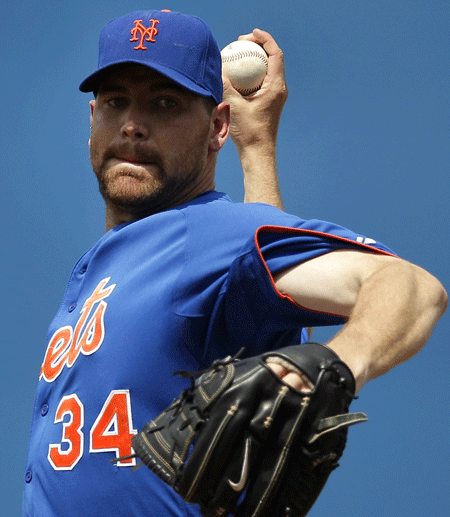
Even younger Ruben Tejada

This is pretty cool: On a trip to Binghamton in 2009, Matt Cerrone and I interviewed Josh Thole, Lucas Duda and Ruben Tejada, who are now actual Major Leaguers. Our video producers dug it up:

Your browser does not support iframes.

Nice work by SNY.tv video men Jeff and Jay remembering this stuff and finding it. I especially like the paisley animation up front, because if you were around in 2009 and can remember it, you know it was totally old-timey like that.

Season in preview: Shortstop

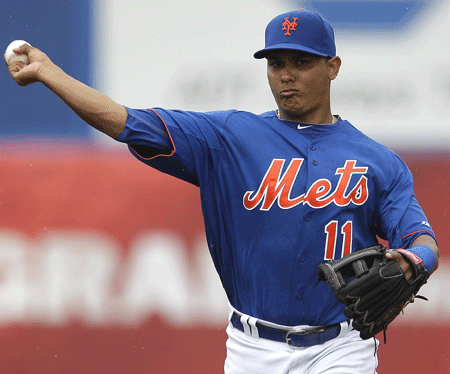
The shortstops in April: Ruben Tejada, Ronny Cedeno
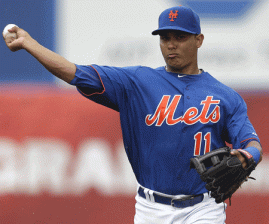
Overview: Patrick Flood has you covered for Ruben Tejada-related analysis. From February:

But putting it all together and comparing Tejada to other players who became regulars at a young age, let’s say conservatively there is:

  • A 5% chance Tejada busts
  • A 10% chance he’s a career bench player
  • A 35% he’s a useful regular
  • A 45% chance he’s an All-Star
  • A 5% chance he’s a Hall of Famer

This is, of course, ignoring all other objective and subjective information about Ruben Tejada. So it’s kind of a silly exercise. But this was really my attempt to explain my (over)enthusiasm for Ruben Tejada in statistical form: Young players who hold their own in the major leagues, even the unimpressive ones, tend to develop into solid everyday players, All Stars, and occasionally Hall of Famers. Ruben Tejada played 174 major league games before his 22nd birthday, and that on its own is an excellent sign for his future.

My my recent takes on Tejada’s age are here and here. He’s young, if you haven’t realized. And considering his age, he acquitted himself pretty nicely at the Major League level in 2011. That bodes very well for his long-term future, if not necessarily his 2012 campaign.

Tejada’s not Jose Reyes. He knows it, we know it, everyone knows it. He’s not going to hit like Jose Reyes did in 2011 in 2012, and he’s never going to steal bases like Reyes does — for whatever that’s worth.

But like I said in the above-linked post, Tejada would have been the youngest player on the Mets’ Double-A team in 2011 and would have hit around .338/.424/.426 there, a line that certainly would have placed him among the team’s top prospects heading into Spring Training this year. Given the way fans tend to overvalue their teams’ prospects, would that have mitigated the sting of Reyes’ departure a bit?

A bit, I’d say. But Opening Day is tomorrow and this is supposed to be about the Mets’ shortstops, not the Marlins’.

Tejada should provide solid defense; he’s not the most athletic shortstop in the world but he seems to have great instincts and a strong sense of fundamentals.

He’s a pretty patient hitter so it seems unlikely he’ll completely collapse on offense. But it’d be kind of surprising to see him repeat his strong 2011 campaign in his second year in the league, since he was never quite that good in the Minors.

If 2012 is a rebuilding or a retooling or a time-biding year for the Mets, they’ll be well-served sticking with Tejada throughout. Young players need time to adjust. Don’t forget that Jose Reyes, for all his hype, mustered only a .273/.300/.387 line when he was 22, in his third year in the league.

Oh there I go again with that.

Ronny Cedeno should provide strong defense and significantly less-strong offense in the backup role.

The shortstops in September: Tejada, Cedeno.

How they stack up: Tejada looks to be in the middle of the pack of NL East shortstops.

I have to figure he’s better than the Braves’ Tyler Pastornicky, who’s about Tejada’s age and wasn’t as good as Tejada’s Double-A equivalency line when he played in Double-A last year. Jimmy Rollins is 33 and looked like he was fading before a somewhat resurgent 2011. When you adjust for the ballparks, Rollins wasn’t so much better than Tejada offensively, but Rollins is a strong defender and way more of a known quantity and obviously gets the preseason nod until Tejada shows more in the big leagues.

The Nats are still going with Ian Desmond, who has not been very good on either side of the ball the past couple of years. Unless he recaptures whatever it was he was doing at the Major and Minor League levels in 2009, I’ll take my chances with Tejada. And the Marlins…

 

All systems almost go

So now everyone’s healthy and Mike Pelfrey’s awesome and we all feel pretty silly for that insufferable fretting.

The former is the real good news: It looks like the Mets will start the season with (knocking wood) only D.J. Carrasco and Pedro Beato on the disabled list, and neither of those guys was likely to make the team if he was healthy anyway. After all that — all that! REMEMBER ALL THAT!? — the Mets are going to start the season with D.J. Carrasco and Pedro Beato on the DL. Some curse.

Guys will get hurt again, of course. Probably soon. The random waves of injuries ebb and flood, and it just so happens that the Mets are opening the season at low tide for injuries. If we’re going to try not to freak out over overblown reports that 19 guys are nicked up, we shouldn’t celebrate too much when the Mets are all healthy at the same time.

And it’s sort of the same deal for Pelfrey. As Toby Hyde likes to say, Pelf be Pelfing. It’s certainly nice that he finished the Grapefruit League season on a good note since it helps stave off the nonsense for a while, but if I’m arguing against putting stock in the negative returns from Spring Training then I’d be foolish to endorse the positive ones. The velocity and yesterday’s spate of swings-and-misses seem like good signs, but yesterday he was facing a team full of backups and Minor Leaguers.

Which is to say: Wait… I don’t know what that’s to say. Opening Day is tomorrow at least, and there’ll be real baseball to celebrate and tiny samples to isolate.

Season in preview: Third base

The third basemen in April: David Wright, Justin Turner, Ronny Cedeno.

Overview: Man, your guess is as good as mine.
Do I really need to go through the whole thing about how David Wright used to be unspeakably awesome then had three straight weird years, two of them still very good but clearly something less than awesome, the third hampered by a broken back? Because if you’re a conscious Mets fan — and I assume if you’re reading this you’re a conscious Mets fan — you must know all about what happened with Wright the past few seasons.

Well, let me restate that: There’s almost no way you know what happened with Wright the past few seasons. You know the outcome, but it doesn’t seem like even David Wright knows exactly what happened.

The Mets took a stab at it this winter, moving the fences in. And with that, well… we’ll see. Maybe it was that, and maybe they fixed it. But maybe it’s just time. Maybe it’s pressure. Maybe it’s the Matt Cain fastball. Maybe it’s some weird little thing we’d never even think to consider. Or maybe it’s no one thing, just some odd combination of things that teamed up to take David Wright down from superstar to just pretty good.

Here’s what’s firm: David Wright is 29. After an ab injury in February, he is purportedly healthy now. He will play his home games in a park that has been made more favorable to hitters, especially right-handed hitters with gap power. And he’s got a $16 million club option on his contract looming after the season, and, barring an extension, free agency after that. If Wright’s ever going to be That Dude again, he should probably start doing it soon.

That’s not even to mention Wright’s defense, which has been awful by every stat these last three years though still suspiciously average-seeming to the eye. Defensive metrics were invented to help quantify assessments that have always been subjective, but now I suspect they bias the way I watch and assess defensive players. And still I never see Wright make (or miss) plays at third and think, “this guy’s one of the very worst defensive third basemen in baseball.” But then maybe I just don’t want to see it. The Mets-fan mind is strange.

The third basemen in September: Wright, Cedeno. Maybe Zach Lutz if he stays healthy. It makes no sense for the Mets to trade David Wright this season. He will still come up in trade talk once a month, as he has for the past year. The only way he gets dealt is if some… oh just read this please.

Overview: The NL East is a great division for awesome third basemen coming off injury-plagued down years, assuming you count Hanley Ramirez as a third baseman. I’m going to go optimistic with this and guess that Wright rights himself a bit and outperforms one of Ramirez and Ryan Zimmerman, and they all outperform old-man Larry Jones and Juan Francisco in Atlanta and the punchless Placido Polanco in Philadelphia.

Sandwich? of the Week

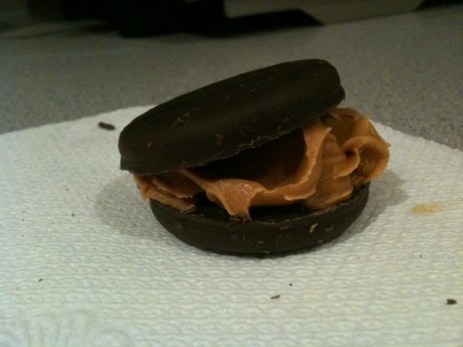
The candidate: Peanut butter between Thin Mints from the analog TedQuarters kitchen. Prepared annually whenever we run out of Tagalongs.

The construction: A dollop of Skippy creamy peanut butter sandwiched between two Thin Mints.

Arguments for sandwich-hood: It’s a familiar, incontrovertible sandwich filling — peanut butter — sandwiched between two identical (and carby) items.

Arguments against: The things doing the sandwiching are cookies. Also, it’s hard to argue that the peanut butter is the focus of the sandwich here: It’s not really the dominant taste so much as a binding agent connecting two delicious Thin Mints. You probably wouldn’t call this a “peanut butter sandwich on Thin Mints” unless you were trying to be cute with it.

How it tastes: Oh, it’s great. It’s a bit messy — Thin Mints are not meant for containing peanut butter, so the peanut butter slides out when you bite into it and you wind up having to lick off the little ring of peanut butter that forms around the sides. But that’s fine, because it’s delicious peanut butter.

But when you get the bites that are both Thin Mint and peanut butter, they’re awesome. Obviously I don’t need to tell you how great peanut butter and chocolate go together, and presumably if you’re familiar with the Thin Mint you’re also familiar with the Tagalong and you know how well Peanut Butter and Chocolate combine with the crunchy texture of a cookie.

I’m not even a big mint guy (well, I’m a big, totally mint guy, like in the 1980’s sense; I don’t generally love things that are mint-flavored, is what I mean to say), but throw in that little hint of cooling mint flavor with the warmness of the chocolate and peanut butter and the crunchiness of the cookie and now we’re talking about f@#$ing dessert.

What it’s worth: Uhh…. I really have no idea. My wife buys the Girl Scout Cookies. Those things are expensive though. I suspect they have uncut cocaine in them. Also: How is it possible that the suggested serving size for Tagalongs is two cookies? It should be no less than seven.

The verdict: I’m conflicted, but I think not a sandwich. It has more to do with the bagel-and-cream-cheese thing than with this being a dessert. The peanut butter here is a nice complement to the Thin Mints, but this thing is primarily Thin Mints. For the purposes of this exercise, I’m willing to consider and devour ice-cream sandwiches, which I suspect are indeed sandwiches. I am that dedicated.

Season in preview: Second base

The second basemen in April: Daniel Murphy, Ronny Cedeno, Justin Turner

Overview: There’s not much to say about Daniel Murphy’s move to second base that I didn’t already get at here, but I’ll add that we’re coming up on Opening Day now and Murphy still looks set to start the season at the keystone in Flushing. So despite a few visible hiccups in the field in Grapefruit League games, nothing Murphy has done this spring has convinced Terry Collins and/or the Mets’ front office that it’s time to bail on the project altogether.

And that’s good. There will be more hiccups, no doubt, and more agonizing over Murphy’s defense. But if he can stay out of harm’s way — no small thing, given the way his last two seasons ended — and capably play the balls hit near him, he should at the very least represent an upgrade over Luis Castillo.

Murphy can hit, we know, earning comparisons to Pete Rose from Keith Hernandez within a few weeks of his Major League call-up then working to bear them out with a reasonably Pete Rosey .320/.362/.448 line before his injury in 2011.The batting average could dip a bit, but Murphy is hardly a free-swinger, and Citi Field’s new dimensions should help his power numbers.

If Murphy can play second, the Mets have a nice player to stabilize a key position through at least 2015. If he can’t, it’s back to the drawing board for like the eight millionth time since Edgardo Alfonzo left.

Ronny Cedeno is good at defense but the Mets probably won’t want his bat in the lineup every day if Murphy gets hurt or can’t hack it defensively. That’s why Turner’s around.

The second basemen in September: Murphy, Cedeno.

How they stack up: Extremely hard to tell until we know how Murphy can field and how long Chase Utley’s out. The Braves have Dan Uggla, a good hitter and terrible defender. The Nationals have Danny Espinoza, a decent defender with some power who doesn’t make a lot of contact. The Marlins have Omar Infante, a decent defender who doesn’t hit much. And until Utley gets healthy, the Phillies have Freddy Galvis, a 22-year-old with a stellar defensive reputation and a career .613 Minor League OPS. It’s easy to imagine the Mets having the best or worst second baseman in the division.


Season in preview: First base

I need to make these shorter or they’re never going to get done. Less talk more rock.

The first basemen in April: Ike Davis, Justin Turner.
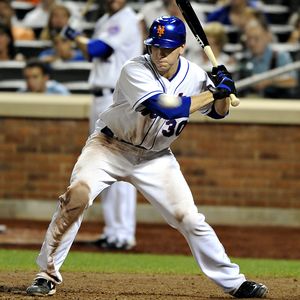
Overview: Last year, Davis performed like one of the best players in baseball for a little over a month before he fell victim to David Wright’s hardest hit of the 2011 season. Upon his arrival to Spring Training this year, he pronounced his ankle healthy then was diagnosed with Valley Fever, a lung infection common in the area of Arizona where Davis resides that never presents any symptoms in 60 percent of cases but that sidetracked Conor Jackson’s career and had half the Internet writing tearful requiems for the Mets’ first baseman.

Davis seems to be OK. He has played regularly throughout Spring Training and reported no trouble with his health. But the diagnosis combined with his small-sample supremacy last season mean people will inevitably blame Valley Fever if and when he fails to produce a 155 OPS+ over 550 at-bats in 2012. But then people are people, and I really shouldn’t get too hung up on all the stupid things they blame for stuff.

What matters is this: Davis, provided he is in fact healthy and feeling no effects of either the Valley Fever or last season’s ankle injury, should be at least a very good hitter and an excellent defensive first baseman. Over the first 652 at-bats of his career, he has got a 123 OPS+, a mark that’s undeniably trending upward even if you allow that he’s not quite as good as he looked in the first month of 2011.

Davis just turned 25 and the Mets just brought the fences in. If you’re looking for elements of the 2012 Mets you can dream on, here’s one of them: Maybe Davis blossoms into an excellent player, even a superstar. It’s no guarantee, but not a lot of guys hit as well as he did as young as he did.

Justin Turner will back up Davis, mostly, it seems, because Terry Collins doesn’t want to burden Daniel Murphy or Lucas Duda with the job while they’re learning new positions and maybe a little bit because he wants to have Justin Turner on the team and needs to find some good reason to keep him around.

Turner’s fine as a second righty pinch-hitting option (if you think you need two) and fallback plan in case Murphy doesn’t work out at second, but if he’s starting more than once every two weeks or so at first, that’s not so great. But Collins seems to know that too, since he said the team would move Duda or Murphy to first if Davis were to be out for more than a couple of weeks.

The first basemen in September: Davis, Mike Baxter. Playing a hunch that says Turner gets traded, since it seems like he’d have value to a team that needs a second baseman in a pinch. But then, if you’re playing at home, I’m three positions deep and already assuming two traids, and this isn’t a fantasy team.

Overview: I’m going to say Davis will be the best first baseman in the division in 2012. Freddie Freeman hit well for a 21-year-old in his rookie season in 2011 so there’s a chance he’ll outproduce Davis offensively, but Freeman’s something of a butcher in the field. Ryan Howard’s going to miss the first part of the season returning from Achilles surgery and subsequent infection and has been in reasonably steep decline for a while. Gaby Sanchez is pretty good but not great and unlikely to be getting any better.

And the Nationals have… whoa, WTF, the Nationals still have Adam LaRoche at first? WAIT, the Nationals have only had Adam LaRoche for one year and he only played 43 games for them, and Adam LaRoche has only been playing since 2004? I’m sorry; I don’t buy it. Can’t be true. Adam LaRoche has been on the Nationals since they moved from Montreal in 2005, and he was an old man then. I don’t care what these newfangled websites say. And in any case he’s not likely to be better than Ike Davis.

Reggie Miller says he is an “all-world pitcher” and “could play Major League Baseball today”

In related news, the Mets should totally sign Reggie Miller. I secretly love Miller in a Stockholm Syndromey way because he’s responsible for several of the craziest and most heartbreaking things I’ve ever seen on a basketball court — or in any sporting arena, really. And it’d be pretty sweet to have him in the bullpen if the Mets ever needed to square off against the Knicks in some sort of bizarre exhibition.

Via N.Y. Baseball Digest, via Repoz.

Don’t watch this if you haven’t since gone to college and found a basketball team you care about way more to make it sting less:

Season in preview: Catchers

No time for fuss. I’m outsourcing most of this one to 2011 me.

The catchers in April: Josh Thole, Mike Nickease.

Overview: Here’s what I wrote in this space last year:

I think David Wright and Jose Reyes spoiled us. We forget that it took Reyes two and a half seasons to reach his All-Star form, and we expect every player that comes through the system to quickly achieve the type of success that Reyes and Wright enjoyed early in their careers. It’s almost unbelievable that the Mets were able to develop two legitimate All-Stars in such a short time, yet now we hope every prospect can immediately reach that level.

But no team entirely consists of All-Stars, and good teams need guys, too. A frequent point of contention with Minaya’s administration was that the Mets too often complemented their great players with terrible ones, casting misplaced blame on the Wrights and Carlos Beltrans of the world when meanwhile Jeff Conine was still getting important at-bats. Great teams need dudes: Low-cost, generally homegrown contributors that can benefit a roster without vacuuming up the payroll that should be dedicated toward the All-Stars.

And I think Josh Thole might be a dude. In his first 286 Major League plate appearances, Thole has a solid .286/.357/.373 line. It’s a small sample and his power numbers won’t make anyone forget Mike Piazza, but Thole has nonetheless hit like a better than average catcher whenever he has been in the big leagues. Moreover, the numbers aren’t terribly out of line with his Minor League stats; Thole has always been a patient hitter with doubles power….

Thole is still young and reasonably new to Major League play, so he could endure an adjustment period at the plate in 2011. But we should be patient. He has hit in the Minors and worked to become a solid defender behind the plate. Cost-controlled catchers with an above-average ability to get on base don’t come around every day, and even if Thole needs some time to develop at the big-league level, he is likely good enough and young enough to contribute to the Mets’ next contender.

I still think all of that about Josh Thole. He endured some growing pains offensively and defensively in 2011, though the latter have been somewhat overblown: He led the league in passed balls, but many of them came with R.A. Dickey on the mound.

Thole’s still just 25. It doesn’t look like he’ll hit for much more power anytime soon, but he’s at the age when most hitters are still improving. It seems reasonable to expect that after more exposure to big-league pitching, Thole takes better swings at better pitches in 2012 and starts hitting like a better-than-average catcher again.

Thole’s backup, Mike Nickeas, doesn’t seem likely to hit much at all. Outside of strong years at Double-A in 2006 and 2010, Nickeas hasn’t hit well at any level above A-ball and enters the season the Mets’ backup catcher despite only 63 big-league at-bats on his resume. But Nickeas has a reputation as a great defender and a smart player, and he’s in the conversation with R.A. Dickey and Manny Acosta for best hair on the team if Danny Herrera doesn’t break camp with the Mets.

The catchers in September: Thole, Nickeas. If Nickeas doesn’t hit at all, he could be replaced by Lucas May or Rob Johnson. I like the guy, so I’m betting he manages to at least get on base some in limited at-bats against lefties.

How they stack up: Brian McCann is excellent, and his backup, David Ross, can hit a bit too. In Washington, Wilson Ramos got his career off to a great start last year. Ramos’ Major League OPS last year was better than his career Minor League line so I wouldn’t be surprised to see him slow down a bit, but it’d be foolishly optimistic to predict Thole will outperform him in 2012. John Buck had a really weird first year with the Marlins, walking more and playing more than he ever did in the American League but also hitting for way less power. Carlos Ruiz fell back toward Earth after a career 2010 and posted a .283/.371/.383 line, which sort of seems like the ceiling Josh Thole season.

Since Buck is 31 and Ruiz is 33, I’ll guess Thole manages to outplay one of them in 2012. More likely Buck, since Ruiz benefits from the Phillies’ magic even though he’s a 33-year-old catcher who caught 128 games in 2011.