Via Emma Span. Available for purchase:


I can practically promise you that no GM in baseball, given the option, would choose to run his team on a small budget, because is exceedingly hard to find and maintain a well-paying, high-profile job like Major League general manager if you are a crazy person.
 Though spending tons of money on payroll and free-agent acquisitions may not always be the wisest way to build a winning baseball team, it is undoubtedly easier to construct a strong roster with the flexibility provided by a massive budget.
This offseason, like last offseason, Sandy Alderson will have to spend the limited resources he has at his disposal in the most efficient way he can figure. That has been the GM’s job since way before Moneyball — the book, the movie, or the events that inspired it.
That book tells an interesting story about the particular way that one particular general manager found to maximize his limited budget. Yes, Billy Beane sought players with high on-base percentages, but not because of the blinders-on SABR-worship people seem to believe he embodies. Beane wanted guys with high on-base percentages because that stat, he found, was at the time generally under-compensated relative to the extent to which it contributed to winning baseball.
That’s it. It’s not emblematic of “SABR <3 OBP” or anything like that. I’m sure if given the opportunity, Beane would have loved to sign players who also boasted high batting averages, played great defense and hit tons of home runs — any GM would. But he lacked the money with which to do so, so he identified an important component of winning that he could afford and pursued it.
Oh, whatever. I didn’t start writing this to summarize (and oversimplify) Moneyball. All I mean to say is this:
Common sense is not a dogma. Attempting to employ the best and most efficient practices to operate your baseball team means only that you’re a reasonable businessman, not any sort of zealot or brainwashed disciple of anyone or anything.
Stats and scouting are both just tools used by Major League front offices to evaluate baseball players. All teams use tools. All teams try to use the best tools at their disposal to identify players they believe will succeed. All teams have budgets.
No amount of finger-pointing and name-calling and talking-point regurgitating will make any of that untrue, and for every one or two or three examples of some specific way to build a successful baseball team there are as many counter-examples of successful baseball teams built some other way. The only indubitably true principle uniting the way all great teams are constructed is so obvious it’s laughable:
You want good players.
Preferably you want good, inexpensive players, so you can afford as many good players as possible. And you and I and Sandy Alderson might all have different ways to define what determines a good player, but the basic underlying truth is that you want players who will help you consistently score more runs than your opponent in some way or another. It’s really not rocket science.
It seems like this is coming up a lot lately, especially since the Moneyball movie came out. Instead of repeating myself more than I already do, I’m going to re-publish this post that originally ran on Nov. 1, 2010 — following Sandy Alderson’s introductory press conference.
A few years ago, I painted the interior walls of an apartment with a friend. Neither of us had ever endeavored a paint job of that magnitude before, but we figured it wasn’t exactly rocket science — tape the moldings, paint the walls.
 The actual painting part wasn’t terrible, but taping all the edges turned out to be a huge pain in the ass. We spent at least as much time taping as we did painting, and the project took us about twice as long as we expected.
Just before we finished, the cable guy came. He complimented our paint job, and asked if we had taped up all the moldings. We said that we had, and he informed us to the existence of paint edgers, an inexpensive tool that paints the edges of walls without the need for all that tape.
We cursed ourselves for not doing more research and cursed fate (and probably Cablevision) for sending the cable guy so late in our process, but at no point did we curse the paint edger.
That’s why it’s a bit weird to me, as I sort through all the reactions to Sandy Alderson’s introductory press conference at Citi Field on Friday, that so many people seemed to get so riled up about sabermetrics.
For one thing, I don’t even know what “sabermetrics” means. I know it involves baseball and statistics, and I know that lots of people seem willing to speak or write on behalf of all so-called sabermetricians. But which stats define sabermetrics? It’s not batting average; we know that. Is it on-base percentage, or is that still too basic? It strikes me as strange that we should need a fancy term for those who recognize the merits of hitters that get on base often.
My understanding has always been that the numbers we throw under the umbrella of sabermetrics are those that aim to give us a more precise understanding of a player’s value than the so-called traditional ones on the back of a baseball card, and that “sabermetrics” itself refers to the pursuit of those more precise metrics.
The book Moneyball, contrary to widespread belief, was not just about sabermetrics. It was about a cash-strapped baseball team identifying an inefficiency in the market and taking advantage of it. Running a successful business.
So I get a bit confused when I see debate over when Alderson first started using sabermetrics, like he at some point flipped on a light switch to enact sabermetrics, and from there his team was a sabermetric team. I’m pretty sure it doesn’t work like that. All stats are just tools, and every team uses stats, among other tools, to evaluate players.
That’s all. No real point in getting frustrated about it. Some teams use the tape and some teams use the edger, and probably most teams use both depending on the circumstances, and everyone’s got an opinion on which option works better. The point is there’s no real good reason to get upset and say, “f@#$ you, it’s tape!” or to be all, “yield to the dominance of the edger!” because it’s really silly to get so worked up over tools.
If you hope Sandy Alderson uses sabermetrics and Moneyball to run the Mets, then great. If you hope he doesn’t, that’s fine too. Both of those words are just big sweeping labels assigned to reasonably simple concepts, and if you want to use them or not use them to describe what Alderson does as Mets GM, you know, whatever.
All I care is that he seems dedicated to running the team the right way, and appears apt to do so.
I got an email today from reader Katie asking me to help her promote a friend and fellow reader’s forthcoming metal festival. Gladly.
There is precedent for this. If you have a metal band and I know for a fact you read this blog, it’s a pretty safe bet I’ll help you promote it. Most other bands too.
I do that partly because I assume all regular readers are pretty awesome and I’m generally happy to help awesome people share their awesomeness with the world. But mostly I feel so indebted to all the friends and family that indulged my own performances (in various pursuits) for so long that I feel compelled to, well, pay it forward a bit. So check out the Metal Suckfest.
Thinking about posting a link to that show — and thinking about why I should post it — got me feeling a bit nostalgic for the days when I actually did stuff. (Also at least a little bit depressed, since I realized it has been about five years now since I’ve done any regular public performing, which I always very much enjoyed. Maybe I should get back into that somehow.)
So in the spirit of nostalgia, the three most satisfying performances I can remember, in chronological order:
Ted Berg and Pizza Night, December, 2000: I did a lot of standup comedy during my first two years of college. I won some campus contest early in freshman year, and my class’ student government always booked me for the end-of-semester pre-finals events. The winter of my sophomore year I was charged with doing 75 minutes, which is really, really hard. There was to be free pizza there, guaranteeing a pretty solid crowd.
And — I apologize for the utter lack of humility here — I nailed it. I can’t even remember most of the material now and I regret that no one thought to tape it. I spent a ton of time thinking about it beforehand (instead of, you know, studying and stuff), and I worked out clean segues and callbacks to earlier jokes and all that stuff. And for that night, it just worked.
When you’re doing standup comedy and things are going well, it’s about the best feeling in the world. All I have is a microphone and I’m keeping all these people entertained! Awesome for the ego.
Some stupid conference, February, 2003: The guy who directed the jazz band at Georgetown also booked jazz combos for local events. A group of six guys from the jazz band made up his cheap-rate jazz combo. We were thrilled to be playing for any money at all, and at most of the gigs we could score free drinks during breaks. We played some cocktail hours at weddings and a bunch of catered receptions for business conferences.
The guy always insisted that we play for the entire length of time we agreed to play for, even if there was no one left at the event. I guess he had been burned on that in the past or something.
At the reception for some stupid conference, we were booked from 5-8, but everyone was gone by 6:45. We kept playing, but ditched the jazz charts to jam on band-room funk classics. Then the coolest thing ever happened: The catering crew cleaning up after the reception started dancing, and gathered in front of where we were playing for a spontaneous funk throwdown. It was hilarious and totally sweet.
 Protocol show, August, 2006: Protocol played a particularly nerdy brand of eclectic funk, with lyrics about zombies and plate tectonics and songs in all sorts of odd meters and modes. We practiced a ton, though, and by the end of our three-year run we were pretty tight.
This was the second-to-last Protocol show. I had started my job at MLB.com a couple months earlier, and I used that as an excuse to quit the band. Truth is I thought it had run its course, and my living in Brooklyn made it logistically tough to join the other guys at practice as often as any of us would have liked.
This was our last gig at the Continental, an East Village spot where we played bi-weekly. Because it was our last time playing in Manhattan, we managed to draw a ton of people out — including my boss and a couple of new co-workers. We made our bizarre rock with as much enthusiasm and energy as we ever did, and people responded.
That was, incidentally, the night that inspired the mustache headshot that ran with my old SNY.tv column. We had a song called “Mustache,” which I sang while wearing a fake mustache. When I started writing the column, my boss feared I looked too young to be taken seriously and suggested I use a photo of myself in the fake mustache he saw at the show. Obviously I obliged.
OK, this is getting awful long but I shouldn’t brag about those successes without mentioning these three career lows:
DC Improv, February, 2000: Remember when I said how great it feels to put on a successful standup show? That high is not nearly as extreme as the awful feeling of utterly bombing. I was in college, so I made a lot of reasonably immature college-kid jokes about beer and porn and stuff. At my lone appearance at the DC Improv, I went on before Lewis Black, who does a bunch of political humor and draws a good and varied crowd in DC.
I told my first joke about porn and spotted in the first row a girl of about 14 sitting with her parents. I froze up. I managed to stumble through the short set, but it all sucked. Very lonely feeling, very sparse laughs.
Moo Shoo Porkestra, December, 2002: The Moo Shoo Porkestra played many incredibly fun shows, and I’d say it produced more in terms of total satisfaction than Protocol did. This one came during a snowstorm on a Tuesday night at the Tombs, a popular college bar near Georgetown. We were tired, we went on late, and by the time we finished, only my friend Scott (who sometimes comments here) was paying any attention. That’s actually the image that comes to mind when I think about how I owe it to the world to help promote other people’s shows: Scott, sitting behind his half-drunk beer at a large and otherwise empty table about 10 feet from where we were playing. So Katie, you should thank Scott.
Protocol show, April, 2005: I can’t remember the bar, but we played in a basement on the Upper East Side to a crowd of about 10-15 people. I had a hernia at the time and played the show from a stool. It sucked.
The Jets won last night. I planned to recap that with a longer post, but I had a meeting that occupied my whole morning and I covered most of what I wanted to say in the below video with Brian Bassett. So in lieu of that, here’s Darrelle Revis doing his thing:
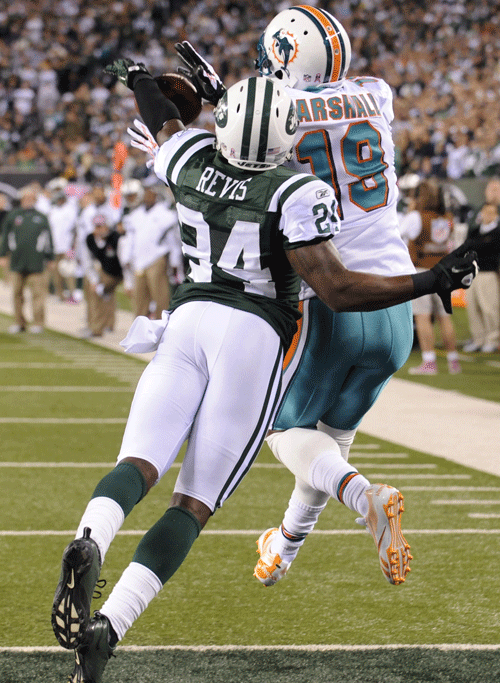
And here’s me and Brian talking about it:
If Earth were in Orlando and the closest star system, Alpha Centauri, were in Los Angeles, then NASA’s two Voyager spacecraft, the most distant manmade objects, have traveled just one mile.
Yeah, I hate to sound defeatist but it doesn’t sound likely we’re going to be exploring other star systems anytime in our lifetimes. Which is total b.s.
Here’s something I said on the Happy Recap radio show Sunday night:
I think you’ve got to bring Pelfrey back, and I know that frustrates Mets fans to hear. Because it’s frustrating to watch him pitch, and I feel the same way. He’s not, you know, he’s not great. And he doesn’t have a second pitch so he’s not really able to get a lot of swings and misses; he yields a lot of contact which I think is why you see so much fluctuation in his performance.
But I think the value in Pelfrey — and it’s one that really shouldn’t be understated — is he’s healthy. He stays healthy and throws 200 innings just about every year. And that’s not something you can easily find. And if you go about replacing him with the type of guys like Tim Redding, and Brian Lawrence, and the scrap-heap fifth starters, you wind up taxing the rest of your pitching staff a ton. And Pelfrey, as bad as he can be starting, he does have a ton of starts where it’s six or seven innings, three or four runs, and those are worth something.
If the Mets had, if Matt Harvey had been at Triple-A and Familia and Mejia and all those guys were ready to go — if this was next year and all those guys were still progressing — then sure, you cut bait on a guy like Pelfrey. But I think right now, the way the Mets need innings, they’re best suited bringing him back. And maybe if he’s pitching well and those guys are knocking on the door from Triple-A come the middle of the season, maybe then Pelfrey has some value to some contending team that needs a back-of-the-rotation starter and then you can flip him for something. I don’t think it would be wise to just let him walk in an arbitration year.
Here’s how at least one listener interpreted that:
ted berg seems to like pelf a lot……?
Yes, as everyone seems especially eager to remind you, the Mets once traded Nelson Cruz. LOL.
 They traded Cruz straight-up to the A’s on Aug. 30, 2000 for middle infielder Jorge Velandia, who sucked. Velandia spent parts of three seasons with the Major League Mets and posted a whopping .497 OPS.
A few years later, after Cruz had already reached and hit well at Double-A in 2004, the A’s traded him to the Brewers for Keith Ginter, who also sucked. Ginter spent a season in Oakland and posted a downright Jorge Velandian .497 OPS.
Then — then! — the Brewers included Cruz in a deal with a half season’s worth of Carlos Lee, who didn’t suck then, for Julian Cordero, who sucked, Kevin Mench and Laynce Nix, who sort of sucked, and a half a season of Francisco Cordero, who decidedly did not suck.
Cruz spent part of 2006 and most of 2007 with the Major League Rangers, but he sucked then — enough so that the Rangers sent him back to Triple-A for 2008. Cruz beat the hell out of the ball in Triple-A Oklahoma and became a favorite of this guy in the old Flushing Fussing column on SNY.tv, where I wrote:
Any phone calls to the Rangers, though, should start with a question about Flushing Fussing favorite Nelson Cruz. Cruz, a 28-year-old right-hander who struggled in parts of three big-league seasons, has shown that he has absolutely nothing left to prove in Triple-A. Granted, he’s playing in a big-time hitter’s park in Oklahoma, but the dude’s got a .349 batting average with a .442 on-base percentage and 37 homers in 350 at-bats in 2008. If the Rangers don’t want to take any more chances on Cruz, I certainly hope the Mets will. He needs only more time to adjust to the Majors than the Rangers have given him. The guy can rake.
The Rangers finally did take another chance on Cruz late in August after David Murphy got hurt, and Cruz proceeded to not suck. (Except on the road, it should be noted, where Cruz can boast only a .726 career OPS. I normally attribute stuff like that to randomness but Cruz’s home/road splits are pretty consistent.)
Anyway, yeah, the Mets traded Nelson Cruz. So did the A’s and Brewers, and it wasn’t until his fourth season with the Rangers that he became an everyday player. LOL.
Do you have any albums you wore out when you were younger that now seem so obscure? I’ve got a bunch — mostly random early-90s ska and punk compilations, and some albums I bought on whims because I liked the one song I knew by the band (usually from one of those compilations).
This was before the Internet had all that it now has, and I wasn’t tapped in enough to read ‘zines or whatever, so I had little more than the patches on the jean jacket of that one mohawked dude in the school for guidance. (I suppose that should be embarrassing to admit, but I’m also pretty sure that’s the way I first heard about Fishbone. So I regret nothing.)
Anyway, I enjoyed Ten Foot Pole’s “Rev” a whole lot for a couple years. I bought it because the band had been featured on Punk-o-Rama. It was straightforward, West Coast punk stuff, but that’s pretty much what I was hoping for when I bought it.
Then one day I was looking through baseball cards and caught the factoid on the back of Scott Radinsky’s: “Scott is the lead singer of the band Ten Foot Pole,” it said. Blew my mind.
Mostly, I was shocked that I had come to the band through its music and not because the lead singer was a baseball player. But then I couldn’t believe that I hadn’t noticed anywhere in the liner notes that Scott Radinsky was the band’s lead singer. For whatever reason, Radinsky was credited on the album as “Scott Pulmyfinger.” Hilarious!
Radinsky was named the Indians’ pitching coach today. Maybe next year when they come to play the Yankees I’ll try to catch up to him and talk about what happened to the Offspring.
2. David Wells, Red Sox (2005-2006), two years, $8 million dollars
The Red Sox took a chance on the 41-year-old Wells before the 2005 season, giving him a two-year deal. Wells made 30 starts and pitched 184 innings in 2005, going 15-7 and posting a 4.45 ERA (with a 3.83 FIP) for an iffy fielding Red Sox team. That performance right there was worth more than the $8 million Boston paid Wells, with anything else in 2006 being gravy — which was all they got. Wells was injured for most of 2006, but made eight gravy starts for Boston before being traded to the Padres at the August deadline.
Seriously, this is the second-best contract, and it was given to a fat, 42-year-old pitcher making $4 million dollars a year. We could stop here, because that’s probably all anyone needs to know about signing free agent pitchers to multi-year deals.
– Patrick Flood, PatrickFloodBlog.com.
Patrick Flood looks at the 10 best and 10 worst multi-year deals for free-agent pitchers. It’s about what you expect if you’re in the camp that says free-agent pitchers are almost always a bad investment, but it’s still pretty eye-opening. Also, if you’re in that camp, I’ll see you at the swimming hole.
 Tedquarters