Mets hire bench coach. FIRE THE BENCH COACH!

The Mets will reportedly hire Bob Geren as their new bench coach. I wanted Dave Magadan.

WHAT DO THEY HAVE AGAINST MAGADAN? Just another classless move by this organization, disrespecting their history. I guess there’s no formula in Sandy Alderson’s spreadsheets that accounts for MY PERSONAL MISGUIDED RAGE!

I have never met Bob Geren and honestly I know almost nothing about his approach to baseball or even what a bench coach is supposed to do, but I am certain this is the single worst thing that has ever happened to this franchise and the Mets will crash and burn under the incompetent thumb of their new bench coach.

From the mailbag

Has the luster/nostalgia of being a fan worn off since you are now an employee of the team you root for? Is it work for you? I ask this because, as a member of tv production, I would never want something I do for pleasure to feel like work. I would love to hear your take on it.

– Alex, via email.

Not really, no.

A couple of things: First off, I’m not a Mets employee. It seems like the general perception is that SNY and the Mets are two arms of the same entity, but in my day-to-day dealings it’s not like that at all. I have a season credential to cover the team, like many members of the media do, and when I need to set up something specific I go through the media-relations department, as someone from any other media outlet would.

That said, SNY’s ratings and (more pertinent to me) the traffic on these sites depend in many ways on the Mets’ performance. I am benefited professionally by the Mets playing well, which perhaps alters — but certainly does not diminish — the way I root for the team.

I think it’s this part of the job — the writing, which is hardly my primary responsibility — that most impacts the way I follow the team. I suspect that if I just showed up to the office and helped manage and edit the content on SNY.tv without ever publicly expressing my opinions about the club, I’d remain now pretty much the same fan I was in 2005, before I got my first job in media. I would know a bit more about the sausage-factory stuff that goes into a game broadcast, but not really root for the team any differently than I did before I worked here.

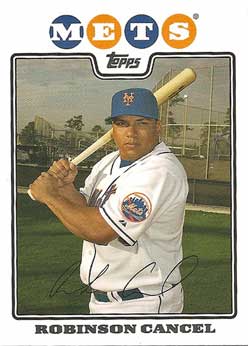
In mid-June of 2008, during the height of the great Internet Val Pascucci Campaign, Robinson Cancel smacked a pinch-hit two-run single up the middle that helped the Mets beat the Rangers. And it immediately pissed me off. I thought, wrote and maintain that Cancel had no business getting pinch-hit opportunities or even being on a third catcher on the Major League roster when the team had Pascucci crushing the ball in Triple-A. So when he got the hit, instead of being thrilled by it as a Mets fan, I was annoyed because it worked against my point.

That led to quite a bit of soul-searching, and the realization that I needed to emotionally divest myself from my writing while watching the games. It’s not the easiest thing to do, but I believe doing it successfully enhances both my enjoyment of the games and the writing itself.

I really, really, really like baseball. When I go on vacation from my job covering baseball, I usually go watch baseball somewhere. Baseball f@#$ing rules. And there’s just nothing I’m going to come across in my professional life that makes me feel otherwise.

Before I worked in this industry, I typically watched every game but ignored a lot of the nonsense surrounding it. I tuned in to the rumor-mill stuff every offseason and near the trade deadline, but I generally avoided most newspaper columns, blogs and WFAN. Not by any hard and fast rule, I just tended to seek entertainment elsewhere.

If I was working somewhere else and I saw that the Mets pulled Jose Reyes after one bunt base hit on the last game of the season, I’d probably shrug a little, say something snarky about bunting, and move on. Now I know that when something like that happens, I’m probably going to feel pressured to address it in some more substantive way. And sometimes that kind of sucks. But it’s still way, way, way better than not having a job writing about baseball.

The late-90s Mets had a “porn room”

Patrick asked Leiter if it was true that the Mets teams of the late-90s and early oughts had a “porn room.”  Which, while it sounds salacious, is really just a way of implying that boys have always been boys and it will forever be thus.  ”Porn room?” Big deal. It’s not like every frat house, locker room and ship in the United States Navy isn’t lousy with such things.

Except the question kind of rattled Leiter. You can watch the video over at SportsGrid.  Anyone who has ever tried to first joke away and then sort of explain away a mildly embarrassing truth will recognize Leiter’s vamping toward an answer.  And Patrick’s smiling.  Whether the Mets really did have a porn room back then was an open question when Patrick asked it, but I think the matter was more or less settled by the time Leiter was done answering.

Craig Calcaterra, HardballTalk.

Alright so who do we think was responsible for the porn room? The only thing I think we can say with certainty is that it wasn’t John Olerud. I’ll take a shot in the dark and guess it was Todd Pratt.

What does Lloyd Christmas have to say about all this?

[Rex Ryan and Mike Tannenbaum] denied, with straight faces, that this trade had anything to do with Mason complaining with other receivers to Ryan about the offense, as reported in the Daily News, or Mason’s critical comments about the offense after the Baltimore loss.

“It’s not like we’re singling out anybody …,” Ryan said. “It wasn’t that he wasn’t buying in … I was the most excited guy in the building when Derrick signed here. For whatever reason, it wasn’t working.”

The Jets keep looking dumber and dumber on this, denying the existence or impact of events that surely influence their decision-making process. Ryan, as much as he hates to admit it, turns out to be like most other pro football coaches when the temperature flares. He has his limits. And the Jets are not so very different from the other members of the No Fun League after all, despite the happy talk and the be-yourself rhetoric.

Filip Bondy, N.Y. Daily News.

So if you’re following at home: The Daily News reports that three Jets receivers, including Derrick Mason, enact a mutiny against Brian Schottenheimer by complaining to Rex Ryan about the team’s offense. The Jets deny these reports, but bench Mason and trade him a few days later. The Daily News asserts Mason was traded because of his role in the mutiny. The Jets deny that too.

Who really cares? What does it matter how Ryan and Tannenbaum publicly justify the move as long as the move was made to better the Jets?

Mason is a 37-year-old receiver whose output has been in sharp decline since 2007. The Jets signed him to a two-year deal late in the weird offseason. For whatever reason, he never got in sync with Mark Sanchez and never contributed much to the offense, and Ryan and Tannenbaum felt he didn’t offer them much as a fourth receiver since he did not play on special teams. When the Jets found a taker for his contract, they made the trade.

The news item in the same paper cites a source saying that Mason struggled to grasp the playbook, but Bondy chastises Ryan and Tannenbaum for claiming they traded Mason because of his performance. Isn’t that just semantics? If you don’t grasp the playbook in the NFL, you don’t perform well.

One of Rex Ryan’s greatest strengths as a coach appears also to be his greatest weakness: He believes in his guys and wants everyone else to believe in his guys, too, and he must expect his players will in turn believe in him and strive to live up to his lofty expectations. (I suspect this works especially well on players with daddy issues.) It seems every time someone mentions a Jet to Ryan, the coach insists that guy is the very best at his role in the NFL. This player is the best backup tackle in the NFL. This one’s the best coordinator. This other dude is the best placekick holder this league has ever seen.

And that’s fine. It’s a good way for a coach to be. If Ryan were to come out and say, “yeah, we screwed up — Vlad Ducasse pretty much sucks,” maybe his candor pleases some in the media and fanbase (though it inevitably enrages others). But that would do Ryan no favors with the players in his locker room and the ones around the league he will someday woo.

Where Ryan struggles, it seems, is in recognizing when some Jet is not in fact the best player in the league in his role. Colin Baxter is not the best backup center in football. Eric Smith is not the best safety in the league. Brian Schottenheimer is not the best offensive coordinator. Derrick Mason certainly was not the game’s best slot receiver, nor would he have caught the 90-100 passes Ryan once predicted.

So it seems, then, that the Jets’ willingness to move Mason is a good sign, in that it shows that Ryan and Tannenbaum can tacitly admit a mistake and hold players accountable when they fail to meet the expectations. That they did so — and chose to compliment Kerley instead of scolding Mason — hardly seems dumb.

Wait hold on

But it sure seems to me that purely as a baseball question, you would much rather give a guy a bigger and shorter contract than stretch it out over six or seven or eight years, where everyone finds themselves facing an awkward ending when the player isn’t worth the money anymore and the team has to figure out how to handle it, the player has to deal with the abuse, and so on.

Honestly, in some cases, I’d rather give a guy four years at $100 million than six years at $100 million.

Joe Posnanski, SI.com.

I enjoy Posnanski’s writing as much as you probably do, but I’m not sure this makes any sense. Why would a team want to lock up a guy for four years for the same amount of money with which they could lock him up for six years? Is the awkwardness he refers to really so intolerable that teams should give up the chance they’ll get two extra years of production from the player for no additional cost?

I think the problem is only perception: Since teams almost always reap most of the returns on a free agent deal in its first couple of years, they (and their fans) should approach the deals that way and consider anything they receive from the player on the back end as gravy. Actually I wrote almost exactly this same thing in June.

The biggest reason I can figure for any awkwardness is that teams are often hesitant to part ways with sunk cost. I realize there are human interactions involved, and maybe it’s too hard a PR hit for a team to just up and cut a former star player it expects won’t give them any more production than some available replacement. But it happens pretty frequently in football (since large parts of contracts aren’t guaranteed) and somehow the NFL soldiers on in spite of any ill-will created by disloyal franchises.


What we troll about when we troll about Wally

If you want to incite uproar on Twitter, mention Wally Backman. Just Tweet something innocuous like, “I saw Wally Backman at my corner store this morning buying coffee and a buttered roll,” and watch the response.

First, people will speculate that the sighting means he’s joining your local Major League Baseball team to fill some vacant coaching position. Some people will think this is terrible news, and other people will argue that it’s great news.

Then, once everyone realizes that the reported purchase of the buttered roll indicates little more than that Wally Backman purchased a buttered roll, people will spin it to fit with whatever they already believe about Backman.

“Coffee and a buttered roll! What an honest, blue-collar breakfast,” one will Tweet. “He’s perfect for this town.”

But then someone else will be all, “Coffee and a buttered roll!? That’s the same breakfast George Bamberger favored, and he was a terrible manager!”

Then the first guy will reply to the other guy like, “You’re ignorant! Many great managers have sworn by coffees and buttered rolls!” And the second guy will say, “Why do you love him so much? I’ll murder you dead!” Then the first guy will respond, “I’m cuckolding you as we speak!”

And it’ll go on and on like that until everyone realizes Twitter is stupid and that buttered rolls have little predictive power for managerial ability.

That’s the main thing: Twitter is pretty stupid. It can be a valuable tool for monitoring breaking news and a fun vehicle of validation for those that try to traffic in succinct one-liners, but it is a miserable forum for debate.

Anything worth arguing at any great length is almost by its nature too nuanced to be stripped down to 140-character bursts, and the immediacy and impersonality inherent in the medium encourage inflammatory implications (and interpretations). But then of course it’s people driving Twitter, and eschewing intelligent discussion in favor of incessant, oversimplified polemics is really nothing new in any forum in which humans interact.

I get sucked in, too, of course. But mostly I resort to sarcastic trolling, extending the most fervent common arguments to absurd heights for easy entertainment. It’s cheap and shticky, but it’s great for that whole validation thing.

Which is to confess: When I blame Carlos Beltran or heap shame upon Jose Reyes or worship at the altar of Wally Backman, I don’t really mean any of those things. I mean rather to mock those that do say and believe those things, especially if they deliver them with a certain Twitterish zeal.

The latter issue is the one currently en Twitter vogue. If you believe what you read, Backman is either very likely or definitely not joining the Nationals as Davey Johnson’s third-base coach and protege. And by now most Mets fans seem certain that Backman will either be the single best or absolute worst Major League manager of all time, when the truth is very obviously somewhere in the middle.

I can attest that Backman has a tremendous knowledge of the young players in the Mets’ system — and not only those he managed in Brooklyn and Binghamton. I believe his players really do respect him and enjoy playing for him, and that he is probably a strong motivator.

But I imagine if he were managing the Major League Mets I would grow frustrated with some of his in-game strategies, and that he might need to temper his temper to avoid the type of back-page nonsense that has tormented the organization in recent years.

I am likely biased a bit toward Backman now because — as some of his staunch allies have been eager to point out — he has been a very obliging and helpful guest for multiple SNY.tv video interviews over the past couple of years, and because I don’t believe there’s any such thing as unbiased journalism (or anything). But it shouldn’t offend Wally or anyone to hear that I expect he would have strengths and weaknesses as a Major League manager, just like everyone else in the entire world.

Wally Backman was an ’86 Met, and his presence in the organization is a pleasant reminder of that year to the legions of fans nostalgic for those dirty-uniformed mustache heroes that dominated the National League.

On and off the field he has suffered trials and enjoyed triumphs. Multiple Major League organizations, including the current Mets, have deemed him worthy of stewarding their precious Minor League commodities. The Diamondbacks saw fit to fire him less than a week after naming him their Major League manager.

If and when he finds a job managing in the bigs, he will be hailed as a hero if his team succeeds and chastised as a goat if they fail. In either case, his effect will likely be overstated, as a manager’s influence usually is.