I watched the Space Shuttle Discovery launch yesterday from Cocoa Beach, a well-trodden strip of white sand between a narrow grid of bungalows and the Atlantic Ocean. It is 10 miles south of the Kennedy Space Center and a popular spot to witness the spectacle of liftoff for anyone unwilling or unable to brave the crowds at Space View Park.
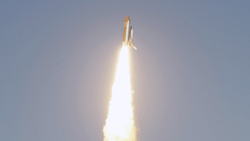 Discovery is the most veteran of the three space shuttles still in operation. It has made 38 missions to space since its first launch in August of 1984. It has housed 246 astronauts, deployed 31 satellites and orbited the earth 5,628 times, according to the Wikipedia. It left the planet yesterday with a crew of six plus one humanoid robot, bound for the International Space Station to drop off supplies and the robot.
On the beach, the crowd stood and stared impatiently toward the north at the scheduled launch time, 4:50 p.m. No one seemed sure where exactly to look until the shuttle rocketed (literally) into view, its glowing orange plume of burning fuel trailing and leaving behind an expanding tower of white smoke.
Discovery shot up and out over the Atlantic, then ducked behind a cloud. People on the beach cheered when it emerged again, then hid behind another cloud, then poked out once more. At some point, maybe a half minute after the launch, we could hear the low rumble of ignition and then what I think was a sonic boom. Then, finally, the shuttle disappeared behind a cloud and never returned, off into space.
Space, bro. Outer space.
The crowd stood looking skyward still for a few moments after it was clear there was nothing more to see.
“Is that it?” asked a skinny teenager in a bikini.
Yeah, that’s pretty much it. The astronauts will attach a storage module to the ISS, take care of some space business, then return to Earth on March 7. This is Discovery’s last mission. After it touches down, it will be grounded in a museum or stripped for parts or converted into a really sweet low-rider or sent wherever it is that old space shuttles go to die.
The remaining two shuttles are each slated for one more launch – one in April, one in June — then retirement. The current space policy calls for a manned mission to an asteroid by 2025 and a manned orbit of Mars by 2030, but they will rely on privately designed spacecrafts.
We’re not really doing this anymore. Not the way we used to, at least. And really, 2025… I mean, who knows what could come before then? Wars, locusts, zombies, whatever.
Sensing the vague gravity of the event, I stopped in a dusty souvenir shop on my way out of town to pick up something for my 3-year-old nephew, C.J.
Inside, a leathery man behind the counter in a Hawaiian shirt waxed nostalgic with a tourist.
“In the days of Gemini, they just had three pilots circling the lighthouse, giving them thumbs up when the air was clear,” he said. “Hell, John Glenn went to space with a rocket between his legs.”
“They were cowboys back then. Cowboys.”
I bought the single item in the store even remotely appropriate for a 3-year-old: a small metal windup shuttle, the only one left on a shelf half-full of fading posters. The toy is dirty, its right wing is scratched and it looks like it may have once been chewed by a dog.
The front wheel is off-kilter, so when I wind it back and let it go on my desk here, it drives in circles. It is pathetic. My nephew will like it because he’s gracious, and because he’s too young to understand how pitiful a substitute the model makes for the real thing, which transports people to space.
C.J. won’t know –- at least not until someone tells him -– that 20 years ago we read science magazines in school that promised affordable vacations to the moon by 2010, and that the whole space-exploration thing hasn’t exactly shook out the way we once imagined it would.
But that’s not a thing to lament; it’s just a thing. Space is inconceivably huge, and presumably out there somewhere floats inexplicably awesome stuff that could offer massive benefit to our society, but we’ve got no feasible way to get to it. Turns out everything else in space is really, really far away.
Thinking back to the beach yesterday, I am struck now by an amazing juxtaposition I spotted, one that didn’t seem out of the ordinary at the time: People using smartphones to snap photos of the launch.
We once assumed the most advanced 21st-century technology would deliver us outward to the stars, but our most astonishing achievements of late have turned inward, the series of tubes and everything. And we can squint now and see the ways that unprecedented acess to information and to each other can help us endeavor deeper and achieve more while navigating humanity, an expanse nearly as vast and perplexing as outer space.
 I asked Bay about it during batting practice this morning. Turns out what he was using was the “ocular enhancer” machine the team agreed to lease as part of
  The company works mostly in maple, and I got into a conversation with the representative about MLB’s new restrictions on maple bats, most of which
 Thole said he found the new mask a bit too heavy, and that he tried it out for a while after he had a concussion but didn’t think it made much of a difference. He said that getting hit in the face with a fastball is going to hurt no matter what mask you’re wearing.
 Tedquarters