
Food for thought

We all know at this point that long-term contracts for pitchers are very risky; after all (to paraphrase one of your recent posts), pitchers get hurt a lot.  Given that fact, let’s entertain a hypothetical scenario: Let’s say an ace hits the free agent market in his prime, and teams are lining up to woo him.  Conventional wisdom says that, most of the time, the team that ponies up in dollars and years will get the prize, right?  Well, what if a rogue team took a different approach, and instead of offering, say, a six-year, $140m deal, offered a three-year, $90m deal instead?  What do you think would happen?  Would the pitcher scoff at the lower total contract, or would he be interested in the higher annual payout and the lure of another round of free agency in three years?  I’d bet the pitcher would at least think twice about it.  As for the team offering those terms, it would be mitigating the risk of injury to the player; it would save itself money in total dollars committed; and it would have greater flexibility in player personnel decision making in the medium-to-long term.  Food for thought.

– Nate, via e-mail.

Hmm. Hmmmmmmmmmm. That is some tasty food for thought.

It seems like a reasonable enough idea that I’m trying to figure out why it hasn’t happened. I suppose it mostly depends on the pitcher: If he has been so thoroughly injury-free that he and his agent are confident he will be healthy in three years, a deal like that would make  a lot of sense for him. Of course, if that were the case, the team would also probably be reasonably confident that the pitcher would be healthy in three years and might prefer to lock him up for less money per year over a longer term.

I guess the only even vaguely comparable situation is when Roger Clemens signed a couple of massive part-year deals with the Astros and Yankees in 2006 and 2007 (Ed. Note: And he is BAAAACK!), but in those cases I’m pretty sure it was Clemens limiting the length, doing his own version of the Favre festering-boil thing, only in Clemens’ case with an actual festering boil.

Otherwise, maybe it has something to do with the way teams want to structure payouts? As Mets fans have all now seen, teams can invest and earn interest on the money they owe players in the latter years of contracts, so perhaps it behooves the team to avoid giving a player so much money so quickly?

But really, I don’t know. If I had to guess, I would figure it is the agents — smart enough to vote down a confident player who believes he’s invincible — that get in the way of that type of deal. They probably convince the pitchers — rightfully — that they’re in a dangerous trade, and that the security of a $140 million deal (in this example) is better for them and their families. But I’m probably missing something. Some union thing? Any ideas?

Until recently, CC Sabathia ate Cap’n Crunch every day

Turns out the secret to CC Sabathia’s 25-pound weight loss this winter was another guy with the same initials.

“Not eating Cap’n Crunch every day,” Sabathia revealed when asked what changes he made to his diet to help him trim down from 315 lbs. to 290 since the end of last season. “I’m actually what it says on the back of my card.”

Mark Feinsand, N.Y. Daily News.

Wow.

I’m in no position to judge anyone for his dietary choices, it’s just a bit surprising to me that anyone would waste so much space and calories on Cap’n Crunch. It’s not even close to the Top 3 sugary cereals. Those are, in order: Lucky Charms, Cinnamon Toast Crunch and Golden Grahams. And I avoid even those, because if I’m going to destroy my body it’s going to be with bacon dammit, not breakfast cereal. I generally start my days with a bowl of Kashi Honey Sunshine, which is actually shaped just like Cap’n Crunch, and is clearly not as good for me as it purports to be because it’s decent-tasting.

Cap’n Crunch reminds me of dog food, and for a very specific reason: My late dog, Muffin, ate Cap’n Crunch for breakfast every morning even though no one else in my family did. I don’t really know how it started — I was 7 or so — or why we had the cereal in the house to begin with, but she wouldn’t even eat Purina or whatever she was supposed to eat. She just wanted Cap’n Crunch. Also: Burgers. Dog ate a lot of burgers. Shockingly, she weighed twice as much as she should have and eventually died of dog diabetes. Good dog, though. Very chill. Slept a lot.

Anyway, good for the big fella for dropping down to his listed weight. No idea if it will actually impact his pitching at all, but you figure it’s got to help with his already impressive stamina.

Never bet against Ken Jennings

At Brad’s and Ken’s gods-throwing-lightning level, the difference between winning and losing usually isn’t mental agility, but the ability to time the milliseconds between the moment Alex finishes the clue and one of the producers activates the buzzers, slamming your thumb down with either (a) near-perfect reflexes at the off-camera lights telling you the buzzers are go, or (b) a near-perfect guess at the off-stage producer’s timing.

Since a computer can obviously react to the “go” lights more rapidly and consistently than any human, it will probably win. My two cents, anyway.

The only alternative I can imagine is if Watson is given a human-like randomness in buzzing of a few milliseconds, but there’s no report I can find of any such delay. Apparently, if its algorithms generate a feeling of suave cockiness, dudebox can buzz in instantly.

Combined with Watson’s inhuman inability to forget anything or stress out, I don’t see how any mere primate has a prayer. (And that’s a measure of the amazing accomplishment of IBM’s engineers. Big applause to them. Still, the human ego has a fallback: as Ken has noted, Watson still couldn’t write a clever Jeopardy! clue to save its backside bus.)

Jeopardy! champion Bob Harris, Boing Boing.

This is a good point, and good insight into how that works. Any Jeopardy! fan will tell you there’s a rule that you can’t buzz in until Alex Trebek is done talking, but I never was quite sure if there was some sort of prompt or what. Turns out it’s a light. That explains the delay before contestants buzz in for audio and video clues, too.

But I am not betting against Ken Jennings in a Jeopardy! match, whether against man or computer or beast or whatever. Remember that he is the O.G. Jeopardy-dominating machine, and as far as we know he is yet to glitch out.

What he said

Here’s the thing I don’t get: why say this at all? Mejia’s own performance will dictate where he will land eventually. That and the organization’s evaluation of his performance. There’s just no question that a top-line starter is more valuable than a short-reliever….

Warthen was being honest, and I suppose he deserves our approval for that. However, sometimes, tact is as important as honesty. I don’t know what question from what reporter prompted this discussion. Nor do I really care. The issue here is that there are other people with the Mets who think Mejia has the potential to be a starting pitcher and he is being developed with that goal in mind this season. Warthen, while expressing a personal opinion, is essentially publicly expressing disagreement with others in the organization.

Toby Hyde, MetsMinorLeagueBlog.com.

People seem to be making a lot about Warthen’s comment that Mejia profiles as a Major League reliever, but I’m with Toby: It doesn’t really matter much. If we’re assuming that decisions about the way the team’s top prospect is handled are now the dominion of the front office — sigh! — the Major League pitching coach’s opinion probably doesn’t much impact the way the team develops Mejia.

(Oh man, remember all that last year? Holy hell, did that happen?)

Anyway, it might be better if Warthen kept opinions like this one to himself, just for the sake of public relations. But though I’ve ripped Warthen for things he has said in the past, Mets pitchers publicly and privately rave about him, so he must be doing something right. It’s probably not fair to judge him just based on what he says to the press.

(Very little) about the nanshiki ball

With red wristbands and a thick mane flowing out the back of his helmet, Nishioka was standing on second base in the eighth inning of a quarterfinal game against the United States in the inaugural World Baseball Classic in 2006.

Japan’s batter had just been hit by a pitch when time was called so the trainer could come out. Nishioka seized upon the lull to fulfill a dream. He stepped off the bag, walked over toward Derek Jeter and introduced himself.

Brad Lefton, N.Y. Times.

Good read from Lefton and the Times about the Twins’ newest infielder, Japanese import Tsuyoshi Nishioka. Nishioka briefly used only one name — Pele-style — and had only “Tsuyoshi” on the team roster, which I imagine could not have gone over well with our hero.

Anyway, this article seems like as good a segue as I’m going to find to bring up something I’ve been thinking about in terms of Japanese baseball, and which I can’t find a whole lot about online.

Toward the end of the fall, as numbers started dwindling at our weekly pickup baseball game in Brooklyn, we found ourselves with only enough guys to field one team. We sought out competitors, and found a few rogue teams from other leagues that themselves weren’t yet ready to shelve their bats for the winter. We played against a team of Mexican dudes called the Aztecs from a Red Hook league, and then a couple of games against the Cubs from the New York City Metro Baseball League, a wood-bat league that plays in Central Park.

For our last game of the season, we played a group of Japanese guys that play in a Japanese league spanning the Tri-State area. Unlike the Cubs and the Aztecs, though, these guys used some different equipment than we did. Most notably: The nanshiki ball.

I can’t find much about the nanshiki ball online in English, but one of the guys told me it’s essentially the standard for every amateur-level league in Japan, Taiwan and Korea. It is slightly lighter than a regular baseball, and made of rubber. It has raised “seams,” but they’re the same color as the ball. The guy said it is used for safety, but also to save space — because the ball doesn’t travel as far, fields where it is used do not need to be as large as they would with a harder baseball.

Our pitchers were unwilling to use the nanshiki ball and theirs were unwilling to use our ball, so we agreed that they would use the nanshiki ball when they were in the field and we would use ours.

Because the ball compressed when it made contact with the bat, it was very difficult to drive. And since it was impossible to read the seams on pitches, it seemed to reward the slap hitters over the more powerful guys.

The opposing fielders, for their part, seemed way more eager than we were to use their bodies to knock the ball down, perhaps because the cost in pain is less (or perhaps because they were generally better fielders than us).

Anyway, I wonder if this in any affects the development of Asian players. I have no idea how long the nanshiki ball has been in use and at what levels exactly, so it could be that no current Major Leaguer has ever used the thing. But as younger Japanese players like Nishioka start switching leagues, it’s at least an interesting thing to consider, I think.

Oliver Perez shows up early

Well there’s this: According to David Lennon of Newsday in a subscriber-only piece, Oliver Perez showed up to Mets camp a couple days early yesterday, only to find the complex locked. Perfect. Lennon reported that Perez then picked up some workout clothes and left to exercise on his own.

In the grand scheme of things, the report means very little, of course. But for some reason fans seem to use the date a player reports for Spring Training as a barometer for his commitment. If he is there a week early, he is focused and prepared, a dedicated team player. If he only arrives the day he is contractually obligated to show up, hellfire and sanctimony, fire and brimstone.
Of course, there’s some confirmation bias at play. Fans note when Perez is not listed among the players that arrived early to camp because they have already decided that he is lazy and unfocused. No one even notices that Mike Pelfrey’s not there — hey, he’s got a young kid and another on the way; maybe he wants to spend time with this family!

Neither Pelf nor Perez nor anyone else should be faulted, ever, for failing to show up before the mandatory reporting date. For one thing, no one has any idea what type of work a player does on his own time, in his home gym or with his personal trainer or whatever. Second, showing up early is voluntary. I rarely come into the office on weekends. I could, and I’m sure my bosses would appreciate the extra effort, but I’ve got lots of other stuff to take care of.

Maybe some players determine that showing up a couple days early will help them get a leg up on the competition or earn good standing with the team, but maybe others want time to get in the best shape possible before they show up to camp so they can make a good impression when they do. And maybe some really just don’t want to put in the extra work. Who knows? I don’t.

Point is, we can knock “not showing up early” to camp off our list of complaints about Oliver Perez. We’re going to have to instead focus on the big ones: “Owed $12 million” and “Not very good.” The former is certainly not his fault. The latter might be.

There have always been mixed reports on Perez’s work ethic, and it’s difficult to tell to what extent they’re true and to what extent he’s simply an easy punching bag for media because he’s a) already disliked by fans and b) not a great quote. The only concrete evidence we have of his selfishness is his refusal to go to the Minor Leagues last year, something well within his rights as a Major League veteran. Of course, as fans, it’s well within our rights to boo him for occupying a roster spot.

Sandwich of the Week

Here’s another sandwich recommended by a reader like you. This particular sandwich has been endorsed many times over, but first by Carl. He actually emailed me about it back in May, before I was even writing about sandwiches on this site with any regularity.

Please, if you know of an exceptional or exceptionally interesting sandwich — especially if it’s easily accessible via subway from Midtown or by car from Westchester — let me know about it. You can email me at tberg@sny.tv or use the contact form above.

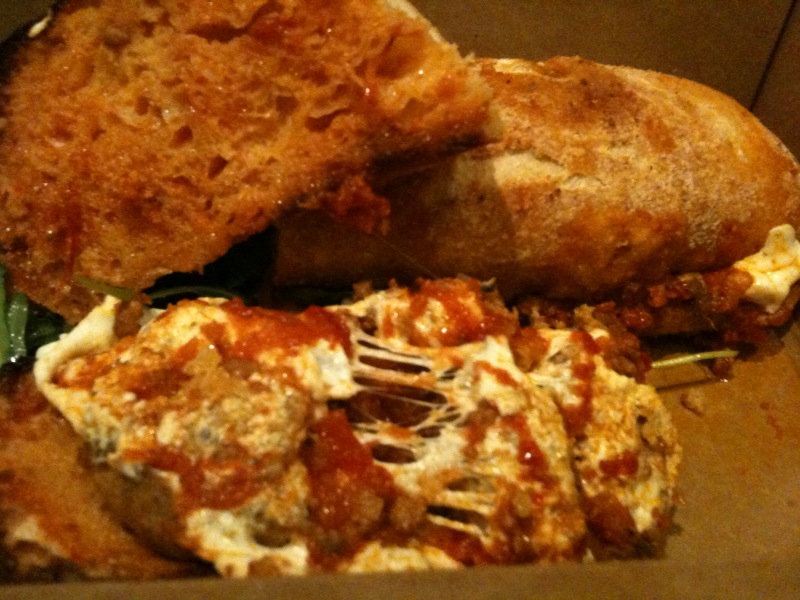
The sandwich: Spicy pork meatball hero with spicy red sauce and mozzarella, from The Meatball Shop, 84 Stanton St. in Manhattan.

The construction: Several (three?) spicy pork meatballs smashed and spread out onto a baguette with fresh mozzarella cheese. Then they toast the whole thing so the cheese is melted.

Important background information: As I’ve noted several times, my mother is Italian and I am fiercely loyal to her meatballs. Though I love meatballs in concept, I rarely order them from restaurants because I know they will not match the ones I grew up enjoying. Mom’s are a bit less bready than most, I’ve found, so they’re more coarse: delicious hunks of well-seasoned ground beef. And I guess she fries them at a hotter temperature than most people do, because they maintain a bit of a crispness on the outside that I rarely find in other meatballs. Superb, honestly. The showpiece of her very impressive array of culinary delights.

But the Meatball Shop is all the rage in the trendy Lower East Side, and though I’m not what you’d call trendy myself, I figure when trends overlap with sandwiches I should probably get on that. Plus a bunch of people whose opinions I respect told me I must eat this sandwich.

I trekked down there on Thursday and the place was packed. No open tables and people stacked about three deep at the bar. This is sort of pathetic, but since I was alone and starving I wound up ordering the sandwich to go, hopping in a cab to Grand Central and eating it in the dining concourse while waiting for my train back to the suburbs.

What it looks like:

How it tastes: Hell and yes.

Believe it or not, the thing that first jumps out at you on this sandwich is the baguette. As mentioned, it’s toasted so it’s got a great crispness on the outside, and it’s sturdy enough to withstand a 10-minute cab ride’s worth of grease accumulation from the meatballs and cheese. That’s impressive.

And the pork is excellent. Since the meatballs are smashed up the experience is more akin to eating a sloppy joe (the ground-meat kind, not the Jersey kind), only if the sloppy joe were made with loose sausage meat from a spicy Italian sausage. That’s about as best as I can describe the seasoning, I think — it’s a melange of flavors, though principally it is spicy in the red-peppery way that things can be spicy.

Next time I venture to the Meatball Shop, though — and this sandwich was good enough to guarantee there will be a next time — I might try something different than the spicy pork meatball and spicy sauce combination. The Meatball Shop’s sandwich offerings are fully customizable: pick a meatball, pick a sauce, pick a cheese.

And though the spicy pork with spicy sauce was recommended by the Grub Street sandwich list, among others, I wonder if the sandwich might be a little more interesting with one of the other sauces. I won’t dismiss it as a one-note sandwich because there were too many good flavors in the meat itself, but I found myself wondering which flavors were coming from the meat and which from the sauce, and it seemed like there was some overlap there.

And due to the spice and the powerful meat flavor, the mozzarella served more as a binding agent to hold the meatballs near the bread than an additional source of flavor. Not that I’m complaining — this thing was messy enough with the cheese and would likely have ruined my shirt without it. But I do think fresh mozzarella loses something when it’s fully melted. Don’t quote me on that because it’s a theory I’m going to have to revisit, but I feel like all my favorite sandwiches incorporating fresh mozzarella pile thick slices on top and don’t mess with them.

What it’s worth: Cost $9, and it was a lot of food. It was a good enough sandwich that I kept plowing through it even after I was stuffed, which happened about 2/3 of the way in. Cleaned the plate. Came with a small but pretty decent footnote of a salad, too.

How it rates: I struggled with this one. Again, a reminder that all these ratings are completely subjective and I might very well rate any sandwich differently if I ate it at a different time, in a different mood or whatever. It’s three days later and I’m still thinking about how great the meatball hero was, but at no point did it feel quite like a Hall of Famer. I’m going to give it an 88 out of 100, and remind you that this might be a Hall of Fame sandwich to anyone who didn’t grow up with a mother that makes unbelievable meatballs.