I saw this about a month ago but Tommy Bennett reminded me of it today. This is the weirdest and best thing the Internet has ever produced. I’m curious if it’s altered in any way besides the speed.
Gimme pizza
1

I saw this about a month ago but Tommy Bennett reminded me of it today. This is the weirdest and best thing the Internet has ever produced. I’m curious if it’s altered in any way besides the speed.
And he still wants to start. You know, he wouldn’t be the first underwhelming former Mets reliever to morph into an underwhelming innings-eater at age 32.
Depending on what report you read, the Mets are either interested in former Padres pitcher Chris Young or taking him out to a celebratory dinner while the ink dries on his contract, presumably also providing him a jolly ribbing, in the tradition of rival Ivy League alumni.
 In terms of height and education, the 6-foot-10 Princeton grad is in the upper echelon of Major League pitchers, and, for that matter, humans.
In terms of likely ability to impact a Major League club in 2011, Young’s stature is not nearly so impressive.
Though Young was a very good pitcher when he was last fully healthy, he has not been fully healthy since 2007. Labrum surgery ended his 2009 campaign in June, and he missed most of the 2010 season with a strain in the same shoulder. He did return in September to pitch well in three short starts, but even then his average fastball velocity hovered somewhere in the R.A. Dickey territory, and he wasn’t throwing knuckleballs.
So there are quite a few red flags for Young.
But all that said, if Young weren’t coming off two straight years with shoulder problems and hadn’t suffered a massive decline in velocity, the Mets probably wouldn’t be pursuing him. Remember that the team is strapped for cash and that Javier Vazquez — himself of the declining velocity, and of the 80 ERA+ in 2010 — just got $7 million from the Marlins.
We don’t know the cost of Young’s contract yet, or if there will even be one, but assuming it is small, his signing is exactly the type the Mets must make this offseason. He represents a very low-risk pickup with a potentially high reward, however unlikely. With a couple more like him and a good deal of luck, perhaps they can cobble together a decent pitching staff on a discount.
And I have to hope that this front office — more than the last one — does its due diligence on players before and after inking them to deals. It may be that the Mets executives or their scouts know something about Young or saw something in his late-season starts that makes his recovery more likely than it seems on paper.
If you’re a fan of baseball and urban decay, don’t miss David Roth’s write-up about abandoned Bernie Robbins Stadium in Atlantic City. I passed the place on my way out of town in July and thought, “holy hell, what happened here?” Now I know.
Greg Prince at Faith and Fear in Flushing names R.A. Dickey that site’s Most Valuable Met for 2010, and compiles Dickey’s best pre- and post-game sound bytes.
A few people have asked that I write up the McRib while it’s on its current limited-time-only run at McDonald’s. I finally had one on Sunday.
I theorized before I did that the McRib might not seem so impressive this time around. The way I figured, the last time I ate a McRib I probably didn’t have nearly as much experience with “real” barbecue food as I do now. I really only began to understand the great joys of wood-fired meat in college — a time for expanding horizons, no doubt — thanks to the excellent work of a place called Rockland’s right up the street from the bar where the Moo Shoo Porkestra played weekly. I mention my band only so you can better understand my lifelong dedication to pork (and also, maybe, because I’m still proud of the name).
Since then, barbecue has become pervasive in New York, with numerous delicious purveyors available. Hill Country and Blue Smoke are my favorite, for what it’s worth.
Anyway, I speculated that my familiarity with barbecue would render the McRib less exciting, and that the only reason the McRib appealed to me — and many others — in the past was that it was the only limited exposure people in the northern half of this country ever had to barbecue-style food.
What I failed to consider, though, is that eating at fancy and/or “authentic” Mexican places has never made Taco Bell any less delicious, since I recognize it’s a totally different thing.
Maybe I’m nuts or my memory is failing me, but the McRib seemed a bit different than I remember it. I seem to recall the meat itself appearing a bit stranger, almost reconstituted in that odd McNugget fashion, where this just appeared to be ground pork with some seasoning in there. Also, it doesn’t appear as if McDonald’s went as far in its hilarious attempt to shape the meat like actual ribs. And I definitely don’t remember there being this many onions, though I may have ordered it sans onions in the past:
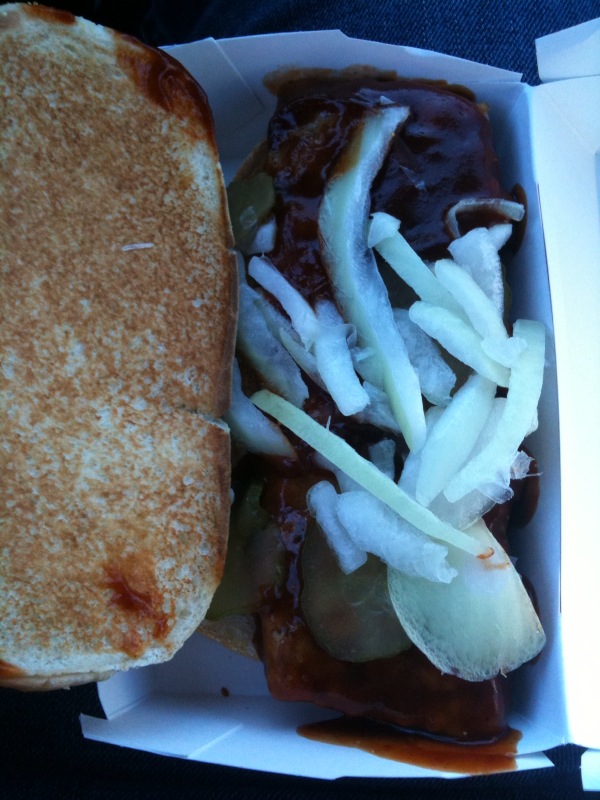
I’m not a big onion guy so I knocked a couple of those puppies off before I bit in. I also took time to carefully redistribute the pickles, since they were all piled up on one side of the sandwich.
As for the taste: Not bad. There’s a ton of sauce on there and the sauce is extremely sweet, so that was a little overwhelming. But it’s not a bad flavor, and the pork is at least edible, plus pickles are delicious and the bun tastes like grilled McDonald’s, a good thing.
Straight-up, though, I’d rather have their cheeseburger. When I go to McDonald’s, it’s never because I want a burger or a pork sandwich or pancakes, it’s because I want McDonald’s. The taste, though still good, is pretty distinct from what the food is actually supposed to be. It tastes like McDonald’s. And to me, that flavor is best transmitted through a cheeseburger and fries.
Anyway, because I happened to eat the McRib on the same day I smoked and ate actual pork spare ribs, I figured I’d run down a little tale of the tape for y’all. First, here’s what the spare ribs looked like:
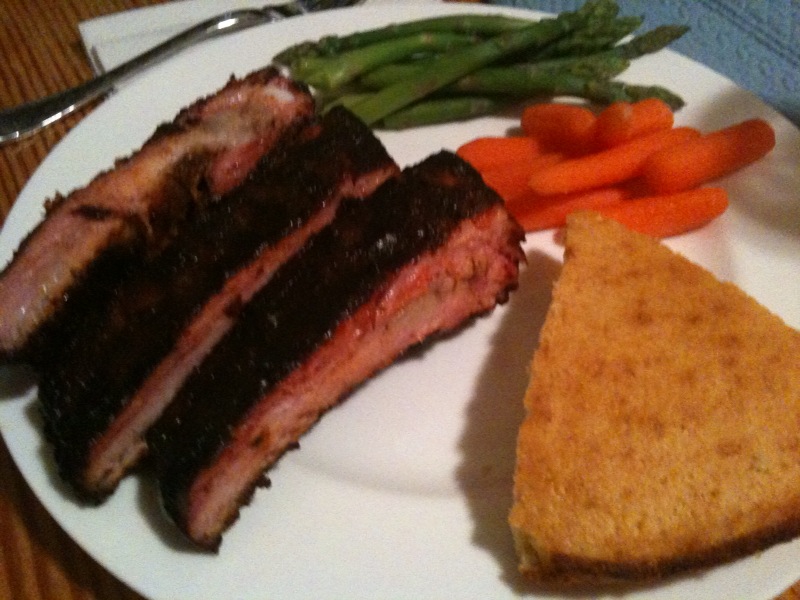
And how they stack up to the McRib:
| Actual ribs | The McRib | |
|---|---|---|
| Cost per serving | Roughly $5 | $2.89 |
| Time investment required | Six hours, including prep and cook time | Three minutes, if you happen to be driving by McDonald’s |
| Presentation | On plate with vegetables and cornbread | Cardboard box |
| Smells like | Hickory smoke | McDonald’s |
| Pork shape | St. Louis cut ribs | Simulated ribs |
| Pork quality | Fall-off-the-bone tender and moist | Vague |
| Pork flavor | Lots of it | Vague |
| Sauce flavor | Sweet and tangy with a tad too much vinegar | Slightly tangy and candy sweet |
| Sauce prevalence | Thin, sticky glaze over the ribs | Goo everywhere |
| With pickles? | No | Yes |
| Bread pairing | Cornbread my wife made | Sort of a stretched-out hamburger bun |
| Edible while driving? | Not at all | With great concentration |
| Napkins required | Multiple paper towels | Leg of jeans |
The deepening marriage of athleticism and artistry is changing synchronized swimming, an obscure Olympic sport that was memorably satirized in a 1984 “Saturday Night Live” sketch. “Le Rêve” and USA Synchro, the sport’s national governing body, have a sponsorship agreement “to combine resources,” said Sandra Mahoney, the national team director. The show, which opened in 2005, will support USA Synchro financially, as well as assist with choreography and acrobatic training for the athletes.
“They, in turn, will be able to build our talent for the Olympics so that they have talent down the line,” Mahoney said….
“It’s a contact sport now,” she added. “So they can’t ridicule us anymore.”
No matter what anyone says, I will continue to ridicule the “sport” of synchronized swimming. It is ridiculous.
And of course I recognize that it requires an absolute ton of talent, athleticism and grace — like way more than I could ever hope to have. Clearly it’s a difficult thing to endeavor, trying to synch up so many intricate motions so precisely with your teammates and the music, all while working to stay afloat.
But to me, anything that is judged on wholly subjective criteria should not count as a sport. I want a clear winner, whether it’s the person who wins the race or the team that outscores its opponent. And I realize that there are plenty of reasonably subjective decisions made by referees in football and everything, but whatever. Shut up. Stop picking nits.
Back in the WCSN.com days, we covered a ton of silly sports, but none quite as silly as synchronized swimming (though Tom Boorstein argues it’s rhythmic gymnastics). There would be times when my only duty was to monitor the video stream to make sure it was operating properly, which meant I’d be sitting in a reasonably bustling office setting getting paid to sit there and watch synchronized swimming. And I giggled throughout.
It’s just a silly thing to watch. I can’t really explain it except to say that it vaguely resembles something you might see at Sea World, only with humans instead of porpoises. Also, I’ve never been to Sea World.
I defy you to watch this and not chuckle:
Josh passes along this Sporcle name-that-sandwich quiz. I got 23 of 25, but I can’t tell you which two I missed because then you’ll know them and I don’t want you to beat me.
With a 2010 salary of $11.5 million, Javier Vazquez qualified as a major disappointment this last season with the Yankees. However, the free agent didn’t have to wait too long to find a new home, as the 34-year-old righty starting pitcher has signed a one-year contract with the Marlins.
The contract will be worth $7 million, and comes with a full no-trade clause. It also has a built-in clause that the Marlins can’t offer Vazquez arbitration after the year, which will help to make him more desirable next winter. Vazquez is signing with Florida in large part so he can re-establish some of the value he lost with New York.
– Jeff Sullivan, SBNation.com.
OK, a couple of interesting things here. For one, I was hoping the Mets might make a run at Vazquez. Just based on the back of his baseball card alone he looks like a solid candidate to bounce back — last season was his first real clunker in years, plus he’s perpetually healthy. Also, pitching in the National League East — and in a pitcher’s park — would likely help him.
 As Eric Simon pointed out, though, Vazquez’s average fastball velocity took a pretty steep hit last season, falling from 91.1 MPH in 2009 to 88.7. That’s a bit unnerving.
If Vazquez returns to anywhere near his 2009 form — or even his less-spectacular 2008 form — he should be worth way beyond the $7 million the Marlins will pay him. Pitchers that can reliably throw over 200 decent innings do not grow on trees.
But that he cost so much should be at least marginally interesting to Mets fans, since starting pitching seems like the team’s most obvious place for an upgrade this offseason. The innings-eater types — Vazquez, Jon Garland, Ted Lilly, Jake Westbrook, Hiroki Kuroda — have been flying off the shelves this offseason, and not exactly at discount prices.
If the reports about the Mets’ very-limited payroll flexibility are true, then it seems entirely possible they’ll be priced out of the mid-level starting pitcher market and enter 2011 without another reliable starter on the staff. By my count, the only non-Cliff Lee free agent starters who have proven capable of racking up lots of innings over the past few years are Carl Pavano, Kevin Millwood, Dave Bush and Braden Looper.
None of those options is particularly inspiring, for a variety of reasons. (Of course, for the same reasons, none besides Pavano seems likely to command that much money.) Perhaps one slips through the cracks and is available at a big discount later in the winter, but at this point, none seems like a big enough upgrade over Pat Misch and Dillon Gee to be worth paying him nearly all of the Mets’ offseason resources.
Right now, it appears as if the Mets’ best option will be to pick up a couple of upside guys coming off injuries. Joe Janish put together a good list of candidates at Mets Today over the weekend. At first look, lefties Jeremy Bonderman and Chris Capuano seem like decent options, though obviously the cost and the Mets’ scouting assessments are paramount.
The other part of Vazquez’s contract that’s of interest to Mets fans — and all fans, really — is the no-arbitration clause. That was presumably included so that if Vazquez does bounce back and becomes a Type A free agent next offseason, whatever team signs him next will not be forced to surrender a first-round pick to the Marlins. Carlos Beltran’s contract includes the same clause.
It stands to reason that the clause is a byproduct of the league-wide emphasis on the draft, and if that type of contract becomes a trend it will ultimately benefit a big-market club like the Mets. Since the Mets are likely to be big spenders again in the not-too-distant future, they will stand to gain from being able to pursue free agents without risking first-round draft picks.
 Tedquarters