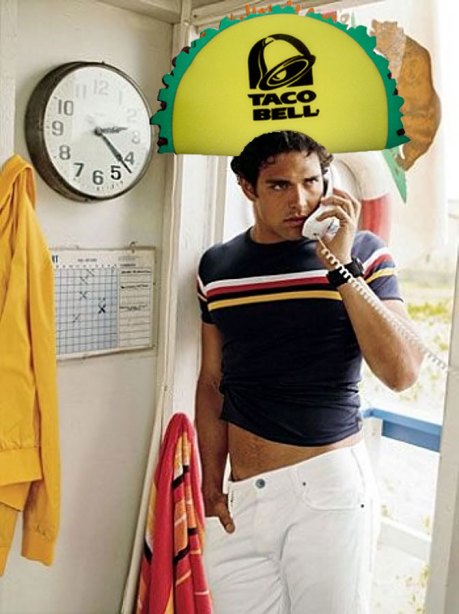
Job titles I would like to have: Chief Futurist

Spotted this interview on Boing Boing today, an interesting talk with Intel Chief Futurist Brian David Johnson about using science fiction to help imagine future technology.

But the big story here: “Cheif Futurist” is an actual job title. I want that. I mean, “Senior Editorial Producer” is great and all, and I recognize that in this day and age I’m lucky to even be employed. But Chief Futurist sounds so badass.

Perhaps this is not news to you, because apparently Futurology is enough of a thing to have its own Wikipedia page. I always thought “futurist” just referred to the people who made stuff look futuristic in movies like Blade Runner. But there’s even a list of notable futurists. From the Wikipedia, it really sounds like some futurists are smart people dedicated to researching historical patterns and trends to try to predict the future, and others are complete B.S. artists.

I want to fall in with that second group. No disrespect to the folks doing all the trend analysis and probability stuff, but that seems like a lot of work. I’m looking for someone to pay me to just sit around and make up stuff about what might happen in the future, based on nothing all that coherent except my general understanding of how people behave.

Watch, I’m about to break off a little futurism for you: In 42 years we will have live-in robot maids, talking dogs, flying cars, and a bustling space-sprocket industry. We’ll live in giant, disk-shaped apartment complexes in the sky with treadmills for walking our talking dogs and mechanisms that perform all our mundane tasks at the push of a button. And a dreamy rock star will record a hit song called “Eep Opp Ork Ah-Ah.”

And that’s just amateur futurism! Imagine what I could do if you hired me professionally and I really had time to think about it. Just let me know where to send my resume.

Return of the Mook?

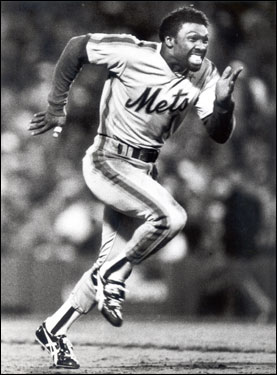
The rest of the staff remains in flux, although a source said Mookie Wilson might return at first base. Bench coach Dave Jauss might be asked to fill the minor league field coordinator position that Collins vacated, and Ken Oberkfell will either remain as manager of Triple-A Buffalo or become bench coach. Hitting coach Howard Johnson is unlikely to remain in that role, but will be employed by the organization in some capacity.

Andy Martino, N.Y. Daily News.

Cool. Mookie has been employed by the club in some role or another for years now — team ambassador, organizational baserunning coordinator, Cyclones manager, first-base coach. Obviously I think the Mets should have a first-base coach that they think will do a good job of it, that understands and preaches the organizational first-base coach philosophy and that they’re certain will consistently yell, “Back!” on pickoff moves and remind runners how many outs there are. But if they think Mookie can handle that, then, you know, awesome.

The only reason I mention him here, really, is to brag: One time Mookie Wilson called me. I was working on a freelance piece about the 1988 Mets, so I contacted the team to see if they could put me in touch with some former players. They obliged, and told me Mookie would be calling me soon.

If you’ve heard Mookie Wilson speak, you know he has a pretty distinct voice, so I had no doubt whom I was speaking with when I heard him say, “Hello, is this Ted?”

But even so, I played dumb. “Ahh, yes. Who is this?”

“This is Mookie Wilson.”

It was awesome. I know I’m pathetic.

Impress Nick Mangold, win Jets tickets

Long tweet so bear with me. The 10000th tweet contest for 4 tickets to Thurs. game will require you to do the #JETS chant while wearing green in a location in NYC (btw 48th and 42nd streets) tomorrow at 11am. With the 10000th tweet I will tell you the location. The winner will be the first to do the chant. Good luck!

Nick Mangold, Twitter.

I would totally do this if I wasn’t going to be at the Terry Collins presser tomorrow morning and didn’t have plans for Thanksgiving.

The big surprise, though, is while you’re doing the J-E-T-S chant Nick Mangold pops up out of nowhere and pancake-blocks you.

Being Derek Jeter

I know I shouldn’t post this video here because it only perpetuates this type of stuff, and that there’s not much left to be said about the weirdness of paparazzi culture. But if you ever want to feel sympathy for a rich, famous, handsome Hall of Famer and his rich, famous beautiful actress girlfriend, watch this.

It’s not that the videographer is particularly aggressive or anything like that. He pretty much just stands there filming, then asks Jeter about whatever movie he just saw. Plus I realize that part of the bargain of being a celebrity — and dating celebrities — is sacrificing a good deal of your privacy.

So maybe I shouldn’t feel bad for them at all. But there’s something about Jeter’s brief, disgusted glance at the camera from the car that makes him seem way more human than he ever does during Yankee games (even when he’s diving in vain for groundballs).

On relevance

Alderson doesn’t have to be told that all of this has caused the Mets to have become irrelevant. To change that, the manager is going to be a most important part of the process. The Mets’ hierarchy all decided that Collins, twice fired, with no postseason games on his managerial resume, is the right man to make them relevant again. There is nothing to suggest he isn’t just another retread manager and not the kind of difference-maker the organization so desperately needs.

Bill Madden, N.Y. Daily News.

What does Madden mean by “relevant” here?

I feel like the term is thrown about by sportswriters and talk-radio hosts pretty frequently, and I’m never sure exactly what it means. I mean, I know what the word “relevant” means, I just don’t know when it pertains to sports teams. Is it just a stand-in for “worth writing about”?

Does Sandy Alderson really know that the Mets are irrelevant, and should he be charged with restoring their relevance? Seems like he should work on making them better, to hell with everything else.

Does “relevant” just mean good, though? Because if Madden’s saying, “Sandy Alderson knows the Mets have not been that good the last few years and he should try to make them good,” then I agree wholeheartedly. I don’t think the manager really is a most important part of that process, but I’m willing to agree to disagree on that point.

I’m pretty sure when the Jets hired Rex Ryan, people said he made them relevant again. Is that because he filled up columns with his bravado and made sportswriters all over the Metro area forget the snoozefest press conferences of the Eric Mangini Era? Or is that because he helped make the Jets good?

I should mention that none of these questions is rhetorical. I really want to know what everyone means when they say a team is relevant or irrelevant, how it’s different from good or bad, and why it matters.

Because if we’re to define relevant as “having significant and demonstrable bearing on the matter at hand,” as Merriam-Webster does, and the matter at hand is New York sports or the consciousness of the New York sports fan, then the Mets and Jets are perpetually relevant as far as I’m concerned. Since I root for those teams and follow them closely regardless of whether they win or lose, they always have significant and demonstrable bearing on me — at least in as much as any sports team can.

Balls on the money

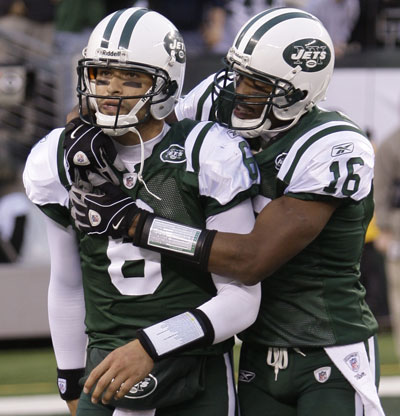
Everybody look at Mark Sanchez:

No, seriously. Look at him:

On my walk to the studio this afternoon I overheard a couple guys walking in front of me recapping the Jets game. I didn’t pick up much of their conversation, but I caught this:

“He threw two balls on the money.

Presumably the man was referring to Sanchez’s last two passes of the game, the 42-yard strike to Braylon Edwards and the six-yard game-winning touchdown to Santonio Holmes on the next play. But I think “balls on the money” is a pretty apt way to describe Sanchez’s performance the last couple weeks. And I say that even though I have no idea what “balls on the money” even means.

It’s beyond cliched to refer to Sanchez’s poise, now that Deadspin exposed the N.Y. media’s penchant for using the term to characterize the Jets’ young QB. But watch the Jets’ last drive and offer me a better description. Or just look at the second picture above — taken immediately after the touchdown pass to Holmes. Sanchez isn’t even smiling yet. Brad Smith is giving his quarterback a well-deserved celebratory hug, and Sanchez appears to be still focused on the task he just completed.

Yesterday, for perhaps the first time in his young career, Sanchez — with help from his receivers — carried the Jets to victory. In the fourth quarter, with the Texans surging, the Jets’ secondary, offensive line and ground game all fell apart. Sanchez picked them up.

Some will say the Jets were lucky to beat the Texans, like they were lucky to beat the Browns and the Lions, and they don’t really deserve their NFL-best 8-2 record.

To that I say: Whatever. Look at Mark Sanchez.

I am Jack’s apathy

Word leaked out yesterday that the Mets will hire Terry Collins to be their next manager, and now a good subsection of the fanbase is furious.

If I had to guess, I’d say all the angry fans fall somewhere on a Venn diagram with three intersecting circles.

In the first circle are the straight-up haters. These are the particularly bizarre fans that will lash out at just about any decision the team makes, no matter how large or small. They are the frustrating — and frustrated — fatalists, certain that the Mets are irreparably broken and no new front-office or roster overhaul will ever make any difference. I suspect some of them may be masochists and take odd pleasure in watching their team struggle.

The second circle is for the irascible Backman lobby. These fans, wooed by the media, by nostalgia or by Wally Backman himself, are certain that Backman — and no one but Backman — should be the Mets’ manager for now and forever, warts and inexperience be damned.

The third and perhaps largest circle belongs to a more reasonable set: The fans who doubt Collins’ ability to helm a Major League team based on his past failures with the Astros and Angels, most notably the miserable turn in 1999 when Mo Vaughn and his teammates in Anaheim petitioned upper management to have Collins relieved of duty.

Sometimes I get fired up over what I think are bad decisions, or the perpetuation of what I believe are fallacies or just dumb ideas. In this particular case, though — even after reading the reactions of the Mets fans who seem so incredibly mad — I find it difficult to muster up any emotion at all. Perhaps some entertained bewilderment about how people could get so angry over what will likely be an innocuous but informed decision made by reasonable men to fill an overrated position.

It’s not that I don’t harbor any doubts about Collins, either. It’s just that the almost unbelievable gusto with which some fans are decrying the decision, for whatever reason, leaves me feeling numb.

But if I could gather those angry fans and somehow prevent them from rioting long enough to talk to them, I’d probably ask this: Do you believe that people can change?

And that’s not a rhetorical question. I’m actually curious. Tons of people seem willing to argue otherwise based on old maxims — “A leopard can’t change his stripes” — as if just because something has been stated a billion times it must be true.

The fatalists, by definition, likely believe people cannot change, so they think Jeff Wilpon will never improve in his role as Mets’ COO, Sandy Alderson will still look for juiced-up players capable of smashing 50+ homers and Terry Collins will inevitably alienate the clubhouse with his alpha-male attitude. I don’t think I’ll be able to convince those people otherwise, so if by some chance you’ve found you’re way here and you’re one of them, please click away. I appreciate the traffic, but there’s nothing for you here. Try to enjoy your weird life.

The Backmanites and the reasonable doubters, though, must at least be open to the idea. After all, one of the main tenets of the Backman Lobby stated that Backman not only has changed from the man whose legal and financial troubles lost him a managerial position in Arizona, but would be willing to change again to fall in line with Alderson’s presumed organizational philosophy.

And if your doubts are only the reasonable ones, and you consider yourself to be a reasonable person, I follow up: Do you try to change? Do you work out to get in better shape, or read to learn more about the world, or consider your mistakes to avoid repeating them?

I sure do. Maybe I’m just self-conscious, and maybe my efforts to better myself are in vain and pathetic. But to me it seems downright arrogant, stubborn and small-minded to think, “well, this is how I am and the way I came out of the womb. If people don’t like it, so be it.”

Maybe Terry Collins thinks that way. I don’t know. I had one ten-minute conversation with the man and he really didn’t seem like it, but one ten-minute conversation is probably not the best way to judge a man’s character. Maybe he’ll take command of the Mets and repeat all the mistakes of his past. Maybe he learned nothing from his stints in Houston and Anaheim and his DUI arrest in 2002.

I’m not arguing, of course, that someone’s history should be entirely ignored when considering him for a job. That’d be crazy, like penciling in Jeff Francoeur for right field in 2011 and thinking, “hey, maybe he’s different now; maybe he learned to lay off bad pitches.” You, me, Terry Collins, Jeff Francoeur, we face uphill battles when we try to change our most deeply ingrained ways.

But I think, with an open mind and dedication, we can. And I would hope that if Sandy Alderson, Paul DePodesta, J.P. Ricciardi and John Ricco sat down with Collins for multiple hour-long interviews, they asked him if he learned from his prior stints and left satisfied that he did.

John Steinbeck:

‘Thou mayest!’ Why, that makes a man great, that gives him stature with the gods, for in his weakness and his filth and his murder of his brother he has still the great choice. He can choose his course and fight it through and win. … It is easy out of laziness, out of weakness, to throw oneself into the lap of deity, saying, ‘I couldn’t help it; the way was set.’ But think of the glory of the choice!

Heroic reader creates awesome map

Katherine — who reads TedQuarters for the sandwich reviews even though she’s not a sports fan — sent along the following Google map, which plots and color-codes every sandwich in the five boroughs that I’ve reviewed here.

The Hall of Fame sandwiches are in blue. Sandwiches receiving 80-89 ratings are in green, 70-79 are yellow, and 60-69 are pink.

This might be my proudest blogger moment. Finally, my efforts are legitimized.

View TedQuarters Sandwich of the Week in a larger map