
Manhattan mini golf

Hudson River Park’s newest pier — opening Friday and stretching 1,000 feet into the river — adds a West Coast flair to the Big Apple with competition-ready beach volleyball courts, skate park and kids’ climbing walls.

“It’s like a small part of Redondo Beach here in New York,” Connie Fishman, president of the Hudson River Park Trust, said of the newly rebuilt Pier 25.

Like Redondo Beach, with an ocean pier and a national reputation for beach volleyball, Pier 25 was designed for the active, outdoors set with futuristic kids’ playgrounds and climbing walls, miniature golf, basketball and volleyball.

Tom Topousis, New York Post.

I suppose the climbing walls and volleyball courts are cool if you’re into that stuff, but I excerpt this Post piece here because of the mini-golf mention.

I am something of a mini-golf enthusiast, and though I no longer live in the city, I’m happy to hear Manhattanites will have access to miniature golf without having to leave the borough.

A little Internet research tells me there had previously been a mini-golf course on Pier 25, but since I never knew about it, as far as I’m concerned it never existed. Also, apparently there are nine holes at South Street Seaport.

This article makes the course at Governor’s Island sound pretty appealing, and though I didn’t get to play it while there for the Vendys, it did appear inviting. It just would have seemed strange, I think, for a lone man, stuffed to the point of delirium, to stroll up for a round of solo mini golf.

And I didn’t notice any moving obstacles anyway. Apparently there are some at the New York Hall of Science — I didn’t even know there was a mini-golf course there — but that’s only a nine-hole affair. Way too many area mini-golf courses are the terrain-based type, which I guess do a better job of simulating actual golf, but don’t feature big spinning wheels that knock your ball off the course or clowns that spit it back at you, Happy Gilmore style.

As far as I know, you pretty much have to go to Lake George to find a course with a bunch of moving, spinning things, and that’s terrible. Not that going to Lake George is terrible, because funnel cake and everything, but it’s just a long way to go to find decent moving-obstacle-based mini-golf. Get on it, local business.

Giants win World Series behind awesome pitching, offense of hilarious retreads

And apparently this means — you guessed it: Moneyball has been debunked!

Brian Sabean has singlehandedly shown that shrewd business principles are no longer the way to run a baseball team, or, really, anything.

F@#! it, it’s time for the Mets to go all in on Cliff Lee. Eight years, 160 mil. Because hey, the Giants gave Barry Zito a terrible contract, and now they’re World Champions! Moneyball is dead! Long live JuanUribeBall!

Tim Lincecum is ridiculously awesome, by the way. Look at this World Champion:

Sandwich of the Week

This is last week’s sandwich of the week, which I meant to publish Saturday. I failed on that, but here’s a sandwich:

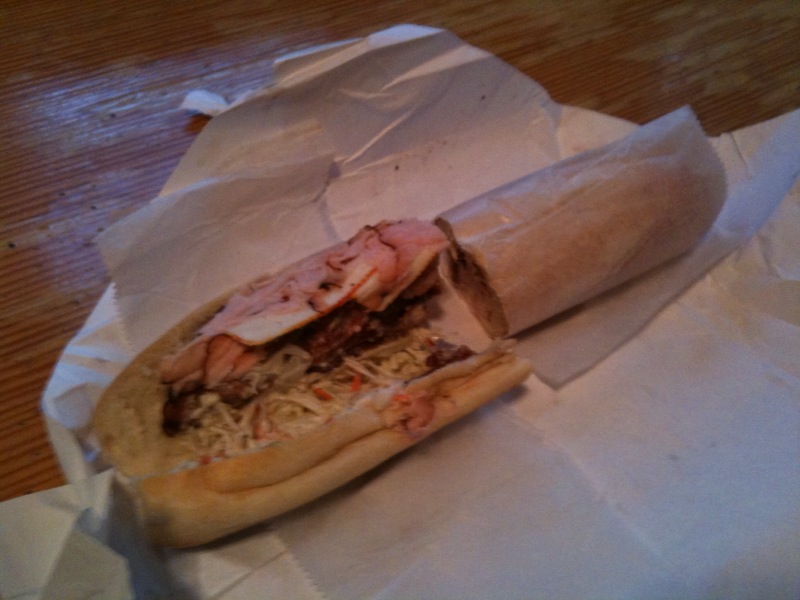
The sandwich: Honey-Maple Turkey, bacon, muenster and cole slaw on a “wedge,” from Pop’s Deli in Hawthorne, N.Y.

The construction: All of those things I just mentioned, piled onto a hero roll, which for some reason they call a “wedge” in Westchester (and some parts of Jersey).

I should note now that I think there’s a difference in the bread styles used for long sandwiches between the delis I grew up with on Long Island and those I now enjoy in Westchester. This could be a small sample size thing, but I’m pretty sure the standard “hero” on Long Island comes on bread that’s a bit flakier and more airy than the Westchester “wedge” bread, which is dense and chewy.

I’m obviously partial to the one I’m more familiar with (more on this to follow), but both are good. And I’m open to the possibility that, in each area, I’m only eating bread from one specific wholesale bakery that supplies bread to all the local delis (for Long Island, I know this to be true).

Is this the difference between Italian and French bread? Hmm… come to think of it, is there a difference between Italian bread and French bread?

Important background information: I think all discussions of effective branding should start with Boar’s Head. Bad lunchmeat can be downright disgusting, but I know when I order Boar’s Head products I can expect a certain quality. And yeah, I recognize that Boar’s Head probably isn’t the best lunchmeat available. But it’s consistently good, and I’d rather not take my chances with an unknown quantity, given the risk.

For that reason, I often order specific Boar’s Head products like Honey-Maple Turkey at delis, since it assures that they’re not going to try to slice up some off-brand turkey that will turn out gross.

This particular sandwich was the product of endless sandwich tinkering from  my years behind the deli counter, and it’s good enough that I think it should be given a name and standardized like the Reuben once was. Preferably, it should be named after me.

What it looks like:


How it tastes: Very good, of course. I came to this sandwich, I think, after determining that the sweetness of the Honey-Maple Turkey goes well with bacon (like just about everything else). Pop’s does a good job with bacon — always well-done and crispy — and the turkey was sliced nice and thin, maximizing surface area and thus flavor.

If you appreciate cole slaw even a little bit — I know it’s a divisive salad — I strongly recommend you try it on a sandwich. It adds the moisture you might hope for from mayonnaise or mustard, but it’s obviously way tastier than mayo plus adds an additional crunchy element on top of the bacon.

Muenster cheese you know about, presumably. I don’t remember why I initially put muenster on this sandwich, but it plays. There are a lot of flavors here, and I think a stronger cheese like a cheddar might conflict with the cole slaw, or something. The muenster here is just about complementing the rest of the sandwich, and also making sure the sandwich has cheese on it.

Like I said, both forms of the long-sandwich bread are very good, but I find the Westchester variety fills me up a lot faster than the Long Island type. I think it’s a density thing, but I’m also willing to consider that this sandwich was probably 14″ long and filled with bacon. Could be a simple size thing, too. In either case, this sandwich beat me. Too long, couldn’t finish, to paraphrase the Internet.

The other issue is I’ve now had this sandwich so many times that I’m probably almost biased against it. It’s a bit routine now, even though it’s still really good.

What it’s worth: Cost me about $7.50, I believe, which is a pretty great deal. This really should have been two meals, and I should have known better than to start the second half of the sandwich. I didn’t know better, but that’s on me.

How it rates: 80 out of 100. I can’t find many baseball players from Westchester and this sandwich is a lot better than Dan Pasqua, so I’m just going to go ahead and go with a Long Island guy that’s probably better than an 80: The Frank Viola of Sandwiches. I have no idea why.

Cold turkey

Because adenosine, in part, serves to regulate blood pressure by causing vasodilation, the increased effects of adenosine due to caffeine withdrawal cause the blood vessels of the head to dilate, leading to an excess of blood in the head and causing a headache and nausea. This means caffeine has vasoconstriction properties.[94] Reduced catecholamine activity may cause feelings of fatigue and drowsiness. A reduction in serotonin levels when caffeine use is stopped can cause anxiety, irritability, inability to concentrate, and diminished motivation to initiate or to complete daily tasks; in extreme cases it may cause mild depression. Together, these effects have come to be known as a “crash”.[95]

Withdrawal symptoms — possibly including headache, irritability, an inability to concentrate, drowsiness, insomnia and pain in the stomach, upper body, and joints[96] — may appear within 12 to 24 hours after discontinuation of caffeine intake, peak at roughly 48 hours, and usually last from one to five days, representing the time required for the number of adenosine receptors in the brain to revert to “normal” levels, uninfluenced by caffeine consumption.

The Wikipedia, “Caffeine.”

If you ever doubt caffeine’s potency, try quitting it cold turkey. When I pulled into a rest stop off the Jersey Turnpike to clean out my car yesterday and realized I had already drank about 48 ounces of coffee and a bottle of Diet Mountain Dew, I realized I should probably go off caffeine for a while. Now I have a brutal headache, and I’m quite irritable. Who wants to fight me?

What are sabermetrics?

A few years ago, I painted the interior walls of an apartment with a friend. Neither of us had ever endeavored a paint job of that magnitude before, but we figured it wasn’t exactly rocket science — tape the moldings, paint the walls.

The actual painting part wasn’t terrible, but taping all the edges turned out to be a huge pain in the ass. We spent at least as much time taping as we did painting, and the project took us about twice as long as we expected.

Just before we finished, the cable guy came. He complimented our paint job, and asked if we had taped up all the moldings. We said that we had, and he informed us to the existence of paint edgers, an inexpensive tool that paints the edges of walls without the need for all that tape.

We cursed ourselves for not doing more research and cursed fate (and probably Cablevision) for sending the cable guy so late in our process, but at no point did we curse the paint edger.

That’s why it’s a bit weird to me, as I sort through all the reactions to Sandy Alderson’s introductory press conference at Citi Field on Friday, that so many people seemed to get so riled up about sabermetrics.

For one thing, I don’t even know what “sabermetrics” means. I know it involves baseball and statistics, and I know that lots of people seem willing to speak or write on behalf of all so-called sabermetricians. But which stats define sabermetrics? It’s not batting average; we know that. Is it on-base percentage, or is that still too basic? It strikes me as strange that we should need a fancy term for those who recognize the merits of hitters that get on base often.

My understanding has always been that the numbers we throw under the umbrella of sabermetrics are those that aim to give us a more precise understanding of a player’s value than the so-called traditional ones on the back of a baseball card, and that “sabermetrics” itself refers to the pursuit of those more precise metrics.

The book Moneyball, contrary to widespread belief, was not just about sabermetrics. It was about a cash-strapped baseball team identifying an inefficiency in the market and taking advantage of it. Running a successful business.

So I get a bit confused when I see debate over when Alderson first started using sabermetrics, like he at some point flipped on a light switch to enact sabermetrics, and from there his team was a sabermetric team. I’m pretty sure it doesn’t work like that. All stats are just tools, and every team uses stats, among other tools, to evaluate players.

That’s all. No real point in getting frustrated about it. Some teams use the tape and some teams use the edger, and probably most teams use both depending on the circumstances, and everyone’s got an opinion on which option works better. The point is there’s no real good reason to get upset and say, “f@#$ you, it’s tape!” or to be all, “yield to the dominance of the edger!” because it’s really silly to get so worked up over tools.

If you hope Sandy Alderson uses sabermetrics and Moneyball to run the Mets, then great. If you hope he doesn’t, that’s fine too. Both of those words are just big sweeping labels assigned to reasonably simple concepts, and if you want to use them or not use them to describe what Alderson does as Mets GM, you know, whatever.

All I care is that he seems dedicated to running the team the right way, and appears apt to do so.