Hat tip to Eric Simon:
The Timecrowave
Reply

Hat tip to Eric Simon:
What I have come to understand is that everybody believes they can be a general manager.
That makes me realize that NOBODY UNDERSTANDS WHAT THE GENERAL MANAGER’S JOB REALLY ENTAILS!
Most fans (I am including talk show hosts as fans) believe that the general manager’s job is all about putting together the major league team. Certainly that is a major part of the job, but it is far from the entirety of it. There are many more responsibilities that a general manager has beyond just building the 25-man roster in the big leagues. Let’s take a look at some of those duties and then we will look at the major league roster construction….
So despite what you might believe know this — not everyone can be a general manager.
In fact, there are very few that are capable.
– Steve Phillips, AOL Fanhouse.
In a lengthy and vaguely patronizing column, Phillips reminds readers that there’s a lot more to being a Major League GM than putting together a 25-man roster.
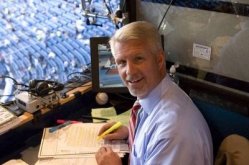 Like talking to the scouts, for one. And talking to the manager. And talking to the owner. And talking to the team doctor. And talking to the press. And sometimes, depending on the GM, talking to the players.
I have no doubt that being a GM of a Major League team takes an unbelievable amount of hard work and requires insane hours, but it does seem pretty damn obnoxious to suggest that there are very few people capable. There are a lot of really smart people in the world, and a lot of them are probably willing to work extremely hard for a seven-figure salary and the right to run a baseball team.
I’m not saying I’m one of them; I’ve worked my share of 80-hour weeks in my life, but it’s not something I have the capacity to do regularly.
But I’m certain I know plenty of intelligent, hard-working, driven people who would know better than to trade for Mo Vaughn. And all of them probably recognize that Carlos Beltran is a great baseball player.
Top prospect Jenrry Mejia, whose dazzling Grapefruit League performance prompted the Mets to place him on the Opening Day roster as a reliever, is expected to head to the minors to resume being used as a starting pitcher. That could be timed with R.A. Dickey’s activation before Wednesday’s start, a team source told ESPNNewYork.com….
The Mets could be facing major rotation issues behind Johan Santana and Mike Pelfrey, so stretching out Mejia for starting work makes sense. Oliver Perez has been dispatched to the bullpen, John Maine — while largely producing of late — doesn’t have the zip he had in 2007 and Jon Niese has a mild right hamstring strain. The Mets will have Dickey face the Washington Nationals on Wednesday and use Hisanori Takahashi in place of Niese on Friday.
Well, good. Stretching Mejia out in the Minors is the right move, even if it appears the Mets may have been forced into it by all the shakiness in their rotation. And Mejia’s stint as a Major League reliever will keep his innings total down for the season, plus — for whatever this is worth — give him a taste of big-league hitters and the confidence to know he can get them out.
 Some will suggest that this was the plan all along, but, without any inside knowledge of the Mets’ thinking, I’d guess otherwise. I doubt that a team with a well-conceived and conservative plan for developing its best pitching prospect would ever allow him to pitch in four games in five nights, as he did in mid-April, or three games in a row as he did last week.
We can point to the examples of Johan Santana, Adam Wainwright and Francisco Liriano, but neither Wainwright nor Liriano ever endured those offenses, and Santana pitched in three consecutive games only once in parts of four seasons as a reliever. So it’s probably best that Mejia will now be out of the hands of a desperate manager prone to overusing relievers.
I’m not certain, though, that success will come as readily for Mejia the starter as it did for Mejia the reliever. It’s much, much easier to pitch well in one-inning stints than in six- or seven-inning ones, especially when you’ve got one dominant pitch. Mejia wasn’t great as a starter in Double-A last year and struggled in the Arizona Fall League. He looks like a good bet to be excellent eventually, but it might take some time. Developing and commanding a secondary arsenal is no small feat.
As for talk that the Mets are now somehow screwing with Mejia? I say this: Whatever. Maybe he never should have been in the bullpen in the first place, but if moving him back into a starting role now requires jerking him around, then the Mets should jerk him around. Starting pitchers are worlds more valuable than relievers, and top pitching prospects should be starting until they prove they can’t.
So all’s well that ends well. Here’s hoping Mejia quiets my doubts, dominates the Minors and makes a quick trip back to the Mets to reinforce their beleaguered rotation.
Someone started keeping score at our weekly pickup baseball games in Brooklyn, which seemed sweet when I realized it meant we could start keeping our stats, and then significantly less sweet when I noticed I profile similarly to Luis Castillo (after two games, I’m slashing .285/.375/.285).
Anyway, on the bench Sunday we got to wondering why a strikeout is scored a “K.” I figured it wasn’t “S” because of sacrifices, but we couldn’t determine why it would be “K” instead of “T” or some other letter in the word “strikeout.”
The use of “K” for a strikeout was invented by Henry Chadwick, a newspaper journalist who is widely credited as the originator of the box score and the baseball scorecard. Both the box score and scorecard persist largely unchanged to this day, as the game itself is largely unchanged except for the number of balls and strikes allowed to the pitcher and batter. The letter “S” was used to coin “sacrifice” so Chadwick decided to use “K”, with “K” being the last letter in “struck.” Chadwick also invented many other baseball scoring abbreviations, such as using numbers to designate player positions (progressing from the batter, pitcher [1] and catcher [2], through the infield, with the shortstop counted after the basemen, at number 6, to the right fielder [9]).[2]
That Chadwick first established the convention of using the “K” abbreviation is well-founded, with reliable and authentic primary materials surviving (see citation above). Those unaware of Chadwick’s contributions have speculated that “K” was derived from the 19th century pitcher Matt Kilroy‘s last name. If not for the evidence supporting Chadwick’s earlier use of “K”, this speculation would be reasonable: Kilroy did much to raise the prominence of the strikeout, setting an all-time record of 513 strikeouts in 1886, only two years after overhand pitching was permitted. Kilroy’s record, however, is forever confined to its era: the pitcher’s mound during his record-setting season was only 50 feet (15 m) from the batter; it was moved to its current distance of 60’6″ in 1893. The modern record (1901-) is 383 strikeouts, held by Nolan Ryan, one better than Sandy Koufax’s 382.
That makes sense, I suppose. “K” somehow does seem more appropriate than “T” or “I” or whatever, but probably only because I’m used to it. Plus those letters can’t be written backwards to denote called third strikes.
But I like the Kilroy story better, for Styx-related reasons.
I revived my SNY.tv column today. The new post is here. As I’ve mentioned before, I never meant to let that spot lay dormant so long. I figured it would be shut down or replaced by this blog by now, but for a variety of reasons, it’s still there. And since I’m the editor of SNY.tv, I recognize that it reflects poorly on the site to have a column on the site without any new posts for six months.
As is often the case, I didn’t say all I wanted to say. I had noble intentions, but I think I missed my mark a bit. It’s about the picture below, but also about omens and signs and hexes and all that stuff, which comes up here sometimes too.
If I grapple with all that too frequently in this space or others, I apologize. For a while now, baseball has seemed microcosmic, like a chalkboard that helps me sort out so many big-picture issues in a more digestible fashion. And I initially aimed to construe that through the column. I think I’m a little rusty on longer-form writing.
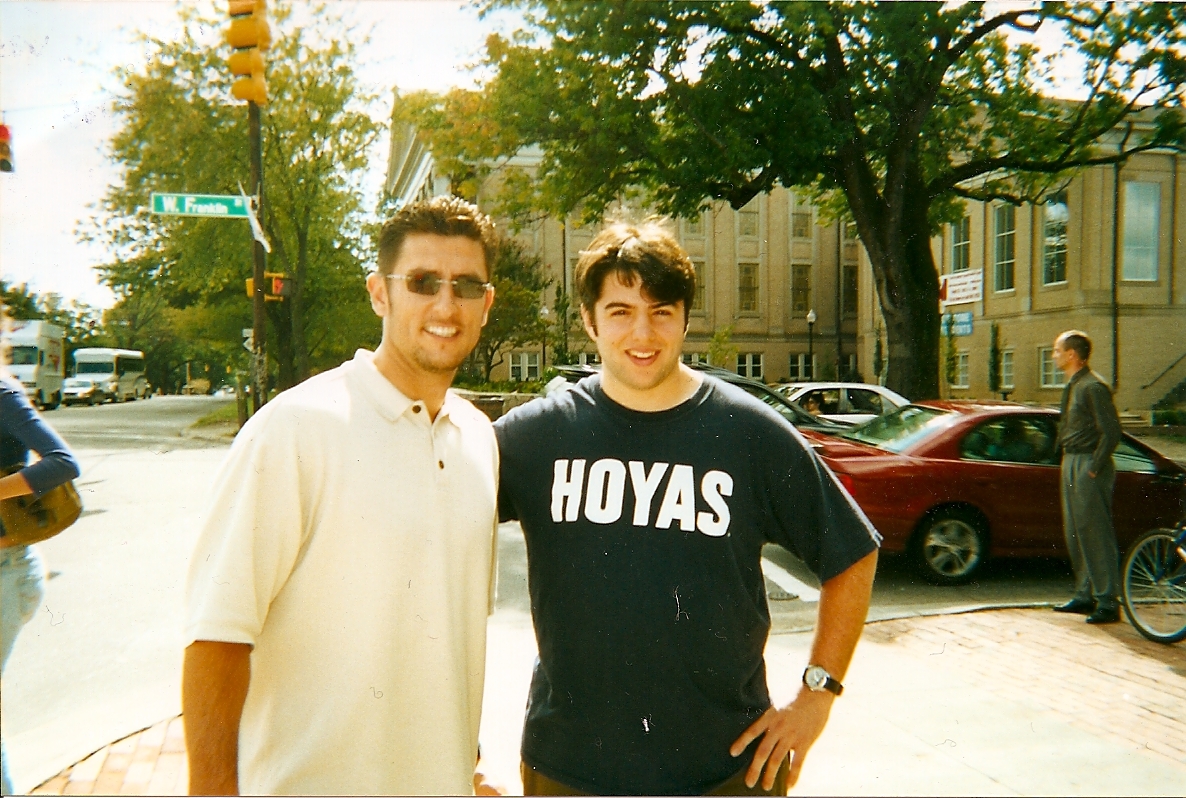
Anyway, here’s the photo of me and Nomar Garciaparra that prompted the column. If you look really closely, you can see Mia Hamm reflected in Nomar’s sunglasses. She took the picture. Also, I needed a haircut:
Here’s your chance to meet me in real life: I’ll be at the Blue and Orange Open Mic on Thursday at River in Hell’s Kitchen. I’m not sure I’ll get on the microphone, but look for a handsome guy standing in the corner muttering all the same things you read here. That’ll be me.
The Mets game will be on and there’ll be booze there. So there’s a pretty solid chance it will be no different from your regular Thursday night, only you’ll be surrounded by other people watching the Mets who also have access to booze.
Here’s the second part in the two-part series on at-bat music. This time, I talk to Rod Barajas and Ike Davis about their choices. I like this one:
I’m hoping to finish an SNY.tv column that’s been in the hopper for way too long. That may or may not happen. For now, here’s Cannonball Adderly:
Not only did Justin Bieber throw out the first pitch, but the teen sensation’s hit “Baby” blasted through U.S. Cellular Field when Teahen came up to bat. Teahen usually plays a reggaeton song by former teammate Jose Lima’s band and mixes in other tunes like “Barbie Girl” by Aqua and “A Bay Bay” by Hurricane Chris.
Not this night. With Bieber at the park, Teahen figured why not use “Baby”? Although he’s not necessarily a die-hard fan of the singer, he said he got turned on to the song a few months ago by his girlfriend and even has it on his iPhone.
– Andrew Seligman, Associated Press.
I’ve got to assume those choices are drenched in irony, which catapults Mark Teahen toward the top of the list of my favorite baseball players. I can’t imagine anyone takes “Barbie Girl” seriously. And bonus points for using Jose Lima’s band. Just the reminder of Jose Lima’s existence is probably enough to make a hitter salivate as he walks to the plate.
Also, Teahen operates a Twitter feed in the name of his dog, Espy.
H/T to Baseball Think Factory for the link.
But the first one (or 122nd or 196th one, depending on how you want to count ’em) is special:
 Tedquarters