The wonder Down Under

This is cool: Major League Baseball is partnering with the Australia Baseball Federation to create a new winter league for Major Leaguers staying fresh in the offseason and native Australians looking to make their mark. The article doesn’t make it clear, but I assume it will work like winter ball in Venezuela or the Dominican Republic, where Major League teams often dispatch young players to hone their games in the offseason.

We tend to look at the years since the 1994 player strike as “The Steroid Era” or some such nonsense, but we overlooked that 1994 was also the year Chan Ho Park made his Major League debut, ushering in a new era of Asian players in the Majors. The following year brought Nomomania, and since then Japanese, Korean and Taiwanese players have become common sights on Major League rosters.

Since that year — an arbitrary endpoint, no doubt — we have also seen a growing trickle from Aruba, Australia, Colombia, Curacao, Netherlands Antilles and Nicaragua, along with the consistent influx of players from Canada, the Dominican Republic, Mexico, Puerto Rico and Venezuela. To date, there has still only been one player hailing from a ship on the Atlantic Ocean.

I suppose that, with leagues now rolling in Italy and the Netherlands, the Majors will boast more European players soon. Teams have also done outreach work in China and India, two countries with massive populations crazy for sport. Multiple organizations are working to spread the game in Africa.

Simply put, baseball is becoming more global. I imagine this is all tied up with the Internet, another thing that has gone more global since 1994, since there’s just so much more information available to everyone now. Now we not only know about Yu Darvish, but we can follow his career in stats and video.

It’s cool, and I’m certain it’s a very, very good thing for the sport. In high school, I often got in arguments with soccer players over which game was better. They’d fall back on the argument that people all over the world played soccer, and I’d insist that was just because people all over the world hadn’t seen baseball yet. Now, people are seeing baseball, and they see that it is good.

Immortality

It turns out Babe Ruth is buried about a mile from my house.

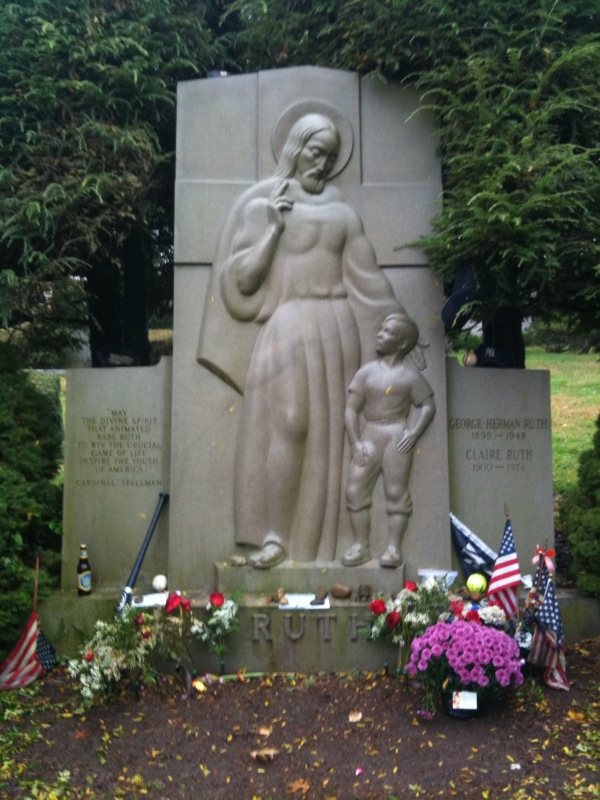
The rain washed away my plans to play baseball in Brooklyn today, so I had nothing better to do than go check out the Bambino’s grave. It looks like this:
-1

At wakes and funerals, people often nod to the coffin and say things like, “It’s hard to believe he’s in there,” or, if it’s an open-casket affair, “He looks so good.”

But he’s not in there. And that’s not him that looks good. Those are merely the flesh and bones that he once inhabited. The person you knew was something that lived and breathed and thought and loved and miraculously somehow operated without batteries. That thing in the casket does none of those things. He is gone. Maybe to somewhere else, maybe to nowhere at all, but certainly not here. Kaput. Adios. So it goes.

I recognize that some people feel otherwise, and I certainly respect their right to pray over the caskets and visit the graves of their lost loved ones. But to me, cemeteries are only repositories for human bodies that are no longer of use to their owners, and vast reminders of our own mortality.

Ruth’s grave, though, feels different. Ruth’s grave is a reminder of the human potential for immortality.

It is large but unspectacular, featuring an engraving of Jesus guiding a small child flanked on the right by the names of Ruth and his wife, Claire, and on the left by an epitaph from Francis Cardinal Spellman. Around its base today were letters from fans, baseballs, Yankees hats, prayer cards and some news clippings about the current Yankees club. Against the stone leaned a bat, a 34-inch toothpick compared to the 54-ounce job Ruth swung. And someone left an unopened bottle of Sam Adams Summer Ale, because if the Babe were around today he’d certainly thirst for a beer with hints of lemon zest.

Standing there in the rain, I felt moved, maybe as much as I ever have been by a gravesite. Not toward sadness or anything like that. Toward something more akin to amazement. I kept thinking: “Holy crap, Ruth is down there. Babe Ruth. The Babe Ruth.”

On one hand, it’s oddly equalizing. Here lies Babe Ruth: 714 home runs, a 1.164 career OPS and a six-foot box. Same as the rest of us, really.

On the other, it’s wholly mesmerizing. To someone of my generation, it’s difficult to believe Babe Ruth actually existed. He died just a few weeks after my parents were born. Even my grandparents only would have caught the downside of his prime, and they passed away before I ever thought to ask them about him. Babe Ruth stands more like a mythical figure, a person whose existence we have some evidence of but whose awesomeness we can never fully comprehend.

And some parts of him are in there. They’re down in the ground, a few feet deep, not a mile from my house.

Is there really some of Ruth’s DNA somewhere not too far below where I just stood? Should that be exhumed? Could we clone Babe Ruth?

And what would happen if that happened? Could Ruth dominate current Major League pitching the way he dominated Major League pitching of the 1920s, back before the league had Black guys and Latin guys and Asian guys, and before weight training and before video scouting and before, ahh, nutritional supplements? Or would he just be some guy, some power hitting outfielder with a little bit of patience, like a Ryan Klesko or something?

Would Ruth, if he were around today, be chastised for playing the game the wrong way? Would he even play the game at all? Perhaps baseball was more the product of Ruth’s nurture than his nature. Maybe something about that Baltimore orphanage made it destined to produce the greatest hitter of all time.

Who knows?

What we know is that in 1915, Gavvy Cravath set the modern-era record with 24 home runs, and by 1920, Ruth had more than doubled it. And yeah, I know that 1920 marked the beginning of the so-called live-ball era when fresh equipment created a hitter’s paradise, but no one else hit more than 19 home runs that year. Ruth had 54.

Think of how crazy that must have looked. 54. Fifty-four home runs when the record — set by Ruth the year before — was 29. That’s like some player (a converted pitcher, no less), hitting 80 home runs next season, and then 150 the year after that. Mind-blowing.

And Ruth wasn’t just the game’s first great power hitter. We’re approaching a century since Ruth’s 1914 debut, and he remains the game’s greatest power hitter. Sure, some guys have hit more home runs in their career and some guys have hit more home runs in a season, but no one has even come close to Ruth’s .690 career slugging average.

Simply put: Babe Ruth was the Babe Ruth of being Babe Ruth.

And now what remains of him is busy not being Babe Ruth within walking distance of my house. So that’s cool. I imagine I’ll be back.

Breaking News: Celtics partner with Chipotle

The Celtics announced yesterday that they are partnering with Chipotle Mexican Grill.

The chain, known for serving absolutely massive burritos and vaguely attempting to pass them off as healthy, will sponsor in-game promotions wherein winners receive “Burrito Bucks,” redeemable for free burritos.

There is no word yet on whether Chipotle will actually be served inside the Garden, but clearly this pioneering decision on the part of the Celtics and Chipotle is one that will send shockwaves throughout the sport. Delicious shockwaves filled with guacamole and fresh salsa.

Burritos and professional basketball: How did no one think of this before?

In a related story, Eddy Curry has demanded a trade to the Celtics1.

1: This part of this blog entry is not true.

On the rumor mill

I’m hitting the Friday-afternoon wall, and I’m concerned the “From the Wikipedia” post I prepped earlier might be a bit too dark for public consumption, so I’ll check out for the evening with this:

The offseason rumor mill is already churning, and nothing inspires reader e-mails as frequently as vague reports on the Internet and talk-radio that certain teams are interested in certain players.

Here’s my general rule of thumb for rumors: If it doesn’t sound feasible, it’s probably not true. If it does sound feasible, it’s probably not true.

Pay attention to the language used in so many of these reports. Know that there’s a huge difference between “could” and “will” and between “considering” and “planning.”

For example: I personally guarantee that Omar Minaya will consider trading David Wright this offseason. One day, he will just be thinking about stuff — who knows what — and he’ll think, “should I trade David Wright this offseason?”

Soon after, he’ll probably think, “nah.” Then he’ll get on with his day. But he will have considered it. Will he have seriously considered it? No. But it was considered nonetheless.

There should be many moves this offseason, as there are in every offseason, and I know as well as anyone that it’s fun to speculate on what they should or what they will be.

But the offseason hasn’t even started yet, and no GM — and certainly no writer — has his finger firmly on what the market will be for free agents or trade chips. We can speculate on both, of course, based on examples from the past. But we definitely can’t know.

So often, deals that are rumored to be in the works for weeks or months never pan out, and the ones that actually happen have never been rumored anywhere. Sometimes it’s the other way around, of course, but not often enough for me to be convinced about any scoop I read anywhere.

In other words: Enjoy the rumors, but enjoy them skeptically.

Chuck D is so cool.

More on Newsday

Apparently Repoz at Baseball Think Factory found his way here and linked up my recent Newsday post. It has sparked an interesting discussion over there and I urge you to check it out.

First off, as commenter NaOH pointed out both there and here, I probably missed a big aspect of the reasoning behind the decision. He writes:

Cablevision owns Newsday. Cablevision, for now, also owns the Knicks and Rangers, but they will be spinning off that portion of the business. Cablevision’s core assets are tied to television and cable: Rainbow Media Holdings, digital cable service, providing Internet service, and VOIP. This move is about using Newsday as another value-added component to Cablevision’s range of core offerings. Why? Because Verizon FIOS is steadily chipping away at their customer base.

That seems pretty likely, when I think about it. Still, I wonder a) how much value access to Newsday adds to a television or cable subscription and b) how long Newsday could possibly last if its parent company is making moves that will stave off online readership.

I have a “From the Wikipedia” post I’m hoping to do later today and I don’t want to harp on this since it’s not really about sports, but I find the whole subject massively interesting. I suppose I should, since I work in online journalism.

A man I firmly believe should be in the Baseball Hall of Fame, Sean Forman — the creator of baseball-reference.com — provided a pretty interesting business model for newspapers in the BBTF thread. He’s one of very few people that I’m willing to admit are likely way, way smarter than me, so it’s probably worth reading what he has to say.

Anyway, whatever the reason, the main point of said Newsday post stands: I won’t be able to read Davidoff or Best or Lennon anymore, and that’s a shame.

Previewing Jets and Raiders

If the Jets lose this week, I will be a very sad man.

Here’s me on the phone with Brian Bassett to discuss:

C’mon, that’s an impressive “wounds” segue there.

Learning a lesson

I’ve beat up on John Harper a fair share in this space. I’ve never met the guy and it’s not anything personal, but I read the Daily News every morning and Harper often focuses his columns on (what I deem to be) unquantifiable nonsense.

But Harper published a column yesterday that has to be considered a must-read. And I don’t toss that phrase around liberally.
Essentially, Harper is issuing a huge “my bad” on behalf of the mainstream New York media for criticizing Cashman upon his failure to acquire Johan Santana before the 2008 season. He writes:

All along Cashman clung to what he believed was a better idea, a long-term vision that is materializing right before our eyes as CC Sabathia pitches the Yankees toward the World Series while players such as Phil Hughes and Melky Cabrera, who would have been dealt for Santana, contribute as well.

Cashman was skewered for the gamble, and the Yankees did pay a price, missing out on the playoffs last season. But more and more it is looking as if that were a relatively small price to pay for a likely return to the World Series and more in the years ahead.

In a market where way, way too often people simply dismiss the idea of rebuilding or retooling by saying, “Well, New York demands a winner! We must win now,” Harper admits here that sometimes, patience pays off.

I think that’s something pretty important for fans and the media to remember when discussing the Mets this offseason. Yes, I think the Mets should be active on the free-agent market if they can find good players to fill in some of their holes at the right cost.

But I am certain there’ll be a call for the Mets to trade a gang of their better prospects for one good player, and I’m equally certain that’s a bad idea. The Mets have many holes to fill this offseason and, regardless of how they fill them, many question marks heading into 2010.

Moving forward — and especially if they continue to be active in the free-agent market — the Mets will need to have contributors that they’re not paying too much for. Real, actual Major League contributors who are above replacement-level. And the way to get those guys is not to trade away prospects in bulk.

You’ve heard this from me before, of course. Many times. But it’s still true, and it’s nice — and quite rare — to hear a newspaper columnist echo the sentiment.

Items of note

Theo Epstein echoes your boy, me. Obviously I didn’t invent the idea, but it’s awesome to hear it from the mouth of an actual Major League GM.

Joe Janish gives a thorough rundown on Aroldis Chapman. The coolest thing about Chapman? He’s one of like 12 people who live in Andorra. I’ve always been fascinated by the tiny European nations. Chapman should help his country blow by Lichtenstein in their annual rivalry game*.

*- Note: totally fictional

Ruben Tejada and Ike Davis are torching Arizona Fall League pitching.

Mike Salfino blinds me with science while investigating Mark Sanchez’s psychological state.

Zoe Rice, a familiar name in the Mets’ blogosphere, and I speculate on some good potential board-game movies for the Perpetual Post. This might be funny, but I can’t tell how it came out because it’s blocked by SNY’s fascist Web filter. We’re apparently not supposed to play or read about games, which ends up blocking a whole lot of baseball content and even more game-theory content. I’m looking at you, IT director Gil.

UPDATE, 10:23 A.M.
Gil has lifted the ban on games on my computer. Great job by him. The mark of a good IT man is his ability to keep up with the times. The times clearly called for the ban on games on my computer to be lifted.