Where they’re at, pt. 2

Last week I looked at all the age-27 and younger position players who have suited up for the Mets this year to try to assess what we’ve learned about them in 2012 and how it bodes for their futures with the club. Here’s the sequel to that post: The pitchers.
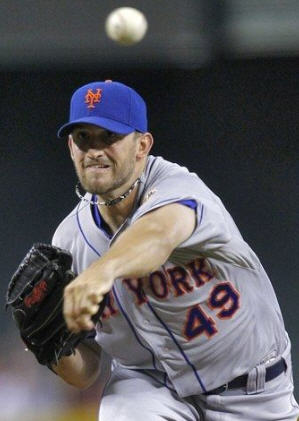
Jonathon Niese: With a contract extension inked early in the season, Niese obviously has a part in the Mets’ future. The young lefty — still only 25 and with over 500 Major League innings on his resume — has pitched like a credible middle-of-the-rotation starter so far this year. Niese faded after July in 2010 and 2011, so the next couple of months could go a long way toward determining whether that’s a pattern or a coincidence. With a solid ground-ball rate and strong rate stats, Niese has pitched to his peripherals with a 3.72 ERA in the first four-plus months of 2012, benefiting from a career-low batting average on balls in play but suffering a bit from a career-high home run per fly ball rate. Both should normalize a bit, but as long as Niese stays healthy and keeps pitching the way he has there should be no doubt of his status in the Mets’ rotation moving forward.

Dillon Gee: Gee had kind of a weird year. The second-year starter struck out way more batters, walked way fewer and yielded more groundballs than he did in his rookie campaign, but the results didn’t quite follow. If he’s done for 2012 after surgery to correct a blood clot in his shoulder, he finishes with an unspectacular 4.10 ERA but a 3.69 FIP and a 3.53 xFIP. Gee’s high strikeout rate was more in line with his Triple-A numbers from 2010, so perhaps, if he returns healthy in 2013, the improvement is sustainable. It allowed him to average nearly an inning more per start in 2012 than he did in 2011 and makes Gee look like a valuable member of a big-league staff. Whether he’s in the Mets’ rotation come Opening Day 2013 should depend entirely on his recovery.

Bobby Parnell: My friend Ripps, a true SABR if there ever was one, sent me this text message a couple nights ago: “It feels like Bobby Parnell should be better than he is but it seems like he is much worse than he is.” I couldn’t put it better myself. Parnell’s blazing fastball and now-nasty-looking curveball have made him by far the Mets’ best reliever this year: He has the best strikeout to walk rate and best ERA of anyone who has been in the bullpen for the bulk of year — faint praise, for sure. Parnell’s few high-profile meltdowns and his unfortunate association with the rest of the Mets’ relief corps have clouded what should be a partly sunny outlook: This will be his third straight season as a capable Major League reliever, and he gets a lot of ground balls, strikes out more than a batter an inning, and doesn’t walk too many. He’s 27 so it seems unlikely he’ll get much better, but he’s under team control through 2016 and good enough that he should be an important part of a Major League bullpen as long as he’s healthy. But it does seem like he’s worse than that, for whatever reason.

Jeremy Hefner: No one outside the Hefner household appears to get too excited about Jeremy Hefner starts, and Hefner himself admitted he wasn’t as good as Johan Santana earlier this week — true, but a surprisingly humble statement from a Major Leaguer. Hefner’s only 26, though, and his 5.04 ERA in 50 innings with the Major League club masks solid peripherals and a strong part-season at Triple-A Buffalo. He throws strikes, which is more than many can say. His lack of strikeout stuff means he’ll likely have to rely on weak contact and a good defense behind him, which could get him in trouble on occasion. But he seems well-suited to the role given to Miguel Batista at this season’s outset: A long reliever and spot starter for the big-league Mets. Hefner’s got options remaining so he could ride the Buffalo shuttle if there’s a roster crunch next season, but he’s good enough to keep around.

Matt Harvey: Even after Sunday’s shaky start, it looks like Harvey will have to pitch his way out of the Mets’ 2013 rotation. Though Harvey hasn’t pitched very deep in games so far at the big-league level, he has shown the stuff to overpower Major League hitters and struck out 23 of them in his first 16 1/3 innings at the level. He’s still a bit wild — walking 3.9 batters per nine both at Triple-A Buffalo and so far in the Majors — but Harvey’s health and performance this season bode well for his future. He looks fit to at least join Niese and Gee as solid young starters in the Mets’ rotation next year with a reasonable shot to be better than both.

Elvin Ramirez: Elvin Ramirez has thrown 12 1/3 Major League innings this year, and though I watch nearly every pitch of every game I can hardly remember any of them. They’ve been pretty forgettable, as Ramirez, who has been wild throughout his Minor League career, has walked more than he’s whiffed in the bigs. That’s not good, and though Ramirez mounted a 1.99 ERA in 40 2/3 innings at Double-A and Triple-A this year, the walks prevent him from looking like a dependable Major League reliever. He’s only 24, so Ramirez still has time, but counting on him to be a part of the 2013 bullpen seems foolish until it’s clear he’s made some improvement or adjustment.

Josh Edgin: Edgin was also pretty wild in the Minors, but he appeared to improve across the season and into his first 12 Major League innings. Sort of by default, Edgin has emerged as one of the Mets’ best late-inning options in the very early part of his big-league career. He’s lefty and he throws hard, which means he likely has a long big-league future. Unless the Mets go crazy for bullpen arms in free agency — and perhaps even if they do — Edgin should be penciled in for the team’s 2013 bullpen. If he performs anything like he has in his first month in his next two, write over that pencil in ink.

Chris Schwinden: If you’re only aware of Schwinden’s three woeful Major League outings in 2012, you don’t know a quarter of the story. After being DFA’d by the Mets in late May, he was claimed by the Blue Jays. He made one start for their Triple-A team, then was waived again and claimed by the Indians. He made three starts for their Triple-A Columbus squad, then was DFA’d in late June. He got picked up by the Yankees, made one start for their Triple-A team before being DFA’d again and picked up by the Mets, the only organization he had known before his whirlwind tour of the highest Minor League level. Schwinden has actually been great in Buffalo this season, boasting a strikeout to walk ratio over three and a 2.19 ERA in 78 innings. His 2012 transaction ledger suggests he can have value to a Major League team as a spot starter or fill-in member of the rotation, but also that teams see him as expendable when rosters get crowded. I’m rooting for him, for what it’s worth.

Pedro Beato: Beato’s seven sporadic outings with the big club in 2012 did not go well, but he’ll be back. He has a 1.97 ERA in Triple-A this year with a 0.906 WHIP, and he’s still got the arm that everyone raved about when the Mets grabbed him in the Rule 5 draft before 2011. Bullpen arms are fickle. Beato could pitch well for a few years in the future and someday earn a “closer” label somewhere and hang around the Majors for years. Or he could prove a Manny Acosta type, good enough to dominate Triple-A and pitch well in spurts at the big-league level. Either way, if he’s around and healthy come February he should compete for a role in the Mets’ 2013 bullpen.

Robert Carson: Carson’s got youth, handedness, arm strength and roster status on his side, but he looked pretty hittable in Double-A and in his insignificantly brief Major League stints this year. His first go-round in Triple-A has gone well over a very short sample, but oddly Carson has had more success against righties than lefties. Lefty relievers often seem to emerge in their mid-to-late 20s, so it’s way too soon to rule out a successful big-league career for Carson. But it’s also way too soon to expect one.

In sum, and despite this season’s bullpen atrocities, the future of Mets pitching looks better than it did last year at this time. If Gee returns to form, the Mets should enter 2013 with at least a solid pitching staff. R.A. Dickey looks like a lock for the front of it, with Niese and Harvey somewhere behind him, and Johan Santana and Gee inked in if they’re healthy. Plus, in Parnell, Hefner, Edgin and Beato they’ve got youngish arms with varying degrees of promise that should vie for bullpen roles. And, in Zack Wheeler, Jenrry Mejia and Jeurys Familia, the Mets have three talented 22-year-old pitchers in Triple-A.

But don’t think about trades. The cliches are true: There’s no such thing as too much pitching and there’s no such thing as a pitching prospect. The best way to build a great staff is to compile as many good pitchers as possible and hope some of them stay healthy. The Mets now appear to have a deep crop of good or potentially good pitchers. Let’s hope some of them stay healthy.

Sandwich of the Week

Philadelphia style.

The sandwich: The 50/50 from Jake’s Sandwich Board on South 12th St. in Philly, recommended by Twitter multiple times over.

The construction:  Slow-roasted pulled pork, bacon, house sriracha spread and provolone cheese on a sesame-seed hoagie.

Important background information: Jake’s sandwich board features a slew of awesome-sounding sandwiches. I picked the 50/50 because of a sign near the front calling it the Sandwich of the Year in some newspaper or magazine’s poll, and because the two guys ahead of me on line both also ordered 50/50s so it seemed like the thing to get.

Jake’s, which opened in 2010, also offers a ridiculous eating challenge that seems aimed directly at getting the establishment on Man vs. Food. If you can eat a two-foot, three-pound sandwich, four soft pretzels, a box of Tasty Kakes, 24 peanut chews and a large cherry soda in 45 minutes, it’s all free and you get your photo on the wall. If you fail, as almost everyone does, you still get your photo on the wall but with a big stamp on it that says “FAILED.”

When I sat down to await my sandwich, the guys at the next table over were in the midst of a discussion of Jake’s wall of fame and shame. “I don’t see him on here,” one guy said.

“Well, his doctor told him he had to stop,” said another.

What it looks like:


How it tastes: Decadent. Delicious, but spectacularly decadent.

The pulled pork is so tender it hardly gives when you bite it, allowing your jaw to tear through a whole lot of pork in very little time. The meat itself has a pleasant pork flavor with a soft, black-peppery kick, which combines with the “house sriracha spread” — which looks and tastes a hell of a lot like sriracha and mayo mixed — to give the thing an indistinct back-of-the-mouth heat that never quite bites or cuts but is present throughout.

Bacon is bacon, and it’s well-prepared — thin-sliced but layered thickly, crunchy but not overcooked, still oozing grease from its recesses. The provolone cheese is piled on top and I caught myself wishing at times during the first half of the sandwich that they had found a way to better distribute it throughout. By the second half, it melted onto the pork and provided a nice sharp flavor and some creaminess on the other side of the sriracha spread.

The bread was soft, but it wilted in the center under the considerable grease of the ingredients on top. But I’m not sure it’s fair to fault the bread. A yellowish, translucent grease spilled out the back of the sandwich starting with the first bite and pooled up in the wax paper below, ultimately catching some thicker splashes of bright pink sriracha spread to create an ominous, psychedelic lava lamp of grease in the dish.

In my head I could hear the guy at the next table again. “His doctor told him he had to stop.” But I looked at that guy and he was midway through some massive and awesome-looking sandwich. And I looked down at the remaining quarter of mine, wondering what my own doctor would say — almost certainly: “stop!” — then picked it up and polished it off.

I suspect the sandwich is called the 50/50 because it’s even money it’ll kill you. Wouldn’t be the worst way to go out.

What it’s worth: It cost only $8, which is a pretty great deal. It’s obvious every ingredient in there is quality, and if you had more will power than me you could probably make two meals out of it.

How it rates: 77 out of 100. On taste and texture alone it’s a borderline Hall of Famer, but it’s docked points for the associated grease and guilt.


Friday Q&A, pt. 2: The randos

Oh absolutely. I don’t know that the photographed burger has too many toppings, but when a place piles on too much stuff that isn’t bacon and cheese, it can get ridiculous and gimmicky. I don’t have any hard-and-fast rule about how many toppings a burger should have because it’s all about proportion, but there are few things more disappointing than a burger when I can’t actually taste the burger. As a general guideline, I would say it’s safe to add one extra, offbeat ingredient when the burger is fully loaded with typical ingredients and two extra offbeat ingredients when it isn’t.

But I very much enjoyed this bacon cheeseburger at J.G. Melon the other day:


Bacon, cheese, burger. Elegant in its bluntness, with pickles and onions on the side as optional toppings — I’ll have the former. When every ingredient is delicious, you don’t need to go crazy with toppings. You can, of course, but you don’t need to.

Well, I don’t know yet. I’m spending the day in Philadelphia, enjoying some sort of native sandwich for lunch and likely going out to dinner somewhere with the wife before we head back to New York. Something good, for sure. Usually I rely on Roadfood.com for travel eating recommendations.

I’m way more interested in what you have for dinner, Rob. What’s the best native food in the Netherlands? All I’ve heard about from friends who have been there is late-night drunken falafel in Amsterdam. Presumably that is neither native to the region nor the best thing available there. Anyone?

I actually think about that sometimes. I liked working in the deli because it made so much sense: We have food, you have money, we have the time and equipment with which to prepare this food in some delicious way you’ve requested, and for that you are willing to give us money that we will then use to buy more food. It’s the circle of sandwich life.

But opening and operating a business takes so much time and effort, represents such a huge financial risk, and seems so prone to randomness. And I have a job writing about baseball and sandwiches that provides health insurance. It’s not something I’m eager to walk away from.

I do think, though, that someone should give me some sort of massive stipend to serve as a sandwich consultant for a restaurant. “Sandwich Curator” if you want a fancy title. Basically I come up with new sandwich concepts or tell you how you can improve your sandwiches, then you pay me a ton of money and feed me lots of free sandwiches. WIN-WIN!

https://twitter.com/TheFoyeEffect/status/231073098030514176

Holy crap I’ve never even considered that. You mean the zesty Pepper Jack sauce, incidentally, but yeah… they need to get that stuff out there. Think of the things we could Baja!


Friday Q&a, pt. 1: Mets outfield stuff

Luckily I don’t have to decide right now, so this is purely hypothetical. Also, I don’t have to decide in the offseason either. I don’t ever have to decide whether to tender arbitration to Andres Torres and Manny Acosta. But if by some weird chance Sandy Alderson called me in the next five minutes and said, “Hey Ted! It’s me, Sandy Alderson. Should we tender contracts to Torres and Acosta this season? It’s your call, but we need you to decide right now,” I’d probably say yes to Torres and no to Acosta.

The Mets need outfielders in the worst way. Torres certainly hasn’t earned a starting role in 2012, but he’s probably good enough to merit whatever increase he gets on his $2.7 million salary this year. He covers a ton of ground in the outfield, he’s a switch hitter, and he has quietly raised his on-base percentage to a respectable .351 (as of Thursday afternoon when I’m writing this). He seems a good fit as a fourth outfielder, regardless of who else is on the team.

The counter argument, I guess, is that with Jordany Valdespin and Kirk Nieuwenhuis sort of in the fold and Matt den Dekker hopefully coming up the pike, the Mets don’t really need center fielders. But neither Valdespin nor den Dekker can be counted on for much Major League offense at this point, and Nieuwenhuis obviously needs some work. Plus all three of those guys hit left-handed. I look for bigger upgrades, certainly, but unless I’m planning to sign another switch-hitting center fielder, I’m bringing back Torres.

Incidentally, another switch-hitting center fielder — B.J. Upton — [bah – update: Upton is not a switch hitter. My mistake, he bats right] is slated for free agency this offseason. Upton’s enduring a down year and comes with something of a spotty reputation, but he’s a really nice player and he won’t turn 28 until later this month. He’s not the superstar he was once expected to become and I have no idea what he’ll fetch on the open market, but he does seem like a pretty good fit for the Mets. Just depends on the cost, obviously. (That should cover Andrea’s question, incidentally.)

As for Acosta: I’m a pretty big Acosta apologist (Acostogist?) and he’s not likely to earn that much in arbitration, but the guy’s got an ERA over 10. He’s got good enough stuff that you’d expect someone will want him, but I can’t imagine there’ll be a feeding frenzy for his services. I’d try to non-tender him and bring him back on a Minor League deal or something.

https://twitter.com/RobPatterson83/status/231055658169008130

Lots of questions about the outfield. Let’s throw Jordany Valdespin into that mix too, to cover @SeanKenny’s question.

In decreasing order of likeliness to start in the 2013 outfield, I’ll say: Nieuwenhuis, Torres, Duda, Valdespin, Bay. As bad as he looked for the last part of his tenure with the 2012 Mets, Nieuwenhuis might be the best all-around player of that lot right now, and he stands to improve moving forward. If the Mets’ opponent starts a righty on Opening Day, I’m guessing Nieuwenhuis is in there.

As I said above, it appears there’s a role for Torres on next year’s club barring a free-agent signing or two, so by default he’s vaguely likely to start Opening Day.

Duda’s future with the team most likely depends on his ability to play the outfield, and there’s not much evidence he can do that just yet. The team appears committed to Ike Davis at first. Since it seems likely Duda will hit like a capable Major League corner player again, he has some value. But there’s not much sense in the Mets’ parting ways with him until he starts hitting at some level or he shows he absolutely cannot play left field. He saw his first time there in Buffalo on Tuesday; the Mets should spend the rest of the month trying to figure out if they can make that work. If it does, he’ll be back in the lineup in the Majors.

Valdespin now looks like he has a Major League future of some sort, but I suspect his offense will regress this year and the Mets will want him to learn to be more patient. And I’d be pretty surprised if Bay’s on the roster to start next season, sunk cost be damned.

So if you’re playing at home, the guy I have as most likely to start Opening Day next year is one of the two currently in Triple-A. Weird. Whatever. Who’ve you got?

Breaking point

Jason Bay started in left field for the Mets last night after missing all but one at-bat’s worth of the last two games with a shin injury. He went 0-for-4 with a walk and two strikeouts and left an orchestra on base. Since returning from the disabled list on July 17, Bay is hitting .093 with a .204 on-base percentage and one extra-base hit — a home run against the Nats in his second game back. Though it’s still only a 121 at-bat sample, he now has a .531 OPS for the year, the lowest it has been after more than five games in any season of his career.

Bay is a really nice guy. By nearly all accounts, he’s dedicated to improving himself and working as hard as he did in the strong seasons that earned him the four-year, $66 million contract with a vesting option for 2014 he inked with the Mets before 2010. He is purportedly a very good teammate and, when he’s not struggling, he is hailed as a leader in the clubhouse. And the Mets are still on the hook for all $16 million of Bay’s 2013 salary and the $3 million buyout on the option.

But something has to give. This doesn’t seem revelatory to anyone who has watched Bay struggle these past few weeks and these past few years, yet someone or some collection of people in the Mets’ organization is keeping Bay on the roster and starting the bulk of the team’s games.

Why? The Mets are 15-18 in games Bay has started and 36-36 in the others, so they haven’t exactly been way worse with him in the lineup than without him. Maybe that’s a factor, though it doesn’t seem a particularly good one. He hits right-handed on a roster full of lefties. Sure, he has fared worse against lefties this year than every position player who has spent any significant time with the club besides the backup catchers and Kirk Nieuwenhuis (with whom he is about even)But Bay’s handedness must be a consideration. Plus he runs the bases well in the increasingly rare instance he reaches one safely, and he plays sure-handed if not rangy defense in left field. And there’s all that money.

None of those, in isolation or in conjunction with the rest, seems like a good enough reason to keep Bay in the lineup every night or even on the roster. Presumably Sandy Alderson would like to see Bay bounce back to the point where he could find some team somewhere willing to take on even a little of Bay’s salary in a Gary Matthews-type deal, but what could Bay really do in the next two months to convince anyone he’s worth appreciably more than a guy available at the league minimum? Nothing that seems likely after three straight seasons of underwhelming to awful performance, that’s for sure.

The Mets don’t have many appreciably better options, but a case could be made that both the recently dispatched Nieuwenhuis and Lucas Duda offer more advantage to the Mets even against lefties. Duda is not a good defensive outfielder, but he out-hit Bay against lefties this year and seems apt to potentially be such a massive offensive upgrade against righties to mitigate his flaws. Nieuwenhuis struggled against lefties this year and in the Minors last year, but he is likely a better defender than Bay.

But even if you allow that Duda and Nieuwenhuis are in Triple-A to work on fixing the issues preventing them from excelling at the big-league level and that the team is prioritizing their development over its needs at the big-league level, and even if you figure that the team wants to be able to bring Bay to Spring Training next year to see if he’s somehow rejuvenated and ready to contribute somehow before they cut him loose for good, there’s really no justification for starting him against right-handed pitchers like they did last night. With switch-hitting Andres Torres and lefty-hitting Jordany Valdespin and Mike Baxter on the roster, the Mets could field an all-lefty-hitting outfield with strong defense. And Scott Hairston, too, represents a better option against righties than Bay at this point.

If the Mets want to keep Bay around for whatever reason, they should give him the best chance to succeed by playing him only against left-handers. If they’re still interested in winning as many games as they can — and they showed that they are when they held on to Hairston at the trade deadline — there’s just no good excuse to give Bay so much playing time.

More like the no-trade deadline amirite?

Over at Amazin’ Avenue, Chris McShane contends that the Mets were smart not to force trades at the trade deadline. And he’s right. The hoopla and nonsense surrounding the trade deadline (and the Winter Meetings) seem more like facts of life at this point than anything worth lamenting. Plenty of fans — excited or angry or passionate in some way — demand improvements or change, and old and new media fan the flames because it’s something to talk about in the midst of a long season. So it swells to this tremendous tidal wave of silliness. You can surf it or fight it or try to duck it entirely, but it’s coming regardless.

The Mets didn’t trade Scott Hairston. For some reason this pisses people off even though Scott Hairston has been one of the best reasons to watch the Mets all season. Reportedly, they fielded some offers and didn’t hear anything they felt was worth more to their short- or long-term future than the next couple months of Hairston’s lefty-mashing. Since the Mets’ front office seems to be in the business of making reasonable decisions, and since they employ an army of scouts and I don’t, and since they heard what was offered for Hairston and I didn’t, I’ll give them the benefit of the doubt on this one.

From the Wikipedia: Roosevelt Island

I brought my bike to the city a few weeks ago and I’ve been riding around a good deal. It’s awesome. I really can’t say enough for bicycling as an inexpensive means of transportation and exercise. You can cover so much ground relatively quickly, and in New York City especially you can speed over massive suspension bridges, take in awesome views and escape to odd parts of the five boroughs with different landscapes and distinct cultures and all sorts of new things to see.

From the Wikipedia: Roosevelt Island

Roosevelt Island is a small place with a huge Wikipedia page. It doesn’t say this on the page, but Roosevelt Island is the weirdest. It’s two miles long and 800 feet wide and sits in the shadow of Manhattan in the East River. While riding there a few days ago, I saw a pizza delivery guy and wondered if he was the only pizza delivery guy working on Roosevelt Island at that time. It turns out only 9,500 people live on the island, so it seems a reasonably safe bet that there’s only one active pizza-delivery guy at any given time. What happens if 10 people happen to order pizza delivery at the same time? You’ll have to be patient, I guess. The only dude is busy right now. Or — or! — you can just go pick it up, because how far can you possibly be from the pizzeria if you live on Roosevelt Island?

The island was purchased in 1637 by Dutch governor Wouter Van Twiller from the Canarsie Indians. At that point, it was known as “Hog Island,” which is crazy intriguing. Were there lots of wild hogs there? The Wikipedia doesn’t say. But if Roosevelt Island is conducive to hog breeding we should probably get on that. Or at least open up a destination barbecue joint there called “Hog Island.”

When the English ousted the Dutch from the area, the island was seized by Captain John Manning and renamed Manning’s Island for about 20 years until Manning gave it to his son-in-law Robert Blackwell, who called it Blackwell’s Island. In 1921, it was renamed Welfare Island. Then in 1973, a few years after it had been leased by a development corporation, it was renamed Roosevelt Island, presumably because it was hard to convince people to rent apartments on Welfare Island.

In the 19th century, the island was primarily used to isolate all the distasteful elements of urban life, kind of the Danny DeVito in Twins to Manhattan’s Arnold Schwarzenegger. The city built a penitentiary on the island in 1832, then a lunatic asylum in 1839, then a smallpox hospital in 1856. These attractions drew some of the island’s most famous visitors. Anarchist Emma Goldman, corrupt mayor Boss Tweed, jazz legend Billie Holliday and actress Mae West all spent time in jail there. Nellie Bly and Charles Dickens both visited and wrote about the lunatic asylum.

Before 1909, you could only travel to the island by ship or by swimming. When the Queensboro Bridge opened, so too did a trolley that took passengers from Manhattan and Queens to the center of the bridge, where they could take an elevator down to the island. The trolley and elevator were closed in 1955 with the opening of the Welfare Island Bridge to Queens.

In 1976, Roosevelt Island got one of its most recognizable features: The tramway that lets residents take an amusement-park to work in Manhattan. The tramway was supposed to be temporary, but everyone must have realized how awesome it was and decided to leave it there. You may recognize the tramway from the first Tobey Maguire Spiderman movie, or the 1983 Sylvester Stallone film Nighthawks, or City Slickers, or The Professional, or a 2005 episode of CSI: New York or a 2010 episode of America’s Next Top Model or a 2012 episode of White Collar, or from the King Kong Tramway ride at Universal Studios, Florida. Like I said, Roosevelt Island has a very extensive Wikipedia page.

You can also get to Roorsevelt Island by the F train, but c’mon. Lame.

The first residential development on Roosevelt Island, on the north part of the island, is called Northtown. The most recent development, on the south part of the island, is called Southtown. In 2007, Southtown got a Starbucks and a Duane Reade. You can read all about the latest happenings in Roosevelt Island in the Main Street WIRE, a bi-weekly newspaper dedicated to Roosevelt Island matters that is delivered to every residence on the island and that receives a suspicious amount of coverage on the Roosevelt Island Wikipedia page.

I’m already 750 words deep and nowhere near done recapping the page, so here are some other facts about Roosevelt Island worth knowing:

  • A remnant of the lunatic asylum — the Octagon — and the ruins of the smallpox hospital are still standing and worth checking out if you’re riding your bike around Roosevelt Island. But good luck figuring out how to get there.
  • The island’s waste is collected and compacted by an automated vacuum collection system, the only such system serving a residential complex in the United States.
  • The Wikipedia claims that Sarah Jessica Parker lived there, but it lacks a citation. But former U.N. secretary-general Kofi Annan and “Grandpa” Al Lewis of The Munsters definitely lived there.
  • In 1939, the New York Cubans of the Negro National League played their home games on the island. There are a bunch of athletic fields still there now and they make for some pretty epic settings, what with the river and the skyline and all.
  • Outside shots of the smallpox hospital in ruins are used to depict the Foot Clan’s secret hideout in the first Teenage Mutant Ninja Turtles movie.
  • Development of the island was based on the “new communities” proposed in Lyndon Johnson’s “Great Society” programs. Though the island is technically part of the borough of Manhattan, its government and infrastructure are operated by state-created public-benefit corporation. Police on the island are, as far as I can tell, state officers and not members of the NYPD proper.