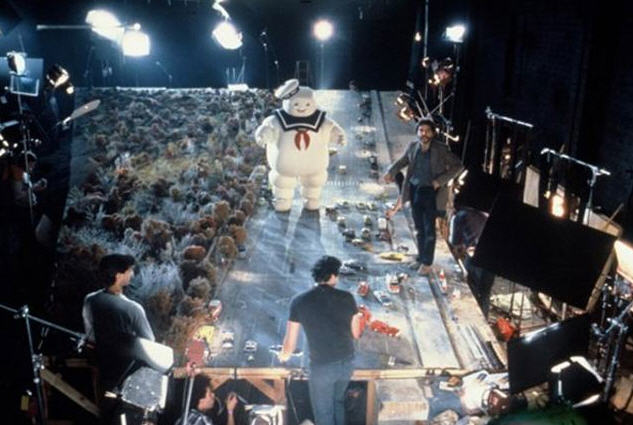
Gothamist has behind-the-scenes photos from the filming of Ghostbusters. Check ’em out if you’re not terrified beyond the capacity for rational thought.

Gothamist has behind-the-scenes photos from the filming of Ghostbusters. Check ’em out if you’re not terrified beyond the capacity for rational thought.
Grant Brisbee from McCoveyChronicles.com skypes in:
http://web.sny.tv/media/video.jsp?content_id=23467221&topic_id=30955196
Even if athletes never got any stronger or faster, and if their techniques and training never changed, they would still break records from time to time. That’s because the ability of each person who decides to compete, and the outcome of each competition, are affected by random processes. What happened on the way to the track that might affect the athletes’ performance? What’s the weather like? And so on. Every sporting event is a matter of chance as well as of achievement, and chance always offers the possibility of a breakthrough.
That said, the mathematics of record-breaking—also known as “extreme-value statistics”—tell us that, all things being equal, the frequency of world records will tend to diminish. At a certain point, we’ll have rolled the dice so many times that the chance of our beating our best score drops close to zero. That’s why new sports and new classes of competitors typically produce more records than old ones. Women athletes weren’t allowed to compete in the Olympic marathon until 1984. Since then, their record time has dropped by about 10 minutes, while the men have managed to shave off only five.
-Daniel Enger, Popular Science.
Good read on one of the more interesting aspects of Olympic competition.
I wrote on Friday — and plenty before that — that this year for the Mets is mostly about next year for the Mets. Obviously the full season will provide the best and broadest wealth of information with which the team can assess its players moving forward. But since the trade deadline is nearly upon us and Mets fans everywhere are looking for ways the team could improve its standings in the short- and long-term future, I figured it’s a good time to look around the roster and try to determine which of the Mets’ young (and youngish) players should figure into their plans for next year and beyond.
 The following are all the position players who have played in the Mets this year and are in their age-27 season or younger.
Josh Thole: Thole is 25. He has struggled at the plate a bit this year, but by all accounts his defense has improved. It seems reasonable to expect Thole’s offense to bounce back toward his career norms and, given his age, improve a little bit from there. That’d make him only about a league-average catcher, but since the Mets don’t have much in the way of catching prospects in the high Minors and since going big for a free-agent catcher seems like a bad risk, Thole seems like a passable option to start games behind the plate for the Mets in 2013 and beyond. Ideally, they will find a decent, righty-hitting catcher with which to platoon him.
Ike Davis: Fun with arbitrary endpoints! Since June 6, Davis has a .958 OPS. That’s the good news. The bad news is that he started out so poorly that a month and a half’s worth of excellent production has only brought his season rate up to a .718. Davis appears to have suffered a few more defensive hiccups this season than he did in the past. A strong finish to the 2012 campaign from Davis will go a long way toward convincing the Mets and their fans that he should be their everyday first baseman moving forward, and I’d bet on that. Davis’ career OPS is now at .785, a touch above league average for first basemen even despite his youth and his woeful first half to this season.
Daniel Murphy: While the rest of the Mets have slumped, Murphy’s second-half resurgence has raised his season rates to his career norms. This is Murphy: High batting average, solid but unspectacular on-base percentage, doubles power without many home runs. Murphy’s defense hasn’t been good, but it seems to have improved to the point that it’s worth carrying at second base to keep his bat in the lineup. He’s never going to be Joe Morgan there, but if he hits he can play.
Ruben Tejada: The future looks bright for Tejada, once dismissed as a non-prospect due to his lack of obvious physical talents. For the second straight year, he has gotten on base a lot and played good defense. The biggest thing, of course, is that he’s 22. Just being able to not embarrass yourself in the big-leagues at Tejada’s age is impressive. His .297/.361/.352 line over the past two years suggests he could be a capable-to-plus Major League middle infielder for a long time coming.
Lucas Duda: Duda, as you know, got demoted a couple weeks ago. His defense in right field was atrocious and he didn’t hit enough to make up for it. But despite his offensive struggles this season, Duda has been good enough in the Majors and Minors the past few years to suggest he has a Major League career ahead of him. It’s just not in right field, and it might not be with the Mets. There aren’t many teams on which hitting left-handed is a detriment to your chances of making the roster, but Duda’s handedness doesn’t help his case for the club as long as so many other lefty hitters are around. (For what it’s worth: Duda has been better against lefties than Jason Bay this year.) He needs to start playing left field in Triple-A. If, for whatever reason, he can do that better than he can play right, maybe he resurfaces in the Mets’ starting lineup before long. If he can’t, he’s trade bait or a Triple-A hedge for Davis at first.
Kirk Nieuwenhuis: I argued on the podcast recently that Nieuwenhuis is the young outfielder most likely to emerge as a Major League regular. It’s not now, of course, with the once bro-tastic center fielder heading back to Buffalo to make way for Mike Baxter. Nothing Nieuwenhuis did or didn’t do in the Majors this year should surprise anyone who has been following him since the Minors: He played solid defense wherever the Mets put him, he hit for a little bit of power, and he struck out way too much. The good news is he’s 24 and — though it’s easy to forget — coming off a mostly lost 2011 season. With more reps in Triple-A, Nieuwenhuis should be able to pull it together and become, at the least, a platoon outfielder in the future. Unless the Mets bring in a couple of everyday type players, look for that to happen as soon as next year.
Justin Turner: Justin Turner is great at throwing pies and coming up to the plate to “Call Me Maybe,” and is by all accounts an awesome dude. He’s a justifiable Major Leaguer on a team that needs a second baseman in a pinch or needs a low-cost backup middle infielder. With Murphy looking more like a reasonable starter at second base, though, and Ronny Cedeno around to backup second and short, Turner appears rather redundant on the Mets’ roster. That’s not his fault and it’s not necessarily the case moving forward, but if anyone’s willing to give up anything of value for Turner’s services, the Mets should probably go for it.
Jordany Valdespin: Without looking, how many times has Jordany Valdespin walked this season? Any guesses? It’s twice. He has walked two times in 111 plate appearances: once May 8 and once July 6. His early-career power outburst has been awesome to watch, but it is unsustainable. If Valdespin doesn’t start taking more pitches, he’s not going to get any to drive. Still, his transition to the Majors and to the outfield at his relatively young age has been strong enough to suggest he’ll probably have a big-league career. I can’t think of a great comp, but I’d guess his upside is as a solid utilityman, playing all over the outfield and filling in at second, maybe third, and shortstop in a desperate situation.
Mike Baxter: It’s easy to glorify Baxter based on a tiny, 65 at-bat sample and one heroic moment, so let’s do just that: Mike Baxter is the best. Remember that catch he made? Remember all the timely hits? The Pride of Whitestone returns tonight, and if he hadn’t cemented his status as a folk hero yet, he’ll do it now by taking playing time away from Bay.
Josh Satin and Zach Lutz: Neither of these guys got much of a chance in the Majors this year, but they’re both right-handed and both routinely hit well in the Minors. If Lutz — the more powerful hitter of the two — can stay healthy, it wouldn’t be terribly surprising to see him spend more time with the big club next year as a right-handed bench bat and backup to Davis.
So what’ve we learned so far this season? The Mets have a bunch of guys who appear apt to become capable Major League role players or platoon guys, a few who look like solid regulars, and no offensive player (beyond David Wright) who looks likely to become a bona fide star.
There’s no rule that you must have any set number of guys labeled stars to succeed, of course, and if the Mets happen to get career years out of Davis, Tejada, Thole and Murphy next year along with typical production from Wright, their offense could be very good. They should be looking for outfielders, though — especially outfielders than can hit lefties.
The sample size specter haunts me.
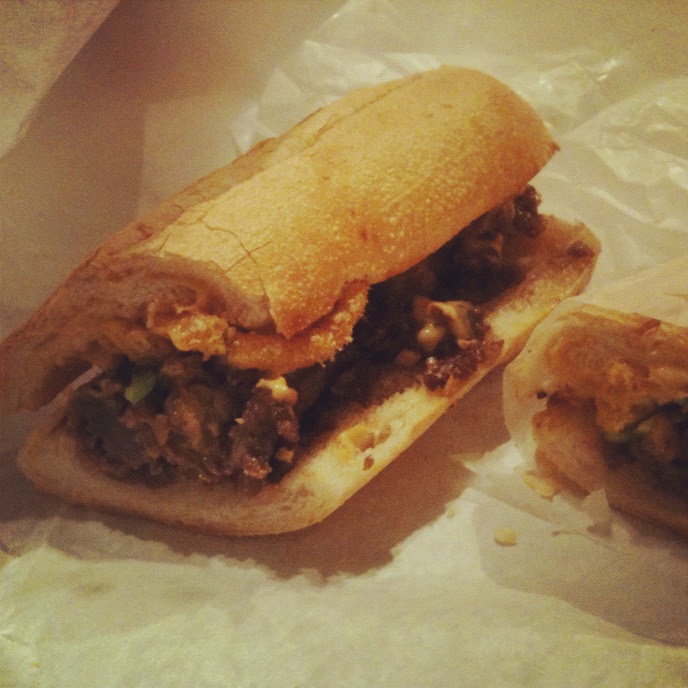
The sandwich: Cheesesteak from No. 7 Sub, Plaza Hotel, 59th and 5th in Manhattan.
The construction: Thinly sliced steak with miso whiz, pickled jalapenos and Funyuns on a toasted hoagie roll.
Important background information: I’ve been hearing great things about No. 7 Sub and meaning to try it since I first started writing about sandwiches here. But until a few weeks ago, I had no idea they had a location in the basement of the Plaza Hotel, about seven blocks from my office. Also down there: a Luke’s Lobster, purveyor of Josh Thole’s favorite sandwich, and an outpost of Billy’s, my favorite bakery in the city.
What it looks like:
How it tastes: Either good enough to be a borderline Hall of Famer, decidedly too salty, or — most likely — somewhere in between. I had this one twice, and the experience reminded me how silly this whole enterprise of rating sandwiches really is. Please do not take the numbers I throw out too seriously. I suspect that if I went back and tried every sandwich I’ve reviewed here, I might return with an entirely different Sandwich Hall of Fame.
Which is to say: Small sample size, small sample sample size…
Anyway, the first time I ordered the cheesesteak, I watched the man behind the counter carefully construct it — toasting one side of the bread first, plain, then adding the steak and miso Whiz to the other side and toasting that, then painstakingly laying the remaining ingredients in an even pile on top and completing the sandwich. I can practically guarantee that Funyuns have never been handled with such great care.
Speaking of: Funyuns on a sandwich! What a concept. The snack chip on a sandwich thing is nothing new, but the Funyuns seemed a particularly good fit, especially on a cheesesteak. They provide some subtle, salty, pleasant faux-onion flavor, and they’re puffy and sturdy enough to maintain some crunch under duress. (Presumably it has happened somewhere already, but someone needs to try putting puffed Cheetos on a sandwich.)
There wasn’t an overwhelming amount of steak, miso Whiz or jalapenos, but it all worked that first time. I could pick up the distinct flavor of miso and the spice of the peppers on top of the slight chewiness of the steak. It’s almost unconscionable to consider calling a sandwich with Funyuns on it “delicate,” but that’s kind of how it tasted. None of the flavors were overpowering, it wasn’t too greasy, there was an interesting variety of textures.
The second time, this cheesesteak almost tasted like a caricature of the sandwich I had the week before. I don’t know what went wrong in the process (or what went right the first time), but I suspect the proportions were off. By taste, at least, there was less steak and fewer jalapenos and way more miso Whiz and Funyuns. The Funyuns didn’t present as much crunch but the salt remained, and the extra miso Whiz meant that saltiness and miso flavor dominated the sandwich. Still really good, mind you, just nowhere near as delicious as the one I had the week before.
What it’s worth: $12, which isn’t cheap for cheesesteak, Funyuns or no. Both halves make for a pretty big meal, though.
How it rates: 80 out of 100, the mean of the two versions I had.
Yesterday’s post about Finnish baseball will be pushed off the homepage by this one, so I don’t have to break my rule about not being too Finn-heavy on this blog. And thank heaven for that, because everyone who has ever been to the Internet needs to drop what he or she is doing and take a look at what Meredith passed along.
Apparently, a) From the 1920s through the 1960s in Finland, wrestling matches were typically accompanied by accordion music, and accordion players often received top billing alongside the wrestlers; b) Kimmo Pohjonen, the man known as “the Jimi Hendrix of accordion,” is working to revive this tradition by teaming up with a group of 10 Finnish wrestlers and a choreographer; and c) he’s coming to Lincoln Center next week.
Most importantly, just watch this:
You see, it’s ironic because- well, no, I guess it’s postmodern, because, you see… no. Meta, it’s meta in that- OH GOD I’M DOING IT TOO
 Tedquarters