Recipe to follow once I find it.

Recipe to follow once I find it.
The following is a drawing from around 1790 by British caricaturist and illustrator Thomas Rowlandson. It’s called “A kick-up at a hazard table!” Hazard was a dice game popular in London in the 18th century — an earlier, more complex version of craps.
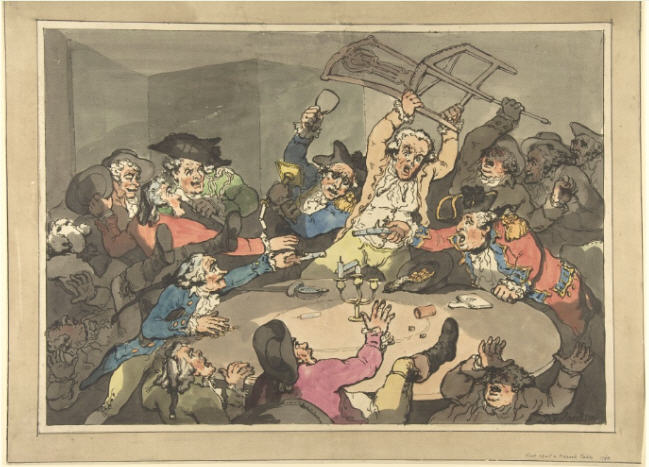
The drawing caught my eye at the Met a couple of months ago. Mostly, I like it because it seems like a good, funny time capsule, and because it appears to be drawn with the type of confidence and enthusiasm that I generally enjoy in all forms of media. Partly, I like it because I am a baseball fan who appreciates the staggering power of randomness.
I don’t know many particulars of 18th-century British society beyond wig-powdering. Maybe the melee depicted above ensued after harsh words about King George III or the changing political tide in Europe. But I assume the conflagration in Rowlandson’s drawing came in response to a costly run of misfortune at the table.
Constructing a baseball team is hardly a game of pure chance. Teams can scout and analyze and coach to improve their odds, and the probabilities are never as discrete or obvious as those in a dice roll. But because its outcomes are impossible to accurately predict, it always requires a series of gambles.
The Mets started 2012 with calculated risks all over the field. They inked young players with short resumes into spots up and down their lineup. Two of them were coming off season-ending injuries. Two were playing new positions. Two had never spent a full season as a Major League regular before. To boot, all starting pitchers come with a significant chance of injury. And given the fluctuations in performance typical of relief pitchers, bullpens are often labeled a crapshoot. Undoubtedly, with more offseason resources to play with, the Mets’ front office could have better hedged some of its bets. But every team enters every season relying on some degree of good luck for success.
For most of the first half, the Mets rolled sevens way more often than snake eyes. Or something. I don’t really know craps or hazard and I’m growing rather tired of this metaphor. Two of the team’s surest bets — David Wright and R.A. Dickey — paid off more than anyone could have expected. Johan Santana, coming off a surgery that ended many careers, pitched like an ace for two months. The bullpen sucked and some of the young players struggled, as you probably know, but the team’s wins were more than enough to outweigh its losses.
Since the All-Star Break, their luck has turned. Santana and Dillon Gee got hurt and left the Mets relying on pitchers with much longer odds of success. The bullpen still sucks, some of the young players have continued struggling, others have struggled to new lows, and role players that contributed more than expected in the first half have done the opposite in the early parts of the second. Everything, it seems, went wrong at exactly the same time.
Now fans — myself included — are kicking up like a bunch of 18th-century British dudes after a series of unfavorable dice rolls, except hopefully without the pistols. We’re yelling, pointing fingers, smashing chairs, and scurrying for the exit with our hands above our head, drowning in woe-is-mes and I-told-you-sos. We’re blaming Terry Collins for the same decisions we often celebrated in the first half. We’re faulting Alderson for his actions and inaction. We’re questioning the team’s once-heralded chemistry, and we’re pinning almost everything on Miguel Batista or Jason Bay or Lucas Duda or Andres Torres.
Some of those gripes are legit, no doubt. The Mets counted on some bad bets, and in hindsight we can squint and see how they were bad from when they were made. But I suspect, for most of us, if we were shown in early March the Mets’ baseball-reference page in late July, we’d raise eyebrows at some parts and nod knowingly at others, concede that 47-50 sounds about right even if we hoped they’d be better, then scan down the pitching column and say, “whoa, wait: Mike Pelfrey got hurt?”
It’s the timing that’s killing us. Or killing me, at least. Even recognizing what I do about chance and small samples, the Mets’ early success seemed so reliable that I started believing they had figured out a way to buck the odds, or, at the very least, that their good fortune could continue through September.
It didn’t. Such is fortune. Such is baseball. Every year, a couple of teams enjoy a seemingly magical run of good luck, and fans of all the others lament all the bets — safe and silly — that didn’t ultimately pay off.
Here are your 2012 Mets, 47-50: Bad in the bullpen, short in the rotation, awful on defense, and with an offense that doesn’t appear quite good enough to overcome all that. The good news, if you’re searching, is that every game provides the team more information with which to make better bets in the future.
The best news, I suppose, is that their luck can change again as swiftly as it did at the All-Star Break. There’s still plenty of time. Santana could return and pitch like vintage Johan Santana again. R.A. Dickey could enjoy another ridiculous run of dominance, David Wright could continue performing like the very best player in baseball, and, hell, maybe the guys in the bullpen could even pitch to their career rates and maintain a damned lead just once. The team’s mid-season gambles could bring back massive and unexpected returns. It doesn’t seem likely, but then I guess outside of a few glorious weeks, it never really did.
With the Mets’ bullpen, going into extra innings is like going into sudden death overtime in hockey and pulling the goaltender.
I lied earlier when I said there’d be something about the Mets here later today or tomorrow. There won’t be. This site will be undergoing some maintenance tomorrow. I should be back up and running on Wednesday.
I wrote that headline before Sunday’s Mets game. Hopefully something extremely awesome happens in it to make the headline obsolete. Otherwise: Panic!
I’m out of the office today. There’ll be something about the Mets here later or tomorrow.
This one came on rec from @BobbyBigWheel. The man can scout a sandwich.
The sandwich: Chicken from Cheeky Sandwiches, 35 Orchard St. in Manhattan.
The construction: Fried chicken with red cabbage slaw and white gravy on a buttermilk biscuit.
Important background information: You could walk right by Cheeky Sandwiches twice and miss it. I know because I did. Nearby, pierced scenesters spill out of a gallery full of black and white photographs that look ripped from the liner of a Tool album, smoking cigarettes and saying things like, “fresh” and “bold.” Inside, Cheeky Sandwiches is tiny, clean and unpretentious. It serves beer, soda, wine and sandwiches, and it feels like a sensible foothold upon which to steady yourself before or after venturing into the gripping Lower Manhattan strangeness beyond.
What it looks like:

How it tastes: Fresh. And bold.
First, the former: It seems possible everything on the Chicken at Cheeky Sandwiches save the slaw was prepared after I ordered it. And that seems almost impossible, given how quickly the guy worked. The chicken was moist, and the breading remained crispy under the strain of the creamy gravy. And the biscuit, piping hot, was crumbly and toasty on the outside and soft on the inside, buttery with just a hint of buttermilk tartness.
As for the bold: That came from the slaw, an assertive, crunchy, vinegary bite mixed in to an otherwise homey, comforting sandwich. It reminded me a bit of the red cabbage often served with German foods like sauerbraten, and indeed, at times felt like something that would fit better in a different sandwich.
It’s tough: I feel like if I had this without the slaw, I’d pine for a little something extra to put the sandwich over the top. But with the slaw, I found myself wishing at times that it wasn’t distracting my palate from the biscuit, chicken and gravy. Some tastes were perfect — Hall of Fame-caliber bites. In others, the slaw was too strong.
This seems like as good a time as any to remind everyone that nearly every one of these sandwich reviews comes off a pathetically small, one-sandwich sample. I suspect I could return to Cheeky Sandwiches, get this same sandwich with slightly different proportions, and deem it an inner-circle Hall of Famer.
But since that hasn’t happened yet, and this is the only one of its kind I’ve sampled, this still-awesome sandwich will fall slightly short of that hallowed distinction. It didn’t help, I will add, that the biscuit could not quite withstand the elements of the sandwich and fell apart before it was finished. The biscuit is crucial to the excellence of the sandwich, though, so I’d never suggest it be replaced with another form of bread.
What it’s worth: It costs $6.50. It’s not huge, but it’s certainly a small meal, and two of them would be more than a large meal. The price seems very reasonable, given the quality of the ingredients.
How it rates: 88 out of 100.
https://twitter.com/connallon/status/226308319172784129
I tackled Chicago pizza here during a trip to Chicago a couple years ago. The condensed version: It’s delicious, but it’s not pizza. It’s like a pizza-style cake. It’s really cute that they call it pizza, but as far as I’m concerned pizza is something that can be — and often should be — eaten by the curb late in the evening, folded in half with one hand while the grease drips out the back and onto the increasingly translucent paper plate you’re cradling in the other. Chicago-style “pizza” requires a knife and fork and takes 45 minutes to prepare. Bah.
Again, still good, and good enough to be good anywhere. My issue with it is entirely semantic, and pretty silly really.
Notable exception to “good enough to be good anywhere:” Pizzeria Uno, at least in its non-Chicago locations. Not a fan. Actually, my wife and I first bonded over our mutual distaste for Pizzeria Uno and the movie Titanic.
https://twitter.com/jeffpaternostro/status/226305592413802497
OK, how about a five-show lineup?
1. Paul McCartney: I know McCartney already played Citi Field back in 2009, but I was busy getting married and I missed it. Plus, McCartney is a living legend, a former Beatle, and still awesome. I saw him at Yankee Stadium last summer. The guy rocks. He’s all over the stage, plus he’s actually playing the instruments he purports to play and not just holding them pretending to play while relying on the band behind him for the sound. How does a 70-year-old man have so much dexterity and energy? Also: Despite being one of the band’s lead singers, McCartney is somehow perhaps the most underrated Beatle. Listen to the bass parts. They’re so good.
2. The Flaming Lips: Regardless of how you feel about the Flaming Lips’ music, go see them live sometime. I can practically guarantee they’ll do something awesome that you’ve never seen a band do before. Confetti guns, giant hamster balls, Wizard of Oz covers, laser shows, everything. It’s great spectacle, and I’d love to see how they translate it to a venue that big.
3. Styx: Though I am no fan of REO Speedwagon’s, I really enjoyed the fact that REO Speedwagon was playing at Citi Field because REO Speedwagon is hilarious and bad and great fodder for comedy. Styx is even worse and even sillier. Maybe we could have them come play all of Kilroy Was Here for the second set.
4. The Wu-Tang Clan: Because duh.
5. Bill Withers: What’s Bill Withers doing these days anyway? He wrote pretty awesome songs and it’d be good to see him get some work.
https://twitter.com/hoyasaxa/status/226305919116521472
Santore! For those uninitiated, Chicken Madnesses are available from Wisemiller’s, a small deli and grocery right near the Georgetown campus. It is without a doubt the university’s most popular and frequently discussed sandwich. It’s grilled chicken, bacon and red and green peppers all chopped up and covered with some seasoning (which I’d guess is a mix of paprika, cayenne, and garlic salt), topped with melted provolone, lettuce, tomato and mayo. What makes it special, I think, is the distinctive flavor of the Wisey’s grill, which is strong enough that it makes everyplace where a Wisey’s sub has been smell like Wisey’s for the next several hours.
So I would say that no, adding barbecue sauce or replacing the mayo with barbecue sauce does not make it a different sandwich. It’s the overpowering Wisey’s-ishness of the creation that makes it (as well as its better, burger-based cousin) Madness, and Madness can be sauced in plenty of ways.
Also, if you’re in the Georgetown area of D.C., you should probably check out Wisemiller’s. I suspect the Madness sandwiches don’t taste as good to those who didn’t rely on them to get through college, but they have bacon regardless.
Via email, Chris writes:
The Foo Fighters song ‘Rope’ popped up on my Ipod recently and the beginning of that song always reminds me of the song Detachable Penis that was popular back when we were in middle school. Which leads me to my question. Is Detachable Penis the dumbest or most ridiculous song of our lifetime to ever get regular mainstream airplay? I know there was some ridiculous stuff coming out of the 80’s but that’s mostly in hindsight.
More like awesomest song of our lifetime to ever get regular mainstream airplay!
Chris is right though; that’s a tremendously weird song to be in a rock radio rotation. And it’s not just the subject matter. The song itself is weird, and it’s more of a spoken word/standup routine than a proper song.
I kind of love it, for what it’s worth. I bought the album after I saw the song featured on Beavis and Butt-head, I believe. Two notable stories: I had a short-lived sketch comedy show in college called The Brodeo, and we used the beginning of Detachable Penis for our opening credit sequence. I edited it, and though I had no idea what I was doing, I did a pretty solid job aligning the guitar hits with still-screens of the actors in the show. The only problem is I screwed up the audio fade-out. So, unintentionally, as the credits ended you could hear the first line of the song — “I woke up this morning with a bad hangover and my penis was missing again.” We decided it worked and left it in; a happy accident.
Second: King Missile and their lead singer, John S. Hall, both released albums on labels that were under the umbrella of the Knitting Factory’s record company while I interned there one summer. It was a tiny operation and, among other things, I answered phones. Sometimes John S. Hall would call in, and every time I heard his voice I wanted to be all, “say you checked the medicine cabinet because you leave it there sometimes! Say it!” I never did though.
https://twitter.com/RobPatterson83/status/226309308453900288
Legit chance? Yes. Likely? Probably not.
So much can happen between now and next spring, but Wheeler should be promoted to Triple-A soon. Figuring the Mets will want to limit his innings to around 150 — he’s at 101 2/3 now — he’ll probably only get a handful of starts at the Minors’ highest level before the end of the season.
Wheeler still walks batters at a pretty high rate, and I suspect the Mets would want to see evidence that he has cut that down before they promote him. The good news is his walk rate has steadily declined as he has advanced through the Minors — 5.8 BB9 in Low A in 2010, then 4.1 BB9 in High A in 2011, and now 3.2 BB9 in Double-A in 2012. Also, he allows very few hits and home runs, which implies he yields mostly weak contact.
Provided he’s healthy, Wheeler will get an invite to big-league camp in Spring Training. There — again, provided health — he will likely join Johan Santana, R.A. Dickey, Jon Niese, Dillon Gee, Matt Harvey, Jeurys Familia, Jenrry Mejia, whoever else survives the coming 40-man roster crunch, and whomever the Mets add to the 40-man roster to protect from the Rule 5 Draft.
Wheeler is reputed to have more talent than a lot of those guys, so maybe if he shines in Spring Training and the Mets decide he has nothing left to prove in the Minors, he’ll make the team. The front office appears to be pretty conservative with promoting its pitching prospects, though, so if I had to bet, I’d guess Wheeler starts next season in Triple-A and (given continued success) joins the big club whenever it first has a need.
https://twitter.com/JasonCronk/status/226309241076580354
My thoughts are this: I agree. Not for a rental, at least. If the Mets were trading for a guy — at any position, really — with an established level of success that they’d have under control for the next few years, then sure, trade prospects. If the Mets were trading for a guy signed through the end of 2012, then they shouldn’t give up anything they think will help them in the future. Winning a Wild Card means entry to a one-game play-in, like you say. And besides that, relievers are fickle. Remember how much better the Mets’ bullpen looked on paper coming into 2012 than it has looked on the field in 2012? There are very few closers that come with guaranteed success in the role, and fewer yet that will be available at this trade deadline. Buying one on behalf of the 2012 season — when the rest of the bullpen will still be the rest of the bullpen, when the team still won’t hit lefties or play good defense — at the possible detriment to 2013-2015, seems silly.
Could he benefit from more regular at-bats in Buffalo? Probably. Would I send him down if I were in charge? Probably not. Though he has certainly struggled, Nieuwenhuis still offers value to the Mets, and the Mets are still trying to win as much games as they can.
Against righties this year, Nieuwenhuis has a .782 OPS. Jason Bay’s OPS against righties for the last two years is more than 150 points lower. Nieuwenhuis is rangy on defense and fast on the basepaths.
It seems about time the Mets stop giving Bay regular starts against right-handers. If he starts crushing lefties enough for anyone to suspect he can hit like the 2009-vintage Jason Bay again, then by all means, play him every day again. At this point, though, with slew of lefties that appear apt to out-hit Bay against righties and the team still in contention, penciling him into the lineup daily hurts the team.
So if it were up to me — and it’s not, thankfully — I’m keeping Nieuwenhuis around and playing him against righty starters, hoping he adjusts and breaks out of his slump. Whenever Mike Baxter is ready to return, I reassess. But that’s down the road.
Via email, Luke writes:
I like Terry Collins, but his use of Miguel Batista in high leverage situations drives me into a furious rage, and I break things. How do you feel about it?
I was perhaps Batista’s last apologist among Mets fans in 2012 since I’m fascinated by the way he always puts up woeful peripherals but an above-average ERA. But yeah, the sight of Batista warming up in late innings of a tight game is certainly frustrating. The thing is, if Bobby Parnell’s the interim closer, which member of the Mets’ bullpen would you want to see warming up in the late innings of a tight game? Ramon Ramirez has probably pitched his way into more responsibility, but that’s pretty much it.
A few more good email questions came in after I wrote this, but I’m closing in on 800 words so I’m going to stop here. I’ll get to the ones that are still relevant in future mailbag posts.
With Toby and Patrick. Lots of talk about the Mets, some talk about the concept of “dog years.” For what it’s worth, in that conversation I misused the word “homocentric.” I should have said “anthropocentric.”
On iTunes here.
 Tedquarters