Pascucci movement starts anew

Over at Amazin’ Avenue, Chris McShane argues that the Mets should designate Justin Turner for assignment and replace him with one of Josh Satin or Valentino Pascucci. Given the team’s glut of middle infielders and its reliance on Scott Hairston as a regular starter, it makes sense to bring on another right-handed bat. But Jason Bay is on his way back, which should — for better or worse — relegate Hairston back to the bench.

Turner has options, for what it’s worth, so the Mets could send him down without losing him. They would need to clear a 40-man spot for a right-handed-hitting replacement.

The spark that bled

Think of it this way: If someone told you in March that by the first of July you’d be rightfully pissed that David Wright isn’t starting the All-Star Game, well, you probably wouldn’t be pissed at all.
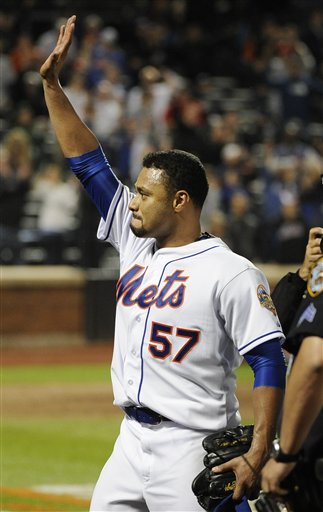
And if that same prognosticator could tell you then, with certainty, that Johan Santana would get left off the All-Star Team despite being worth more this season than every pitcher on it except Clayton Kershaw and R.A. Dickey, you’d probably grip him in a massive bear hug right there, and maybe dance a little in awestruck giddiness. After all, you’ve just met some sort of soothsayer, and he brings very, very good news.

Of course, it’s not March. It’s July and you already know that Dickey and Santana are having fantastic years and that Wright has had just about the best half-season of his career. So if you’re mad that Santana and Wright did not get the recognition they deserved, and if you’ll be mad if and when Dickey isn’t named the game’s starter, that’s understandable.

But isn’t it great to feel feelings again?

The All-Star Game, in its current incarnation, is stupid. Someday, long after the rules have changed and once the breadth of the stupidity has set in, we will look back on this and smack our heads and wonder how in hell it happened. Fans vote to choose the All-Star starters, but then the All-Star Game counts for something. It doesn’t count for that much, mind you, and it’s not like the way World Series home-field advantage was determined before This Time It Counts was any less arbitrary. It’s just… why?

Not-stupid things include the 2012 Mets, no matter how they looked last night. The 2012 Mets are still in the thick of playoff contention here on the first of July. The 2012 Mets have overcome their own awful defense and miserable bullpen to outscore their opponents by 22 runs, playing — for the most part — decent and exciting baseball with a strong flair for the dramatic.

They have won despite the early loss of Mike Pelfrey and with his spot in their rotation occupied for much of the year by guys who make us miss Mike Pelfrey. They have won despite prolonged slumps from Daniel Murphy and Ike Davis, guys expected to be among their best hitters. They have won despite injuries to just about everyone they’ve used at shortstop, and they have won despite underwhelming production from Josh Thole, Lucas Duda, Andres Torres and, whenever he’s been healthy, Jason Bay.

The Mets have won because Wright has carried their offense for half a season. Check this out: The Mets have a .722 OPS on the year, right around the middle of the pack in the National League. Take out Wright’s production, though, and by my math it drops to .690, above only the Padres, Cubs, Pirates and the suddenly miserable Dodgers. Replace Wright with the median third baseman and the number ticks up slightly, but not by much. Wright is the difference between a decent offense and a crappy one.

And the Mets have won because their starting rotation is good. Dillon Gee has pitched better and deeper into games. Jon Niese appears to be making good on his solid peripherals. And Dickey and Santana have been wonderful. Literally wonderful. Dickey is doing things with a knuckleball that no one ever has, and Santana is pitching like Johan Santana after a surgery that ruins lesser careers. The Mets have two pitchers that inspire wonder.

It is all enough to add up to a 43-37 start for these Mets, and the hope that with a little more offense from Davis, Murphy and Duda in the second half and any sort of improvement in the bullpen, they might even actually… man, I don’t even want to say it. Hope! Legit hope.

Has it really only been three years?

I can’t speak for you. But I can identify the watershed moment for me when my desperate Mets-fan optimism awoke from its long slumber and shook out the cramps prompted by three unfortunate seasons bookended by frustrating offseasons. It’s Mike Baxter slamming into the wall to save Santana’s no-hitter a month ago yesterday. Baxter crashes against the wall and nowhere in my conscious mind exists any concern about the team’s financial future or ticket sales or crummy defense. He hangs on to the ball and I could care less about the latest stupid fire-sale column or who said what on Twitter.

And I know a no-hitter is just one game, and they’re frivolities decided in large part by luck, and that Baxter, in giving himself up in the midst of a strong season, might have cost the Mets more than he provided. It’s not a rational thing. It’s that brief, unencumbered, wrenched-stomach feeling — nerves and joy — of thinking that you’re watching something special, that you’ve got some small part in something awesome. And even knowing that baseball is entertainment and its outcomes are, in truth, more or less meaningless, you feel Citi Field rumble with excitement for maybe the first time ever and realize that you’re hardly alone.

I want that again now. Again and again. And maybe I’m blinded by that hope, but now I can look up and down the Mets’ roster, and without even squinting or straining or rationalizing I can consider the several ways in which they might produce the greatest and longest-lasting version of that satisfaction, no matter what anyone says.

Which is to say: Screw the haters. Love the Mets.

Twitter Q&A: The randos

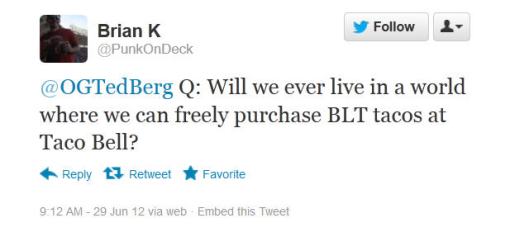
It depends. Many people believe there’s a utopian afterlife in store for us after our earthly existence, in which case, presumably, there will be infinite BLT tacos available. But some people believe those who do not lead virtuous lives are doomed to an afterlife spent in a torturous netherworld where there are likely no Taco Bells whatsoever.

I’ve never been dead, so I can’t confirm or deny the existence of an afterlife with BLT Tacos. And it is not my place to speculate. On this plane, the best method I can think of for returning the BLT Taco and the entire Sizzlin’ Bacon Menu to Taco Bell menuboards is to bombard your local congressional representative with letters and emails. Show ’em this:

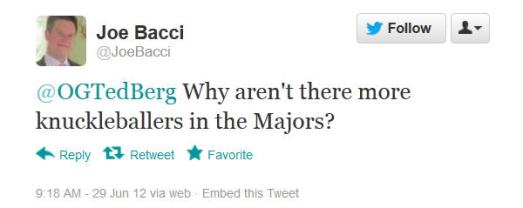
That’s a good question. I suspect it’s a combination of factors, including — from most to least accessible:

1) It’s really hard. I watched Rob Johnson and Lucas May throw knuckleballs to each other while warming up in Buffalo on Tuesday. They both actually broke off a couple of pretty good ones among a plethora of wild and/or spinning ones. To succeed as a knuckleballer, you need to be able to control it well enough to get it over the plate at least half the time (ideally more), and you have an extremely narrow margin for error. If your knuckleball spins just a little bit, you just threw a straight, slow pitch to a Major League hitter, and he’s going to crush it. Patrick Flood covered this a couple weeks ago.

2) It’s stigmatized. Baseball is full of silly unwritten rules oft followed and enforced by players purporting to be acting to maintain the game’s integrity and old-school-ness. Stealing signs while you’re on second base is clearly a smart strategy that can give your team a competitive advantage, but if you are caught or suspected of doing so you will likely be drilled with a baseball. It’s silly, especially since every catcher takes measures to obscure the signs when there’s a runner on second.

And I think it’s that same nonsensical mentality that leads some players and ex-player analysts to dismiss the pitch (and those who endeavor it) as a gimmick, or worse, as something almost cowardly. Meanwhile, it takes a hell of a lot of guts to become a Major League knuckleballer, what with how hard it is to do and how much faith you need to have in the knuckleball actually behaving like a knuckleball once you release it.

3) This one’s a bit harder to grasp, but I wonder if the scarcity of knuckleballers contributes to their success. Presumably if every team had a knuckleballer, hitters would get a better sense of how to approach the pitch. But then knuckleballers have been scarce for a while, and if it were true that hitters’ exposure to more knuckleballers made all knuckleballers less effective, it seems like the number of knuckleballers in the league would be more cyclical. Plus the 1945 Senators had four knuckleballers on the same staff and they did alright. So forget this one.

I’m guessing it’s mostly that it’s really hard. Not that hard to throw one good knuckleball, but really hard to throw something like 99% good knuckleballs.

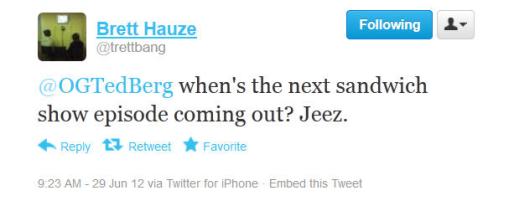
Someday soon I hope. I can’t stop thinking about the sandwich and I’m looking forward to reliving the glory that was eating that sandwich.


Twitter Q&A: Mets stuff

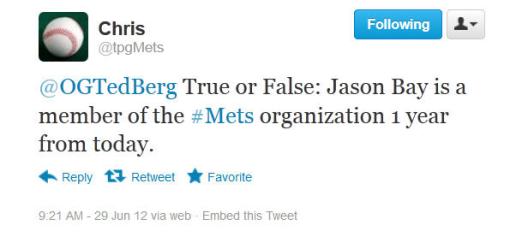
I’m going to guess false. Bay has a couple of things working to his advantage, assuming staying on the Mets is an advantage: His contract and his handedness.

Bay is owed $19 million after this season. In Oliver Perez and Luis Castillo, Sandy Alderson showed a willingness to part ways with highly priced veterans who didn’t appear apt to help the club. But if Bay can’t turn it around in 2012 and doesn’t look likely to help the Mets in 2013, it shouldn’t matter how much he’s owed. It might be tough for the club to stomach swallowing that much sunk cost, but if they can find a guy at or slightly above the league minimum they think can outproduce Bay — which doesn’t seem unreasonable — then, you know, peace out.

Bay does hit right-handed, which is valuable to the Mets because of their glut of lefty-hitting outfielders. With Lucas Duda, Kirk Nieuwenhuis and Mike Baxter in the fold and Matt den Dekker coming up the pike, Bay could balance out the mix a little. Again, though, it doesn’t seem crazy to imagine the Mets finding a righty-hitting outfielder that can outproduce Bay against lefties on the cheap. Scott Hairston, for example.

The Mets will and should give Bay every chance to make good on his contract. Since it hasn’t happened yet, and with the injuries piling up, it doesn’t seem likely to happen. And this front office doesn’t seem prone to carrying players that can’t pull their weight just because they’re paying them. I’d guess Bay comes to Spring Training, we read a couple stories about how he’s in the best shape of his life, and the Mets keep him around while the roster picture clears up. If no one gets hurt and he isn’t 2009 (or even 2010) Jason Bay again, they cut him loose late or send him packing in a Gary Matthews Jr.-style deal, provided he’s willing to waive his no-trade clause.

But trying to predict things in baseball is often a fool’s errand.

There were a bunch of questions similar to this one. As Rob suggests, the Mets should be reluctant to trade prospects for bullpen help. Trading for relievers at the deadline is generally a really bad way to get good value for your young players. And that seems especially likely this season, with more teams in the Wild Card hunt and the price of rental players (presumably) inflated. Flags fly forever and prospects are no safe bet to pan out, so if there was some way the Mets could guarantee that trading a prospect would net them a World Series win, it’d be worth it. Since there isn’t, hanging on to the young guys seems like the best way to win a championship. It doesn’t help or hurt the team’s chances this year, and it doesn’t hinder them for years to come either.

That said: The Mets could use some bullpen help. I suspect their biggest help will come from regression to the mean — bullpen performances are fickle and exist only in small sample sizes, and Frank Francisco, Ramon Ramirez and Jon Rauch are all probably better than they have been this year.

An extra quality arm would sure be nice, though. Justin Hampson earned the first crack at being the second lefty in the bullpen. If he can’t cut it, maybe Edgin will get a look. The Triple-A relievers that appear most likely to help the 2012 Mets’ bullpen are a couple of familiar ones, though: Manny Acosta and Pedro Beato.

Acosta has been lights-out in a small sample since returning to the Bisons, posting a 1.32 ERA with 15 strikeouts and no walks in 13 2/3 innings. He was almost unfathomably bad in the early part of the year with the Mets, but pretty good for the big club in 2010 and 2011. If whatever was wrong is better now, Acosta could again provide some quality innings out of the bullpen down the stretch. The ERA will be ugly all year.

Beato has also pitched well in Buffalo, striking out 16 and walking eight (three of them intentionally) while yielding a 1.35 ERA in 20 innings. He’s throwing in the low-to-mid-90s again and says he feels fully healthy after shoulder soreness sidelined him for the early part of the season.

Mejia to the Bullpen version 2.0 looks like it’s somehow going even worse than it did the first time around. Maybe something clicks for him and he figures out how to throw strikes in a relief role, but right now he doesn’t look anywhere near ready to help the big club there.

My first instinct was to assume confirmation bias, but I went to the gamelog. The Mets are 6-12 in their first games after traveling this year and have been outscored 106-82 in them.

But 18 games, you know, is a small sample size. And I don’t think it’s enough to rule out randomness. One of those rough losses came with Chris Schwinden on the mound in Colorado and another was Johan Santana’s oddly scheduled return after the no-hitter. It’s something worth keeping an eye on, I suppose, but it’s too soon to rule out noise. The Mets have, at times, played some pretty bad baseball in the middle of homestands and at the end of road trips too. And they’ve had some pretty strong games the first day after traveling that get swept under the rug a bit when we’re trying to identify a trend.

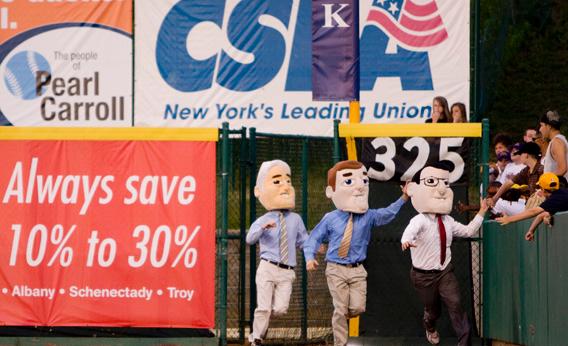
From the Wikipedia: Theodore Roosevelt

The Wikipedia page for Theodore Roosevelt is far too long to thoroughly recap in this space, especially while I’m here in Buffalo and out of my normal routine. Plus it contains lots of politics, obviously, and I don’t want to open the door for a comments-section Ron Paul flame-war. So these are bits and pieces of Roosevelt’s Wikipedia page that seem worth highlighting.

From the Wikipedia: Theodore Roosevelt.

Theodore Roosevelt was the 26th President of the United States of America. He held the office from 1901-1909, then ran for it again in 1912 (more on that in a bit). He is known, per the Wikipedia, for his “exuberant personality” and “robust masculinity.”

(Is there a better adjective to pair with “masculinity” than “robust?” Vigorous? Potent? Hulking? I’ll take robust. Good work by the Wikipedia there.)

Here are some highlights from Roosevelt’s Wikipedia page:

– Roosevelt was born to a wealthy Manhattan family in 1858. But unlike the uppity pencil-necks the city produces these days, Roosevelt took an early interest in killing and collecting wild animals after obtaining the head of a dead seal from a local market when he was 7. The young Roosevelt learned rudimentary taxidermy and began displaying the animals he had caught, killed, stuffed and studied at what he then called “The Roosevelt Museum of Natural History.” The Wikipedia doesn’t say where exactly this was or how it smelt, or why no one thought it was weird.

– While studying at Harvard, Roosevelt competitively boxed and rowed, edited the school’s literary magazine, and began work on a study of the U.S. Navy’s role in the War of 1812 that is still considered a seminal research work on that war.

– In February, 1884, Roosevelt’s wife and mother died on the same day due to unrelated illnesses. Later that year, he grew frustrated in his political career and moved to a ranch in the Badlands he had purchased on a buffalo-hunting expedition a year earlier. There, he learned to be a cowboy and wrote books about it, and became a deputy sheriff. Three outlaws made the mistake of stealing Roosevelt’s riverboat and escaping with it, so he hunted them down, caught them and stayed awake for 40 straight hours to guard them en route to Dickinson for a fair trial.

– Roosevelt found the name “Teddy” vulgar and called it “an outrageous impertinence.” He preferred to be addressed as “Colonel Roosevelt” or simply “The Colonel.” He achieved that rank during his time with the Rough Riders in the Spanish-American War, during which time, presumably, he developed the military tactic known as “Stop, drop, shut ’em down, open up shop.” That’s how Rough Riders roll.

– After his presidency, Roosevelt went on a safari in Africa with some game-hunting luminaries. They killed or trapped 11,400 animals, including 512 big-game animals. They ate 262 of them.

– During his second campaign for presidential election in 1912, Roosevelt was shot in the chest by a criminally insane New York bartender named John Schrank. Schrank had stalked Roosevelt for three weeks because William McKinley’s ghost came to him in a dream and told him to kill the presidential hopeful. He did not; the bullet went through Roosevelt’s eyeglass case and a folded copy of the 50-page speech he was about to give then lodged in Roosevelt’s chest. Roosevelt knew from his hunting and zoological studies that if he was not coughing blood the bullet had not reached his lung, so he declined suggestions that he go to the hospital and spoke for 90 minutes with blood all over his shirt. The bullet stayed in Roosevelt’s chest for the rest of his life.

– In 1913, Roosevelt — bullet still in chest — was commissioned by the Museum of Natural History to expedition through the Brazilian jungle to bring back uncharted animal specimens and seek the headwaters of the River of Doubt. (Seeking the Headwaters of the River of Doubt, by the way, is almost certainly the title of a forthcoming Sufjan Stevens song.) During the trip, Roosevelt jumped into the river to stop two canoes from crashing and suffered a minor flesh wound. The wound became so infected that Roosevelt grew delirious and at times would endlessly repeat the first line from Samuel Coleridge’s poem “Kubla Khan.” Roosevelt even asked to be left behind so the expedition could continue on schedule, but his son Kermit convinced him to remain with the group. He made it home, and after his return the River of Doubt was renamed Rio Roosevelt.

– Roosevelt said a lot of things that were implicitly or explicitly racist and endorsed the forced sterilization of criminals and “the feeble-minded.”

– During his presidency, Roosevelt liked to skinny-dip in the Potomac River in the Winter.