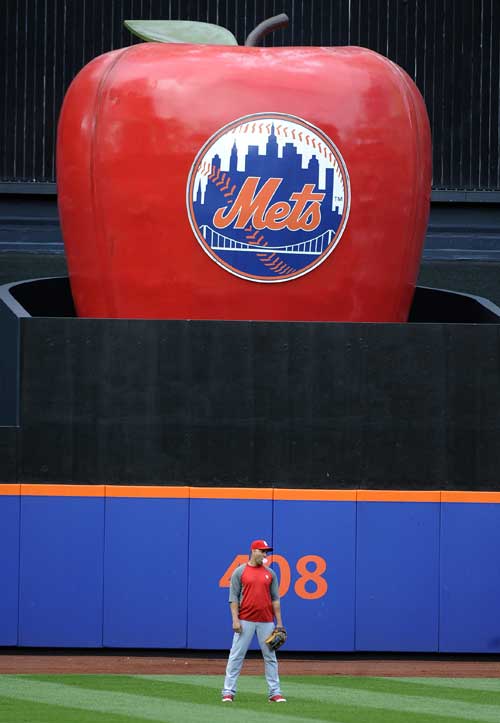
This

If we take away Santana’s no hitter, or even qualify it, we’d have to similarly invalidate or downgrade pretty much everything that has ever happened in the history of baseball. The record books would contain nothing but asterisks.

Matthew Callan, Amazin’ Avenue.com.

This. Qualifications of Santana’s no-hitter are so blisteringly stupid that they probably don’t deserve a response as thorough and considered as Callan’s. It happened. Johan Santana pitched a full nine-inning game and allowed zero hits. That’s a no-hitter. OK bye.

Santana and Dickey and arbitrary endpoints

Since Johan Santana’s underwhelming start against the Pirates on May 21, Santana and R.A. Dickey have combined to throw 41 1/3 innings in five starts and have allowed one earned run over that time, good for a 0.22 ERA. They have struck out 45 batters and walked five, allowing 19 hits over the stretch.

Oh, also the Mets are currently tied for first place, despite the injuries and the LOLMets.


That just happened

Johan Santana threw a no-hitter tonight. It was the Mets’ first in 8,020 games since they started playing in 1962. And it was awesome.
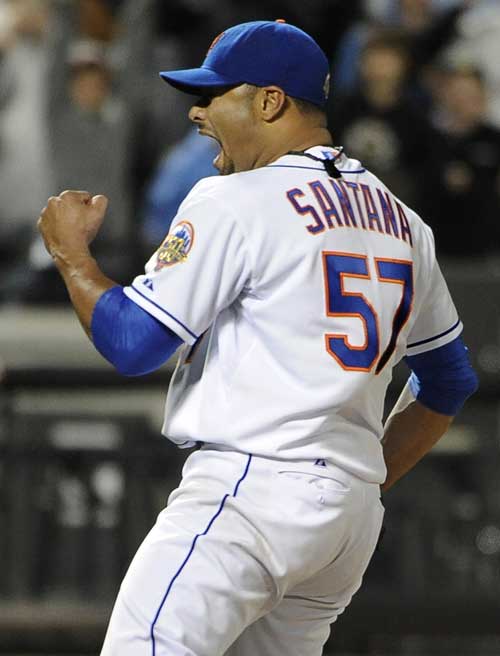
This is a time when I should try to string together coherent thoughts, but my Mets-fan excitement is making it difficult. So here are some incoherent thoughts:

– With one out in the ninth inning, I ditched the press box for a standing spot in the Excelsior level behind home plate. It was — obviously — the first truly great moment I’ve seen at Citi Field. The crowd produced a shrill, steady whoop throughout the frame, swelling to a roar when Santana notched the second strike on David Freese’s foul ball.

Maybe this is embarrassing to admit, but I was trembling. I’m not entirely sure if it was from excitement, caffeine or the cold, but I stood there shaking in my shoes as Santana chased the Mets’ first no-hitter. Sure, it’s one game, and no-hitters are frivolities in some way, and I know it’s not actually as important as a team clinching the pennant or — imagine — winning the World Series. But then it’s baseball. Who’s to say what about it is important and what isn’t when it’s inherently unimportant?

I’ve been a Mets fan since 1987, conscious of the possibility (and unlikelihood) of their first no-hitter until the opponents’ first hit in every single Mets game I’ve watched in my entire life. The pining long predates my understanding of batting average on balls in play and baseball’s pervasive randomness and all that. I honestly don’t know what it’ll be like to watch a Mets game now without this eventuality looming.

I hugged a maintenance guy and high-fived a security guard. I probably shouldn’t have celebrated with my credential on, but whatever. It felt awesome. It actually reminded me of the Grand Slam Single game from 1999 — the way the whole stadium came together: a massive, raucous family reunion.

– Speaking of Mets fans: Mike Baxter. If you somehow missed it, Baxter slammed against the left-field wall full-speed on a running catch in the seventh inning that saved the no-hitter. Baxter said afterward that he would have made the same play if it were a close game that wasn’t a no-hitter, and maybe that’s true. We haven’t seen enough of Baxter to really know.

But I find it difficult to believe that anyone who grew up a Mets fan isn’t standing out in left field thinking the whole damn time about the gravity of the situation. I’m projecting here, but I like the idea that Mets-fan Mike Baxter was going to do absolutely everything he could to preserve Santana’s effort. And he did.

After he crashed into the wall, Baxter crumpled up on the warning track but somehow held onto the ball. When he was finally helped off the field by the Mets’ trainers, the crowd gave him a standing ovation. It was a beautiful moment. Please do your part to make sure Mike Baxter never pays for a beer in New York ever again.

– Terry Collins said before the game that, by his understanding, the most important thing he had to do to keep Santana healthy in his recovery from shoulder surgery was limit the lefty’s pitch counts to about a 115-pitch maximum. Santana threw 134 in this one. Collins choked back tears throughout his post-game press conference and said he’ll feel awful if Santana can’t pitch in five days.

For the sake of accountability, I should mention that I tweeted that it seemed like the best idea to take Santana out after he had thrown 120 or so pitches through 8. Obviously I’m glad that didn’t happen. Also, from the sounds of it, no one but Santana was going to take Santana out of that game. You remember how he feels about coming out of games before he wants to, right? The “I’m a man! I’m a man!” thing?

– Johan Santana is a man.

– Oh, so there were a couple of questionable calls by umpires. A line drive down the third-base line by Carlos Beltran, notably, appeared to hit the line. But guess what? Bad calls, for better or worse, go both ways. The Mets have lost games and seasons on bad calls. That evens out. It worked out in their favor tonight. Also, if this game happened in 1997 before HD TV and the Coors Light Freeze Frame and everything else, they’d have replayed that foul ball a couple of times, everyone would have shrugged, like, “whoa, that was close,” and then we’d never make a whole thing out of it.

– no-hitter no-hitter no-hitter no-hitter!

– R.A. Dickey called Santana “supernatural” after the game. That happens to be the name of the (Carlos) Santana album featuring “Smooth,” the song to which Santana warms up. I have hated this song since it got wildly overplayed immediately after it came out, but while Santana was warming today, I found myself thinking, “Man, (Johan) Santana’s going to make me like this song.” No-hitter!

You’ve won this time, Rob Thomas:

Beltran, exonerated

There are, I’m pretty sure, like three Mets fans left who blame Carlos Beltran for signing a massive contract or for not swinging at Adam Wainwright’s curveball in 2006 or for neglecting the advice of the Mets’ crack medical staff before the 2010 season or for destroying the team’s clubhouse chemistry with his “expected & than” return later that year.

Those people are silly, and because silly people can sometimes be exuberant with their silliness and revel in the attention it brings them, they’re loud with their opinions on Twitter, in comments sections and probably on WFAN if you’ve got the stomach for listening. By now, after Carlos Beltran left Flushing as one of the Mets’ five best position players of all time and gave the team a prized pitching prospect as a parting gift, the haters and blamers get drowned out and shouted down pretty quickly. But then everyone — myself included — harps on their continued existence, as if there aren’t three people in India who think Gandhi totally sucked and three at Microsoft who think Bill Gates was a moron, and so on.

Carlos Beltran sat in the Cardinals’ dugout before Friday night’s game and answered questions from members of the New York and St. Louis media for about 20 minutes. He talked about his time with the Mets, the disappointing finishes of 2006 and 2007, his friends on the team (“I love him,” he said of Johan Santana), his appreciation for Terry Collins, his arrival in St. Louis, everything.

And he talked a lot about Mets fans, mostly because he was asked a lot about Mets fans. When asked why they never embraced him, he suggested it’s because he isn’t very emotional on the field and never wanted to betray himself by acting like something he is not. Stuff you know about, really. And he kept saying, “that’s their choice,” because probably — and hopefully — Carlos Beltran knows enough about baseball to realize that Carlos Beltran is awesome at baseball no matter what anyone says.

And after the third or fourth question about Mets fans and why so many of them don’t really like him (even though I suspect most of them do), he said, “Maybe there were fans here that didn’t treat me how I expected. But there were other fans here who treated me with love.”

The Mets showed a short pre-game video tribute to Beltran. It featured lots of highlights of Carlos Beltran playing baseball, so it was unutterably awesome. Then everyone (in my earshot, at least) who was at the game, paying attention and moved enough to respond in some way cheered the man. Some reported hearing boos. I heard none.

I moved out from the press box to Section 327 of the Excelsior level* before Beltran’s first at-bat. When Beltran was introduced, one guy I could hear booed him loudly and persistently. One guy. Everyone else in the area clapped, some standing as they did. It was a much, much warmer reception than the one Jose Reyes received a month earlier.

Again: When you — we — defend Beltran against his remaining Mets-fan haters, we are likely giving way too much credence to a handful of loud fools and an army of strawmen. And Beltran’s best defense is his great offense, to borrow a football phrase. Every time he steps on a baseball field, Beltran makes the blamers look dumber.

We can spare them our energy now. Carlos Beltran’s got this.

*- Can someone please make t-shirts that say “I’m calling it Loge”?

From the Wikipedia: Tetris Effect

I went to the Internet to look up what it’s called when I go to bed and involuntarily start reliving some activity I tried that day. Does no one else get this? If I go skiing, I fall asleep feeling like I’m skiing. Same for if I’ve been on a boat or on roller coasters or, apparently, hiking along the Grand Canyon. I can’t find a specific name for that phenomenon, which makes me suspect it’s not as common as I figured. It seems to be one of many odd features of hypnagogia, the transitional period between wakefulness and sleep.

But the search led me to this. From the Wikipedia: Tetris Effect.

The Tetris Effect refers to when people spend so much time on an activity — like, say, a particularly addictive video game — that it begins to dominate their thoughts, mental images and dreams.

One of the first published references to the term came in 1996, or, as it was better known to Tetris-effect sufferers, . Australian researched Garth Kidd called it, “a tendency to identify everything in the world as being made of four squares and attempt to determine ‘where it fits in.'” In an article for Philadelphia’s CityPaper that same year, Annette Earling described:

Raised pulse rate, tightened stomach muscles, strange dreams, and the squares… ohhh, the falling squares. I saw them everywhere, and when I didn’t see them in skylines or grocery aisles, I had only to close my eyes and there they were behind my eyelids, falling faster and faster as I furiously rotated them mentally.

According to the Wikipedia, the Tetris Effect is not limited to Tetris. Computer programmers pouring over code, rowers and mathematicians have reported comparable experiences — and lord knows the combination of copy-editing, basic html and bizarre hours required by my job on the ol’ WCSN.com prompted some similar strangeness.

The Tetris Effect as specific to Tetris is now known by the term Game Transfer Phenomenon, which is basically exactly what it sounds like. If you ever play a car-racing game for a while then drive a real car, you’re probably familiar.

But the Tetris Effect, as specific to Tetris, has some beneficial effects too. This is perhaps predictable: A 1994 study showed that people who played 12 30-minute sessions of Tetris improved against a control group in spatial skills, specifically mental rotation, spatial perception and spatial visualization.

Also the Tetris skills seem to develop in the unconscious, procedural memory, as opposed to the declarative memory where facts and knowledge reside. A research paper in 2000 “showed that people with anterograde amnesia, unable to form new declarative memories, reported dreaming of falling shapes after playing Tetris during the day, despite not being able to remember playing the game at all.”

And — and here’s where it gets really weird — a 2009 study suggested that playing Tetris immediately after traumatic events can help prevent traumatic memories. The focus on the Tetris shapes prevents people from replaying the trauma in their mind, in turn “decreasing the accuracy, intensity, and frequency of traumatic reminders.”

So if you ever see something really messed-up happen that you think might haunt you forever, grab your nearest Gameboy, I guess.

The Tetris Effect should not be confused with the similarly named but entirely different phenomenon called “L’effet Tetris,” which is French for The Tetris Effect.

#PraiseBeltran

Carlos Beltran returns to Citi Field tonight for the first time since the Mets traded him last July. Here’s what I wrote about the man then.

Now, Beltran’s leading the National League in home runs. He has a .988 OPS, which would make for the best season of his career. And anyone chalking up any of this to the change of scenery obviously was not watching the Mets from April to July last year.

Carlos Beltran is awesome. That you probably know. More, inevitably, to follow.