Shared partly so my wife sees it because she loves this stuff, but also because it’s just incredibly cool. The money quote: “Johan is not a normal human.” – Dr. David Altchek.
Inside look at Johan Santana’s surgery
Reply

Shared partly so my wife sees it because she loves this stuff, but also because it’s just incredibly cool. The money quote: “Johan is not a normal human.” – Dr. David Altchek.
Acquired and devoured at the Shake Shack location on 86th and Lexington last night:
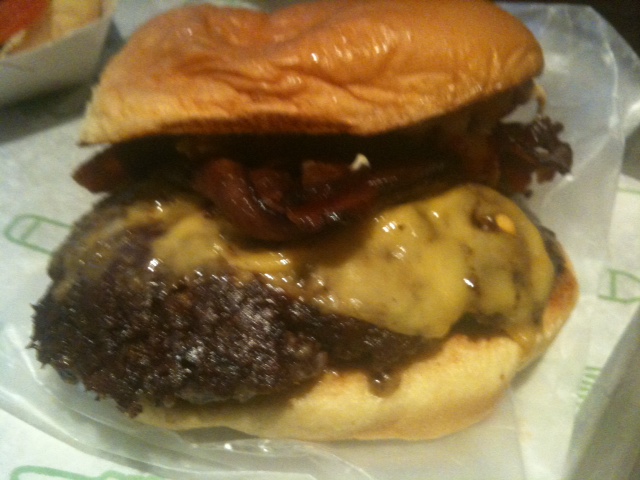
That’s the Smoke Shack, a burger with bacon, cherry-pepper relish and the familiar Shack Sauce.
It’s delicious, no doubt, and you’re never going to hear me say there’s anything in the world that shouldn’t be baconed. But the entire experience confirmed my suspicion that bacon is not really necessary on the Shake Shack burger. The bacon was bacon — though it was a little thick to be perfectly crispy like a great burger-bacon, to be honest — and added delicious bacon flavor. But the best innovation here, I thought, was the cherry-pepper relish, which added a spicy kick that went well with the sweet, creamy Shack sauce.
Straight up, if I ate a Shackburger every night for dinner and then one day I saw this on the menu I’d be all, “oh sweet lord, a change-up!” and order it. But as long as I’m doing everything I can to resist eating a Shackburger every night for dinner, I don’t really need that taco Doritoed, if you know what I’m saying.
Like plenty of hitters around baseball, Ike Davis took an ofer today, striking out twice, flying out and grounding into a double play in the Mets’ 1-0 win over the Braves. I noticed it seemed like Atlanta was feeding him a steady diet of offspeed stuff, so I went to MLB.com’s gameday for closer inspection.
 Davis saw 11 pitches from starter Tommy Hanson. Hanson, who might be related to the band Hanson, threw the Mets’ first baseman one fastball, two sliders, and eight curveballs.
Right-handed reliever Kris Medlen threw Davis a changeup and two curveballs. Lefty Jonny Venters threw Davis two sinkers and three sliders.
After the game, I asked Davis if he knew how many fastballs he saw.
“One,” he said. “Except from the lefty.”
I asked if that was typical.
“That’s the Braves,” he said. “Well, that’s Hanson.”
Davis said he has never hit Hanson well and suggested I look up his career numbers against him. It’s obviously a tiny sample, but Davis is now 2-for-12 with two walks and six strikeouts in his career against Hanson. And the two hits are described as “Pop Fly to Short LF-CF” and “Ground Ball thru 2B-1B” on the baseball-reference play index.
“Most guys don’t have curveballs as sharp as Tommy’s,” Davis said, adding that if he saw as many lesser curveballs, “I’ll hit ’em.”
So, you know, crisis averted.
And to Davis’ credit, Fangraphs’ pitch-type values (and watching the games) confirm that Tommy Hanson throws a very effective curveball and that Davis doesn’t consistently have trouble with curveballs. Plus, it’s probably worth noting that Davis sees about as few fastballs as anyone in the league, so a day full of offspeed offerings is probably nothing new to him.
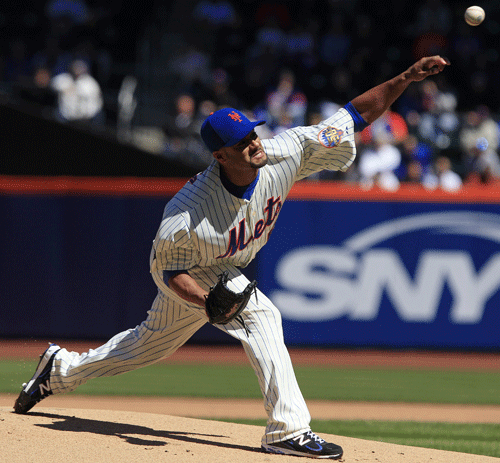
84 pitches, 50 strikes. Not much else to say. It’s a beautiful thing.
The Daily News presents a slideshow of the 15 craziest stadium foods, and most of the ones that aren’t testicles look pretty delicious. I’m especially intrigued by this one from Progressive Field in Cleveland, a chicken and waffles sandwich:

This post has a shelf life of roughly 80 minutes, so don’t sleep on it.
 The Mets’ offseason, more than any other in my twentysomething years of Mets-fan consciousness, was blanketed by an awful shroud of nonsense and negativity. There’s not much need to belabor any of it here: The Wilpons’ looming financial lawsuit and eventual settlement, the bankruptcy rumors, the big-name free-agent departures, the silly helicopter thing, the various illness and injury diagnoses and alleged misdiagnoses, everything. Not all of it — maybe not much of it — actually affects what happens between the foul lines starting in about 80 minutes and ending, in all likelihood, in the early evening on October 3rd in Miami.
Some of it will impact the season’s outcome and our perception of it, no doubt. Maybe if we knew the Mets had more money to throw around this offseason, we could know for certain that Jose Reyes is gone because the team’s front office felt he was a bad bet at six years and $110 million. Or, better, maybe we could be admitting now that the Mets probably overpaid Reyes, and resigned to deal with that in 2015 when it becomes a problem and enjoy his triples while they last.
And maybe under some different set of circumstances, we could predict a better than .500 finish for these Mets and not sound like some pathetically optimistic carp fighting the current. Or we could talk about how the lineup looks primed to score a lot of runs without qualifying it with something about how the defense and pitching staff will probably yield just as many.
But that’s offseason stuff. That’s the stuff of boardrooms and conference centers and courthouses and a woebegone Grapefruit League schedule on Florida’s Treasure Coast.
Now they play baseball. Real, meaningful, baseball.
And every damn ballgame is a miracle. I don’t even mean in the big-picture sense, the microcosm-for-the-world and life-lesson stuff I like to extrapolate and run with here when things get heavy. I mean the actual baseball part: Curveballs biting through the strike zone just as they cross the plate, the exquisite timing and choreography of a 4-6-3 double play, home runs so far gone the outfielder doesn’t even bother giving chase, the need for and enforcement of the infield fly rule, diving catches, frozen ropes, stolen bases, wild pitches. Every game is a weird, awesome juxtaposition of chaos and order, randomness and design. It’s amazing.
Maybe that’s not enough for you, and I get that. Well, no. I don’t get that, but I understand that there are plenty of people in this world less committed to this than I am, people who don’t spend long hours watching and thinking about and talking about and writing about baseball, enjoying every minute of it, who don’t then spend their off-days playing baseball and their vacations watching baseball elsewhere. And maybe for the Mets fans among them, given all the negativity that has been swirling around this franchise, it’s not hard to look elsewhere for entertainment options, to boycott the games at the park and on TV and finally catch up on Justified.
Not me though. I’d rather boycott the negativity and catch up on the baseball. For today at the very least.
Which is to say: Play ball.
Baseball!
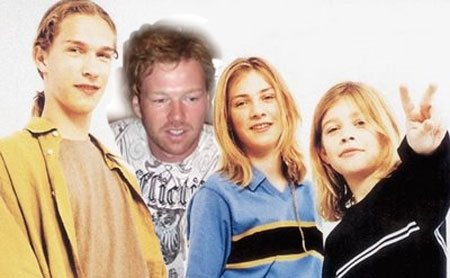
More on that to follow, but I had some subway issues on the way here and the Mets clubhouse is about to open so I have to get going. For now, please enjoy this friendly reminder and photographic evidence that Tulsa-born Braves starter Tommy Hanson may be first cousins with the band Hanson:
The relief pitchers in April: Frank Francisco, Ramon Ramirez, Jon Rauch, Bobby Parnell, Tim Byrdak, Manny Acosta, Miguel Batista.
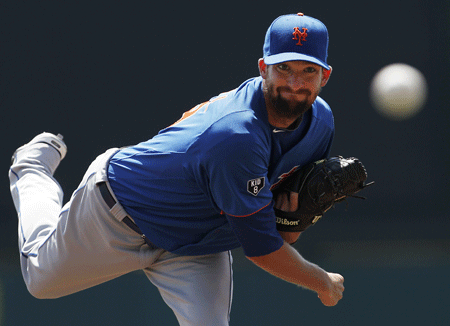 Overview: Before I started this I was looking over the bullpen previews from this year and 2010 and I came upon this bit:
And then there’s the Jenrry Mejia thing. I’ve said my thing on that thing. I refer you to this, this, this, this, and this. I’m kind of sick of shrouding the kid in negativity because he’s a homegrown prospect and I root for homegrown prospects, and now I’ll be rooting like hell for him to dominate in his bullpen role.
The funny thing is, so many people act — and I’m certainly guilty of this myself — as if it’s sort of written in stone that he will. There’s no arguing that he looked great in the Grapefruit League, but 17 innings of Spring Training ball and a rousing endorsement from Jerry Manuel do not necessarily portend Major League success. Big-league hitters — not to mention big-league scouts — are really, really good, recall, and I wonder if Mejia might start looking more like the guy who posted a 4.47 ERA in Double-A last year after the league has seen him a few times.
And then I wonder, of course, if that could ultimately be a ticket back to Binghamton for Mejia, and so a blessing in disguise. And that sucks. This has got to be one of the weirdest fanbase/management divides of all time. I don’t think I’ve ever heard of any team’s fans putting up a more or less unified front urging patience and restraint against a front-office that seems to want no part of it. That’s why you never want your GM making decisions from the hot seat, I guess.
Remember that?
I’ve been thinking about the Mets’ offseason bullpen acquisitions the last few days and trying to decide if I’m justifying them because I have it in my head that Sandy Alderson and the SABRos know what they’re doing. I’ve always held that teams shouldn’t spend offseason assets on relievers and that good bullpens could be cobbled together on the cheap, but the Mets’ front office went out and signed Jon Rauch and Frank Francisco and traded for Ramon Ramirez.
I’ve argued — publicly and privately — that there’s obviously some plan in mind, like maybe the Mets hope to spin a couple of the relievers for young players at the trade deadline (when relievers are often overvalued), or they determined that the easiest way to add wins inexpensively is via bullpen arms. And both of those things could be the case. But I could just as easily be rationalizing.
I’ll say these things: It doesn’t seem like there’s an obvious place the Mets could have allocated the resources they spent on Francisco, Rauch and Ramirez that would have likely added more wins without impeding the progress of a young, team-controlled player, and bringing in two free-agent relief arms and trading for another is a much, much, much, much, much, much, much, much, much better way to go about building your bullpen than making your 20-year-old top prospect your 8th-inning guy. Much.
So there’s that. Plus, it’s not like the Mets spent a lot on the guys they brought in or overpaid for nebulous Kevin Gregg closer labels. Francisco and Ramirez have always been good, and Rauch has more often been good than not good. Manny Acosta, quietly, has a career 119 ERA+ in five partial seasons of work. Byrdak will get lefties out, and Bautista — peripherals be damned — always winds up with pretty solid results and should be a good fit for the long man/spot starter role.
Parnell’s sort of a wild card. He drew raves in Spring Training with his enhanced repertoire and 12 1/3 scoreless innings, but that’s sort of textbook Spring Training trap stuff. Thing is, there’s always been plenty to like about Parnell. Most notably: He throws really hard, he yields a lot of groundballs, and over the last two years his strikeout to walk ratio is just shy of 3:1.
If and when Parnell ascends into a higher-leverage role, you’ll read all about his past failures in similar situations. Believe what you want, but I’d be skeptical. There’s plenty of pressure in the sixth inning of a Major League game, for one thing. For another — and I’ve made this case before — every time Parnell has been promoted, it has come on the heels of a long stretch of effectiveness by the righty. So generally, he has been pitching those high-leverage innings only after periods of heavy use.
On paper it’s a fine enough looking bullpen. Many of them are around this time of year. Once they start actually pitching, we see how the dice turn up.
The relief pitchers in September: C’mon now. Ahh, Francisco, Parnell and five other guys, some of whom are listed above.
Overview: The Braves’ bullpen was awesome last year. The Phillies and Marlins added big-name free-agent closers and the Nationals brought on Brad Lidge and returned the awesome Tyler Clippard. But obviously there’s a ton of randomness in play, enough that I can again safely guess the Mets’ crew will fall somewhere near the middle and hope this year is the one I’m right.
I’m short on time and new ways to say that I’m not sure Jason Bay will ever hit again, so I’m collapsing these three into one. Plus they’re all connected anyway.
 The outfielders in April: Jason Bay, Andres Torres, Lucas Duda, Scott Hairston and Mike Baxter.
Overview: How much longer can this go for Jason Bay? How many more questions will be asked, films watched, stances adjusted, words written, sliders on the outside part of the plate missed, jeers dispensed, grounders topped to third, and nice-guy caveats applied before something finally happens?
Bay has been on the Mets for two years, two of the three worst of his career. He has 18 home runs in 792 at-bats and a .386 slugging percentage. He doesn’t get on base like he used to, either. We’re past the randomness/adjusting to a new league/he’ll return to his mean part of it now. Something has clearly gone awry. This you probably know.
What we don’t know — as with David Wright — is how much of Bay’s struggles had to do with Citi Field’s dimensions and the adjustments he made to attempt to hit home runs there, with lingering injuries and the after-effects of the concussion that ultimately ended Bay’s 2010 campaign. What we can figure is that if Bay keeps producing (or not producing) at this rate, on a rebuilding team and with a vesting 2014 option on his contract based in part on 2012 plate appearances*, the Mets probably won’t keep him in the lineup if they’ve got any more enticing internal options.
The team’s top priority, still, should be getting Bay straightened out if that’s at all possible. For one thing, Bay still has way more immediate offensive upside than anyone the Mets have to replace him. If by some odd chance whatever happened to Bay was just the psychological and physical affects of the fences, and now with the offseason’s changes Bay goes back to being the 2009 Jason Bay on a normal decline, he’s one of the best hitters on the team and the Mets offense suddenly looks awesome.
Plus, if Bay starts hitting even a little bit, it should be way easier for the Mets to move his contract. Bay’s got a full no-trade clause, but though I’m not in his head, it’s hard to imagine he’s been so fond of his time in New York that he wouldn’t be willing to waive it for a chance to join a contender that wants a righty bat near the deadline. Even if Bay crushes the ball in the first half the Mets would probably have to eat some of his contract to move him, though.
If both Bay and prospect Kirk Nieuwenhuis open the year hitting like they did in 2011 at their respective levels, expect some sort of shakeup by the All-Star Break.
As for the rest: Andres Torres looks to be sweet on defense. He didn’t hit much last year, but he’ll be batting leadoff for the Mets because center field is one of Major League Baseball’s approved leadoff-hitter positions.
Torres’ batting average and batting average in balls in play in 2011 were well below his usual Major and Minor League rates, which suggests some bad luck. But he also hit for way less power than he did in 2010 and his short Major League stint in 2009, which suggests something worse than bad luck. If Torres can split the difference and post a line like the .249/.331/.419 aggregate of his last two seasons, he still won’t be much of a leadoff hitter but he’ll be about an average offensive center fielder for the NL.
Lucas Duda will hit. Something apparently flicked on for The Dude right around the same time it flicked off for Jason Bay: After hitting 24 home runs total in his first three Minor League seasons, Duda hit 27 of them across three levels in 2010, finishing his season with the Major League Mets. After an April cameo with the big club in 2011, Duda picked it back up in Buffalo. He joined the Major League club for good in early June and hit .306/.381/.505 the rest of the way.
Duda’s defense in right field was way less awesome, though he was playing an unfamiliar position in an oddly configured park. Now he’s more familiar with the position and the park less oddly configured, so maybe that helps. Maybe it doesn’t and the Mets move him to left if and when the Bay/Nieuwenhuis thing all goes down. It doesn’t seem like there’s a way his defense will be bad enough to keep his bat out of the lineup regardless.
Baxter and Hairston both seem fit for their roles.
The outfielders in September: Duda, Torres, Nieuwenhuis, Bay, Baxter. I’m making traids all over the place and figuring someone will want Scott Hairston’s right-handed bat and affordable contract either at the deadline or in the waiver-trade period, and the Mets’ logjam of righties on the bench will force the deal.
Overview: I’d put the Mets’ outfield better than the Nationals’ if Jayson Werth doesn’t get right quick, but worse than the rest of the division. Lots of mitigating factors involved there though.
All I kept hearing in the streets of New York when you go get bagels in the morning was, ‘Omar, please address the bullpen.’ Well, to all you Mets fans, we’ve addressed the bullpen.
We have to withstand the urge to make short-term decisions just to appease people, because we know it will just do more damage in the long run.
 Tedquarters