
The end of a long, strange Wikipedia journey.
 From the Wikipedia: Piggy Bank.
I assume everyone here knows what a piggy bank is so I’m not going to bog you down with too many details: It’s a pig-shaped receptacle for storing money. Some people collect them, because some people will collect just about anything.
What I didn’t know until I checked the Wikipedia was that the piggy bank is apparently meant to be a pedagogical tool. That’s why, with traditional piggy banks, you can’t ever take money out until you smash them because you’re ready to take all the money out. Piggy banks with rubber stoppers on the bottom so you can open them are newfangled b.s.
So what lesson are we trying to teach our children with piggy banks? A massively important one: Scrimp and save to slowly compile a sizable nest egg, then blow it all in one fell swoop. Literally break the bank, children.
Also, maybe there’s some lesson in there about how it’s wise to tie up your fortune in hog futures. I think back in the day swineherds had something to do with fostering the popularity of the piggy bank.
Oh, and whose bright idea was it to start storing coins in pigs? Someone who mistranslated something. According to the Wikipedia, in Middle English the term “pygg” referred to a type of clay used to make kitchen pots and jars, some of which were used to store change, or pieces of eight, or whatever the hell they called coins when people spoke Middle English.
At some point along the line, someone thought “pygg jar” meant “pig jar” and they started making jars shaped like pigs, and I guess, I don’t know, one thing led to another and we ended up with piggy banks. Sounds like a pretty stupid story, to be honest.
What’s bizarre is that Indonesian people, totally unrelated to the Middle English translation mishap, stored their money in terracotta likenesses of wild boars as far back as the 15th century A.D.
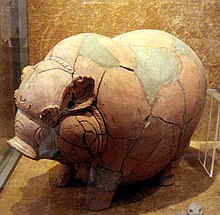 Wild Boary Banks, of course, are the far more badass cousins of the Piggy Bank, but I’m honesty skeptical that Indonesian people and English people both decided to start stuffing coins in clay swine without somehow consulting one another at some point along the way.
I mean, there’s just not enough about a pig or a wild boar that says, “make a statue of me and stick money in it” that would entice two cultures half a world apart to independently start doing so.
I don’t mean to doubt the Wikipedia, but though there’s a picture of something that looks a hell of a lot like an Indonesian Wild Boar Bank from the 15th century, there’s no real citation for the fact, it could just be a small, clay wild boar statue, and furthermore, I mean, c’mon.
 Tedquarters
I see what you did here: a brilliant critique of the Wilpon regime! They need a kick in the coin slot is what you’re saying.
Just as aliens gave both the Egyptians and the Aztecs pyramid-shaped spaceships, so too did they disseminate pig-shaped banks across the world.