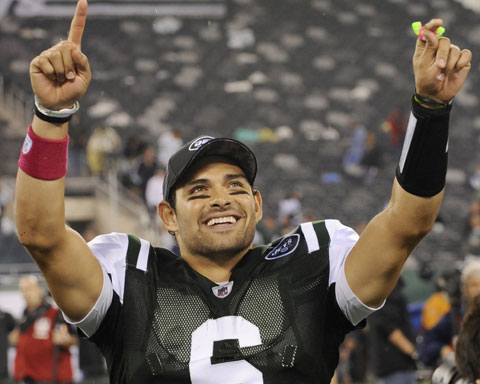
I guess you can probably tell I’m happy about the outcome of last night’s Jets game. There’s not much to say, I think, except that the Jets probably should have won by a lot more — it was a bit frustrating that the Vikings held them to field goals on so many drives.
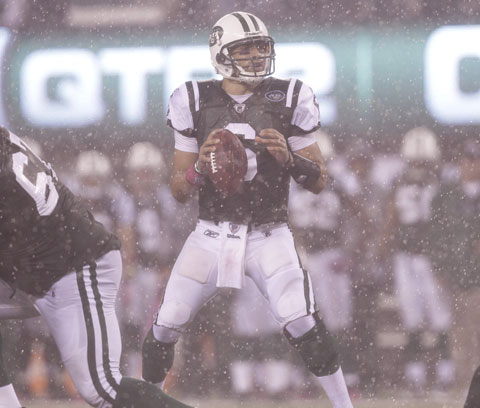
Mark Sanchez, for all his handsomeness and Taco Bell appreciation, did not play his best game. It seemed like he was having some understandable trouble with the wet ball at points, and it was a little baffling why Brian Schottenheimer kept calling pass plays down near the goal line in the torrential downpour.
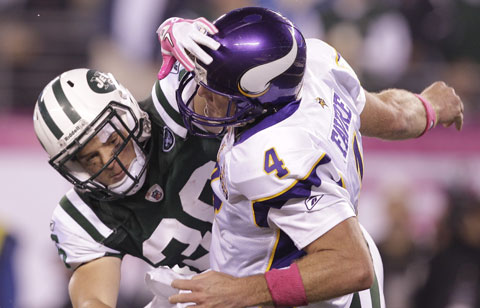
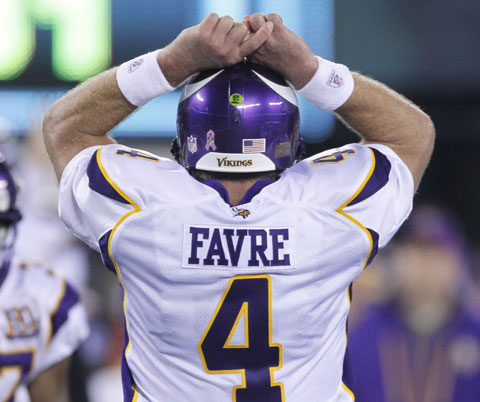
Still, Sanchez didn’t turn the ball over, which is way, way better than Brett Favre could say. And Favre’s epically Favrey interception couldn’t have come at a more perfect time, obviously. Thrilling. Just awesome.
Antonio Cromartie played an amazing game, mostly quieting Randy Moss and helping Jets fans ignore how shaky Darrelle Revis looked at the other corner. Revis said afterward that his hamstring is still sore, which comes as no surprise.
Favre and the Vikings made a game of it late with the big flukish bomb to Moss and a couple of nice drives, but the Jets so effectively stopped Adrian Peterson and the Minnesota running game that they forced Favre to throw the ball, and when Favre has to throw he’ll inevitably just start chucking it. So that happened, so the interception happened, then Dwight Lowery returned it for a touchdown for good measure and to cover the spread, much appreciated.
The Jets head to Denver on Sunday with the opportunity to pick up their fifth straight win entering their bye week. But the Broncos, quietly, and with Kyle Orton of all people at the helm, have established a high-flying passing attack that will test the Jets’ secondary, especially if Revis is out or otherwise playing at sub-Revisian levels. They can’t really run the ball at all, which should help.
Going with a three-man rotation during the final two playoff rounds last season was a less complicated call for the Yankees. For one thing, they did not have a better alternative for Game 4. Chad Gaudin was an unappealing candidate who was never truly considered, and in that light, Sabathia was the only possible choice.
This year, the Yankees have Burnett, whose 5.26 E.R.A. was the highest in franchise history among pitchers who threw at least 180 innings. Girardi was noncommittal when asked whether Burnett would start in the A.L.C.S., but giving him a start in a seven-game series would be less risky, especially because the postseason schedule is not nearly as favorable.
Last year’s A.L.C.S. had an extra day off between Games 4 and 5 that allowed Sabathia, in a dominant Game 4, to be the only one to pitch on short rest. Burnett worked Game 5 on normal four days’ rest and Pettitte, after a rainout, started Game 6 on five days’ rest. Barring rainouts, no such flexibility exists this year. Major League Baseball, bowing to complaints that last year’s series took too long (6 games in 10 days), eliminated that superfluous off day. It means that over a potential seven games for the Yankees — if they committed to using three starters — their final four games would be pitched on short rest.
We should all have such problems. But at first consideration, it strikes me that the Yankees — and for all I know this flies in the face of game theory — should reserve a decision on what to do in Game 4 until they know what happens in the first three games.
If they emerge from those contests up 2-1 or 3-0, then they might as well roll the dice with Burnett in Game 4, knowing that at very worst they’ll be looking at a best-of-3 series with their three best pitchers on regular rest.
If they’re down 2-1 or with their backs to the wall, then they probably need to go with the big fella, as there’s almost no chance they should risk burying themselves with Burnett on the mound.
The problem with that, I imagine, is that Sabathia, Hughes and Pettitte would have to prepare differently if they were planning to start on three days’ rest than on regular rest. So, you know, nevermind.
As promised, I went to Taco Bell on Saturday to sample the two new taco-sauce flavors and the new XXL Chalupa, seen here:
I should note that the in-person Taco Bell reviews have slowed here because I happen to live near the Worst Taco Bell in the World, in Elmsford, N.Y., a fact corroborated by JMU Chris in the comments section here not long ago and by some obviously stoned guy in the Taco Bell the first time I ate there.
I considered driving about 20 minutes past the local Taco Bell to Yonkers to try the new products. That’s how bad my local Taco Bell is. They haven’t yet produced a red shell for a Volcano Taco. I only ordered two items in this particular trip, and they managed to screw up one — I got a crunchy taco instead of a soft, which, is fine because crunchy tacos are still delicious — and it took the woman at the register about five minutes to figure out how to process my request to have my XXL Chalupa without the tomatoes and onions, something that finally happened only because I copped to knowing that the tomatoes and onions are in the Taco Bell computer as “Fresco Salsa.”
But that’s a subject for another day.
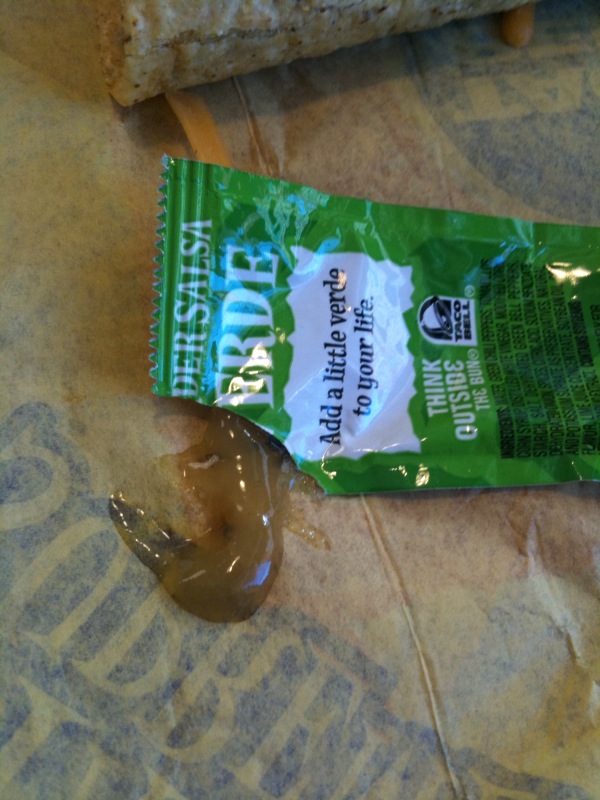
Anyway, now to the important stuff. First the Salsa Verde. Here’s what it looks like:
Not particularly appetizing, I know. But pretty tasty regardless. Apparently green salsa has been available in some forms in certain Taco Bells — especially out West — forever, and many claim you could find it even on the East Coast upon request. I can’t speak to that. I can say that added a nice sweetness to the taco, with that familiar green-chile tang I encountered first in Denver. Mild, but appealing. A nice complement to the existing array of sauces.
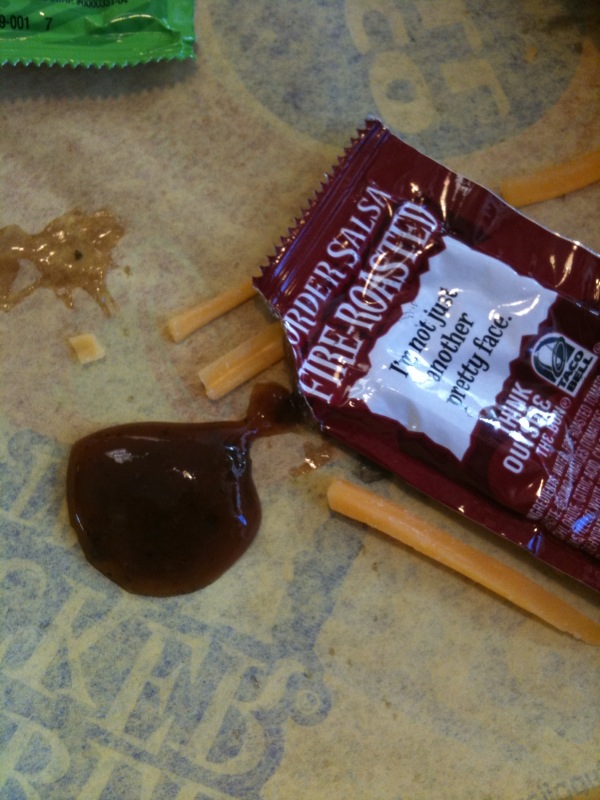
And the Fire-Roasted Salsa:
I guess I had pretty high hopes for this sauce, and at first taste I was impresed — it’s definitely smoky tasting. Probably more toward Liquid Smoke than if it were actually from smoked tomatoes, but I’ve always thought Liquid Smoke did at least a reasonable job capturing smoke flavor, and, you know, it’s Taco Bell. My beef with the sauce, though, was it wasn’t as spicy as I would’ve liked.
It seemed like they took mild sauce and added smoke flavor and a little color, and I would’ve preferred if they ramped up the hot sauce instead. Maybe I should mix it with Fire sauce next time for a spicier hybrid, but I think it speaks to my disappointment that when it came time to sauce my XXL Chalupa, I went back to old familiar Hot.
Speaking of, the main event:
Clearly not as neat as the one in the commercial, but I suppose a lot of things are messier for mortals than they are for Mariano Rivera.
My initial concern about the XXL Chalupa was that the proportions would be off and there would be too much beef, but that wasn’t the case. Everything came in about the right amount, I’d say, the only problem was the construction.
This might be an issue with a one-item sample or with the particular Taco Bell, but I imagine when you’re dealing with a chalupa of this magnitude you’re inviting a great deal of ingredient entropy. On a regular crunchy taco with the right amount of beef, cheese and lettuce, there’s a pretty good chance you get beef, cheese and lettuce in every bite. The XXL Chalupa is so unwieldy that no one topping covered the breadth of the shell, so my first taste was mostly nacho cheese and my last was almost entirely sour cream.
I should note that both of those, as well as every one in between, were unutterably delicious because everything I ate was from Taco Bell. But if you’re looking for a consistent Taco Bell experience, the XXL Chalupa probably isn’t for you. Unless you happen to go to the same Taco Bell that Mariano Rivera frequents, in which case you’re golden.
Also, a special nod to the crunchy red strips, perhaps the most wildly underrated and frequently overlooked Taco Bell ingredient. I really don’t understand why the crunchy red strips aren’t on everything. So crunchy, so red. Such a convenient way to add crunchiness to otherwise uncrunchy products, and thus a great way to make a driveable Taco Bell order crunchy.
I will reiterate here a campaign I have been waging since the debut of the crunchy red strips in the now-defunct Chicken Caesar Grilled Stuft Burrito way back when: Please, Taco Bell, put the crunchy red strips in more stuff. They are delicious. Thank you.
On The Happy Recap radio show last night, we talked a little about the known candidates for the Mets’ GM job and which one I’d choose if I were in position to make that decision. I waffled and hedged like I always do, and stuck to my stance that I really have no idea. But I said something about personality that doesn’t jive with anything I normally write here, so I think I should probably clarify:
I don’t know any of the men interviewing to run the Mets, but I would like to know that whoever gets hired is confident enough to ignore the inevitable onslaught of nonsense he or she will face at some point in the near future.
It has always seemed as if the Mets are run by people conscious of public perception. Omar Minaya, as I mentioned on the show, talked about how he heard from Mets fans about addressing the bullpen whenever he went to get bagels in the winter of 2008.
That’s just a quote, a joke Minaya made to make the J.J. Putz acquisition seem like a no-brainer.
But it would be nice if the Mets could find a general manager cocky enough to turn to the guy on the bagel line — or the guy on the radio, or the guy writing for the newspaper, or the guy who owns the team — and say, “Bro, I appreciate the feedback, but I know a hell of a lot about how to build a baseball team, and I’ve got things under control.”
In other words, while I think the bluster about the particulars of the New York market is normally little more than the New York media overemphasizing the impact of the New York media, in this one instance I think it’s important the Mets hire someone they feel can withstand the pressure to compete immediately, shoulder the comparisons to the winning team across town, and exercise the requisite patience to turn the Mets into a successful, sustainable franchise.
Does that mean anything at all? I don’t know. Theoretically all of the candidates have reached the top of their profession, and that type of climbing usually requires a good deal of confidence.
The Mets have a nice crop of halfway decent young players and, in the right hands, I suspect it won’t be as hard as many think to turn the club around. But it’s going to take some time, and in the interim there are going to be a whole lot of airwaves and newspapers and blogs to fill, and so every move the new GM makes and doesn’t make is going to meet with a hell of a lot of criticism.
And so, basically, the Mets need to hire someone who won’t care.




 Tedquarters