Joe Janish makes a good point

Jon Niese threw 99 pitches, but only 10 were curveballs — supposedly his signature “out” pitch and what many feel is his best weapon. Though, from what we understand, the thin air in Colorado destroys the vertical break of even the best curves. I liked what I saw from Niese’s ability to handle himself in the postgame interviews, and believe he is mentally and emotionally prepared to pitch in New York. Unfortunately, he appears to be extremely vulnerable without the deuce. But, it’s likely the last time in 2010 he pitches at a mile-high altitude, so he should get back to being the MLB-average pitcher the Mets need him to be. I’m not concerned in the least.

Joe Janish, Mets Today.

That seems about right. I forgot all about that factor while watching Niese pitch last night, though, and I kept wondering what happened to his reliable Uncle Charlie.

Indeed, according to ESPN New York, Niese told reporters after the game, “I really didn’t have a feel for my curveball. I tried to throw it for a first-pitch strike and I just really couldn’t get it there. … It’s tough to get a good curveball going here. I left a lot of curveballs hanging in the bullpen when I really wanted to bounce it. To Barmes, I left that hanging and he hit it.”

Mystery solved, then. And that should, as Janish suggests, quiet immediate concerns about Niese. If you’ve got doubts about the effects of altitude on curveball specialists, check out the late Darryl Kile’s career in Colorado, juxtaposed with his seasons immediately before and after.

Bacon Ranch Tortada: Color me unenthused

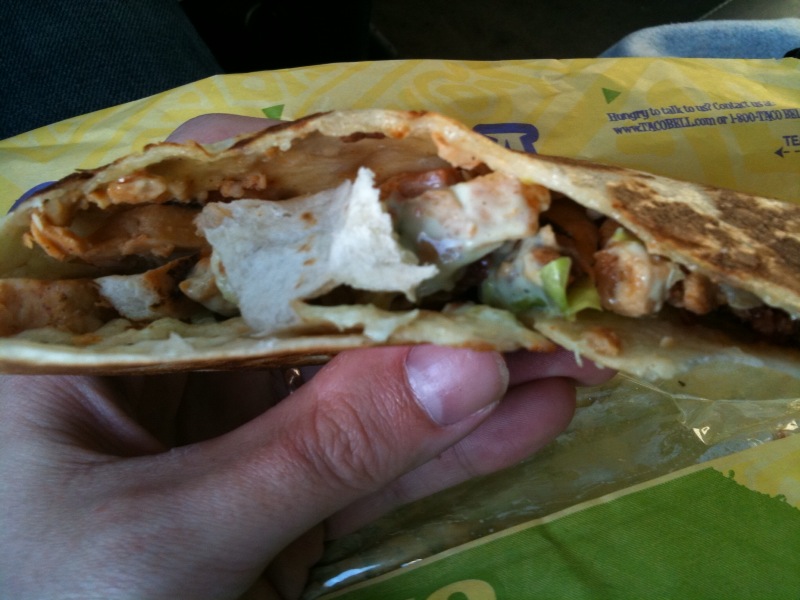
I got so caught up in another new sandwich-style product from a Yum! Foods restaurant that I almost forgot to write up Taco Bell’s new Bacon Ranch Tortada.
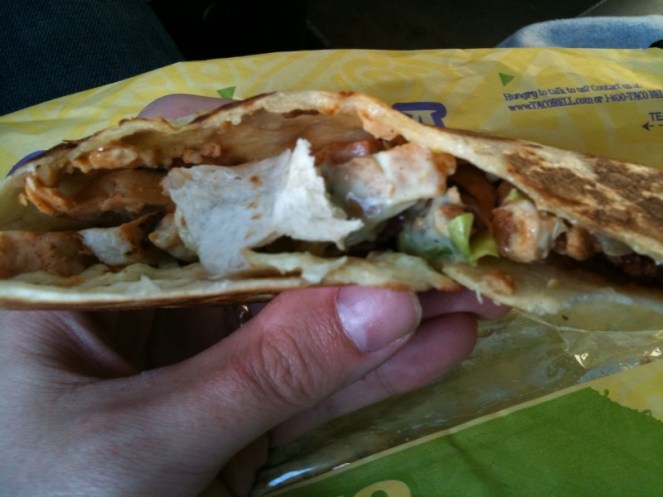
You probably know by now that I like Taco Bell, and you might remember that I enjoy bacon, and you may even recall that I believe meats wrapped in breads are the hallmark of civilization.

Still, I purchased a Bacon Ranch Tortada with tempered expectations. While Taco Bell products with bacon sound amazing in abstraction, they’ve never entirely hit the mark. Remember the Bacon Club Chalupa? Disappointing.

It seems Taco Bell has never really nailed the preparation of good bacon. I mean that as no disrespect to Taco Bell or bacon, naturally, but I think this gets overlooked pretty frequently in discussions of the merits of fast-food restaurants: Wendy’s is the only major national fast-food joint that makes truly delicious bacon.

McDonald’s bacon just kind of tastes like everything else from McDonald’s, only with a slight aroma of bacon. Burger King bacon is thin and soggy. The KFC bacon on the Double Down was overpowered by the fried chicken flavor, and totally extraneous to the sandwich — probably just thrown on there for the sheer Rex Ryan bravado of it all. (Also, probably thrown on there to tempt Rex Ryan, gastric band or no gastric band.)

Wendy’s bacon is legit. The Baconator is the showpiece of Wendy’s bacon package, but even lesser offerings like the Value Menu’s Junior Bacon Cheeseburger provide a decent slice of crispy, tasty bacon — albeit a small one.

Perhaps the secret to preparing decent fast-food bacon died with Dave Thomas though — rest in peace, brother — because even Taco Bell’s bacon is nothing special. Taco Bell chops its bacon up into small bits which bear a decent amount of bacon flavor, but are a bit too salty and entirely lack bacon crunch.

As for the rest of the Bacon Ranch Tortada? Color me unenthused. I should say that another reason I wasn’t expecting much is that I generally avoid chicken products from Taco Bell that aren’t the long-gone Chicken Caesar Grilled Stuft Burrito, a limited-time promotional item most notable as the debut showcase for the Crunchy Red Strips.

Straight up? And again, no disrespect, but Taco Bell chicken has just never done it for me. I’m here for the beef, baby.

Anyway, all that said I thought maybe the Bacon Ranch Tortada would at least be marginally interesting, since the tortada itself appears to be a new development. And I mean really a new development. I’m not sure such a thing as a “tortada” exists in actual Mexican food, as there’s no Wikipedia page for “tortada” and I can’t find any Google returns for tortada that are not about the Taco Bell products.

Still, you have to hand it to Taco Bell for at least improving their ability to come up with more realistically Mexican names for their new products. A tortada sounds way more like something I’d eat in Guadalajara than a MexiMelt, although now that I’ve had both I’d probably opt for the MexiMelt if it were available, because MexiMelts are totally delicious.

The Bacon Ranch Tortada? Less so. It’s not really even a new thing; it’s basically just the tortilla from a Crunchwrap Supreme filled with extant Taco Bell ingredients, plus the disappointing bacon. It’s like a Crunchwrap Supreme without the Crunch, and I guess without the Supreme since there’s no sour cream in there either. Oh, and it’s sliced in half, since that’s what makes it a tortada apparently.

Now look: I don’t begrudge Taco Bell its right to repackage familiar Taco Bell ingredients in new ways, plus I appreciate the use of the delicious avocado ranch sauce here, but it’s my responsibility as a journalist to call Taco Bell out when it misses the mark, and that’s what happened with the Bacon Ranch Tortada. Dry chicken, uninspiring bacon, no crunch. Still delicious, mind you, but not something I’ll ever order again.

Plus, if Taco Bell’s going to keep rolling out new products without actually incorporating new ingredients, they should probably consider my innovative and interactive flash-driven interface idea.

Solutions > vitriol

Based on some of the comments, I’m guessing I didn’t clearly explain what I meant to say in my post earlier this morning. What I meant to say is this:

I’m as disappointed as any Mets fan about the way the team is run, but it has nothing to do with the first seven games of this season. These games have been indicative of many of the problems that have troubled the Mets over the past several seasons, but they are only seven games, and so getting riled up only on account of them — if you were more optimistic before the season — is probably silly. The Mets are better than their .286 winning percentage. A .286 winning percentage would make them one of the worst teams of all time, and I don’t think anyone thinks they’re that.

The Mets can’t bring back Nelson Figueroa from the Phillies now, but they can still work to unbury themselves from the mire by revisiting several of the decisions they likely mishandled near the end of Spring Training and in the early parts of this season.

A couple, real quick:

Start Angel Pagan in center field every day: It sounds as if this is already starting to happen, and based on the overwhelming response to yesterday’s poll, I’m not sure I need bother explaining why it should (also: thanks for reading, Gary Matthews Jr.!).  But to put it simply, Pagan is most likely a better defender than Matthews and almost certainly a better hitter, and the team as currently constructed needs all the offense it can get.

Yes, Pagan makes mistakes in the field and on the basepaths, but no matter how frustrating they can be, they are not enough to mitigate what he offers to the club over Matthews.

Call up Chris Carter to replace Mike Jacobs: This one’s a lot less likely to happen, but I’m sticking with my position on the matter from before the season. Carter’s not off to the best of starts at Triple-A Buffalo, but he’s more likely to get on base than Mike Jacobs and more likely to knock one out than Frank Catalonotto, even if he lacks that elusive Major League experience.

I understand the calls for Ike Davis given Davis’ impressive Spring Training performance and hot start to the year. And I recognize that it seems somewhere between odd and hypocritical for the Mets to be patient with Davis while throwing Jenrry Mejia to the wolves, but the first-base prospect — as impressive as he is — did strike out in more than 25 percent of his plate appearances in Double-A last season while struggling with left-handers. Davis’ time will come, but until he proves he can hit Triple-A pitching (across more than 26 plate appearances), Fernando Tatis and Carter can hold down the fort more aptly than Jacobs until Daniel Murphy returns.

As for the rest? Calls for the heads of Omar Minaya and Jerry Manuel, while understandable, are unrealistic. Those cases should have been made — and in many cases, were made — long before the season started. If the the powers-that-be felt confident enough in their general manager and manager to endure the offseason and start the year with them, changing their minds now would indicate a near-horrifying lack of confidence in their decision-making ability. I’m not entirely sure how or why that matters outside of the inevitable bad press, but it certainly wouldn’t send the best message to the replacement hires.

As for John Maine? In the absence of Figueroa, Maine should probably get at least a few more opportunities to work out his kinks before he’s dispatched to Triple-A or the bullpen. Yes, he looked shaky all Spring and awful in his first two starts, but two starts are two starts, and among all the legitimate concerns about Maine’s velocity and control, it’s easy to forget that he did pitch effectively in a small sample after returning from injury last season. Sure, he beat himself after last night’s game, but Maine beats himself up after every bad start — resist the urge to resort to armchair psychology.

    Search for the Mothership

    In concert, the Mothership was last spotted in Detroit in 1981, belching dry ice fumes and flashing kaleidoscopic light. An aluminum flying saucer, it was about 20 feet in diameter and decked out with dazzling lights. Below it stood a band of otherworldly eccentrics celebrating the hard-won freedoms of the civil rights movement in a freaky, fantastical display.

    Chris Richards, Washington Post.

    Go read this article, a thorough and well-penned investigation of what happened to Parliament-Funkadelic’s Mothership, last seen in a junkyard behind a gas station in Prince George’s County, Maryland in 1982.

    Enjoy some funk. Language NSFW:

    The drumming of restless Mets fans

    Brrrrump bum ba bum, bum bum bum bum ba bum!

    Hear that? An angry mob of restless Mets fans, torches lit, are beating their drums. The drums are getting louder now as their crowd swells, and with the pulsing rhythm comes a cacophonous chorus of chants:

    FIRE JERRY! CALL UP IKE! CAN MINAYA! F@#$ JOHN MAINE!

    Brrrrump bum ba bum, bum bum bum bum ba bum!

    The once-Shea Faithful appear no longer that, and perhaps rightfully so. Their team mustered only two wins in its first seven games of a season in which they were promised results, coming off a season in which they got none of them.

    And the patient contrarians who cry “sample size,” point to a long season and call for calm are drowned out by the drumbeat, hushed by angry villagers yelling, “sample size? I’ll show you sample size! We’re going on four years worth of sample size.”

    Still, though the Mets are not very good, their fans should take solace in the fact that they’re almost certainly not this bad. Despite their 2-5 record, they’ve only been outscored 33-30, and they managed that without Jose Reyes for four of their games.

    Things will get better. Perhaps not much, but better for certain. They can’t get much worse than they were in last night’s loss to the Rockies.

    What’s most puzzling about the drumming is how much of it appears fueled by shock, as if anything happening in front of us is surprising. The 2010 Mets feature several excellent players who have not been good enough to carry too much dead weight in the lineup and on the pitching staff; a top-heavy roster poorly constructed and too frequently mismanaged.

    This is a new thing?

    A quick thought on offensive language

    Thinking out loud: Sherm and I had a quick exchange about linear weights in the comments section here a month ago, and for whatever reason, I thought about it this afternoon.

    For years, I’ve argued that a big reason more people haven’t been exposed to more advanced offensive metrics is a simple matter of the language involved: We have easy verbs at our disposal that describe the standard, back of the baseball card stats that so many of us grew up with.

    If I say, “David Wright hit .307 last season,” you know that I technically mean, “David Wright got base hits in 30.7 percent of his at-bats last season,” and you take it on faith that the average I’m presenting is correct and don’t bother looking up his at-bats and hits and doing long division.

    I can attest that when writing about baseball, it’s sometimes tempting to rely on batting average — even if it’s an imperfect measure of offensive performance — for that reason alone. Saying “he hit .307” is easier and less awkward, in the course of a 500-800 word column, than writing, “he posted a .390 on-base percentage” or “he had an .837 OPS.”

    I have to imagine there are baseball writers out there — ones much more widely read than I am — who would be more willing to incorporate advanced stats into their work if only there were more convenient language in place.

    For a while, I searched for a verb that could convey on-base percentage. I e-mailed back and forth with John Peterson of Blastings! Thrilledge about this back in the day, but I don’t think we ever came up with a reasonable answer. To say “he based .390” sounds like some sort of drug terminology. “He reached .390” sounds like it was something he was striving for. “He safed .390”? Just weird.

    Regardless, perhaps linear weights provide potential for a breakthrough. Though in concept, they are a bit abstract and somewhat difficult to grasp, they attempt to assign specific run values to every possible offensive outcome, relative to zero (making an out).

    The stat wOBA — an attempt at a single, context-neutral universal offensive metric — relies on those linear weights. A good primer can be found here.

    But instead of making the stat an average of linear runs produced per plate appearance, the stat’s creator, Tom Tango, made it scaled to the league-average on-base percentage to make it easier to digest.

    That’s cool, and as someone who has been digesting on-base percentage for a while now, I appreciate it. Still, it adds another layer of complexity to an already esoteric metric, and one I doubt will help it earn any converts among the multitudes who weren’t already using OBP to measure offensive players.

    This is almost certainly wishful thinking, and I’m probably missing something here, but I wonder if the stat would be easier to grasp if it were a simple, unscaled average of linear runs per plate appearance.

    In my imagination — which is far removed from reality — that could solve the verb problem, since I could write “David Wright produced .320 last year,” or whatever it was, and you could know I meant “David Wright produced offensive outcomes worth .32 runs per plate appearance last year.”

    Still too abstract for general consumption? Now that I think about it, yeah. That’s a really broad stretch beyond batting average.

    Plus, like I said, I’m sure I’m missing something somewhere. Step up and tell me how I’m wrong, Internet.

    Mets-Rockies series preview

    This is, without question, the most businesslike conversation I’ve ever had with Scott and Ted, the hosts of Rockiescast and my buddies from college.

    For a far less businesslike and far more unbearably lengthy conversation, check out the most recent episode of that podcast, a slaphappy 90-minute marathon recorded after all three of us had spent a bit too much time in the sun on Sunday.

    Kiss the rings

    Usually, Balfour will design the best ring it can imagine before discussing the budget with team ownership. Management then brings in the veteran players to take a look, and to offer designing input. After the 1999 title, Roger Clemens was so impatient to show off his long-awaited champion’s status that he designed his own hefty ring, with the help of a designer friend, to complement the team’s official ring.

    Jeter hasn’t looked at his rings in a while, but says his favorite is still the one custom-made by Clemens.

    “When we get rings, a lot of people get them,” Jeter said. “The idea of having a ring that only the players got – the players, coaches and The Boss – that was pretty cool.”

    Filip Bondy, N.Y. Daily News.

    Bondy put together an excellent collection of information about World Series rings here, and I urge you to check it out. For one thing, I learned that Chili Davis requested one of his World Series rings be inscribed with “Chili Dawg” instead of his proper name, but his wishes were vetoed by the fascist killjoys who run the Yankees.

    As for the excerpted bit, what a typically annoying and presumptuous thing for Roger Clemens to do. Imagine you’re a jewelry designer. You’ve spent years training and honing your craft, and you know that your big contract — the World Series ring — is one of your best shots to publicize the fruits of your labor.

    It’s not the easiest gig of your year, as you want to create something unique, but that incorporates tradition, and something appropriate for front-office types to wear to their suburban barbecues but flashy enough to suit the fancies of the players. Plus once it’s all done you’ve got to subject your design to the approval of a bunch of guys who haven’t spent nearly as many hours thinking about ring design as you have.

    But you weather it all because it’s a great contract, and because you know when it’s all done your work will be broadcast on the evening news and proudly displayed on the fingers of 25 living, breathing, posturing billboards.

    Then, as you’re tinkering away, crafting your annual showpiece, you get the news: Roger Clemens, perhaps on edge from all the Icy Hot on indecent parts of his body, wants his World Series ring NOW RIGHT NOW, like a petulant child. And so Roger Clemens, because he’s got unlimited resources and couldn’t care less about your artistic process, just went out and made his own damn World Series ring.

    Obviously.

    And then to top it off, Jeter — Derek Jeter, the Captain, the guy who has yet to say something wrong in his entire career — goes out of his way to praise the ring Clemens and his (presumably) tacky Texan designer guy created.

    Why? Exclusivity. Derek Jeter just thinks it’s so special that there’s a ring out there whose value isn’t watered down by all the unimportant people who managed to get their grubby little hands on one.

    The six-game shakedown

    OK, this isn’t a fully formed blog post but I want to publish it somewhere and I can’t quite condense it to 140 characters:

    Mets fans reacting to posts like this one by saying that six games do not signify enough to justify a major overhaul are absolutely correct. Six games’ worth of evidence in a 162-game baseball season should not be used to form any worthwhile conclusions.

    But that reaction implies that Mike Jacobs and Gary Matthews Jr. should have been starting for the Mets in their respective positions in the first place, and there is a whole, whole lot more than six games’ worth of evidence to show otherwise.