Moneyball movie happening

Pitt obviously is committed to seeing this through. Many felt he would jump after Sony execs halted production on the Steven Soderbergh version of Moneyball, days before shooting was supposed to get underway last summer. That version had a $58 million price tag, and a docu-drama visual style that didn’t match the down-the-middle drama that was written by Stan Chervin and Steve Zaillian. Presumably, Pitt will be rewarded with a stronger back-end definition that gives him a bigger payday if the film succeeds…

Mike Fleming, Deadline.com.

I think plenty of people would argue that Brad Pitt’s back-end definition couldn’t possibly be any stronger, but color me psyched for the Moneyball movie regardless.

I would have cast Norm MacDonald as Billy Beane, partly because he sort of looks like Billy Beane and partly because if I were making a movie I’d probably cast Norm MacDonald in the lead even if it were the next Harry Potter or Shaft or whatever.

Regardless, this should be interesting, if not necessarily an exciting movie. Here’s hoping it successfully conveys the actual ideas presented in Moneyball. Movies are a good way to get worthwhile information to people who refuse to read books.

What hath Colonel Sanders wrought?

I did it. I went to KFC and ordered the Double Down on this, the evening of its national debut.

Holy moly.

The Double Down, if you haven’t heard, is a sandwich made with fried chicken instead of bread. It’s got pepper-jack cheese, bacon and special sauce in the middle. The special sauce is predictably orange and pretty obviously mayonnaise-based.

The real winner here, once again, is the United States of America. This is how we rear back and spit in Jamie Oliver’s smug face.

As for the product: The first thing you notice is how damn heavy the thing is. Thing must weigh a pound. It was my local KFC/Taco Bell combo joint, and I foolishly ordered a Volcano Taco as well, not knowing the size of the Double Down.

Damned if I didn’t give that taco away.

I gave a taco away. A hot, crunchy, spicy Volcano Taco, and I couldn’t eat it. The Double Down is greasy, fellas. I’ve got something of an iron stomach, but the Double Down is give-a-taco-away greasy.

Not sure if you would’ve figured that from the whole “two pieces of fried chicken with cheese, bacon and mayonnaise” thing if I didn’t spell it out for you. But yeah, greasy.

Greasy and totally delicious. I probably took 10 years off my life tonight, and I’m not certain it wasn’t worth it. It tastes like, well, two pieces of fried chicken with cheese and bacon inside. I’m not sure how I could describe it that could make it sound better than that. It tastes like what it is, and what it is, frankly, is awesome.

That’s a tasty sandwich, if we’re calling that a sandwich.

That’s a tasty tribute to culinary absurdity.

Will I order one again? I doubt it. It’s not something I’d want to eat while driving, for one thing, so it didn’t seem appropriate for drive-thru ordering, plus I like variety, and the Double Down pretty much prevents you from ordering anything else at KFC or the adjoining Taco Bell while you’re there.

Curtis Granderson looking for help

The one thing everyone keeps asking me about is what I am going to do to respond to the Roll Call tradition from the Bleacher Creatures….

From what I hear, a lot of players do fun things like flex their muscles when they’re called. I still haven’t decided what I am going to do for it and I’m open for suggestions from Big League Stew readers. What should I do? Leave your good ideas for my response in the comment section below.

Curtis Granderson, Big League Stew.

OK, first off: Just about everything about this is awesome. Players going straight to fans for advice on how to participate in a tradition at their new home stadium? Another win for the Internet.

Also, the first commenter suggests giving them the finger. The ninth suggests Granderson greet fans by learning how to hit lefties.

As for an actual suggestion, it’s a tough one. My initial thought is, “Dance the robot,” but that’s just because my initial thought is to dance the robot whenever anyone puts pressure on me to do anything. Man, I really wish I could dance the robot.

In truth, in that setting it would probably seem like trying too hard, as would any salute that took more than a half-second or so. That’s really limiting, and all my best ideas are ill-suited for a family environment. That should make them perfect for Yankee Stadium, of course, but I doubt Granderson’s looking to make any waves in his first home opener.

Except the one, I guess.

Anyway, go help Curtis Granderson. He seems like a nice guy, and if he’s not going to hit lefties, he might as well have something cool to do when the animals in the Yankee Stadium bleachers start chanting his name.

Holmes-piece

Combined with tight end Dustin Keller and the emerging Shonn Greene along with the best line in football, New York has the makings of a powerhouse offense that can bludgeon you to death or make the quick kill. We’re not even mentioning the recovering Leon Washington, once by far the team’s most explosive player. LaDainian Tomlinson is sort of a side show, but he’s at least a competent third-down back if Washington is traded or continues to refuse to sign his contract tender. 

Mike Salfino, SNY.tv.

I’m with Mike. I don’t know the first thing about Santonio Holmes as a person, so I don’t want to waste too much time weighing in on his character issues. I know he’s been accused of some pretty terrible things that I don’t aim to excuse him for, and I know he’s guilty of some pretty hilarious things that I’ll certainly make jokes about in the future.

I know Santonio Holmes is really good at football, though, and if Rex Ryan thinks he can rein him in, then good luck to Rex, and good news for the Jets. It seems like a no-brainer to give up a fifth round pick for a great receiver, even if he’s about to miss the first four games of the season.

Here’s me and Brian Bassett talking about the deal:

Joel Sherman on Jenrry Mejia

Beginning in spring, I have thought the Mets should be looking big picture with Mejia and not over-emphasizing April victories in exchange for stunting his growth. To gain perspective, good organizations look at their teams from 10,000 feet and not up close. The Mets are always so darned worried about today that they put tomorrow in jeopardy.

But even if the Mets want to look at their problems only in the here and now, I would ask what is their current problem?

No team should make decisions based on one week of play, but if given a choice I would rather make a decision based on one week of actual data/results than guess in spring training that my bullpen is going to be bad and put my best starting prospect into that role on a hunch. And one week into the season, what do you trust less, John Maine/Oliver Perez or the set-up crew?

Joel Sherman, N.Y. Post.

If you’ve been following along at home, Sherman has been just about the only newspaper columnist frequently — and rightfully — taking the Mets to task for rushing Jenrry Mejia to the Majors and into a bullpen role, potentially stunting the top prospect’s development in the name of some marginal upgrade to a very shaky-looking 2010 team.

In the linked piece, today’s 3UP column, Sherman hammers home every argument for why the Mets would do better in the end by sending Mejia to the Minors to be stretched out as a starter than by continuing to risk his longterm growth by using him as a reliever.

It’s spot-on, and definitely worth reading.

The way just about all my dreams start

Is o’conner actually basing an entire post – for ESPN no less – on what he santana would say when under truth serum… truth serum… are you kidding me… is this fact or fiction… if it’s fiction, ESPN should have drawn an accompanying cartoon to go with it… maybe johan riding a unicorn… that’d be cool…

Matt Cerrone, MetsBlog.com.

A few people have pointed me toward Ian O’Connor’s truth-serum column, but I’m trying not to indulge that type of stuff these days by responding to it or linking to it. I’m sure I will again someday soon, I don’t want to spend too much time fretting about nonsense when the Mets give me plenty to worry about on their own.

I just wanted to link to Matt’s post because I like the image of Johan Santana riding a unicorn. That could easily inspire the next great work of Awesomist art, following Vin Diesel and Usher Riding Into Battle on a Chariot Pulled by White Tigers.

The depths of unclutchitude

For the second straight April, talk is developing that the Mets can’t hit in the clutch. They’re batting .189 with runners in scoring position, after all.

It’s Monday morning and I’m only one coffee deep into my workweek, so I’m not yet prepared to go to battle over whether the abstract concept of clutchness even really exists. I’ll say it’s a hotly contested issue, to be sure, and there’s little statistical evidence to show that, given a large enough sample size, players will perform significantly better or worse in clutch situations than they would in others.

And I’ll add that practicing group psychology on professional baseball players based only on what little of their emotions they choose to disclose to us seems a bit silly — if not downright foolish — especially when we’re doing it after only six games worth of evidence.

But I will ask this of anyone who is certain the Mets can’t hit in the clutch:

Have you considered the possibility that too many of the Mets simply can’t hit?

Not all of them, for sure. David Wright and Jason Bay and, right now, Jeff Francoeur can hit. No doubt about that.

But take a closer look at the RISP numbers, beyond just the obvious fact that they’ve come in a tiny sample: The Mets actually have a respectable .347 on-base percentage in The Situation, a bit better than the Major League average.

Yesterday, with a runner on second, Livan Hernandez threw four straight balls to Francoeur, then got Gary Matthews Jr. to pop out weakly to shortstop. Why give Francoeur anything decent to swing at when you can see Matthews looming on deck?

I’d venture to guess that’s mostly what’s happening here, combined with the whims of a small sample size. The Mets’ lineup has so many gaping holes in it that pitchers can pitch around or pitch carefully to the good hitters with runners in scoring position, driving up the team’s on-base percentage in the spot, but pushing down the team’s batting average.

The only good-hitting Met that’s been disappointing with runners in scoring position is Bay, and it has come across precisely eight plate appearances. Eight. 8. 1,2,3,4,5,6,7,8. That’s nothing. In his career, Bay has a lifetime .929 OPS with RISP and impressive numbers in just about every clutch situation. Give it time, give it time, give it time.

The return of Jose Reyes to the lineup should help, as it not only fills in one offensive black hole with a decent hitter, but will also likely create more opportunities with runners in scoring position for David Wright, who has only seen four so far this season.

A 2-4 start to the season isn’t easy to stomach coming off the 2009 campaign, and it certainly hasn’t been helped by the Mets’ team-wide failures to come through in big spots so far. But don’t isolate the whims of few games’ worth of stats to diagnose widespread unclutchitude when it’s way more likely that the men who actually failed to perform in the clutch were the ones compiling the roster and filling out the lineup card.

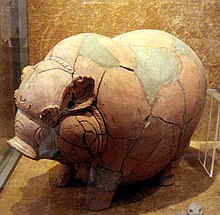
From the Wikipedia: Piggy Bank

The end of a long, strange Wikipedia journey.

From the Wikipedia: Piggy Bank.

I assume everyone here knows what a piggy bank is so I’m not going to bog you down with too many details: It’s a pig-shaped receptacle for storing money. Some people collect them, because some people will collect just about anything.

What I didn’t know until I checked the Wikipedia was that the piggy bank is apparently meant to be a pedagogical tool. That’s why, with traditional piggy banks, you can’t ever take money out until you smash them because you’re ready to take all the money out. Piggy banks with rubber stoppers on the bottom so you can open them are newfangled b.s.

So what lesson are we trying to teach our children with piggy banks? A massively important one: Scrimp and save to slowly compile a sizable nest egg, then blow it all in one fell swoop. Literally break the bank, children.

Also, maybe there’s some lesson in there about how it’s wise to tie up your fortune in hog futures. I think back in the day swineherds had something to do with fostering the popularity of the piggy bank.

Oh, and whose bright idea was it to start storing coins in pigs? Someone who mistranslated something. According to the Wikipedia, in Middle English the term “pygg” referred to a type of clay used to make kitchen pots and jars, some of which were used to store change, or pieces of eight, or whatever the hell they called coins when people spoke Middle English.

At some point along the line, someone thought “pygg jar” meant “pig jar” and they started making jars shaped like pigs, and I guess, I don’t know, one thing led to another and we ended up with piggy banks. Sounds like a pretty stupid story, to be honest.

What’s bizarre is that Indonesian people, totally unrelated to the Middle English translation mishap, stored their money in terracotta likenesses of wild boars as far back as the 15th century A.D.

Wild Boary Banks, of course, are the far more badass cousins of the Piggy Bank, but I’m honesty skeptical that Indonesian people and English people both decided to start stuffing coins in clay swine without somehow consulting one another at some point along the way.

I mean, there’s just not enough about a pig or a wild boar that says, “make a statue of me and stick money in it” that would entice two cultures half a world apart to independently start doing so.

I don’t mean to doubt the Wikipedia, but though there’s a picture of something that looks a hell of a lot like an Indonesian Wild Boar Bank from the 15th century, there’s no real citation for the fact, it could just be a small, clay wild boar statue, and furthermore, I mean, c’mon.

The detritus of opening week

Whoa, alright. I woke up this morning and couldn’t see my bedroom floor. It was covered in my dirty laundry. I couldn’t see the surface of my desk, either, or the bottom of my sink.

This happens during baseball season, especially when the Mets are home, and especially in April when I’m still getting adjusted to a different schedule. I spent every night this week only watching baseball some place or another, and so this morning I needed to commit hours to unburying myself from the detritus of opening week: the laundry, the dirty dishes, the three-day old press notes strewn about my home office.

I don’t envy my wife, who’s trying to live and study to become a doctor amid this squalor.

The house is clean now, and so I’ve got a second to look around at what’s been happening here. And the Mets are 2-2. Here’s hoping all those WFAN callers jumping off bridges after Thursday night’s game swam safely to shore in time for Friday night’s win.

2-2. Fifty percent. Not bad, not great. Just so-so. But given the circumstances, not terrible at all.

And better yet, the Mets have outscored their opponents 22-13 in those four games. Sure, plenty of that is due to some downright miserable play by the Marlins, but a lot of it is thanks to surprisingly good play from elements of the Mets’ roster.

The bullpen, for example. Mets relievers have mustered a 1.93 ERA over their first 14 innings despite a pedestrian 8:5 K:BB ratio.

So that’s cool. Likely to continue? I hope so, but I’m a bit skeptical. Fernando Nieve, one of the most effective bullpen arms so far, has been used in all four of the Mets’ games, and Jerry Manuel seems to manage as if there’s a rule against using a reliever for more than one inning.

Last night, with the Mets up by four runs, Manuel turned to Nieve for the eighth inning, presumably because Nieve is settling in as the elusive “eighth-inning guy,” and maybe because the meat of the Nats’ lineup was coming up. But Hisanori Takahashi had only used 12 pitches to retire the side in order in the seventh. Overuse could become a problem if Manuel is not more careful with his bullpen arms.

Actually, the starting pitching hasn’t been all that terrible either, despite all the preseason hoopla. Though none of the individual performances has been exceptional, no starter has entirely crapped the bed, which is notable given their propensity for bed-crapping. Johan Santana’s start was predictably good, only John Maine’s start could reasonably be described as lousy, and Mike Pelfrey’s — even considering his four walks — might even qualify as pretty damn decent.

As for the offense, Jeff Francoeur is killing it. Killing it. So are Jason Bay and David Wright. Whoever the Mets trot out to center field has managed to get on base at a great clip. Rod Barajas has not, but he’s made up for it with his power. Mike Jacobs, Luis Castillo and Alex Cora have not been at all good.

What does this all mean? Not much. These were four games in a very long season. The good news is that the Mets managed to win two of these four games without Jose Reyes, who returns to the lineup today. So, you know, good.

Craig Calcaterra on 300-game winners

One of the reasons sports journalism gets disrespected so much is that it is standard operating procedure to simply repeat evidence-free and even counter-factual assertions about things and no one cares. Case in point: the “no one will ever reach 300 wins again” meme, which gets repeated three or four times a year by people who should know better….

The last four 300 game winners all pitched in five man rotations and in the era of bullpen specialization. Only Greg Maddux had more than 36 starts in any one season. A five man rotation may cut down on wins per season, but in reducing workloads it may very well lengthen careers.  To cite these factors as bars to another pitcher winning 300 games is simply and unexcusably ignorant.

Craig Calcaterra, HardballTalk.

Amen. Making sweeping predictions about the rest of baseball’s future is one of my biggest pet peeves, especially when they involve plateau’s as eminently reachable as 300 wins. As Craig points out, we’ve seen several people in the last decade pointed to as the last 300-game winner. When will people learn to stop saying that?

And I’ll add to Craig’s point that the five-man rotation doesn’t necessarily prevent a pitcher from reaching 300 games: the five-man rotation is hardly set in stone for the rest of baseball’s history.

It certainly seems, right now, like pitching top starters on four days’ rest is the best way to maximize their efforts while keeping them healthy for the long haul, but who knows what we’ll learn in the next 20 years? The next 40 years?

The game is constantly evolving, and so it’s not unreasonable to expect someone to come up with some way to reshuffle pitching staffs so that the top starters pitch more frequently, or that a certain pitcher on the staff is in position to earn more wins. Maybe Rick Peterson’s work in biomechanics will advance to the point that in 15 minutes he’ll be able to know how many pitches a hurler’s arm could handle in a season. Sounds unlikely, but probably Tommy John surgery did once, too.