Art Attack: Shaq’s Size Does Matter exhibit

“Now this is a table for Shaq,” said a girl with day-glo orange hair and tattered leggings to a man in a black jacket with all sorts of extraneous zippers.

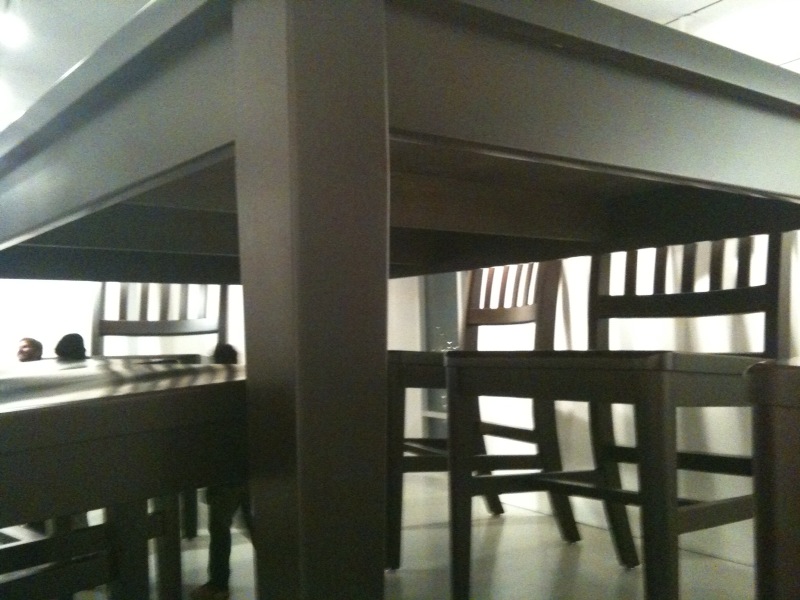
They stood under Robert Therrien’s No Title (Table and Six Chairs) and gawked at the massiveness of the work. The piece is not hard to describe: It is a plain-looking table and six chairs, just tremendous. The seat of each chair stood nearly five feet high, the back stretching to just shy of 10 feet, almost scraping the ceiling. The table — like the chairs, made of aluminum painted to look like dark wood — stood almost as tall, at about nine feet. And, at 12 feet wide and 18 1/2 feet long, its awesome dimensions tested the confines of what should have been a large gallery space at the FLAG Art Foundation in Chelsea.
Size Does Matter, the first art exhibition curated by Shaquille O’Neal, opened Friday night to a large crowd that appeared to be some mix of New York aesthetes, curious hipsters and intrigued basketball fans. It was difficult to tell — in Manhattan, one person could easily be all three — and there was no dominant draw among the few people I asked. Some came because it was Shaq’s art show, for sure. Others came to see the works on display from high-profile artists like Jeff Koons and Ron Mueck. One noted “all the buzz” around the show.

Hype breeds hype and crowds attract crowds. Shaq curated an art exhibit and landed some big-name works, and a bunch of people showed up. No surprises there, I guess.

Though Shaq himself is colossal, the exhibition was more than just impressively huge things. There were tiny things too — like Willard Wigan’s (literally) microscopic sculptures of the Obama family and Shaq inside the eyes of needles, and Jim Torok’s Self Portrait with Yellow Sunglasses.

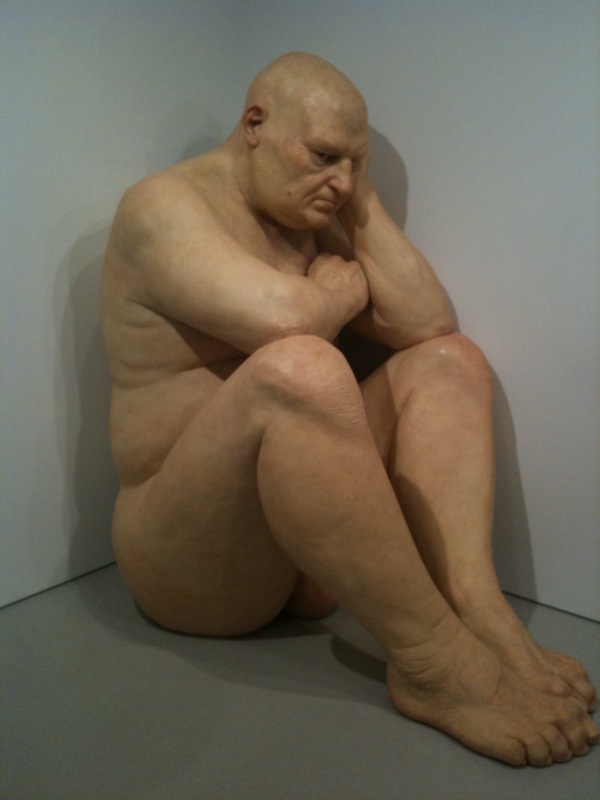
More than anything, though, the show was about jarring proportions. Richard Dupont’s Untitled (Terminal Stage), which cannot really be adequately represented by a photograph, featured three sculptures, modeled after the artist, in cast polyurethane resin, set up a few feet apart from one another in a triangle.
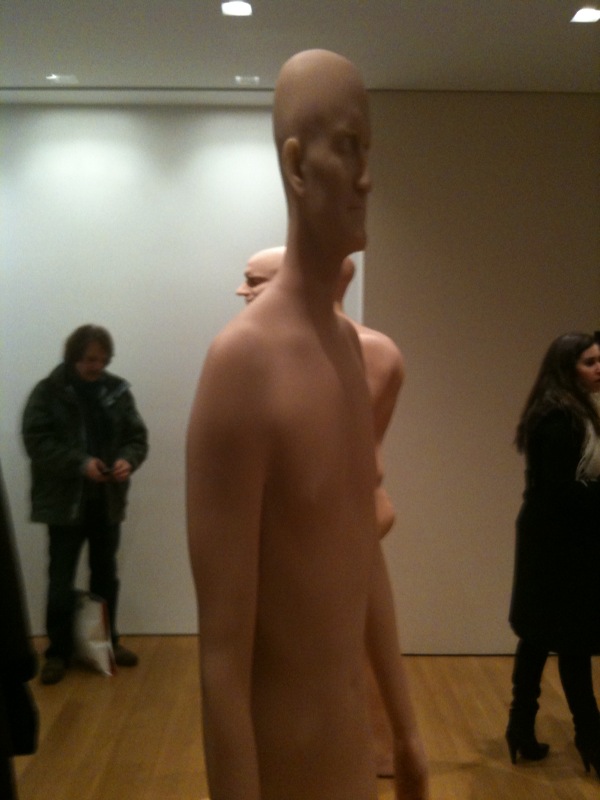
Though from some angles, the sculptures might look identical — and in realistic human scale — each was skewed in some unique way so that, from a certain perspective, it looked like it was being viewed through a funhouse mirror or, as one onlooker said, “through someone else’s glasses.”

It was fascinating to behold, and to feel my eyes try to adjust and process information that clearly did not connect with my brain’s long-conditioned notion of what humans and sculptures of humans should be shaped like.

And it was even more fascinating, of course, to watch other people go through the same process.

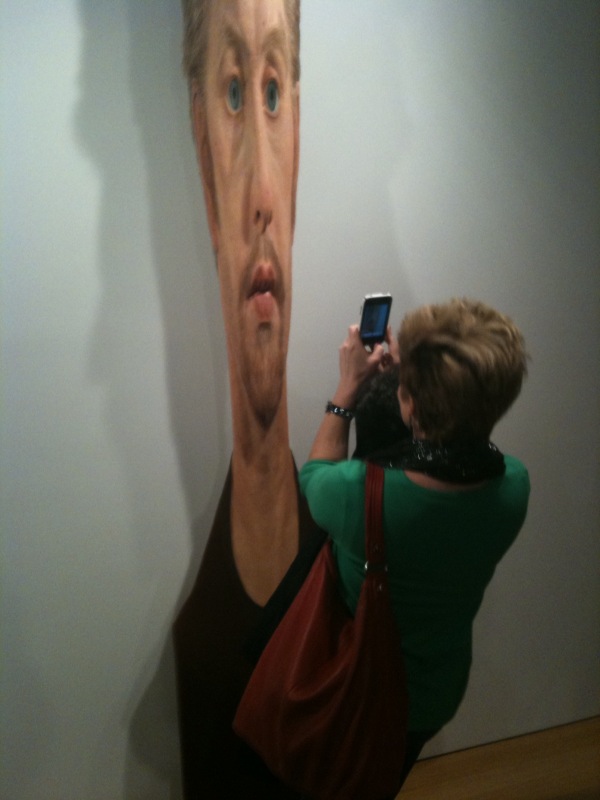
Evan Penny’s amazing Stretch #2, while not as dizzying, inspired a similar reaction. A nine-foot tall silicon sculpture of a stretched head, the work impressed crowds and baffled amateur photographers.
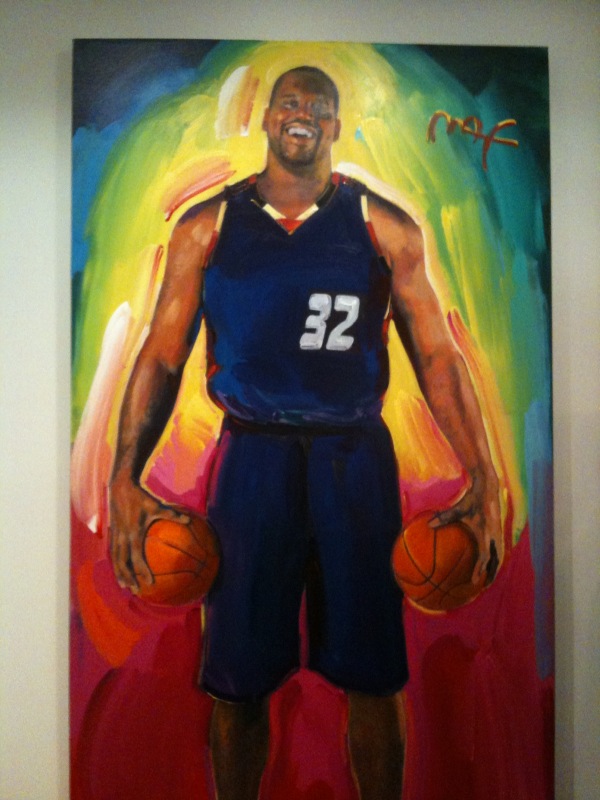
There are traces of Shaq’s persona throughout the exhibit, beyond just the life-size portrait of a smiling Shaq by Peter Max that graces the gallery’s reading room.

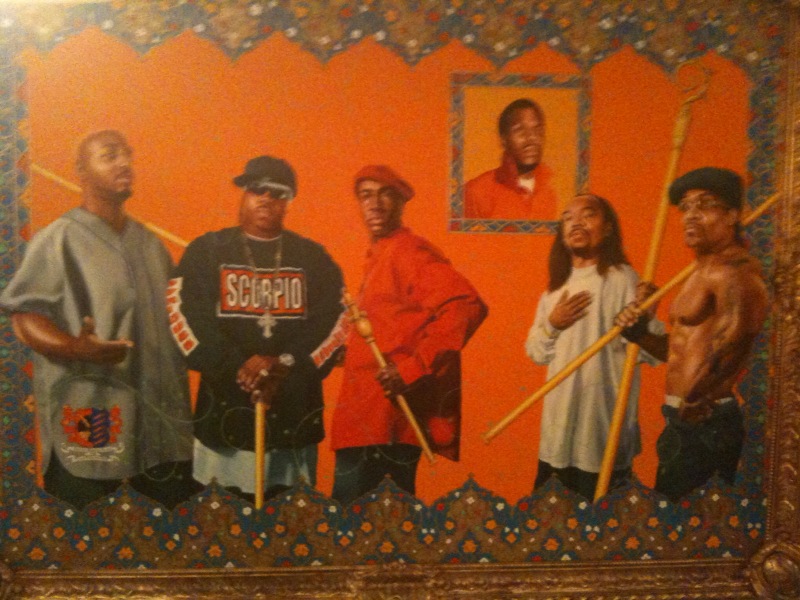
A photograph from Paul Pfeiffer’s basketball series, Four Horseman of the Apocalypse, is on display, as is a reminder of one of Shaq’s previous forays off the basketball court: his hip-hop career.  Kehinde Wiley’s portrait, Grand Master Flash and the Furious Five, hangs directly across from Max’s piece.
Still, even with two floors packed with cool pieces to look at, I kept going back to Therrien’s table.

It’s tough to say, with a work like that, who should get credit for the way it’s displayed, and whether it’s even reasonable to assess a piece based partly on the room that contains it. The Internet shows me that the same work has previously been shown in much bigger rooms, and even outdoors.

But someone — presumably Shaq himself — chose to show Therrien’s piece in a Manhattan space probably not really suitable for works of its scale. And someone set it up in that particular room at the FLAG Art Foundation, alone, filling every last bit of it, each chair sitting mere inches from the wall. At some step along the line, someone — or some collection of someones — made conscious choices to cram that table and those chairs in that space, and so I think it’s reasonable to assess its effect as displayed, even if its not necessarily the original one Therrien intended.

Because that table moved me in a way I did not honestly expect to be moved by Shaq’s art exhibition. Looking up at the tremendous table jammed into the room, and seeing all the people coming in and staring and laughing and taking pictures with it, it made me feel Shaq somehow, for a fleeting second, and it was so damn sad that I had to brace myself against the wall.

How uncomfortable must it be, sometimes, to be that big? How claustrophobic? Our world is not built for 7’1″, 350 pound men, just as that room was not built for an 18 1/2 foot-long table. What desk did Shaq sit at in middle school?

The Shaq we know, his public persona, is playful, and the work is a playful piece, too — make no mistake. It’s a giant dinner table, after all. It’s fun. But something about all the people enjoying it, reveling in its gentle giantism, made me wonder if Shaq ever wants to hide. You can’t hope to blend in when you’re 7’1″ and 350 pounds. Maybe on the court in the NBA, but never once the game is over.

And when I thought about it that way, it made perfect sense that Shaq’s art exhibition would not be a mere celebration of big things, but a more complex exploration of scale and perception. Shaq’s sheer size is a big part — maybe the biggest part, no pun intended — of what made him a great basketball player and of what makes him so entertaining a character. But I would venture to guess it has also complicated his life in ways I cannot entirely comprehend.

I don’t know. Maybe it’s just a big table.

It all made me remember this tweet from the Big Aristotle himself, though:

If u feel alone and by yourself, look in the mirror, and wow, there’s two of you. Be who you are. Who are you. I am me. Ugly, lol. Shaq

Smile, Shaq. You’re money.

Seriously, the iPhone pictures here don’t do these works justice. If you’re in New York, go see the show. It’s at 545 W. 25th St, between 10th and 11th, it’s free, and it’s open Wednesday-Saturday from 12-5 p.m.
Mets fans now just kind of shrugging at weird news

Today Jerry Manuel, for the second straight offseason, said he’d consider batting Jose Reyes third.

Matt Cerrone followed with a poll, and his readers are currently split right down the middle on whether it’s a good idea. It’s actually 50-percent yes and 50-percent no after 3540 votes. I don’t know if I’ve ever seen that before.
Obviously it’s a bit more complex than a straight yes-or-no, good idea/bad idea thing, which might be the source of the Met fan ambivalance. It’s certainly the source of mine.

I’ve always assumed Reyes would develop a little more power as he aged. I don’t have a ton of evidence to back that up, but he’s impressively broad if you see him up close, and it feels like when he does hit home runs, they’re not ones that just edge over the wall — he knocks the crap out of ’em.

That’s a biased and unscientific assessment, but I’m open to Manuel’s notion that Reyes, if healthy for a full season in 2010, could produce a few more extra-base hits than we’ve come to expect from him.

The thing is, if he’s not going to be batting leadoff, he damn well better be replaced by someone who gets on-base as frequently as he does. I touched on this a little last week: The most important quality for a leadoff hitter is not actually speed, but the ability to get on base.

So if Luis Castillo, David Wright or Jason Bay is manning the leadoff spot, I suppose I’m cool with Jose hitting third. Since no one else is likely to post a higher OBP, no one else should lead off.

I’m looking at you, Angel Pagan.

Since there’s no chance Wright or Bay will lead off, that pretty much leaves Castillo. He’s not a lock to get on base at a higher clip than Reyes, but even on his old knees he’s a decent fit to bat leadoff. He’ll certainly find his way to first base with some frequency, and it’s not like he has any power that would go to waste at the top of the order.

I still like him as a ninth hitter with Reyes leading off, since that’d be a good way to make use of Castillo’s OBP and then, after the first time through the order, Reyes’ power, while maximizing Reyes’ at-bats. But that’s probably not happening.

And I’ll settle on the status quo on this one: Let Reyes do his thing, leading off and stealing bases and making things fun to watch. If he’s going to start hitting for more power, make him force the issue. That’s a good type of problem to have.

Mike Jacobs is not like Matt Stairs

So Jerry Manuel said he could see Mike Jacobs serving as a power bat for the bench, like what the Phillies had with Matt Stairs.

But Mike Jacobs is not like Matt Stairs.
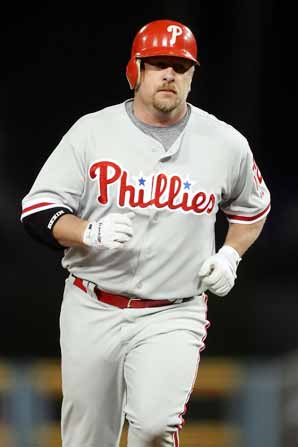
Matt Stairs was notable for a several reasons: He looked like a beer-league softball player, got on-base a lot, hit home runs, and couldn’t really play defense. Mike Jacobs only shares two of those qualities.

Matt Stairs finished his career with a .358 on-base percentage. Mike Jacobs is currently rocking a  lifetime .313 on-base percentage.

I tweeted this information a few minutes ago, and several Mets fans responded — perhaps accurately — that the Mets would only be asking Jacobs to be a lefty pinch-hitter off the bench who wouldn’t have to play defense, and so Manuel wasn’t comparing the two as players so much as he was suggesting Jacobs could fill a similar role.

That’s all well and good, and far be it for me to complain about the Mets finally adding a bench bat with a little pop.

But I’m guessing — and I haven’t run the numbers on this — that for a player to be valuable to his team while only being asked to do one thing, he has to be very good at that one thing. And Jacobs is not that good at that one thing.

Yes, he can hit home runs. That’s great.

What he can’t do — at least probably not well enough to earn a roster spot — is get on base. Not like Stairs could, and maybe not like Quad-A Spring Training invite Chris Carter could, either.

Why’s that important? Well, it’s not like all the situations that call for pinch-hitters only call for a home run. Hitting a home run is always the best possible thing a pinch-hitter can do, of course, but in instances where the team is down by more than one run, getting on base, well… you know.

Plus, if the pinch-hitter is being used to replace the pitcher — as he most often is — his getting on base means the top of the order will get to bat with a man on to drive in. And the top part of the order is where the good hitters hit.

It may feel like I’m on some sort of campaign against Mike Jacobs, but that’s really not the case. I have no personal agenda against the man, and I’m sure he’s a really nice dude. I just bristle when people bandy about Matt Stairs’ name haphazardly.

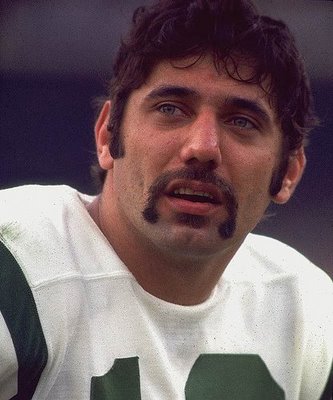
Joe Namath: The O.G. Mark Sanchez

My colleague Mike Salfino pointed me to this bit from Joe Namath’s Wikipedia page:

He was born and raised in Beaver Falls, Pennsylvania, twenty miles from Pittsburgh. He was a standout in football, basketball and baseball. In an age where dunks were still uncommon in high school basketball, Namath regularly dunked in games. Upon graduation, he received offers from six Major League Baseball teams, including the Yankees, Mets, Indians, Reds, Pirates and Phillies, but football prevailed. Namath has told interviewers that he wanted to sign with the Pirates and play baseball like his idol, Roberto Clemente, but elected to play football because his mother wanted him to get a college education.

That’s right. Not only was Joe Namath a stud baseball player, he dunked in high school basketball games long before it came in vogue. That’s because Joe Namath is completely and utterly awesome, kind of like dunking. Man, I so wish I could dunk.

Anyway, lots of people threw around “next Joe Namath” talk during Mark Sanchez’s rise to prominence this year, but I think fans of my generation never fully grasped what that meant.

Luckily, the Internet is positively rife with photos of Joe Namath that help shed some light on the comparison. Here are a select few:

Items of note

I can’t believe this is starting up again. Good lord, it never ends.

Stop the presses: Johan Santana is confident in his abilities. Here I was expecting him to say Garrett Mock is the best pitcher in the NL East.

Ross Ohlendorf interned at the Agriculture Department this offseason. Seems like an interesting dude, definitely an interesting article.

This picture from the Daily News is tremendously awesome. Ladies and gentlemen, Joe Namath playing softball under the 59th St. Bridge in some downright amazing pants:

Donnie Walsh: Cool

Donnie Walsh kind of looks like Earl Milford, founder of Arrested Development’s Milford Academy, but he has made his intentions both seen and heard since he took over the Knicks in April of 2008.

Walsh has worked tirelessly to dig the team out from the under the giant stinking pile of muck Isiah Thomas dumped all over it in his epically terrible tenure.

Today, Walsh pulled off a three-team deal to ensure that the Knicks will be able to sign two max free-agents this offseason, when, among others, LeBron James, Chris Bosh and Dwyane Wade hit the open market. He had to give up a couple draft picks and Jordan Hill to do it, but it was, as Marlo Stanfield might put it, “some Spiderman s@#!.”

It strikes me that, only a few paragraphs deep in this post, I’ve already referenced two of the greatest television shows of all time. It wasn’t intentional, but maybe it had something to do with the subconscious knowledge that the Knicks, for the past several years, have been nearly unwatchable.

So as only a casual fan of the team and, hell, the entire professional game, maybe the allusions to Arrested Development and The Wire signify my hope that next year’s Knicks — with LeBron and Bosh or LeBron and whoever — could become the type of programming so transfixing, so transcendently awesome that I feel the need to watch and rewatch every moment, like I once did those shows.

And it could happen. If it all goes down according to Walsh’s plan, it’s entirely likely.

The fear, of course, is that it won’t. That King James will stay put in Cleveland and Walsh will be left with some lesser free-agent haul and egg all over his face.

The thing is, Walsh — with the way he’s gone about eradicating the detritus of Isiah’s amazing orgy of suckitude — should by now have earned enough faith from the Knicks’ fanbase for it to assume he’ll do well with the cap space he’s fought for since the day he took the reins.

So the Knicks’ deadline deals — to this partial but somewhat distanced observer, at least —  don’t say “LeBron or bust,” as much as they say “tabula rasa.” Walsh will enter the offseason with a clean slate and a ton of flexibility to mold the team in his and Mike D’Antoni’s image, and only Eddy Curry left to show for the Isiah Thomas Era.

Of course, building a good team is a lot different than dismantling a crappy one, and it remains to be seen if Walsh is nearly as good at the former as he is at the latter.

Put me down for bullish, though. At the very least, I’m guessing he’ll be better than Isiah.

Hilarious Triple-A lineup scenario

Chris Wilcox Will Davidian did a nice job over at BlueAndOrange.net with something I’ve been meaning to do for a while: Aggregating all of the minor moves seemingly made to improve the Mets’ Triple-A farm club.

Buffalo, as I’ve mentioned before, has one of the most active and dedicated Minor League fanbases, and during last season the Mets promised to do better by the city.

This offseason, they’ve pretty clearly made an effort, as Chris Will details in the link above. But I’ll take it one step further and imagine a hilarious scenario.

All of the following men, in theory, could be on the Mets’ Triple-A club in 2010. This lineup doesn’t include Ike Davis, Ruben Tejada, Josh Thole, Fernando Martinez or Nick Evans and so it’s certainly not one I’m advocating, but the Bisons could have the opportunity to field an entire team of Ken Phelps All-Stars.

Check it out. Here they are, with their career Triple-A slash lines, their total number of Triple-A plate appearances, and their Opening Day ages:

C: Chris Coste: .282/.337/.414 — (Age: 36, AAA PAs: 2142)
1B: Val Pascucci: .278/.397/.509 — (31, 2673)
2B: Andy Green: .300/.381/.486 — (32, 1881)
3B: Mike Cervenak: .299/.337/.457 — (33, 2458)
SS: Russ Adams: .276/.345/.409 — (29, 1927)
LF: Chris Carter: .304/.373/.493 — (27, 2201)
CF: Jesus Feliciano: .310/.357/.391 — (30, 1465)
RF: Mike Hessman: .238/.327/.486 — (32, 3691)

That’s so many Triple-A plate appearances. That’s so much Triple-A mashing.

Mets’ Spring Training off to rollicking start

According to Craig Calcaterra at Hardball Talk, citing a source, Kelvim Escobar may be seriously injured. I’m a little bit skeptical, as I normally am about stories coming from anonymous sources, but since Escobar’s spent the better part of the last two seasons seriously injured, it just would not be that surprising.

Awesome.

If Escobar’s as hurt as Calcaterra’s source suggests, people will look back and slam the Mets for signing him to the one-year, $1.5 million contract they gave him in December.

And then other people will slam those people, and say, “well how come you didn’t criticize them for it at the time?”

But those who did not criticize the Mets for the Escobar deal at the time — and count me among those — probably didn’t realize how limited the Mets’ offseason budget was. Nor would they have realized that the $1.25 million shelled out to a high-risk pickup in Escobar would have theoretically made the difference in acquiring Joel Pineiro, or probably been used to sign Felipe Lopez to play second base.

That’s not going to happen, of course, because the Mets have $8 million committed to that position in Luis Castillo and Alex Cora and appear to hate copping to sunk costs.

Whatever. If Kelvim Escobar’s really seriously hurt, it won’t sink the Mets in 2010. He was slated to be a setup man, a guy who wouldn’t throw more than 70 innings anyway.  I know we keep hearing “eighth inning, eighth inning, eighth inning,” like it’s some elusive and insurmountable hurdle, but A) there’s no rule that says a team should only have one eighth-inning guy and B) it shouldn’t be too hard to find that guy anyway.

It’s just bad news, is all, and a bad way to kick off what should be a beautiful, uplifting time: pitchers and catchers.

Items of note

The Phillies should be the favorites to win the National League East, but I’m kind of surprised by how few people picked the Braves here. Even without Javier Vazquez, their rotation — with Jair Jurrjens, Tommy Hanson, Derek Lowe, Tim Hudson and Kenshin Kawakami — should be pretty awesome, mostly because I think Hanson’s going to be a stud. There’s a lot of uncertainty/badness on their defense, though.

All that was left in Nate Robinson’s locker last night was a can of Vaseline and some tube socks. No comment.

Speaking of the NBA trade deadline, I recommend sticking with my neighbor Tommy Dee at TheKnicksBlog.com today, and not just because I’m a shameless corporate shill. He holds it down.

I did double duty at the Perpetual Post last night, recapping — in a way — Tuesday’s episode of Lost with Zoe Rice and jamming on the life lessons learned from jazz training with Akie Bermiss.