Chester A. Arthur: Muttonchops hero

As far as I’m concerned, this nation’s Golden Age came from 1861-1913.

Now I recognize that the Civil War and plenty of other terrible, horrible  things happened in that span, but I also know that, across those years, nine of the 11 presidents had facial hair. Never before and never since has this great country seen such an explosion of glorious whiskers.

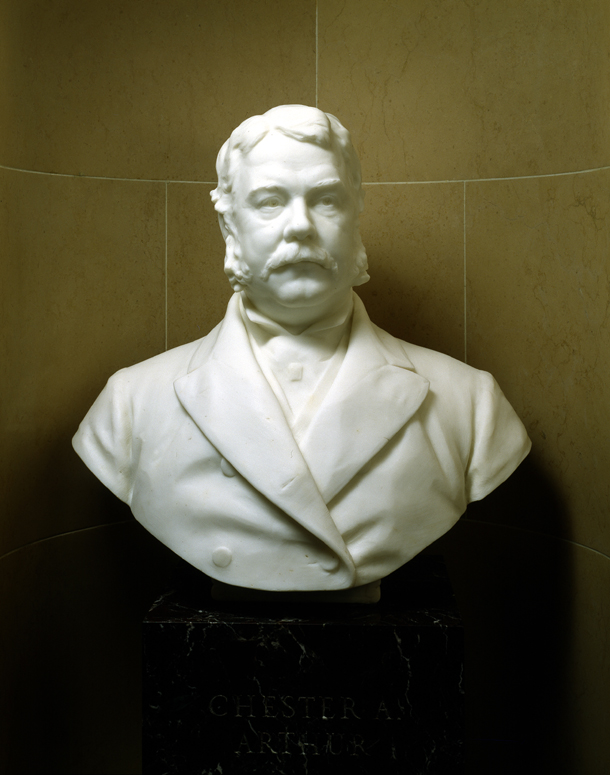
And though he may not have been the greatest Presidentially of the mustachioed and bearded Presidents, one man stands head and shoulders — nay, neckbeard and sideburns — above the rest in terms of facial-hair magnificence: Chester A. Arthur.

I’m convinced that Chester A. Arthur was born with his muttonchops. Seriously. Probably this has something to do with how few likenesses there are available online of Chester A. Arthur as a boy, but even the youngest available portraits of the man feature the impressive chops.

At times in life, and indeed, during his presidency, they would grow so wild as to constitute truly freakish facial hair, like something you’d see at a Korn concert in 1998. The dude had shoulder-length mutton chops. Unreal.

Another fun fact about Chester A. Arthur — which is decidedly not a fun fact for James Garfield — is that Garfield’s assassin shot him specifically so that Arthur, his vice president, could take over. That’s the only time that’s happened. The Wikipedia says this has something to do with rival factions within the Republican party at the time, but I’m unwilling to rule out the idea that assassin Charles Guiteau was just showing some horribly misguided and overzealous respect for Arthur’s awesome muttonchops.

Anyway, here are various likenesses depicting Chester A. Arthur’s muttonchops:

I actually just spent my last 10 minutes making a terrible photoshop rendering of what it might look like if Barack Obama brought back awesome Chester A. Arthur muttonchops, but then I grew concerned that there might be some sort of law in place about drawing facial hair on pictures of sitting Presidents or something. But he should do it, believe me. It’d make politics so much more interesting.

Rex Ryan exposes gut, inspires ridicule

Look: I’ve made plenty of fat jokes at Rex Ryan’s expense. Scores of them.

But I’m not going to beat the guy up for what happened Tuesday night, when he accidentally exposed his gut to the crowd while changing jerseys at a Carolina Hurricanes game, inspiring a New York post news story in the process.

Because it’s not like he pulled up his shirt and did the truffle shuffle for the crowd. Cheerleaders came and brought Rex a new jersey, and I’m guessing he was up on the Jumbotron, under all sorts of pressure to change jerseys immediately, plus he was wearing an undershirt, so he made the switch.

Revealing himself like he did, that’s embarrassing. And unlike devouring tons and tons of food every day, it wasn’t something he was doing consciously. So I just kind of feel bad for the guy.

And in sympathy, I’ll share a story:

I’m no stranger to gut ownership. The size fluctuates depending on the season, how active I’ve been and how much Taco Bell I’ve been eating, but it gets pretty damn impressive at times. Not quite Rex Ryan impressive, but sizy nonetheless.

And it was probably at its largest during my junior year of high school, when my friends first got cars so we first had near-unlimited access to Taco Bell.

That same year, a ski mountain my family used to frequent added something called “tree skiing,” a bizarre and, in retrospect, terrible idea that was exactly what it sounded like; basically they just cleared out the brush from the mountain’s off-slope forest and let people ski among the trees. Awesome.

I was sixteen and so, despite my girth, eager to try all of the dumbest and most dangerous activities available to me, so tree skiing was about the most intriguing thing imaginable.

The place, presumably to minimize lawsuits, didn’t allow skiers to tree-ski from the summit, so you didn’t use the regular chairlift. Instead, you had to take a J-Bar — an antiquated type of lift normally reserved for bunny slopes — which sort of hooks under your ass and shoves you up the mountain while you stand there like a goon.

I’m a decent skier, but I’ve always sucked at negotiating ski lifts. Don’t know why. Maybe I don’t have the patience for it, or I have some sort of mental block.

Regardless, something happened on the J-Bar that day about halfway up the slope. I slipped a little, I guess, and the hook part of the J-Bar — the curl of the J — lost its grip on my ass and started sliding up my back.

Thanks to gravity, I began sliding backwards down the mountain while the J-Bar was still driving forward.

The hook snagged my jacket, pulling me to the ground and somehow yanking my coat, shirt and undershirt up over my head,  exposing my pasty gut to the world as it dragged me up the mountain with my bare back against the snow.

It sucked.

And it would be embarrassing enough just knowing that it happened, and that it was happening, and that the person behind me on the J-Bar might see it all go down. But of course, there was a regular chairlift overhead, and so everyone on there was clapping and laughing and having the time of their damn lives.

I’ll fully admit that if I were in their place I’d have been doing exactly the same thing, because fat people falling makes for some of the world’s strongest comedy. It’s basically the driving force behind the movie The Great Outdoors, which is hilarious.

And so I can’t really fault people for laughing at Ryan’s expense. But I’ll say that inadvertent public gut exposure, when yours is the exposed gut, is not fun at all, and so excuse me for taking it easy on Rex just this once.

For the life of me, I can’t remember how I got up from that precarious position. Maybe whatever happened was so scarring and humiliating that I’ve blocked it. It’s a shame, because if it was that terrible, it was probably also something that would be pretty hilarious to remember now.

The devil you don’t

The fun thing about Daniel Murphy — or maybe the frustrating about Daniel Murphy, depending on whom you’re talking with — is that you can make about 100 different arguments about what role he should play for the 2010 Mets and not really be wrong.

You can use Sabermetrics 101, point to his .266/.313/.427 line from 2009 and say that’s unacceptable for a Major League first baseman. And you could add that he really only had one good partial season in the Minors — in Double-A Binghamton as a 23-year-old in 2008.

Or you can dive a little deeper into his Fangraphs page, as Sam Page has, to show that, despite all his reputation, some hiccups and a tiny sample size, Murphy demonstrated enough range at first base to indicate he might be a good enough defender to make up for any offensive shortcomings.

And you can claim — as I have — that we haven’t seen enough of Murphy to know how good he’ll be moving forward, and that 707 Major League plate appearances are not enough to judge a 24-year-old hitter.

A less convincing argument, I think, is the one that says Mike Jacobs deserves to start over Murphy on the strength of his 99 Major League home runs and 308 RBIs. Sam does a pretty good job tearing that apart in the Amazin’ Avenue piece linked above, and Patrick Flood goes to town on Jacobs’ defense here.

As I wrote yesterday, I don’t even know that it’s worth the time because I can’t imagine the Mets really would consider starting Jacobs at first base. But the Mets have blown my mind plenty of times before, so here’s this:

We don’t know yet that Daniel Murphy is not good. We certainly don’t know that he is good, but we don’t know that he’s not good either. He has yet to fully embarrass or distinguish himself at the Major League level.

We do know that Mike Jacobs is not good. I’m sorry. I know he hits home runs. He also plays terrible defense and never gets on base. And he’s 29, so he’s probably not getting any better.

Murphy, opening the season at 25, could be. As hard as it may be to believe considering how long it seems like we’ve been watching him play, he is the devil we don’t know, which, as far as I’m concerned, is better than the devil we know isn’t very good.

Items of note

John Harper got to catch Johan Santana yesterday. Color me jealous.

The Mets have not contacted Gary Sheffield this winter. It makes sense, since they don’t need him, but maybe it’d be nice if they just called to check in and say hello, you know? Just to see how he’s doing, maybe try to meet up for coffee or something.

Here are some pictures of carnivorous plants.

Stupid UConn couldn’t pull out a win over stupid Syracuse at the stupid Carrier Dome last night, thanks mostly to the stupid Big East refs.

All sorts of Mets stuff from SNY.tv

The debate rages on in the comments section on yesterday’s qualified defense of the Mets’ offseason. It’s currently 49 comments deep and no one’s compared anyone else to Hitler yet, so that’s awesome. One guy called me a shill, but other than that, it was good work all around.

Anyway, I want to reiterate a point I made in the post but that I think got missed, at least based on the thrust of most of the comments. I in no way meant to excuse the Mets for their general lack of moves on the big-league level this year, but only to commend them for not selling the farm. As I wrote:

The Mets had opportunities to inexpensively improve their chances for 2010 without jeopardizing their future and missed them. I don’t know if there’s truth to the reports of budget constraints or bureaucratic inefficiency, or if the problem stems from either or both or is simply an innocent — and damning — misreading of baseball’s marketplace, but whatever it is, it isn’t good.

To that point, Howard Megdal wrote a good column for SNY.tv on Monday about how the Mets could have upgraded their roster for little more than the money they offered to Bengie Molina.

Sam Borden touched on a similar note today, pointing out that, as nice as it is that the Mets are playing up their past, it’d be nice if they did a little more to improve their present.

And if that weren’t all depressing enough, Mike Salfino uses the Bill James Handbook and catches up with Gene McCaffrey of Wise Guy Baseball to project how the Mets’ pitching staff will fare in 2010.

Because, you know, these websites are all about shilling for corporate interests. That’s precisely what we do here. (I honestly don’t know why I get so burned up by that, except, I guess, that it couldn’t be further from the truth, and I hate that anyone might think anything I write could be disingenuous.)

Anyway, Sam argues that my post yesterday defending the Mets for not destroying their future was akin to commending a man for not falling down the stairs on his trip to the basement, and maybe to some extent he’s right. Maybe that’s just how low my expectations have sunk.

I’m not sure, though. I’m still holding out hope that the Mets made a conscious decision to not trade prospects, and that it represents some sort of fundamental philosophical shift for the organization. And that could be very optimistic, I realize.

Regardless, now reports have it that the Mets have no money left. If that’s true, it’s both extremely bad and completely baffling, because, you know, what happened to that money they were ready to offer Bengie Molina and Joel Pineiro and all that?

And it’s a shame because, if it’s true, it would prevent one of the inexpensive moves the Mets could still make to upgrade their 2010 roster: signing Felipe Lopez.

Mike Jacobs: Whatever

I don’t want to burst anyone’s bubble here, because I got plenty of comments and e-mails this offseason from Mets fans eager to see the return of Mike Jacobs to Flushing.

And I don’t want to waste too many words on the subject, because I don’t really want to imagine a situation wherein Jacobs plays too big a role with the big-league club.

But Mike Jacobs is about as one-dimensional a baseball player as could possibly survive in the Major Leagues. He is a power hitter. He does not hit for average, he does not get on base, he does not steal bases in the rare event he gets on, and he is not a good defender. Mike Jacobs sometimes crushes the ball. That’s his game.

It is not enough to make him a good Major Leaguer, or even really a capable Major Leaguer. By WAR, Jacobs has been below replacement-level for the past two seasons, and only barely above it in 2007.

That’s not to say it’s a bad move for the Mets to scoop him up on a Minor League deal. It’s a Minor League deal, after all. It will likely be a bad move if they cite his Major League experience and 32 home runs in 2008 and give him a 25-man roster spot over a more capable and deserving player, but since they haven’t done that yet, I’ll wait on it.

What’s a little bit baffling is where Jacobs fits in with the Buffalo club he’s likely destined for, since Ike Davis seemed destined to be the team’s starting first baseman. Plus the Bisons already have corner bats in Val Pascucci and Mike Hessman, and also Nick Evans and/or Chris Carter if they don’t stick with the big club out of Spring Training.

I guess Davis could be heading back for another go-round at Double-A to start the season, but given the way he torched that level in his half-year there in 2009, I can’t imagine he needs much more time there.

This is speculation upon speculation and I have no idea that it could be the case, but it would sure be neat if adding Jacobs to the Triple-A mix had something to do with giving Davis some time in right field. Davis played two games in right field at Double-A Binghamton last year and supposedly has a great arm — he was a pitcher in college — so having him take some turns in right could give the Mets some flexibility in their future handling of Davis.

Of course, since Hessman, Pascucci, Evans and Carter all have plenty of experience at first, I have no idea why Jacobs would change the way the team uses Davis in Buffalo. I’m just fantasizing, really.

On the whole, Jacobs is a low-cost, low-risk pickup. Since he’s unlikely to post a Major League on-base percentage north of .300, I wouldn’t call him a potential “high-reward” guy, but who knows?

This might be more of the Mets’ whole “doing better by the city of Buffalo” thing they pledged last season. But if that’s the case, man. I sure wish they’d have paid as much attention to the Major League roster as they did to the Triple-A one.

Items of note

MLB is apparently considering fingerprinting Dominican kids to stop age fraud. I get it, and I recognize the league is trying to protect itself, but this all sounds way, way too Big Brotherish for me.

Apparently Brian Cashman sat down with Derek Jeter after the 2007 season and told him his defense was unacceptable. Spoiler alert: It was. How Jeter has managed to improve at his age is beyond me, but the stats — even if they’re not quite a big enough sample — show he has, and kudos to Cashman for handling it so delicately.

Who let Method Man design the Olympic torch?’

Buy a hockey jersey, help Haiti.

Toby Hyde continues his Top 41 countdown of Mets prospects with No. 40, lefty Roy Merritt. Merritt’s warmup music is the following:

Sanchez doing all sorts of hilarious celebrity things

Mark Sanchez coached the DirecTV Celebrity Beach Bowl on Saturday. His team won, because Mark Sanchez is a winner. They triumphed despite carrying dead weight in the form of most of the cast of Gossip Girl, because Mark Sanchez’s Celebrity Beach coaching is just that shrewd.

(The game featured numerous beautiful celebrities I have never heard of. They just keep churning out beautiful celebrities. Then I go to their Wikipedia pages and find out they were born in years I remember. When I was young, I had no idea 29 was so old.)

That night, Mark Sanchez went to a Maxim Magazine pre-Super Bowl party where, according to the Daily News, he had “lots of ladies fawning over him,” then left with Kristin Cavallari from The Hills.

The contingency plan

Bear with me: The Mets have had, to date, a successful offseason.

Before you click away or jump to the comments section to accuse me of abject shillery or horrifying optimism, check out what I wrote in October, after the fateful press conference where Mets brass called 2009’s results “unacceptable” and pledged change for 2010.

I argued then, as I have since, that the Mets — faced with so much uncertainty coming off the injury-addled 2009 campaign — should prioritize the future above all. I said that their offseason mantra should read:

First, do no harm.

That’s not to excuse all the minor failures of the winter, of course. The Mets had opportunities to inexpensively improve their chances for 2010 without jeopardizing their future and missed them. I don’t know if there’s truth to the reports of budget constraints or bureaucratic inefficiency, or if the problem stems from either or both or is simply an innocent — and damning — misreading of baseball’s marketplace, but whatever it is, it isn’t good.

But the Mets haven’t traded a Minor Leaguer since they sent Greg Veloz to the Nationals for Anderson Hernandez in August. And considering how tempting it must have been for the team to package prospects for veteran help this offseason, I will call that a victory.

Because the Mets are in no position to mortgage any little bit of the future for the success of the 2010 team.

I know what you’ll say: You must win every year in New York. This city won’t abide a rebuilding process. I hear you.

That’s not what this needs to be, though. The Mets don’t need to rebuild anything in 2010, they need to reassess. Entering the season with question marks at nearly every position, the Mets must figure out what they’ll get from all the players who were injured, ineffective or irregular last year.

If Jose Reyes, Johan Santana, Oliver Perez and John Maine are healthy, and Mike Pelfrey, David Wright and Francisco Rodriguez perform more like they did in 2008 than they did in 2009, and Jeff Francoeur plays like he did for the Mets and not for the Braves, and Daniel Murphy and Omir Santos prove they’re Major League regulars, and Carlos Beltran comes back healthy as soon as we hope he does, the Mets will be just fine.

That’s a lot of ifs, of course, and should some of them not pan out, the Mets will be less fine. The more ifs that don’t, the less fine they’ll be.

Fans have killed the team for the lack of clear-cut contingency plans, and to some extent, that’s fair. The Mets probably should have found a more capable backup shortstop than Alex Cora for the event that Reyes gets hurt again and another starting pitcher for the brigade.

But to me, the biggest contingency plan for the 2010 Mets is the 2011 Mets.  Because if things go horribly awry this season — and after 2009, we’d be foolish to dismiss that possibility — the team at least won’t have to look far to see the future. Top prospects Ike Davis, Fernando Martinez, Josh Thole and Jon Niese — should he not earn the fifth starter’s role in Spring Training — should all start the year in Triple-A.

Behind them, the team will have another crop of talented young players entering their first full seasons in the high Minors at Double-A Binghamton. The Mets may not be able to boast a star-studded crop of prospects on par with the Rangers or Rays, but theirs is hardly the dreck it’s been made out to be in the local media. ESPN’s Keith Law recently ranked the Mets’ system 15th out of the 30 Major League clubs.

And much of the Mets’ young talent is concentrated in the upper Minor League levels. Seven of Law’s top 10 Mets’ prospects should start the season at Double- or Triple-A, as should Kirk Nieuwenhuis, who missed Law’s list but ranked ninth on Fangraphs’, and Ruben Tejada, who placed ninth in Baseball America’s ranking.

Now I can’t say if this was all held intact by accident or design. For all I know, the Mets were eager to trade all their best prospects for one year of Bronson Arroyo but couldn’t get the paperwork in order.

But I’m hoping that’s not the case, and that there’s real reason for optimism here. I’m hoping someone in the front office — and who knows who it is — recognizes that the best way to develop a sustainable winner is to build one from within.

And so I’m hoping that the Mets’ biggest failure this offseason was not in roster construction, but merely in communication when they threw around terms like “unacceptable” and “change” and “spend” and “trade.” Maybe they would’ve been better off starting with the slogan I suggested back in September:

The 2010 Mets: Please Be Patient While We Get Our S@#$ Together

Instead, we’ve got, essentially, “The 2010 Mets: Losing is unacceptable, so here’s Jason Bay,” and a very angry fanbase.

I can’t imagine that’ll do much for ticket sales or advertising dollars, but I’ll chalk it up to another of the small losses that have shrouded the offseason’s larger win.

Items of note

Apparently the Mets are chopping down the centerfield wall at Citi Field from 16 feet to 8 feet, but I think that’s an overstatement. I’m pretty sure only the little cutaway in front of the apple is 16 feet, and the rest of the center-field wall was 10′ 10″. Still, it will at least make the whole thing slightly more uniform, which is nice for aesthetic purposes.

The Mets brought Mookie Wilson and Bob Melvin into the fold yesterday.

Here is more than you probably ever thought you’d read about the dark Filipino karaoke underworld. Fascinating.

Johnny Damon is now totally ingratiating himself to just about anyone who’ll give him the time of day.